


Wooden Toys for Tummy Time: Best Picks 2026
Reflux babies' wooden-toy tummy time is supervised, awake floor play with the aim of building head, neck and upper-body control without turning a sensitive moment into a struggle. The best wooden toys for tummy time stay within reach, offer gentle sensory interest and suit the short sessions your baby can comfortably manage.
- Wooden toys for tummy time should stay put, feel smooth and reward brief, supervised play.
- Habauk wooden grasping toys suit parents seeking simple sensory play without electronic sounds.
- For reflux babies, choose a calm window between feeds rather than extending an uncomfortable session.
- In 2026, follow the toy's age label and your health visitor's advice before introducing any new play item.
For a broader starting point, this guide to wooden toys for newborns and babies covers the main toy types by developmental stage. This 2026 guide focuses on the narrower challenge of choosing and positioning toys when reflux makes face-down play less comfortable.
Why wooden toys matter for reflux babies
Tummy time happens while a baby is awake and supervised. NHS Start for Life guidance available in 2026 recommends beginning with a few minutes at a time and repeating short sessions throughout the day, rather than expecting one long stretch on the floor.
Reflux changes how you apply that advice. A baby who has recently fed, is arching or appears uncomfortable does not need a more exciting toy; the session needs to stop and resume at a calmer time. Keep following medical advice about feeding and reflux, especially when symptoms are frequent or distressing.
Wood is not automatically better than every other material. Its useful feature here is that a broad, well-shaped wooden toy can remain where you place it, while smooth surfaces and contained rattles provide interest without a screen or flashing light. A rounded wooden ball, however, can roll out of reach immediately, so shape matters more than material alone.
Habauk wooden toys are best for parents seeking HABA graspers, teethers and sound toys that support simple, closely supervised floor play. They are not a treatment for reflux, and no toy should be used to persuade a visibly uncomfortable baby to continue.
How to use wooden toys during tummy time
Choose a comfortable moment
Start when your baby is awake, settled and not showing signs of discomfort. Avoid placing a baby face-down immediately after a feed; reflux advice varies by child, so use the interval recommended by your health visitor, GP or paediatric team rather than following a fixed online timer.
A successful session can be very short. In 2026, the useful measure is not how long another baby manages but whether your baby remains comfortable and alert during their own attempt.
- Begin with a few supervised minutes on a firm, clear play surface
- Try tummy time after a nappy change or another naturally awake period
- Stop if your baby arches, gags, cries unusually or appears distressed
- Note which parts of the day produce the calmest sessions
- Keep following professional advice for persistent or worsening reflux
Check the toy before every session
A tummy-time toy will sit close to your baby's face and hands. Check it more carefully than a decorative nursery item: the surface should feel smooth, every component should remain secure and the age guidance should match your child.
Wooden toys can become damaged through drops, chewing or repeated cleaning. A toy that was suitable last month still needs a quick inspection in 2026 before it returns to the mat.
- Follow the manufacturer's minimum-age guidance
- Remove toys with cracks, splinters, loose parts or peeling surfaces
- Check that no detachable piece presents a choking hazard
- Use only the cleaning method stated by the manufacturer
- Keep cords, long ribbons and unsecured accessories away from the play area
Position the toy within easy reach
Place one toy just in front of your baby's eye line, close enough to notice without needing to crawl. The aim is to encourage a small head lift, turn or arm movement. It is not a reach test.
Move the toy between the left, centre and right positions across separate attempts. That gives your baby a reason to look in different directions without filling the whole mat with objects.
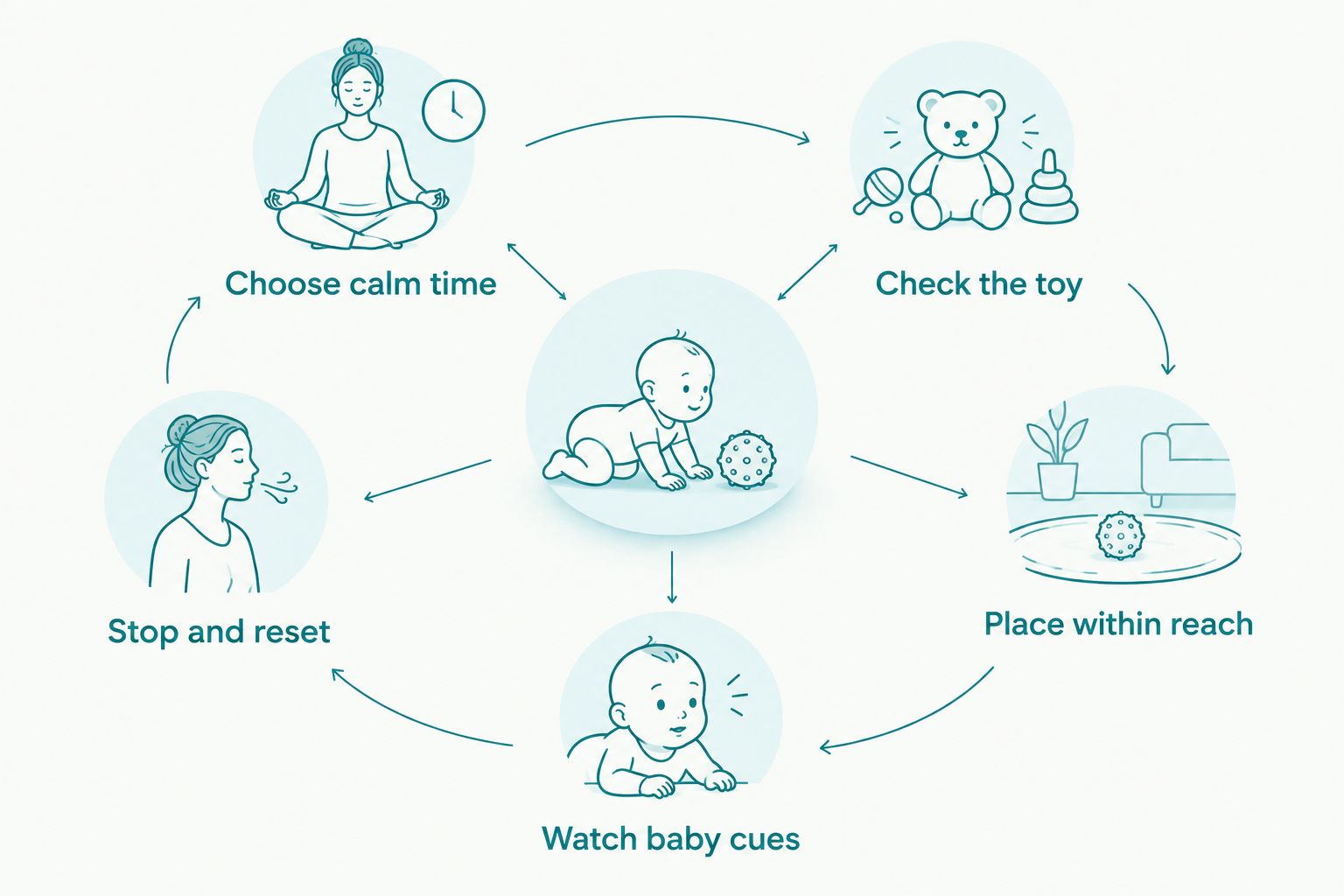
- Begin with the toy near the centre of your baby's view
- Shift it slightly to one side only after your baby notices it
- Alternate sides across sessions instead of favouring one direction
- Bring the toy closer when your baby tires
- Remove any object that repeatedly rolls or slides away
Match the toy to your baby's current action
Choose a toy for what your baby can do now. A baby who mainly looks needs a clear shape or gentle sound. A baby beginning to reach needs a light grasper, while a baby who mouths everything needs an age-suitable toy designed for teething.
Habauk's Color Drops Wooden Grasping and Teething Toy is described for babies aged 6 months and over. Magica is intended for babies beginning to grab, shake and explore, but you should still check its current product guidance against your baby's age before use.
- Use a stationary grasper for early looking and reaching
- Choose a contained rattle when gentle sound helps hold attention
- Reserve stacking sets and loose blocks for later developmental stages
- Pick teething toys only when the product is designed for mouthing
- Introduce one unfamiliar action at a time
Control sound and visual stimulation
Reflux can already make play feel unsettled. A toy should provide a small point of interest, not compete for attention with several colours, noises and moving objects at once.
You control the intensity with a manual toy. Shake a rattle gently, pause and wait for a response. If your baby turns away, startles or becomes upset, quieten the play rather than trying harder.
- Put out one or two toys rather than covering the mat
- Make one gentle sound, then pause for your baby's response
- Keep televisions and phone audio off during the session
- Remove a toy that consistently causes a startle or upset
- Repeat familiar play before adding something new
Clean, rotate and store the toys
Tummy-time toys regularly meet hands, mouths and the floor. Clean them according to their individual care instructions, dry them properly and keep damaged pieces out of circulation.
Rotation does not require a large collection. A grasper, a gentle sound toy and a soft washable option cover different needs without creating visual clutter. In 2026, a smaller selection that matches your baby's stage is more useful than a box of toys meant for later play.
- Keep used toys separate until they have been checked and cleaned
- Follow each product's care instructions rather than soaking wood by default
- Rotate a small selection when interest fades
- Store later-stage pieces away from the current play area
- Recheck age guidance before bringing a stored toy back
Wooden tummy-time options to compare
No single material wins every session. The right option depends on whether your baby is looking, reaching, grasping or mouthing, as well as how settled they feel that day.
| Option | Best for | How to source | Key limitation |
|---|---|---|---|
| Wooden grasping toy | Early reaching and two-handed exploration | Check the current product listing and age guidance | Hard wood needs careful positioning near the face |
| Wooden teething toy | Babies who mouth toys during supervised play | Choose an item specifically designed for teething | Not every wooden grasper is intended for mouthing |
| Wooden sound block or rattle | Encouraging looking, turning and reaching | Compare current sound-toy listings | Sound can be too stimulating when a baby is unsettled |
| Baby-safe mirror | Visual engagement before reliable grasping | Use a purpose-made, shatter-resistant baby mirror | It does not offer wooden texture or grasping practice |
| Soft washable toy | Gentle play close to the face | Follow its care and age label | It can slide or bunch on the mat |
Best overall for early tummy-time play: choose one stable grasper or gentle rattle that matches the manufacturer's age guidance. Best for an unsettled day: use a baby-safe mirror or simply offer your face and voice instead of introducing another object.
The following Habauk wooden toys cover grasping, teething and contained sound. Check the current age guidance on each listing before deciding whether it matches your baby's present stage.


Common mistakes parents make
Treating the toy as reflux relief
A wooden toy can make tummy time interesting, but it cannot treat reflux or make an uncomfortable position appropriate. Stop the session when your baby shows distress and speak to a health professional when reflux affects feeding, growth or general wellbeing.
Using a toy meant for an older stage
A stacking toy might be described as educational, yet still be unsuitable for a baby who is only beginning to lift their head. Developmental value does not override the age label, part size or intended use.
Placing hard toys directly under the face
Early head control is uneven. Leave enough space for your baby to lower their head safely, and keep your hands close when a wooden toy sits near their face.
Adding more toys when attention fades
Looking away often means your baby needs a pause. Replacing one toy with another, then another, can turn a calm floor session into visual and auditory clutter.
Comparing session length with other babies
Tummy-time tolerance changes with tiredness, feeding and reflux symptoms. A comfortable short attempt is more useful than extending play to meet an arbitrary target seen on social media.
A simple 2026 setup
Clear a firm section of floor and stay at your baby's level. Put one age-suitable toy near the centre of their view, with any second option kept out of sight until needed. Your face and voice remain part of the setup; the toy does not have to carry the whole interaction.
For a baby who cannot yet reach, use a stationary visual object or gently move an age-suitable rattle within view. For a baby beginning to grasp, place the toy close to one hand and let the baby initiate contact. For a baby aged 6 months or over, the Color Drops toy is one Habauk option explicitly described for grasping and teething at that stage.
End while the experience is still calm. That creates a repeatable routine without making the toy, the mat or tummy time itself feel like a battle.
FAQ
What are the best wooden toys for tummy time?
The best wooden toys for tummy time are age-suitable graspers, teethers and gentle rattles that remain within easy reach. Choose smooth construction, secure parts and a shape that does not immediately roll away.
Can a baby with reflux do tummy time?
A baby with reflux can usually do supervised tummy time while awake, but timing and comfort matter. Follow your health visitor's or doctor's advice and stop when your baby appears distressed.
Should tummy time happen straight after feeding?
Tummy time should not begin immediately after a feed when reflux is a concern. Use the interval recommended for your baby by a qualified health professional rather than relying on a universal timer.
Are wooden toys safe near a baby's face?
Wooden toys are suitable only when their age guidance, construction and intended use match the baby. Keep hard items out of the direct head-drop area and supervise continuously.
Is a wooden rattle better than a light-up toy for tummy time?
A wooden rattle gives you direct control over when and how much sound it makes. A light-up toy can attract attention too, but flashing lights and repeated electronic sounds can add unnecessary stimulation.
How many toys should I use during tummy time?
Start with one toy and add a second only when it serves a different purpose. A clear play area makes it easier to notice your baby's cues and prevents objects from crowding the mat.
How much do wooden tummy-time toys cost?
Prices vary by toy type and can change, so check the current Habauk listings before buying. Age suitability and safe construction matter more than the number of pieces in a set.
When should I ask for help with baby reflux?
Seek medical advice when reflux is persistent, distressing or affects feeding, growth or wellbeing. Urgent symptoms require prompt assessment through the appropriate NHS service.
One last thing
Awake tummy time and sleep positioning follow different safety rules. NHS guidance in 2026 says babies should sleep flat on their backs, including babies with reflux, and parents should not raise the head of the cot. A toy belongs in supervised awake play, never in the baby's sleep space.