


Best wooden puzzles for 18 month olds
Best overall: a chunky wooden inset puzzle labelled for 18 months or younger. Best for an easier grip: a large-knob inset puzzle. Best alternative for posting play: a wooden shape sorter. This 2026 guide helps you choose a manageable first puzzle, spot unnecessary difficulty and make room for little discoveries together.
- The best wooden puzzles for 18 month olds have easy-to-grasp pieces, clear matching spaces and suitable age labelling.
- Choose chunky inset puzzles for simple matching; choose large-knob puzzles when lifting flat pieces is frustrating.
- Habauk shoppers should put the stated age range before the picture, theme or number of pieces.
- Keep interlocking wooden jigsaws for later when an age-appropriate inset puzzle is still challenging.
Why this matters
A lovely picture does not necessarily make a lovely first puzzle. Your toddler needs to pick up the piece, recognise where it belongs and turn it into position; a busy board can make that small adventure much harder.
At 18 months, which is 1 year and 6 months, choose for the child in front of you rather than a future milestone. When browsing Habauk, start with the manufacturer's age guidance, then look closely at how your child will hold and place each piece.
The best first puzzle gives your toddler an understandable task, not the biggest challenge. Taking pieces out, exploring them and trying again all belong in playtime.
What makes the best wooden puzzles for 18 month olds?
Use these five checks for your 2026 shortlist. An appealing animal or vehicle theme comes after these practical details, not before them.
- Suitable age labelling: choose a puzzle explicitly intended for your child's age. Adult supervision does not make an older-child toy suitable.
- Easy grip: look for chunky pieces or substantial handles your toddler can hold comfortably. Check the whole product, including its attachments.
- Clear matching spaces: separate recesses make the relationship between a piece and its destination easier to show.
- Simple presentation: favour distinct shapes and uncluttered pictures when your toddler is beginning to match.
- Sound condition: inspect the board, edges, pieces and handles. Stop using a puzzle with damage or loose parts.
Do not treat wooden construction as a safety guarantee. The age recommendation, design, condition and manufacturer's instructions matter more than the material alone.
Wooden puzzle types at a glance
These rankings compare formats, not individual products or tested performance. Each format has a different job; the best choice depends on the part of puzzle play your toddler currently enjoys.
| Rank and format | Best for | Standout feature | Key limitation |
|---|---|---|---|
| 1. Chunky inset puzzle | First matching experiences | Separate pieces return to individual recesses | Thin or flush-fitting pieces can be awkward to lift |
| 2. Large-knob inset puzzle | Toddlers who need an easier grip | A substantial handle gives another way to lift | Handle size and attachment need checking |
| 3. Wooden shape sorter | Toddlers who enjoy posting objects | Solid shapes pass through matching openings | Finding the opening adds difficulty; it is not a flat puzzle |
| 4. Interlocking wooden jigsaw | A later step after inset matching | Pieces connect to build a shared picture | Requires joining pieces rather than filling separate spaces |
For a first purchase in 2026, choose an age-appropriate chunky inset puzzle unless your toddler clearly needs a different grip. A shape sorter is an alternative activity, not an automatic upgrade.
1. Chunky inset puzzle: best for first matching
A chunky inset puzzle has separate pieces that fit into individual spaces on a board. Your toddler can explore each match without also having to connect neighbouring pieces.
Choose a layout where you can easily demonstrate a match. A recognisable picture is helpful for conversation, but the piece still needs to be comfortable to pick up and turn.
Chunky inset puzzle pros:
- Each piece has a clear destination.
- You can introduce a single matching task without presenting the whole board.
- Familiar pictures offer something to name together.
- Removing pieces provides a simple starting activity.
Chunky inset puzzle cons:
- A flush-fitting piece can be difficult to retrieve.
- Similar outlines can make an apparently simple board demanding.
- A detailed picture does not necessarily help your toddler find the fit.
Best for: a toddler beginning to explore putting separate pieces back into a board.
Let your child take everything out before expecting anything to go back. Then leave a familiar piece beside its space and demonstrate slowly, without turning the activity into a test.
Verdict: Buy an age-appropriate chunky inset puzzle as the default first choice.
2. Large-knob inset puzzle: best for an easier grip
A large-knob inset puzzle adds a handle to each removable piece. The matching task remains similar to a chunky inset puzzle, but your toddler has a different way to lift and move the pieces.
Look at the handle rather than relying on the word peg. A small peg and a substantial knob present different gripping tasks, even when the pictures underneath look similar.
Large-knob inset puzzle pros:
- Gives your toddler a clear place to hold.
- Makes it possible to lift a piece without getting fingers underneath it.
- Keeps the separate-space matching format.
Large-knob inset puzzle cons:
- The handle is another attachment to inspect for damage or looseness.
- An easy grip does not make a complicated outline easier to match.
- A toddler who prefers holding the whole piece might not use the knob.
Best for: a toddler who understands where pieces belong but struggles to pick them up.
Watch the sticking point. If your child repeatedly reaches for a piece but cannot lift it, change the grip before adding more encouragement or choosing a harder puzzle.
Verdict: Buy when lifting, rather than matching, is the main obstacle.
3. Wooden shape sorter: best for posting play
A wooden shape sorter asks your toddler to put solid pieces through matching openings. It belongs beside puzzles because it involves fitting shapes, but it is not the same activity as placing a flat piece into a board.
Choose this format when your child enjoys putting objects into containers. Keep the manufacturer's age guidance central: neither a wooden body nor a familiar shape establishes suitability for 18 months.
Wooden shape sorter pros:
- Offers a fitting activity for children who enjoy posting.
- Gives you opportunities to demonstrate turning a shape.
- Allows a simple start by presenting a matching piece and opening together.
Wooden shape sorter cons:
- Your toddler might need to find the opening before attempting the fit.
- A box can hide the destination and make the task less obvious.
- Retrieving pieces depends on the product's design.
Best for: a toddler more interested in posting and retrieving than completing a flat picture.
Start with the matching opening facing your child. Let your toddler explore the piece, then show how turning it changes whether it fits; avoid pushing it through for them every time.
Verdict: Buy as a posting-play alternative, not as a required next step.
4. Interlocking wooden jigsaw: best as a later challenge
An interlocking wooden jigsaw builds a picture from connected pieces. Unlike an inset puzzle, it asks your child to work out how pieces relate to each other as well as to the finished image.
Save this format for a suitable next step rather than choosing it because it looks more educational. A familiar picture cannot remove the extra task of joining edges.
Interlocking wooden jigsaw pros:
- Offers a different challenge once separate-space matching is familiar.
- Creates a shared picture you can talk about together.
- Provides opportunities to explore how neighbouring pieces connect.
Interlocking wooden jigsaw cons:
- The destination of an individual piece can be less obvious.
- Joining edges adds another demand beyond matching a recess.
- Small pieces or older-child age labels can rule out a particular product.
Best for: a later purchase when your child enjoys matching and the specific puzzle's age label permits use.
Do not choose by piece count alone. The shape of the joins, clarity of the image, size of the pieces and presence of a supporting frame all change the task.
Verdict: Wait if your toddler is still exploring basic inset matching.
How to introduce a first wooden puzzle
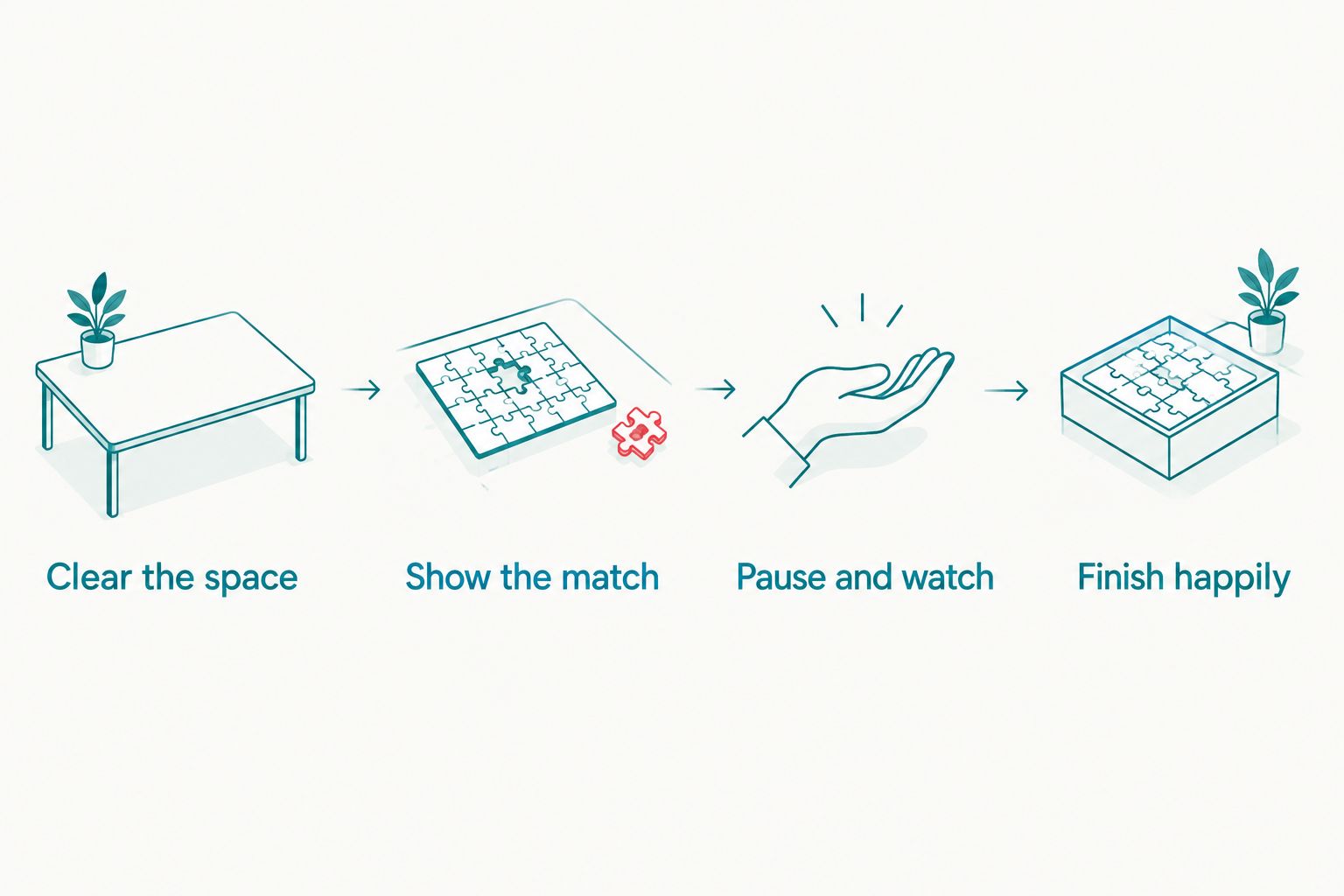
Keep your 2026 puzzle routine simple: make the first action clear, demonstrate it and leave space for your toddler to respond. You do not need to finish the board to have a worthwhile play together.
Clear the space
Put the puzzle on a stable surface with room for the loose pieces. Keep unrelated small objects out of the play area, especially when older siblings have been nearby.
Show the match
Place a piece beside its matching space and demonstrate slowly. Name the picture or shape in ordinary language rather than asking a string of questions.
Pause and watch
Give your toddler room to reach, turn and try. If the piece does not fit, show the turning action again instead of immediately completing it for them.
Finish happily
Stop when your child moves on or becomes frustrated. Leave the board for another day; completing it is not a condition of a good playtime.
Safety checks before the pieces come out
Follow the specific product's age label every time. A warning that a toy is unsuitable for children under 36 months rules it out for an 18-month-old; sitting beside your child does not override that restriction.
Check detachable parts, handles, edges and the board before play. Put damaged pieces aside and follow the manufacturer's instructions for care and use.
For your 2026 shopping list, avoid treating Montessori, educational or natural as substitutes for age information. Those descriptions do not establish that a particular puzzle is suitable for your toddler.
Keep older siblings' puzzles separate. A mixed basket makes it harder to know which pieces belong to the toy you checked.
How these puzzle formats were ranked
The ranking puts age suitability first, followed by grip, clarity of the matching task and ease of introducing the activity. Chunky inset puzzles lead because they separate the matches; large-knob puzzles take the easier-grip slot, while shape sorters serve posting play.
This is a format-based buying guide, not a claim that every puzzle within a format suits every toddler. Habauk wooden puzzles shoppers should check the individual product rather than transferring a recommendation from the category to the whole range.
Which wooden puzzle should you choose?
Choose an age-appropriate chunky inset puzzle if you are unsure. Choose a large-knob version when picking pieces up is frustrating, or a suitable shape sorter when posting is what makes your toddler smile.
For 2026 gift shopping, ask the parent what the child already enjoys before choosing a more complicated board. A manageable match is a better starting point than a puzzle bought mainly for its impressive finished picture.
FAQ
What's the best wooden puzzle for an 18-month-old?
An age-appropriate chunky inset puzzle is the best default first choice. Look for easy-to-grasp pieces, separate matching spaces and a clear layout, then check the manufacturer's age label.
Are peg puzzles or chunky puzzles better at 18 months?
Choose according to how your toddler grips the pieces. Chunky pieces suit whole-piece handling, while a substantial knob offers another way to lift; small pegs are not equivalent to large knobs.
How many pieces should an 18-month-old's puzzle have?
There is no single piece count that makes a puzzle the right choice. Grip, shape similarity, layout and age suitability matter alongside the number of pieces; you can introduce a matching task without presenting every piece.
Can my 18-month-old use a puzzle marked unsuitable under 36 months?
No, a puzzle marked unsuitable for children under 36 months is not suitable for an 18-month-old. Adult supervision does not override the product's age restriction.
Is a wooden shape sorter the same as a puzzle?
A wooden shape sorter is a related fitting activity, not the same as a flat inset puzzle. Your child posts solid shapes through openings rather than placing separate pieces into shallow spaces.
Should I help my toddler finish a puzzle?
Demonstrate a match and offer help without making completion the goal. Taking pieces out, trying different positions and returning another day are all reasonable ways to explore the activity.
What should I check when choosing wooden puzzles from Habauk?
Check the individual puzzle's age recommendation, warnings, piece design and care instructions. Choose a format that matches your toddler's current interests rather than assuming every wooden puzzle suits 18 months.
One last thing
Try making a familiar puzzle less complete before making it more difficult: leave most pieces in place and offer the remaining piece beside its space. The same board becomes a clearer invitation, without another toy joining the shelf.
Make the next attempt easier to understand, not harder to finish.