


Best wooden puzzles for 1 year olds
Best overall: an age-labelled chunky wooden inset puzzle. Best for lifting practice: a large-knob puzzle. Best for shape matching: a simple shape inset board. The best wooden puzzles for 1 year olds let your child explore taking pieces out and putting them back without needing to assemble a picture.
- The best wooden puzzles for 1 year olds are simple inset boards labelled for your child's age.
- Choose chunky picture pieces for a first puzzle; choose large knobs when lifting pieces is the main activity.
- Habauk sells HABA wooden toys; check each product's age guidance before choosing a first-birthday gift.
- A shape sorter is a three-dimensional alternative, not a flat puzzle.
- Skip any puzzle with an older age warning, even when you plan to supervise.
Why this matters
A lovely animal picture can catch your eye, but the action matters more: can your child grasp the piece, lift it out and explore where it belongs? Start there. A complicated picture adds little when the basic movement already gives your little explorer plenty to investigate.
For your 2026 shortlist, separate wooden puzzles from wooden games, stacking toys and magnetic mazes. Habauk sells HABA wooden toys and children's games, but a wooden toy is not automatically a first puzzle or suitable for a first birthday.
Choose the age label first and the puzzle format second. Adult supervision does not make an older child's puzzle suitable for a younger child.
What makes the best wooden puzzle for a 1-year-old?
Use these criteria before falling for the fox, tractor or friendly elephant on the board:
- Age suitability: Check the manufacturer's minimum age and warnings for the exact puzzle, not a similar-looking version.
- Graspable pieces: Look for pieces your child can lift using their current grip, without relying on tiny details.
- Clear matching spaces: Prefer obvious recesses over a busy picture that needs several pieces assembled together.
- Manageable challenge: Choose a task your child can explore, rather than a board you must complete for them.
- Sound condition: Reject loose handles, splinters, cracks, damaged finishes and broken pieces.
- Care instructions: Check how the manufacturer says to clean and dry the puzzle, especially if your child mouths toys.
A first-birthday child is 12 months old, while the description “1-year-old” also covers children approaching 24 months. That is a broad shopping category, not a promise that every child will enjoy the same puzzle. Keep the age guidance fixed, then adjust the challenge to your child.
Wooden puzzle types at a glance
These rankings compare formats, not individual products. Each recommendation depends on finding an intact puzzle explicitly labelled for your child's age.
| Rank and format | Best for | Standout feature | Key limitation |
|---|---|---|---|
| 1. Chunky picture inset puzzle | A first flat puzzle | Separate picture pieces fit into individual recesses | Thin or flush-fitting pieces can be difficult to lift |
| 2. Large-knob wooden puzzle | Lifting practice | A raised handle gives fingers something to grasp | Knobs need careful condition checks |
| 3. Simple shape inset puzzle | Matching outlines | Shapes correspond to clearly defined spaces | Similar shapes can make the task less obvious |
| 4. Wooden shape sorter | Posting and retrieving | Pieces pass through openings into a container | It adds a different challenge from a flat board |
The first three formats can overlap: a picture puzzle might also have large knobs. Choose by the activity you want to offer, not the category name on its own.
1. Chunky picture inset puzzle: best for a first flat puzzle
A chunky inset puzzle has separate pieces that sit in matching spaces on a board. Your child can remove an animal or vehicle without needing to understand how a whole picture fits together. That makes this the clearest starting format for a first puzzle.
Choose recognisable pictures you can name together. A farm theme gives you animals to talk about, but a simpler board with less familiar pictures can still be the better choice if the pieces are easier to handle.
Chunky picture inset puzzle pros:
- Removing pieces is an activity in its own right.
- Each piece has a separate destination.
- Pictures give you something to name and discuss together.
Chunky picture inset puzzle cons:
- A piece that sits flush with the board can be awkward to lift.
- Busy artwork can make matching spaces less obvious.
Best for: A child exploring a first flat puzzle, with an adult nearby to join in.
For a 2026 first-birthday gift, put the exact age label ahead of the theme. Do not assume that “chunky” means suitable from birth or suitable for mouthing.
Verdict: Buy an age-appropriate chunky inset board as the default first puzzle.
2. Large-knob wooden puzzle: best for lifting practice
A large-knob puzzle adds raised handles to the pieces. The handle gives your child something to hold while removing a piece or trying to return it to the board. Choose this format when grasping and lifting are the main attraction.
Look at both the knob and the piece underneath it. An easy-to-hold handle does not remove the need to check the puzzle's minimum age, warnings and overall condition.
Large-knob wooden puzzle pros:
- Raised handles offer an alternative to gripping a flat edge.
- Your child can practise lifting before tackling matching.
- You can demonstrate the movement without completing the whole board.
Large-knob wooden puzzle cons:
- A loose or damaged knob means the puzzle should come out of use.
- A useful handle does not make a complicated picture easier to match.
Best for: A child who enjoys grasping handles and taking objects out of containers or spaces.
Avoid choosing the biggest-looking knob from a photograph alone. Check the product details, then inspect the actual puzzle before handing it over; a close-up picture cannot confirm that a handle remains secure after use.
Verdict: Buy for lifting practice when the exact puzzle is age-appropriate and intact.
3. Simple shape inset puzzle: best for matching outlines
A shape inset board asks your child to match pieces to corresponding spaces. Instead of recognising which animal belongs where, your child explores how an outline fits. Choose this format when you want a clear, shape-led matching activity.
Keep the visual task straightforward. Distinct outlines make a clearer introduction than pieces that differ only slightly, while an uncluttered board leaves the matching spaces easy to see.
Simple shape inset puzzle pros:
- The outline provides a direct clue about where a piece belongs.
- You can name shapes while your child handles them.
- The board supports removing, comparing and replacing pieces.
Simple shape inset puzzle cons:
- Some pieces need turning before they fit.
- Similar outlines can make the puzzle more demanding than it first appears.
Best for: A child interested in comparing objects with the spaces they fit into.
On your 2026 shopping list, treat shape matching as an activity, not a test. Your child does not need to name a triangle or finish the board for the play to count.
Verdict: Buy for clear outline matching, provided the age guidance fits your child.
4. Wooden shape sorter: best for posting and retrieving
A shape sorter is a close alternative to a wooden puzzle, rather than the same thing. Your child moves a piece through an opening into a container, then retrieves it. Choose it when posting objects appeals more than working on a flat board.
The extra dimension changes the task. Your child must bring the piece to the correct opening and orient it, so do not assume that a cheerful box is simpler than an inset puzzle.
Wooden shape sorter pros:
- Posting gives the activity a clear action and result.
- Retrieving pieces becomes part of the play.
- Different openings offer opportunities to compare shapes.
Wooden shape sorter cons:
- Finding and turning towards an opening adds complexity.
- An awkward retrieval method interrupts the activity.
Best for: A child who enjoys putting objects into containers and taking them out again.
Check the instructions for lids, moving parts and access to the pieces. Follow the product's intended use rather than changing the toy to make a difficult opening easier.
Verdict: Buy as an age-appropriate posting alternative; skip it if you want a flat puzzle.
How to introduce a first wooden puzzle
Start with an intact, age-appropriate puzzle on a stable play surface. Sit nearby and let your child investigate; you do not need to turn every piece into a question.
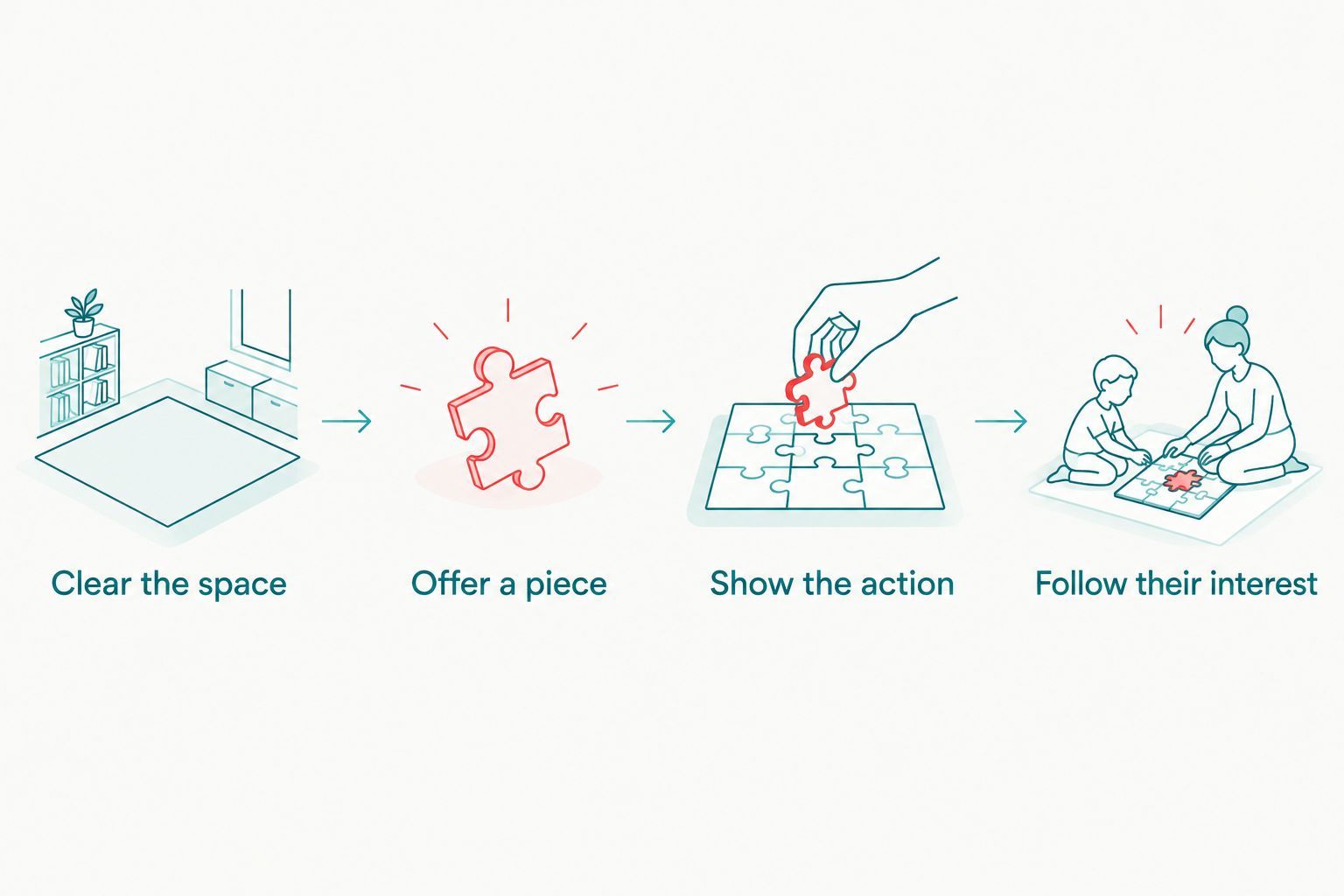
Follow this simple sequence:
- Clear the space: Put away unrelated loose toys so the puzzle has room.
- Offer a piece: Present a manageable part of the activity rather than insisting on the whole board.
- Show the action: Slowly demonstrate lifting or placing, then pause.
- Follow their interest: Join in with naming, removing or matching, depending on what your child chooses.
If your child removes every piece and leaves the board empty, follow that interest. You can name the pictures, place a piece beside its matching space or simply enjoy taking turns lifting pieces out.
Stop when your child loses interest. A completed board is not the goal of every play session. Avoid pressing your child's hand into place or turning repeated attempts into a performance.
What to leave off a first-birthday shortlist
For 2026, keep interlocking jigsaws, layered puzzles and magnetic activities separate from your default first-puzzle choice. Their names describe formats, not age suitability. Check each exact product before deciding whether it belongs in your child's play basket.
For example, the Elephant 2-in-1 Wooden Puzzle has 12 pieces and different pictures on each side. Those details describe the puzzle, but they do not establish suitability for a 12-month-old; do not choose it for a first birthday without confirming its minimum age.
Apply the same care to wooden games. My Very First Games - First Orchard introduces toddlers to cooperative gameplay, but that does not make it an inset puzzle or establish that it suits every 1-year-old.
Habauk's wooden toys include several different kinds of play. Keep your gift brief specific: a first puzzle, a stacking activity and a turn-taking game are different requests.
How these puzzle formats are ranked
This order prioritises a clear first action, graspable pieces and obvious matching spaces. Chunky picture inset puzzles take the default slot because they separate the picture into individual pieces; knob puzzles prioritise lifting, shape boards prioritise outlines, and sorters prioritise posting.
The ranking is a buying framework, not a product-testing result. An unsuitable age label or damaged component rules out any option, regardless of its position here.
Which wooden puzzle should you choose?
Choose a simple chunky inset puzzle labelled for your child's age unless another action clearly interests them more. Pick large knobs for lifting practice, a shape board for outline matching, or a shape sorter for posting.
Habauk is a UK store for parents shopping for HABA wooden toys and children's games. When comparing wooden puzzles with other Habauk wooden toys, keep the same rule: suitability comes before theme, piece count or gift appeal.
For a 2026 present, ask the parent what the child already enjoys doing. That answer gives you a better starting point than choosing the most elaborate board.
FAQ
What's the best wooden puzzle for a 1-year-old?
A simple chunky inset puzzle explicitly labelled for your child's age is the best default format. Choose graspable pieces and clear matching spaces rather than a complicated picture.
Can a 12-month-old play with a wooden puzzle?
A 12-month-old can explore a wooden puzzle that is labelled as suitable for their age. Stay nearby, follow the instructions and let removing pieces be part of the activity.
Are peg puzzles better than chunky puzzles?
Neither format is automatically better: a raised handle supports a different grip from a chunky piece. Choose the age-appropriate format your child can handle, and check handles for looseness or damage.
How many pieces should a first wooden puzzle have?
Choose by age suitability, graspability and clarity rather than a fixed piece count. A board with fewer pieces can still be difficult if the pieces are awkward to lift or the spaces are unclear.
Is a wooden shape sorter the same as a puzzle?
A wooden shape sorter is a related matching activity, not a flat inset puzzle. It adds posting through an opening and retrieving pieces from a container.
Is the Elephant 2-in-1 Wooden Puzzle suitable for a first birthday?
Confirm its minimum age before choosing it for a first birthday. Its 12 pieces and double-sided pictures do not establish suitability for a 1-year-old.
Can I supervise my child using a puzzle labelled for older children?
Do not use supervision to override an older age warning. Choose a puzzle intended for your child's age and follow all product instructions.
One last thing
The empty board can be part of the fun. Before showing your child how to finish a puzzle, watch what they choose to do with it: lifting, carrying and offering you a piece all give you ways to join in without demanding a correct answer.
Buy for the action your child enjoys, not the finished picture you want to see.