


Best wooden puzzles for toddlers
Best overall for picture-ready toddlers: Elephant 2-in-1 Wooden Puzzle. Best for first shape matching: Underwater World Wooden Shape Sorter. Best for graded arranging challenges: Animal Squares Arranging Game. This 2026 guide compares wooden puzzles and puzzle-like alternatives, so you can choose the activity your child is ready to enjoy.
- The best wooden puzzles for toddlers match your child's current skills, not just a favourite animal or theme.
- Elephant 2-in-1 Wooden Puzzle is the picture-building pick; check its age guidance before choosing.
- Underwater World Wooden Shape Sorter offers individual shape matching rather than a traditional jigsaw.
- Habauk's wooden puzzle shortlist separates picture building, shape sorting and arranging challenges.
Why this matters
A wooden jigsaw, a shape sorter and an arranging game ask your child to solve different problems. Choosing between them starts with watching how your little one already plays, rather than looking for the biggest box.
If your child enjoys lifting pieces out and putting them back, start with individual matching. If your child already joins pieces to make pictures, explore a jigsaw. The distinction between wooden peg puzzles for toddlers and interlocking puzzles matters more than whether both feature cheerful animals.
Habauk's wooden puzzle selection is best for parents who want to compare picture puzzles with hands-on sorting and arranging toys. The recommendations below distinguish those formats instead of treating every wooden activity as the same thing.
What makes the best wooden puzzles for toddlers?
For this 2026 shortlist, start with these checks:
- Age guidance: Read the manufacturer's age recommendation and warnings before considering the play features. A toddler-themed picture does not establish suitability.
- A manageable action: Choose between fitting a shape, joining a picture and copying an arrangement. Start with the action your child already attempts.
- Useful clues: Recognisable pictures, distinct shapes or a template give your child something specific to work from.
- Grasp and placement: Look at how your child will pick up, turn and release each piece. Wooden construction alone tells you little about ease of handling.
- Room to explore: Consider whether your child wants a fixed answer, imaginative scenes or patterns to arrange.
- An honest limitation: A good choice still has boundaries. A sorter is not a jigsaw, and a more involved puzzle is not automatically a better first toy.
Wooden puzzles and alternatives at a glance
These are different routes into hands-on problem solving, not interchangeable versions of one puzzle. Check each product's age guidance before choosing; the ranking describes play fit, not a shared minimum age.
| Pick | Best for | Standout feature | Key limitation |
|---|---|---|---|
| Elephant 2-in-1 Wooden Puzzle | Building a recognisable picture | 12 pieces with different pictures on each side | Joining a picture is a different challenge from fitting separate shapes |
| Underwater World Wooden Shape Sorter | First shape-matching activities | Five sea-creature blocks, each with a matching slot | A sorting box, not a flat picture puzzle |
| Farm Sorting Box | Animal-themed matching and pretend play | Wooden figures pushed through matching gaps | Does not offer the picture assembly of a jigsaw |
| On the Farm Arranging Game | Matching wooden pieces to scenes | Farm scenes for matching and arranging | Not a conventional interlocking puzzle |
| Animal Squares Arranging Game | Following graded visual patterns | 12 double-sided template cards across three difficulty levels | Following templates adds a different demand from free arranging |
1. Elephant 2-in-1 Wooden Puzzle: best for picture building
Elephant 2-in-1 Wooden Puzzle is the clearest choice here when you specifically want a wooden picture puzzle. The set contains 12 pieces, with different pictures on each side, giving your child another image to explore without changing the format.
Choose this for a child who already enjoys bringing separate pieces together into a whole. For your 2026 gift list, treat picture-building readiness and the manufacturer's age guidance as separate checks: enthusiasm does not replace suitability.
Elephant 2-in-1 Wooden Puzzle pros:
- A picture-building format rather than a sorting activity.
- Different images on each side of the pieces.
- An animal theme to talk about together while you play.
Elephant 2-in-1 Wooden Puzzle cons:
- The picture-building task is not the same as simple shape placement.
- You need to keep track of which picture your child is assembling.
Best for: A child ready to join pieces into a recognisable image, subject to the product's age guidance.
Verdict: Buy for picture-building readiness; wait if your child still wants individual matching spaces.
2. Underwater World Wooden Shape Sorter: best for first matching
Underwater World Wooden Shape Sorter offers a different starting point: each of its five sea-creature blocks fits into one matching slot. Your child matches an individual object to an opening rather than assembling a complete picture.
That makes it a relevant alternative when your search for a wooden puzzle is really a search for hands-on matching. Keep the distinction clear: you are choosing a shape sorter, not a jigsaw with an underwater picture.
Underwater World Wooden Shape Sorter pros:
- Each sea creature has a corresponding slot.
- Individual placements give you separate actions to demonstrate.
- The sea-creature theme gives you something to name together.
Underwater World Wooden Shape Sorter cons:
- Does not introduce interlocking picture assembly.
- Offers a fixed matching task rather than open-ended picture arrangements.
Best for: A child interested in matching objects to openings, once the product's age recommendation is met.
Verdict: Buy for shape matching; skip if you specifically want a flat wooden jigsaw.
3. Farm Sorting Box: best for animal-themed matching
Farm Sorting Box invites children to push wooden animal figures through matching gaps in the farmhouse walls. The activity centres on finding where each animal belongs, with a familiar farm theme for naming and make-believe.
Choose Farm Sorting Box when your child enjoys acting out little animal stories alongside matching. It occupies a similar broad category to the underwater sorter, but earns its own place for families specifically seeking farm figures and farmhouse play.
Farm Sorting Box pros:
- Wooden figures are part of the matching activity.
- Farmhouse openings give the task a clear setting.
- The animal theme lends itself to little stories between placements.
Farm Sorting Box cons:
- It remains a shape-sorting activity, not a picture puzzle.
- Adds little format variety if you already have a sorter your child enjoys.
Best for: An animal-loving child whose preferred matching game includes pretend farm play.
Verdict: Buy for the farm-play connection; hold if you want a new puzzle format.
4. On the Farm Arranging Game: best for scene matching
On the Farm Arranging Game lets children match wooden pieces onto different farm scenes and arrange them. The scene is the focus, rather than the openings of a sorting box or the joined edges of a jigsaw.
Choose this when your child enjoys placing objects into a setting and talking about what happens there. You can follow the matching activity or leave space for your child to describe a little farm adventure.
On the Farm Arranging Game pros:
- Combines wooden pieces with different farm scenes.
- Offers matching and arranging within the same activity.
- Gives you a setting for shared conversation and storytelling.
On the Farm Arranging Game cons:
- Does not provide conventional interlocking puzzle assembly.
- Scene arranging is a different task from finding a single matching opening.
Best for: A child who enjoys matching pictures and arranging a scene with you.
Verdict: Buy for scene-based play; skip if joining jigsaw pieces is the goal.
5. Animal Squares Arranging Game: best for graded patterns
Animal Squares Arranging Game features a frog, a cat and a mouse, alongside 12 double-sided template cards. The arrangements span three difficulty levels, making this the pick for families looking specifically for visual patterns to follow.
Free arranging and copying a template are not the same activity. Choose Animal Squares Arranging Game when your child shows interest in reproducing a layout, and check the age guidance before introducing the challenge.
Animal Squares Arranging Game pros:
- Template cards give you arrangements to work towards.
- Three difficulty levels distinguish the challenges.
- Animal characters give the patterns a playful focus.
Animal Squares Arranging Game cons:
- Template-following is not the same as completing a picture jigsaw.
- A child who prefers free play need not enjoy copying arrangements.
Best for: A child ready for age-appropriate visual copying rather than only free placement.
Verdict: Buy for pattern-following interest; wait if templates interrupt the fun.
Choose the format before choosing the theme
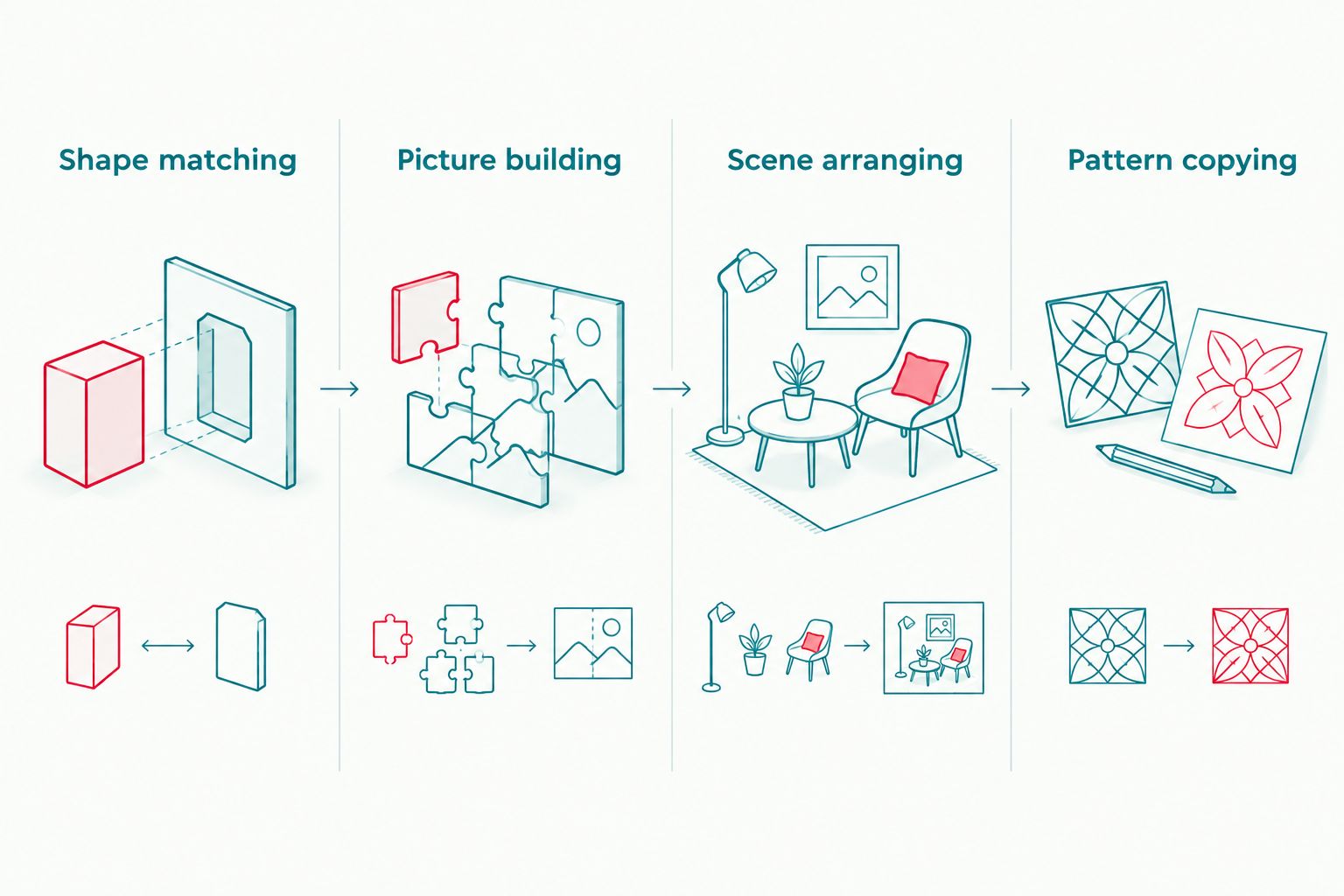
For a 2026 purchase, make the first decision about the action, not the animal. Watch whether your child wants to put something into a gap, build a picture, arrange a scene or copy a pattern; then choose a theme that invites another go.
Use these four routes to narrow the shortlist:
- Shape matching: Underwater World Wooden Shape Sorter.
- Picture building: Elephant 2-in-1 Wooden Puzzle.
- Scene arranging: On the Farm Arranging Game.
- Pattern copying: Animal Squares Arranging Game.
Once the format fits, the theme becomes a lovely finishing touch. A favourite animal gives you something to chat about, but it should not be the reason to choose a task your child cannot yet enjoy.
These product cards bring together the picture puzzle and two different matching formats from the shortlist. Compare the activity first, then read the individual product guidance.


Make a little space for trying again
Set up a puzzle on a clear, stable surface where your child can reach the pieces comfortably. Keep unrelated toys out of the working area, and sit where you can watch without taking over every attempt.
The distinction between loose-piece puzzles and activity panels for toddlers matters when planning a play corner: a tabletop puzzle needs room to spread out and a place to gather its pieces afterwards. Choose the play format around how you will actually use the space, rather than expecting every activity to suit the same spot.
When your child gets stuck, offer a clue tied to the task. Point to the matching opening, name something in the picture or turn a template so it faces your child; leave the next placement to those busy little hands.
Help with the obstacle, not the whole answer. If frustration takes over, put the activity away and return to something familiar. Finishing the box is not the purpose of playing together.
How the choices are ranked
This 2026 ranking prioritises a clear match between the activity and its use case. Picture assembly leads the list because it most directly answers a search for wooden puzzles; sorters and arranging games follow as explicitly labelled alternatives.
The comparison uses the stated product features: pictures, matching slots, scenes and templates. Habauk's shortlist does not treat piece count as a universal difficulty score or turn an animal theme into an age recommendation.
Which wooden puzzle should you choose?
Choose Elephant 2-in-1 Wooden Puzzle if you want a picture puzzle and your child meets its age guidance. Its double-sided pieces make it the most direct answer here, without confusing jigsaw play with sorting.
Choose Underwater World Wooden Shape Sorter if individual shape matching is the better fit. Choose On the Farm Arranging Game for scene play, or Animal Squares Arranging Game when copying patterns is the activity you want.
There is no need to buy every stage at once. Pick the format that suits playtime now.
FAQ
What's the best wooden puzzle for a toddler who already joins picture pieces?
Elephant 2-in-1 Wooden Puzzle is the picture-building pick in this shortlist. It contains 12 pieces with different pictures on each side; check the manufacturer's age guidance before choosing it.
Is a wooden shape sorter the same as a wooden puzzle?
A wooden shape sorter is a matching activity, not a traditional picture jigsaw. Underwater World Wooden Shape Sorter asks children to fit individual sea-creature blocks into corresponding slots.
Should I choose a peg puzzle or a jigsaw first?
Choose according to the action your child can manage, while following the product's age guidance. A peg puzzle involves individual placements, whereas a jigsaw asks your child to bring pieces together into a picture.
How many pieces should a toddler's wooden puzzle have?
Piece count alone does not determine whether a wooden puzzle suits your toddler. Consider piece handling, the clues provided, the type of matching required and the manufacturer's age recommendation.
Which option suits a toddler who loves farm animals?
Farm Sorting Box suits farm-themed shape matching, while On the Farm Arranging Game suits placing wooden pieces onto scenes. Choose the format first, then use your child's interest in animals to narrow the choice.
What's the best option for copying patterns?
Animal Squares Arranging Game is the pattern-copying pick in this shortlist. Its 12 double-sided template cards show arrangements across three difficulty levels; follow its age guidance.
Are wooden puzzles automatically safe for toddlers?
Wooden construction alone does not establish toddler suitability. Follow the manufacturer's age recommendation, warnings and supervision instructions, and stop using damaged pieces.
One last thing
Before adding another puzzle, notice what your child does after finishing the current one. Wanting to repeat it is different from wanting a harder challenge; familiarity can be part of the enjoyment.
For your next 2026 choice, let that observation lead. Habauk's wooden puzzle shortlist gives you different directions to explore, not a race through increasingly complicated boxes.