


Wooden Toys for Language Development: What Works 2026
Wooden toys for early language development are open-ended, sound- and story-rich toys picked for babies and toddlers who are building first words, chosen to grow vocabulary through hands-on play rather than a screen. The right pick for a six-month-old rattling a teether looks nothing like the right pick for a three-year-old running a pretend shop, so the toy has to match the stage, not just the shelf tag that says "educational".
- Wooden toys for language development work best when they prompt naming and a response, not a pre-recorded word from the toy itself.
- Habauk's My Very First Games: Hanna Honeybee builds first vocabulary through matching, aimed at 18 months to 3 years.
- Fun with Sounds Discovery Blocks bridges babbling into first words for babies from around 6 months.
- Turn-taking games move language forward faster than naming drills in 2026 speech and language guidance.
- Skip battery toys that say the word for your child - they remove the need to respond at all.
Why wooden toys matter for early language development
Children pick up words fastest inside back-and-forth exchanges, not from listening to a toy talk at them. That's the core idea behind most current speech and language therapy guidance, and it's why a wooden block that stays silent until you name it does more for vocabulary than one that announces itself.
Wooden, open-ended toys only "work" once a parent narrates, questions or responds to them, which forces the exact naming-and-reply loop that builds early speech. That's a different job to the one plastic light-up toys are built for, and it's why the wooden toys for newborns and babies stage matters as much as the toddler stage that follows it.
By 2026, screen-free play is recommended more consistently for the toddler years specifically because it forces this kind of interaction rather than passive watching. Habauk's wooden toys are built around that gap - a piece that needs a grown-up's voice to make sense of it.
Building language through play, stage by stage
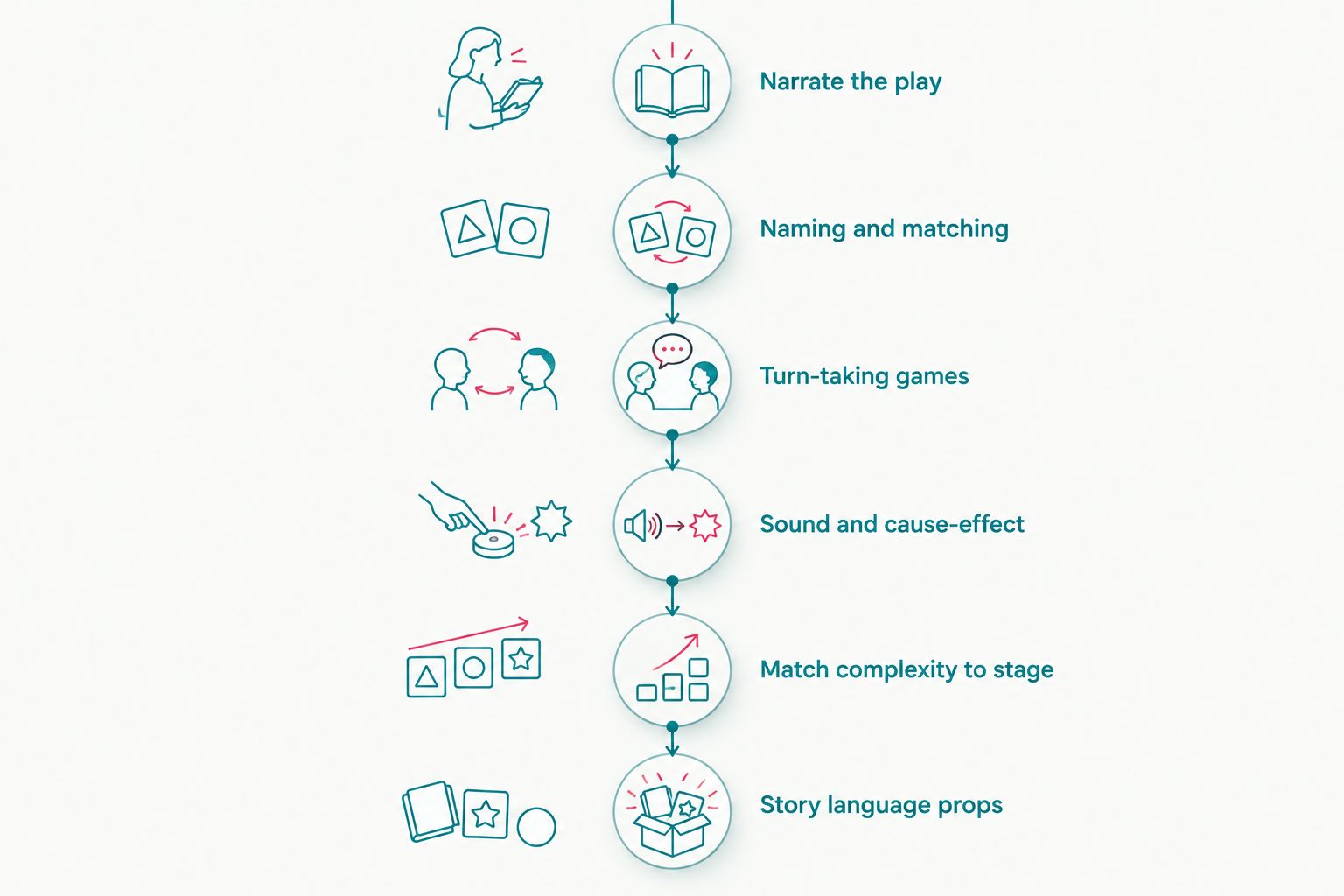
The steps below run in the order most parents actually use them, from newborn sound play through to full pretend-play conversations. Start wherever your child already sits - there's no need to work through every stage from scratch.
Narrate the play before you narrate the rules
This step costs nothing and works with any toy already in the house.
- Name the toy, the colour and the action out loud every time you play
- Pause after naming something and wait three seconds for any response, even a sound
- Use short, complete sentences ("blue block goes on top") instead of single-word labels
- Repeat the same phrase across several days so the word has a chance to stick
- Avoid turning play into a quiz - asking "what colour is this?" on every turn shuts conversation down fast
Choose toys built around naming and matching
Once narration is a habit, a toy designed around a small, fixed vocabulary does more work than a toy with dozens of loose parts.
- Look for toys where each piece has one clear name - an animal, a colour, a single shape
- Pick games with a repeatable vocabulary set of roughly 10-15 words rather than an overwhelming one
- Favour toys that reward correct matching visually, not a toy that reads the answer aloud itself
- My Very First Games: Hanna Honeybee is built around exactly this - a small, repeatable word set for the 18 months-plus stage
Build turn-taking into every session
Turn-taking is the structure behind real conversation, and toddlers pick it up faster from a game than from being told to "wait your turn".
- Play games with an obvious my-turn-your-turn structure - dice, cards, tiles
- Narrate your own turn out loud so your child hears the pattern before they're asked to use it
- Let a toddler "win" the naming round sometimes instead of correcting every miss
- Here Fishy Fishy keeps turns short and the rules forgiving, which matters more than the theme for children under three
Add sound and cause-effect toys for babbling practice
Sound toys give a pre-verbal baby something to mimic before they can form words.
- Pick toys with distinct, different sounds per piece so a child learns to tell them apart
- Shake, tap or roll the toy together and describe what's happening ("shake, shake, rattle")
- Use sound toys from around 6 months as a bridge into first words, not a replacement for talking
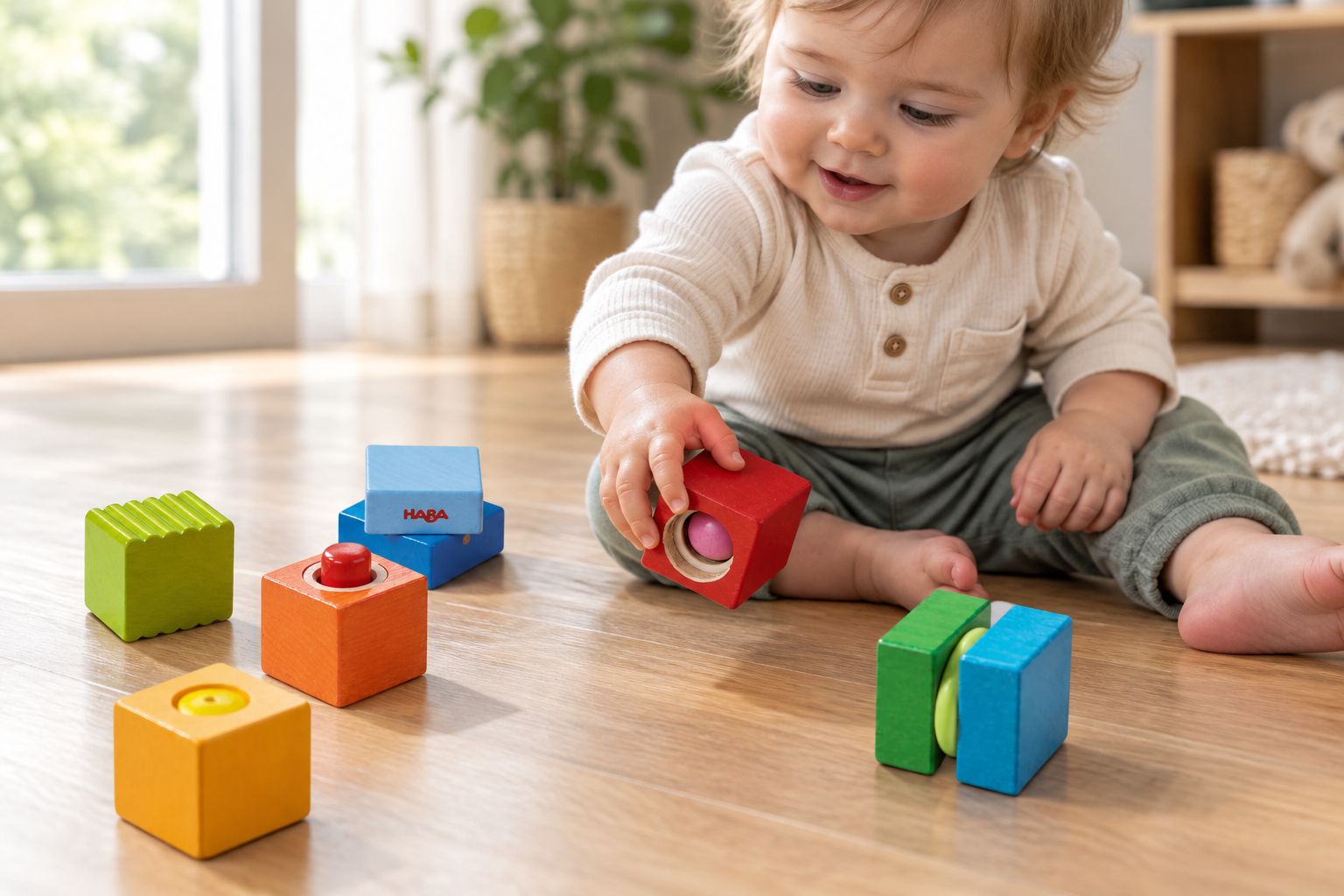
- Fun with Sounds Discovery Blocks pairs a different sound with each block, which gives a baby something concrete to copy
If a toy says the word before your child does, put it down - you're the vocabulary, not the toy.
Match toy complexity to your child's current stage
The most common mistake in 2026 gift-buying is skipping straight to the toy for the age on the box, rather than the stage the child is actually at.
- Start with single-object toys - a rattle, a teether - for babies under 12 months
- Move to two-to-three-step naming games between 18 months and 2.5 years
- Introduce simple story-based pretend play from around 2.5 to 3 years
- Rotate a small handful of toys rather than leaving everything out at once
- Watch which toy your child returns to unprompted - that's the level to build on next, not the one printed on the packaging
“If a toy says the word before your child does, put it down - you're the vocabulary, not the toy.”
Build story language with pretend play props
Pretend play is where naming turns into short sentences and then into stories.
- Use farm, kitchen or shop-style wooden sets to prompt short scripts ("cut the bread", "feed the cow")
- Ask open questions inside pretend play instead of narrating the whole story yourself
- Sound-making instruments extend rhythm and word-song play once naming is solid
- Keep pretend sets small at first - one or two props teach more language than a full set dumped out at once
Comparing the main toy types for language development
| Toy type | Best for | Key limitation |
|---|---|---|
| Sound and cause-effect toys | Babies 6-18 months learning to mimic sound | Loses appeal fast once a toddler wants real words, not sounds |
| Naming and matching games | Toddlers 18 months-3 years building first vocabulary | Needs an adult to keep the pace slow and the vocabulary small |
| Turn-taking games | Toddlers 2-4 years practising conversation structure | Attention spans keep most sessions under 10 minutes |
| Grasping and teether toys | Babies under 12 months, pre-verbal exploration | Builds sensory groundwork, not vocabulary directly |
| Pretend play sets | Children 2.5-5 years building story language | Needs an adult or sibling to prompt dialogue at first |
The verdict for most households in 2026: start with a grasping or sound toy under a year old, move to a naming game by 18 months, and add pretend play props once short sentences appear. Teether Cuddly Rainbow Round covers the grasping stage without any batteries or pre-recorded phrases to compete with your own voice.


Common mistakes parents make with language-focused toys
- Turning naming into a test. Repeating "what's this?" on every turn until a toddler disengages does the opposite of what the game intended.
- Buying toys that say the word for the child. A battery toy that announces "red" removes the need for your toddler to say it back.
- Swapping toys too often. Rotating games every few days before a word has had time to stick slows vocabulary growth rather than speeding it up.
- Reaching for turn-taking games too early. A toddler who can't sit through a full round yet gets frustration, not practice, from a longer game.
FAQ
What's the best wooden toy for language development in 2026?
There isn't one single best toy - it depends on stage. Fun with Sounds Discovery Blocks suits babies from around 6 months, while My Very First Games: Hanna Honeybee suits toddlers from 18 months who are building first vocabulary.
Do wooden toys really help with speech more than plastic toys?
Wooden toys that don't speak or light up force the adult to do the naming, which creates the response loop children need to build words. Plastic toys with pre-recorded phrases can do the talking for the child instead.
At what age should I introduce naming games?
Most toddlers are ready for simple naming and matching games from around 18 months, once they can point at or hand over an object on request.
Is Fun with Sounds Discovery Blocks good for late talkers?
Sound and cause-effect toys like this give a late talker something to mimic without pressure to produce a full word, which is a useful first step before naming games.
How much play time actually builds vocabulary?
Short, repeated sessions matter more than long ones - a few minutes of narrated play several times a day beats one long session once a week.
Are pretend play sets useful before a child can talk properly?
Yes, pretend props work even with single words - a child can hand over a wooden "egg" and say "cook" long before they can form full sentences.
Should sound toys replace reading aloud?
No - sound toys support babbling practice, but reading aloud exposes a child to far more varied vocabulary and sentence structure than any single toy can.
How do I know if a toy is too advanced for my toddler's language stage?
If your child loses interest within seconds or needs constant help to play, the toy is likely a stage ahead - step back to single-object or naming-based play first.
One last thing
The toy that does the most for early language in 2026 usually has no words printed on it anywhere - it's the parent's voice that supplies them, over and over, until they stick.