


Wooden Toys for Problem Solving Skills: 2026 Guide
Wooden toys for problem solving skills work when a toddler can fail at something small, try again, and land on the answer without a parent stepping in — no screen, no single "right" button to press. This guide breaks down which types of wooden toys build which skills, in what order, and where parents most often waste money on toys that are either too easy or too advanced.
- Toddler and preschool problem-solving toys work best when failure is built in, not designed out.
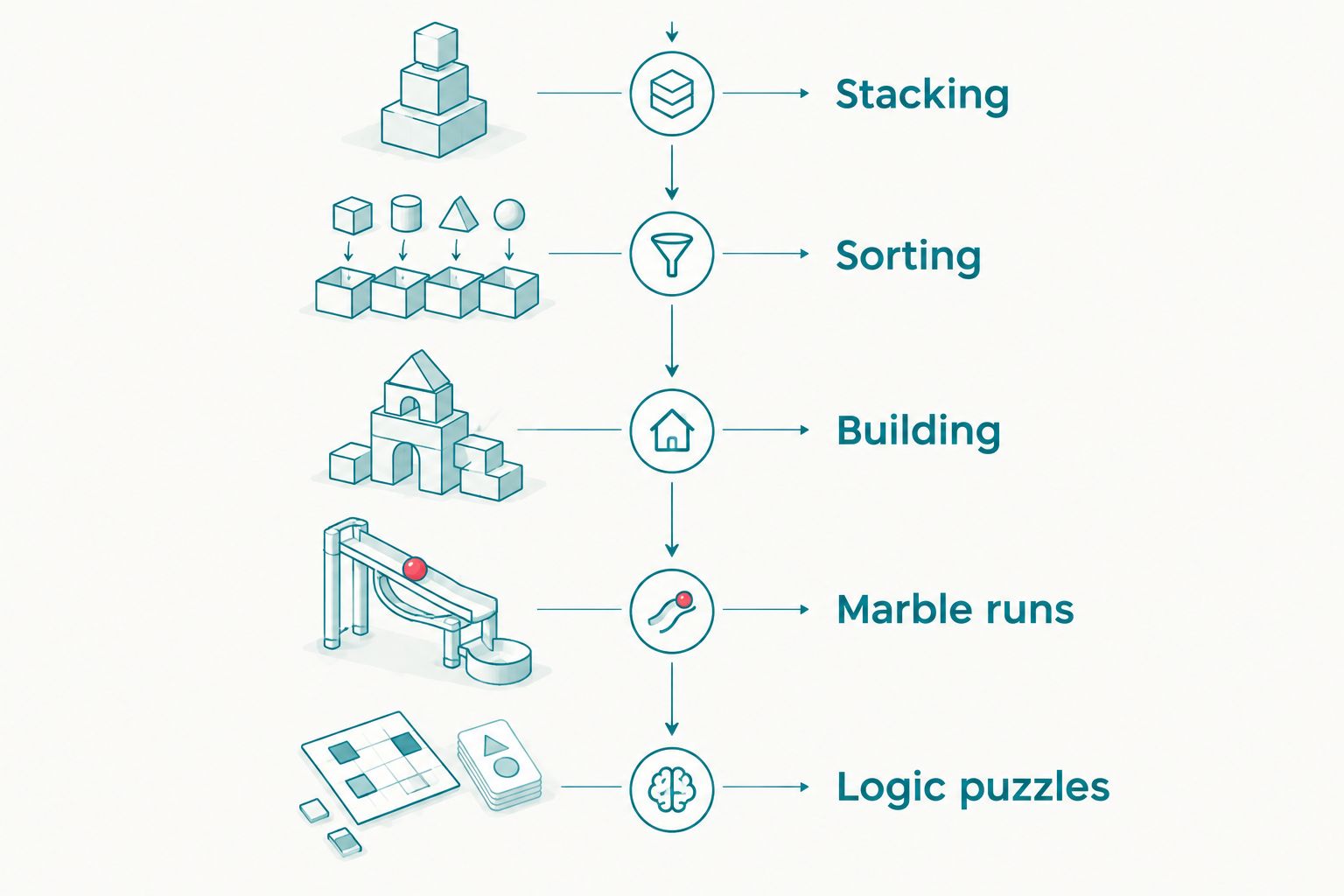
- Start with open stacking and sorting around age 1-2, move to building blocks by 2, marble runs and logic puzzles by 3-4.
- Animal Upon Animal and Rhino Hero build spatial reasoning through balance, not instructions.
- Habauk's Logic Case Starter Set 5 is the natural next step once open-ended stacking stops being a challenge.
- Buying a toy two skill-levels ahead of your child is the single most common mistake parents make in 2026.
Why this matters for toddlers and preschoolers
Problem-solving in children aged 1 to 5 isn't taught with flashcards — it's built through repeated, physical trial and error: does this block fit, does this stack topple, does this piece go here or there. Toddlers and preschoolers need materials that respond honestly to a wrong guess (the tower falls, the peg won't fit) rather than a screen that nudges them toward the correct tap.
This segment also has a shorter attention window than older children, so a toy has to offer a challenge within the first minute or it gets abandoned. Wooden building blocks double as an early maths tool long before a child can count out loud — sorting by size and colour is reasoning practice even when it looks like stacking.
Wooden toys have a practical edge here too: heavier, larger pieces are easier for a two-year-old's still-developing grip to manipulate and harder to lose down the back of a sofa than small plastic parts. That's not a marketing claim — it's why open-ended wooden stacking sets consistently outlast plastic equivalents in nursery settings, where pieces get handled roughly and often.
Building problem-solving skills with wooden toys, step by step
The order matters more than the individual toy. Skip straight to a logic puzzle before a child has mastered basic stacking and you'll get frustration, not learning. Work through these stages roughly in order, adjusting pace to your own child.
Start with open-ended stacking and sorting
Before age 2, the "problem" should be simple and physical: does this shape balance, does this ring go on this size.
- Choose stacking rings or nesting cups with an obvious size progression
- Let the child stack incorrectly and watch it topple — don't correct every attempt
- Pick pieces large enough that a toddler can't choke, so you can step back
- Add colour sorting once stacking is easy, not before
- Keep sessions to 5-10 minutes; longer loses attention at this age
Introduce matching and memory games
Matching pairs, animal shapes, or simple lotto-style games teach a child to hold one image in mind while scanning for its twin — an early working-memory skill.
- Keep the first set to 6-8 pairs; more overwhelms a 2-year-old
- Play face-up before introducing the memory version face-down
- Let the child set the pace; don't time the game
- Move to themed matching (animals, food, shapes) once basic pairs are solved easily
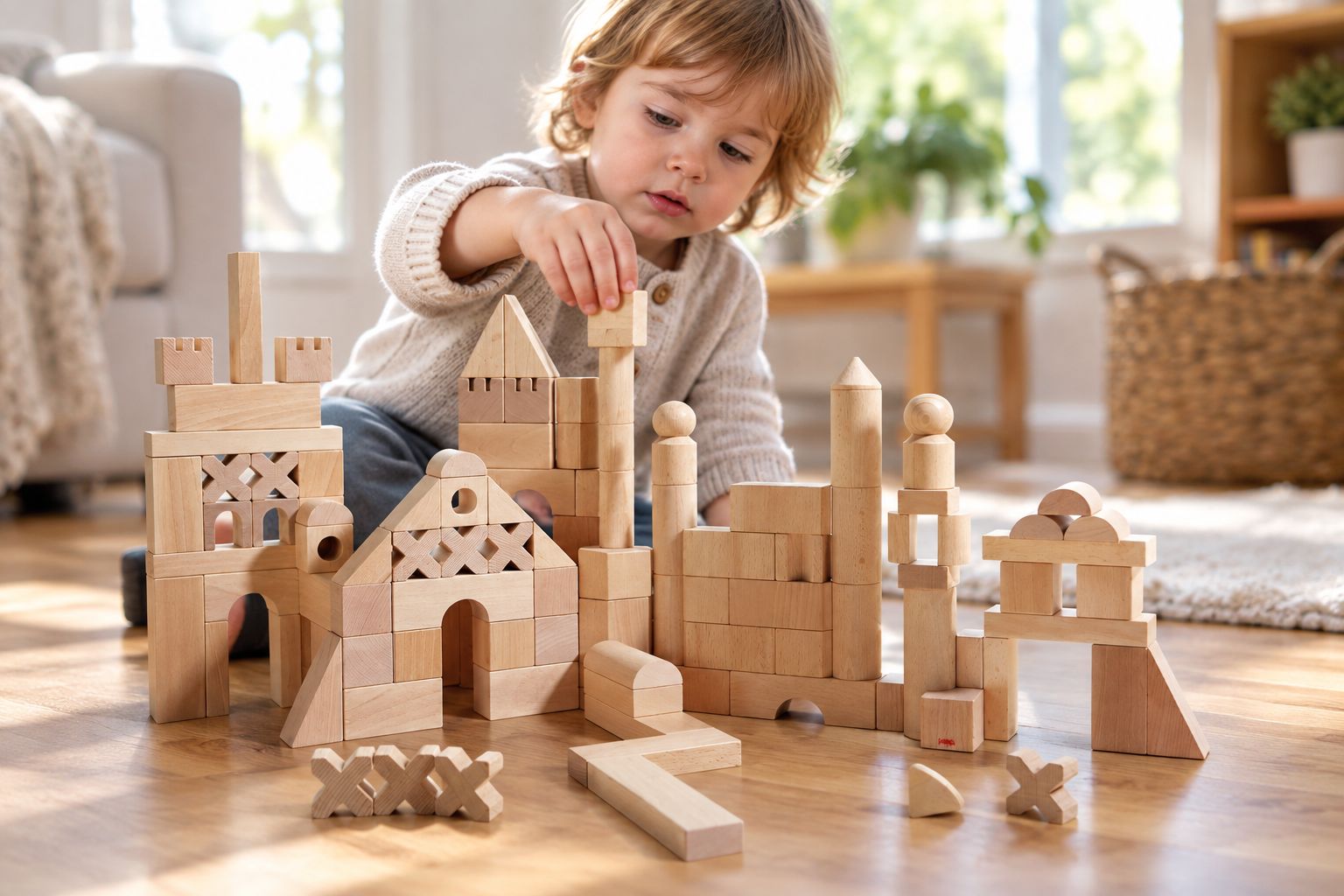
Move into spatial reasoning with building blocks
Blocks are where problem-solving becomes visible: a tower that leans teaches weight distribution faster than any explanation.
- Start with a small set of large, chunky blocks before introducing dozens of pieces at once
- Ask "what happens if" questions rather than showing the answer
- Introduce blocks with texture, sound or colour variation once basic stacking is solid
- Watch for the point where the child self-corrects a wobbly tower — that's the skill forming
Add cause-and-effect with marble runs
A marble run answers its own question instantly: if the track is wrong, the marble stops or flies off. That immediate feedback loop is what makes this stage effective for 3 to 5-year-olds.
- Build the simplest possible track first, then add one piece at a time
- Let the marble fail to reach the end — that's the lesson, not a flaw
- Introduce branching tracks only once a straight run is mastered
- Add sound or spinning elements once the physics itself is understood
Layer in cooperative and turn-based games
Games with rules and turns force a different kind of problem-solving: reading someone else's move and adjusting your own.
- Pick cooperative games first if your child struggles with losing
- Introduce short-round games before anything with a long turn sequence
- Watch for a child changing strategy mid-game — that's the target skill
- Add a second player once solo rules are understood
Increase the challenge with logic puzzles
Once a child can plan two or three moves ahead, single-solution logic puzzles are the next real step up from open-ended play.
- Start with puzzles that have one obvious first move
- Let the child abandon and restart rather than solving it for them
- Move to timed or scored puzzles only once untimed versions feel easy
- Watch for the shift from trial-and-error to visible planning
Rotate and retire toys before boredom sets in
A toy that's mastered stops teaching. Rotating problem-solving toys keeps each one working as a genuine challenge rather than background clutter.
- Box up half the toy shelf and swap it in on a 2-3 week cycle
- Retire a toy once a child solves it instantly without pausing
- Reintroduce a "retired" toy 6+ months later — it often teaches a second skill the second time
- Watch which toys get picked voluntarily; that's the real signal of the right challenge level


Comparing types of problem-solving wooden toys
| Type of toy | Best for | Key limitation |
|---|---|---|
| Open stacking & sorting | Ages 1-2, first cause-and-effect play | Outgrown fast, needs regular rotation |
| Wooden building blocks | Ages 2-4, spatial reasoning and balance | Needs floor space and adult-free time |
| Marble run track sets | Ages 3-5, instant physics feedback | Small parts need supervision under 3 |
| Cooperative board games | Ages 4+, turn-taking and strategy | Needs a second player to work |
| Logic puzzle sets | Ages 4-6, single-solution planning | Too advanced before basic stacking is solid |
Habauk's stacking and building sets are the strongest starting point for problem solving under age 3; logic puzzles like Logic Case Starter Set 5 are the right next step once a child plans ahead rather than guesses.
Common mistakes parents make with problem-solving toys
- Buying two skill-levels ahead: a logic puzzle bought for a 2-year-old gets abandoned, not "grown into" — match the toy to the child now, not in six months.
- Fixing the puzzle for them: stepping in the moment a tower wobbles removes the exact moment the skill would have formed.
- Ignoring group size: cooperative games bought for an only child sit unused until a sibling or friend is around to play.
- No rotation: a shelf of ten toys all left out permanently means none of them stay a genuine challenge past week two.
- Judging by the box age label alone: age ranges are a starting point in 2026, not a rule — a confident 22-month-old can handle Animal Upon Animal before a cautious 3-year-old does.
FAQ
What age should you introduce problem-solving wooden toys?
Open-ended stacking and sorting toys work from around 12 months; save marble runs and logic puzzles for age 3 and up, once basic stacking is easy for the child.
Are wooden toys better than plastic for building problem-solving skills?
Wooden toys tend to be heavier and larger per piece, which suits smaller hands and holds up to rough handling better than lightweight plastic equivalents in nursery and home settings.
How much playtime with problem-solving toys is enough for a toddler?
Five to ten minutes of focused play is enough for a child under 2; preschoolers can sustain 15-20 minutes on a genuinely challenging puzzle or building set.
Is Rhino Hero good for teaching problem-solving skills?
Rhino Hero teaches balance and spatial reasoning through a stacking card-tower format, making it a natural step up once basic block stacking is mastered, typically from age 5.
Do marble runs actually help with problem solving?
Yes — a marble run gives instant, honest feedback on whether a track design works, which builds cause-and-effect reasoning faster than toys where the outcome is hidden.
How do you know a wooden toy is too hard for your toddler?
If a child abandons a toy within a minute without attempting it, or gets visibly frustrated rather than curious, it's a skill-level ahead of where they currently are.
Can siblings of different ages share the same problem-solving toys?
Open-ended sets like building blocks and stacking games work across a wider age range than single-solution puzzles, which suit one skill level and frustrate a younger sibling.
What's a good first cooperative game for problem solving?
Short-round cooperative games with simple rules work best as a first turn-based game, since a child is learning to read another player's move as much as the rules themselves.
One last thing
The single biggest predictor of whether a problem-solving toy actually gets used isn't the toy itself — it's whether a parent lets the child fail at it first. Toys solved instantly by an adult stop being problem-solving toys at all; they become decoration.