


Best Wooden Name Puzzle Personalised Picks (2026)
A personalised wooden name puzzle is one of the most-searched gift categories for newborns, christenings and first birthdays in 2026, but the right pick depends on the child's age, not just the letters spelled out on the box. This guide ranks the five wooden name puzzle styles parents ask about most and names a clear winner for each occasion.
- Classic painted letter puzzles win the best wooden name puzzle personalised overall for everyday nursery play in 2026.
- Chunky peg puzzles are the safer pick for toddlers under two; thinner styles suit ages three and up.
- Multi-layer name puzzles double as nursery wall art but aren't built for solo toddler play.
- Unfinished raw wood puzzles are the budget option if you're willing to paint the letters yourself.
- Flat lacing puzzles travel best because there are no loose pieces to lose.
Why this matters
Personalised gifts get remembered longer than generic ones, and a wooden name puzzle earns its keep two ways: it works as a toy while the child is small enough to handle the pieces, then becomes a keepsake once they've outgrown it. The catch is that most listings online use "wooden name puzzle" as a single category when it actually covers five distinct builds, each suited to a different age and a different job in the nursery.
Get the build wrong and you end up with a puzzle too fiddly for a one-year-old's hands, or a wall-art style piece a toddler keeps trying to prise apart out of frustration. If you're also comparing wooden peg puzzles as a non-personalised alternative from Habauk's range, the age logic below applies to both, since peg size and grip are the same concern either way.
What makes the best wooden name puzzle personalised
- Piece size for the child's age — pieces under roughly 32mm carry a small-parts warning under UK toy safety rules for children under 36 months.
- Letter accuracy and finish — routed or laser-cut letters hold their shape longer than stick-on or printed letters that wear off with washing.
- Wood grade — solid birch or beech resists chipping better than MDF or plywood after years of being dropped, chewed and stacked.
- How the name is applied — engraved and painted names survive handling; vinyl decals peel within months.
- A second life after playtime — the strongest designs double as a nursery shelf or wall piece once the child stops posting pieces in and out.
- Storage and travel — loose pieces get left behind in nappy bags and car seats; some builds are designed around that problem, others aren't.
Wooden name puzzles at a glance
Five builds cover almost every personalised name puzzle sold in 2026. Here's how they stack up before the detail below.
| Style | Best for | Standout feature | Key limitation |
|---|---|---|---|
| Classic painted letter puzzle | Everyday nursery play (best overall) | One painted letter per knob, sturdy hardwood base | Painted finish can chip under heavy chewing |
| Chunky peg puzzle | Toddlers under 2 | Extra-thick pieces sized for small hands | Takes up more shelf space |
| Multi-layer puzzle with picture backing | Nursery wall art | Stays intact as a hanging piece when not in play | Pieces sit flush, hard for toddlers to lift out solo |
| Unfinished raw wood puzzle | Budget or DIY personalisation | Ready to paint or varnish at home | Needs finishing work before it's gift-ready |
| Flat lacing puzzle | Travel and small spaces | No loose pieces to lose in transit | Less tactile for younger toddlers than knob styles |
Read the table left to right and the pattern is clear: nothing here is a bad puzzle, each one just solves a different problem. The mistake most gift buyers make in 2026 is picking on looks alone and skipping the age column entirely.
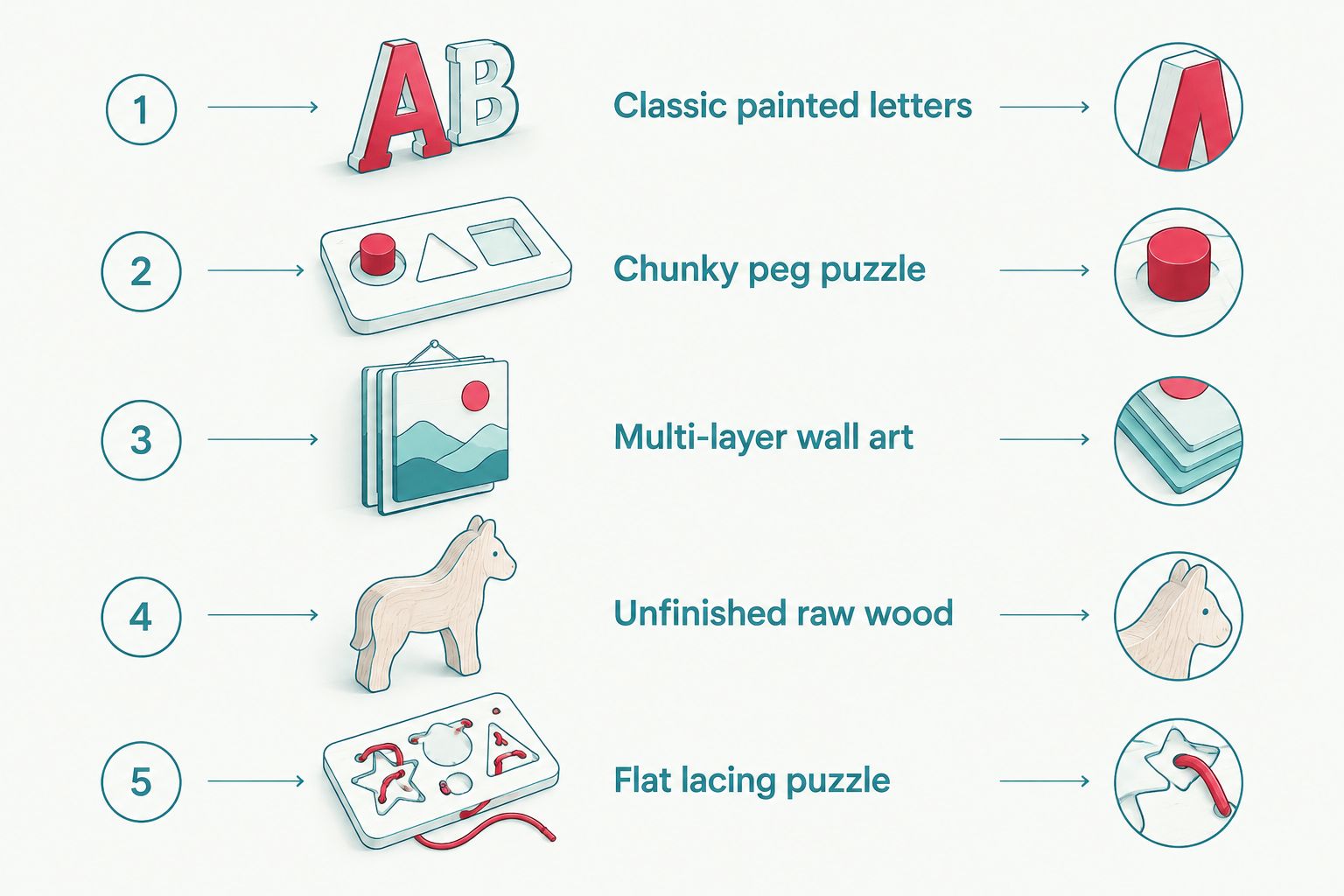
The five styles ranked
1. Classic painted letter puzzle: best wooden name puzzle personalised for everyday nursery play
Each letter of the child's name sits on its own knob piece, painted in a solid colour, set into a routed hardwood base. It's the style most people picture when they search for a personalised name puzzle, and the safest default gift when you don't know the parents' taste well.
Classic painted letter puzzle pros:
- Familiar format that works from roughly 18 months through age 4
- Painted knobs make lifting pieces out easy for smaller hands
- Doubles as an early-letters learning toy, not just a keepsake
Classic painted letter puzzle cons:
- Paint can chip with a determined chewer
- Longer names need a wider base, which not every nursery shelf has room for
Best for: the gift-giver who wants one safe, well-understood option. Verdict: Buy.
2. Chunky peg puzzle: best wooden name puzzle personalised for toddlers under 2
This is the same letter-per-piece idea, built with thicker pieces and larger peg knobs for hands that haven't developed a pincer grip yet. It's worth choosing over the classic style specifically for a first birthday or younger.
Chunky peg puzzle pros:
- Bigger knobs suit fingers that can't yet manage a slim peg
- Thicker pieces are harder to mouth whole, reducing the small-parts risk under 36 months
- Sturdier base survives being dropped from a highchair repeatedly
Chunky peg puzzle cons:
- Bulkier to store than slimmer designs
- Shorter names look sparse on the wider base these puzzles use
Best for: babies and toddlers under two. Verdict: Buy.
3. Multi-layer name puzzle with picture backing: best wooden name puzzle personalised for nursery wall art
The letters sit on top of an illustrated backing board — animals, stars, a birth-detail banner — so the puzzle reads as a finished picture before anyone plays with it at all. It's built to be looked at as much as handled.
Multi-layer puzzle pros:
- Works as nursery decor from day one, no play required
- A strong pick for birth announcements and christening gifts where keepsake value outweighs play value
Multi-layer puzzle cons:
- Pieces often sit flush with the backing, making them hard for a toddler to lift out and post back solo
- Not the pick if the child is already old enough to want a real puzzle to solve
Best for: a keepsake-first gift rather than a daily toy. Verdict: Buy for wall art, Skip if you need a hands-on toy.
4. Unfinished raw wood puzzle: best wooden name puzzle personalised for budget or DIY gifts
The name is laser-cut or routed into raw, unpainted wood, and the finishing — paint, varnish, or nothing — is left to you. It's the cheapest route to a personalised puzzle and a genuine craft afternoon with an older sibling.
Unfinished raw wood puzzle pros:
- Lower cost than a finished, painted equivalent
- Lets you match colours to an existing nursery scheme
- A natural option if you'd rather avoid painted finishes near a baby's mouth
Unfinished raw wood puzzle cons:
- Not gift-ready straight out of the box
- Raw wood needs a food-safe finish before it goes near a teething toddler
Best for: parents happy to finish the puzzle themselves. Verdict: Buy if you have an evening to spare, Wait if it needs to be gift-wrapped tomorrow.
5. Flat lacing puzzle: best wooden name puzzle personalised for travel
Letters are threaded onto a cord or fixed on a flat board with nothing that separates fully, so there's nothing to lose in a car seat pocket or on a flight. It trades tactile play for portability.
Flat lacing puzzle pros:
- Nothing to lose on a journey or at a grandparent's house
- Doubles as an early lacing or threading toy for fine motor practice
Flat lacing puzzle cons:
- Less satisfying for toddlers who like pulling pieces fully out
- Not the strongest keepsake once the child moves past board toys
Best for: travel bags and journeys. Verdict: Buy for travel, Skip as a primary nursery gift.
How the ranking works
The order above runs on age-fit and safety first, keepsake value second, and portability third — in that sequence, because a puzzle that's wrong for the child's age isn't a good gift regardless of how it looks on a shelf. The classic painted style takes the overall spot because it clears the safety bar from roughly 18 months upward and needs no extra context to make sense as a gift. Everything below it earns its place by solving one specific problem — age, decor, budget or travel — better than the classic style does, which is why none of the five gets called a universal winner.
Which wooden name puzzle personalised should you choose?
If you're not sure, buy the classic painted letter puzzle — it fits the widest age range and needs no explanation from the giver. Choose the chunky peg version instead for a child under two, and pick the multi-layer wall-art style only when the keepsake matters more than the play value. Skip the raw wood option unless you're prepared to finish it yourself before the gift date, and reach for the flat lacing style specifically for travel, not as the main gift on its own.
Pairing a name puzzle with the rest of the nursery
A personalised name puzzle rarely arrives alone. If you're building a christening or baby shower gift around it, Habauk's guide to choosing wooden toys as christening gifts covers what else earns its place in that box, and the wooden toys for baby shower gifts guide runs through non-personalised options that work alongside a name puzzle without duplicating it.
Habauk stocks HABA-brand wooden toys and games organised by age rather than personalised name puzzles specifically, so treat this guide as the category comparison and Habauk's own wooden puzzle and game range as the rest of the gift you build around it.
“A name puzzle that doubles as nursery wall art earns its shelf space long after playtime ends.”
FAQ
What's the best wooden name puzzle personalised for a newborn or christening gift?
A classic painted letter puzzle is the safest all-round choice because it suits the widest age range as the child grows. For a strictly keepsake-first gift, a multi-layer puzzle with picture backing works as nursery wall art from day one.
Is a personalised wooden name puzzle safe for a 1-year-old?
Yes, if you choose a chunky peg puzzle with thicker pieces and larger knobs rather than a slim classic design. UK toy safety rules flag small parts as a choking risk for children under 36 months, so piece size matters more than the puzzle's overall look.
What's the difference between a peg puzzle and a multi-layer name puzzle?
A peg puzzle has separate pieces that lift fully out of a base, which makes it a hands-on toy. A multi-layer puzzle sits flush against a picture backing, so it reads as a finished piece of decor rather than something to take apart and rebuild.
Can you paint a wooden name puzzle yourself?
Yes — unfinished raw wood name puzzles are sold specifically for this, letting you match paint colours to a nursery scheme. Use a food-safe, non-toxic finish if the puzzle will go anywhere near a teething toddler.
How much does a personalised wooden name puzzle cost?
Pricing varies by wood grade, name length and finish, so check current listings rather than relying on a fixed figure. Raw unfinished puzzles generally cost less than a fully painted, ready-to-gift version of the same design.
Is a wooden name puzzle better than a personalised blanket as a gift?
A name puzzle doubles as a toy during early childhood and as keepsake decor afterward, while a blanket offers comfort and decor only. Neither replaces the other, and many parents end up with both around a christening or baby shower.
What should I check before buying a personalised name puzzle online?
Confirm the piece size against the child's age, especially for a gift going to a baby under three. Also check whether the name is engraved or painted rather than printed with a decal, since decals wear off with handling and washing.
One last thing
The detail most listings leave out in 2026: check the piece thickness before you buy for a child under three, not just the overall puzzle size. A name puzzle built for a four-year-old's fine motor skills can carry a small-parts warning that makes it the wrong gift for a one-year-old's christening, even though both list as "personalised" on the same product page.