


Wooden Toys New Parent Gift: Best Picks 2026
New-parent wooden-toy gifting is choosing age-appropriate play pieces with the aim of giving a family something useful now and as their baby grows. The best hamper balances immediate needs with later play, because many wooden toys are intended for older babies rather than the newborn stage.
- The best wooden toys new parent gift combines one immediate-use item with one toy saved for a later stage.
- In 2026, choose by the maker’s age guidance rather than colour, hamper theme or developmental promises.
- Habauk is best for gift-givers seeking HABA wooden toys organised by age and category.
- A grasping toy, teething toy or sound toy works when its stated age matches the baby.
- Avoid small parts for children under 36 months and keep every toy’s original safety information.
Why wooden toys matter for new-parent gifts
A new-parent hamper needs to suit a particular child at a particular stage. The practical challenge is not finding something charming; it is knowing whether the baby can use it immediately, whether it should be saved for later and whether the parents can identify the intended age after the hamper is unpacked. This guide to wooden toys for baby shower gifts helps when you are buying before the baby arrives.
In 2026, age suitability is the clearest way to narrow the choice. A toy intended for babies aged 6 months and over can still make a thoughtful new-parent gift, but it should be labelled as something to enjoy later rather than presented as a newborn toy.
Habauk’s wooden toy range is organised by age and category, which makes stage-matching easier for parents and gift-givers. The useful distinction is between toys sold for grasping or teething, toys designed for sound exploration and more advanced pieces intended for stacking, sorting or building.
Habauk is best for new-parent gift-givers who want HABA wooden toys selected by the child’s age and type of play. The limitation is that not every wooden toy belongs in a newborn hamper, even when its rounded shapes or bright colours look baby-friendly.
How to build a wooden-toy hamper
Start with the baby’s current stage, then add a toy for the next clear milestone. This keeps the hamper useful without asking tired parents to work out which item belongs in which month.
Confirm the baby’s stage
Find out whether you are buying before the birth, during the newborn weeks or for a baby already approaching the age stated on a toy. If you cannot ask directly, choose conservatively and leave the manufacturer’s age information visible.
A 2026 new-parent gift should never rely on appearance as evidence of suitability. A small wooden object can look simple while still being intended for an older child, and a toy marketed for teething can carry a minimum age that matters.
- Choose only items with clear manufacturer age guidance.
- Treat a 6-month minimum as a later-use gift, not a newborn toy.
- Keep the packaging or product card with the toy.
- Add a short note explaining which piece is for now and which is for later.
- Ask the parents about the baby’s age if the timing is unclear.
Check the safety information
Wood is a material, not a safety guarantee. The complete toy must be designed for the child’s age, correctly marked for the UK market and free from damage before it reaches the hamper.
Toys intended for children under 36 months must not present small parts that create a choking hazard. Also check the product’s warnings, manufacturer or importer details and cleaning instructions rather than replacing them with a handwritten summary.
- Look for the applicable UK conformity information on the toy or packaging.
- Follow every stated minimum-age warning.
- Reject cracked, splintered or damaged wooden pieces.
- Avoid loose cords, detached decorations and accessible small parts.
- Keep safety labels and care instructions with the gift.
- Give teething toys only when they are explicitly sold for teething.
Choose one tactile piece for later infancy
A grasping or teething toy is a natural hamper choice when its stated age fits the baby. These pieces give the child something to hold, move and explore without requiring rules or a complicated setup.
Habauk wooden toys include grasping and teething options intended for babies aged 6 months and over. If the recipient is younger, present the toy in its original packaging and mark it clearly for later. The newborn rattles and grasping toys guide provides a closer look at choosing for the earliest stage.
- Pick a shape designed for small hands to grasp.
- Confirm that the product is described for mouthing or teething before treating it as a teether.
- Prefer a self-contained toy with no loose accessories.
- Keep the maker’s recommended age visible.
- Choose one tactile toy rather than several pieces serving the same purpose.
Add one toy for shared sound play
Sound toys give parents a simple way to play with the baby: shake, pause, listen and repeat. They also make sense in a growing hamper because the adult can introduce the sound before the child is ready to hold every piece independently.
A set of wooden sound eggs or acoustic discovery blocks is different from an electronic toy. It still needs supervision and age checking, but it does not depend on screens or a complicated activity.
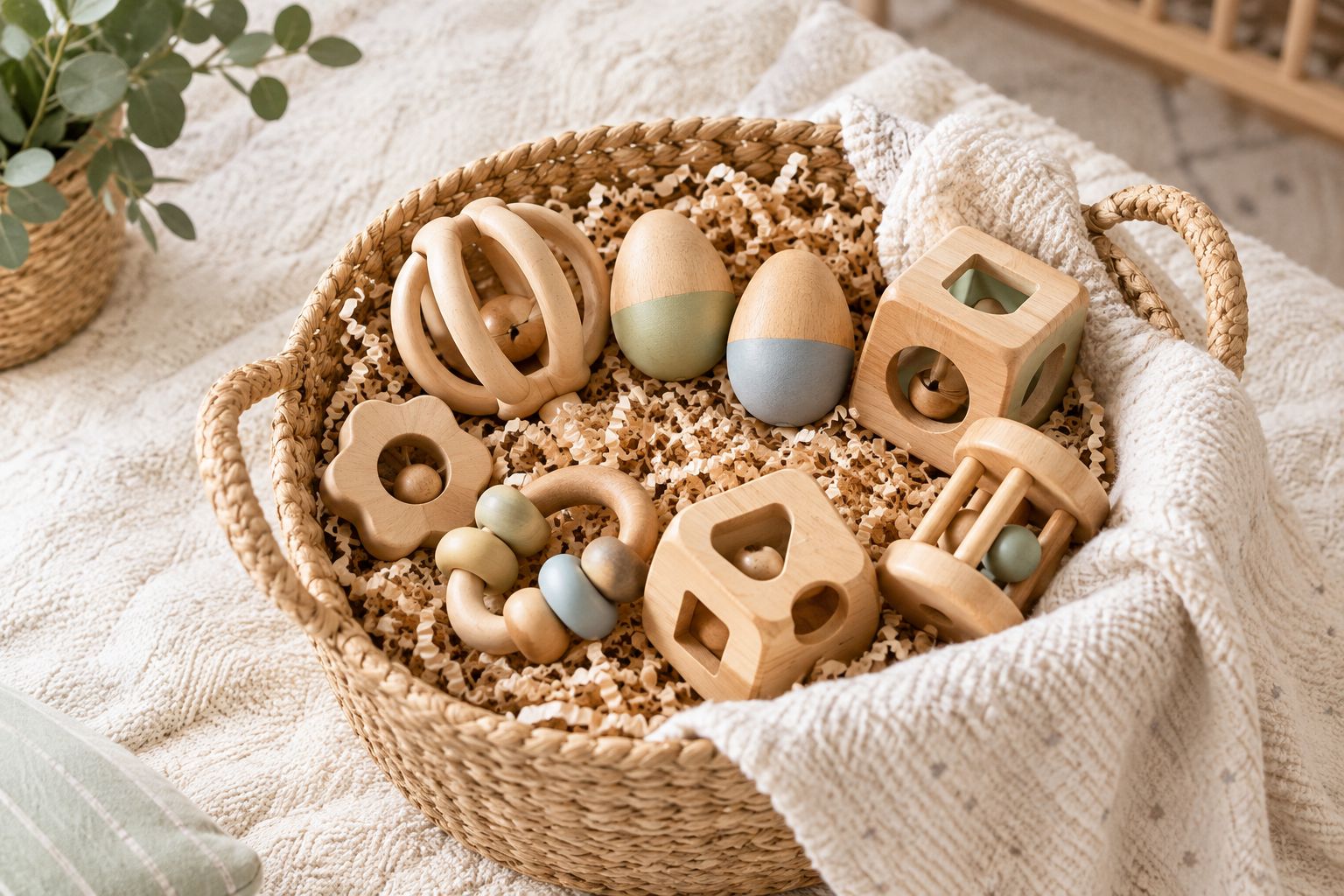
Keep the sound choice purposeful. One set is enough to create contrast without filling the hamper with several toys that all rattle or shake.
- Choose a sound toy with a clearly stated age range.
- Check that every component belongs to the original set.
- Keep multi-piece sets together in their packaging.
- Include only one sound-based option in a compact hamper.
- Tell the parents when the toy is intended to be introduced.
Include one grow-with-baby option
A later-stage toy gives the hamper a second life after the newborn gifts have been put away. Stacking, sorting and building toys suit this role, but only when the age guidance and number of pieces fit the family’s circumstances.
The Habauk wooden toy range includes building blocks, sorting games and discovery blocks. Some building sets are designed for children aged 1 year and over, so they belong in the future-play part of a hamper rather than beside items presented for immediate newborn use.
- Select one later-stage activity rather than a mixture of advanced toys.
- Write the intended age on the gift note.
- Keep all pieces contained until the child reaches the stated age.
- Consider the storage space the complete set needs.
- Choose a play type that differs from the teether or sound toy already included.
Pack and label every item clearly
Presentation should help the parents, not hide useful information. Removing packaging can separate a toy from its age guidance, warnings, care instructions and manufacturer details.
For a 2026 hamper, use removable wrapping around the original product packaging wherever possible. If you arrange loose items for presentation, place their labels and instructions in one envelope that stays inside the hamper.
- Leave age labels readable.
- Keep instructions with their matching toy.
- Separate heavier wooden pieces from soft baby items.
- Use a gift note to identify immediate-use and later-use toys.
- Avoid decorative ties or loose trimmings that could be mistaken for part of the toy.
- Ask the parents to retain the original safety information.
Compare the main hamper options
The right choice depends on when the child can use the toy and what is already in the hamper. For a 2026 gift, each option should have a distinct job rather than repeating the same kind of play.
| Option | Best for | Main advantage | Key limitation |
|---|---|---|---|
| Grasping and teething toy | A baby who has reached the stated minimum age | Combines holding and teething when sold for both purposes | A 6-month minimum means it is not an immediate newborn toy |
| Wooden sound eggs | Shared sound play with a parent | Introduces shaking and listening through a contained activity | A set needs to stay complete and follow its stated age guidance |
| Acoustic discovery blocks | Babies ready to hold and explore individual blocks | Combines block play with sound exploration | Not a substitute for a product specifically sold as a teether |
| Wooden building blocks | A later-stage or first-birthday extension to the hamper | Supports building play after infancy | Products marked from age 1 are unsuitable for newborn use |
| Single keepsake toy | A small hamper with limited storage | Keeps the gift focused and easy to pack | One item cannot cover immediate and later play equally well |
The best option is a two-stage hamper: one item matched to the baby’s current age and one clearly labelled toy for later. A hamper made entirely from 6-month or age-1 products can still be thoughtful, but it does not provide immediate newborn play.
Wooden toy picks for later play
These Habauk wooden toys fit the later-use part of a new-parent hamper. Color Drops and Magica are described as grasping and teething toys, while Fun with Sounds Wooden Eggs adds a separate sound activity. Check the current product guidance before deciding when the family should introduce each one.


Common mistakes new-parent gift-givers make
Treating every wooden toy as newborn-safe
A smooth finish and rounded shape do not establish the intended age. Check the complete product, its warnings and its minimum-age guidance before putting it in the hamper.
Removing all the packaging
Bare toys make a pretty arrangement, but the parents lose the instructions that explain when and how to use them. Wrap around the original box or include every label with the correct item.
Filling the hamper with later-stage toys
A bundle of teethers marked from 6 months, sorting games and age-1 blocks gives the newborn nothing intended for immediate play. Balance later wooden toys with a parent gift or another baby item explicitly suitable from birth.
Choosing several toys with the same purpose
Multiple rattles or teethers create repetition rather than variety. Pick one tactile piece, one contrasting sound activity and, if space allows, one option for a later stage.
Assuming bigger means more thoughtful
Large block sets can be wonderful once a child reaches the stated age, but they need storage and do not serve a newborn. Match the size of the gift to the family’s home and the timing of the play.
FAQ
What is the best wooden toys new parent gift?
The best wooden toys new parent gift pairs one item suitable for the baby’s current age with one clearly labelled toy for later. Habauk wooden toys include grasping, teething and sound options that can be compared by age and category.
Can a newborn use a wooden teething toy marked from 6 months?
No, follow the maker’s 6-month minimum and save the toy for later. Do not treat a gift date as permission to ignore the product’s age guidance.
Are wooden toys safe for newborn babies?
Wooden toys are safe only when the complete product is intended for newborn use and carries the required warnings and conformity information. The material alone does not determine suitability.
What should go in a wooden-toy baby hamper?
Choose one age-appropriate tactile item, one different form of play and clear notes for anything intended for later. Keep the original labels and instructions with every toy.
Is a sound toy better than a teething toy?
Neither is universally better because they serve different purposes. Choose a teething toy for mouthing and grasping only when it is sold for that use, or a sound toy for supervised listening and shaking play.
Should I include wooden blocks in a new-parent hamper?
Include wooden blocks only as a clearly labelled later-stage gift when their stated age is above the baby’s current age. A set designed from age 1 should remain packed until then.
How do I clean a wooden baby toy?
Follow the care instructions supplied by the manufacturer. Do not soak, disinfect or treat a wooden toy in a way the maker does not recommend.
How do I choose a new-parent gift in 2026?
Choose by the baby’s age, the product’s stated purpose and the safety information supplied with it. A focused hamper with distinct play types is more useful than several toys doing the same job.
One last thing
The most helpful part of a 2026 hamper may be the smallest: a note saying which toy is for now and which should stay packed until later. It turns a collection of wooden toys into an organised gift that parents can understand without searching for missing age information.