


Wooden Toys for Bilingual Families: 2026 Guide
Wooden toys for bilingual families work hardest when they need no translation at all. Picture-matching games, sound blocks and stacking sets let a toddler build vocabulary in two or three languages at once, without a single instruction ever being read aloud.
- Wooden toys for bilingual families succeed when play needs no printed words, letting picture and sound cues carry the meaning instead.
- First Orchard and Hanna Honeybee use illustrations, not text, so either parent can narrate in their own language.
- Fun with Sounds Discovery Blocks builds pre-verbal recognition skills that carry across every language a baby hears at home.
- Rotate toys by which parent is playing, not by toy type, to keep One Parent One Language routines steady in 2026.
- Animal Upon Animal needs zero shared vocabulary to play, making it the easiest stacking game for mixed-language households.
Why this matters
Raising a bilingual or multilingual child means every toy either helps the language mix at home or gets in its way. A board game with dense written rules forces one parent to translate before play even starts, and that friction is exactly why so many households end up defaulting to whichever language the instructions happen to be printed in.
Open-ended wooden toys sidestep the problem completely. A stacking game, a sound block or a picture-matching card doesn't care which language names the pieces — it just needs an adult willing to say the word out loud, in whichever language they're using that session. Habauk's HABA-brand games lean on illustration-first rules for exactly this reason, which is why parents raising kids across two or three languages tend to reach for pictures over paragraphs and for games that reward pointing over reading a rulebook. That preference isn't going away in 2026 as more UK households manage two or more home languages day to day.
How to choose wooden toys for bilingual and multilingual families
The order below moves from toys that need zero language at all through to games a school-age bilingual child can handle once reading confidence grows in at least one language. Start at the top if you're building a collection from scratch.
Rule out toys that lean on printed text
Check the actual gameplay, not the box copy, before buying anything new. A box printed in English can still hide a rulebook that plays out entirely in pictures, and that's the toy worth owning.
- Look for symbol-based scoring rather than written point tracks.
- Check whether the rulebook uses diagrams instead of paragraphs of instructions.
- Skip electronic toys with a voice chip locked to one language.
- Favour boxes that show the play pattern in photos, not just words.
- Run one test round before deciding a game needs translating at all.
Reach for picture-matching games before word games
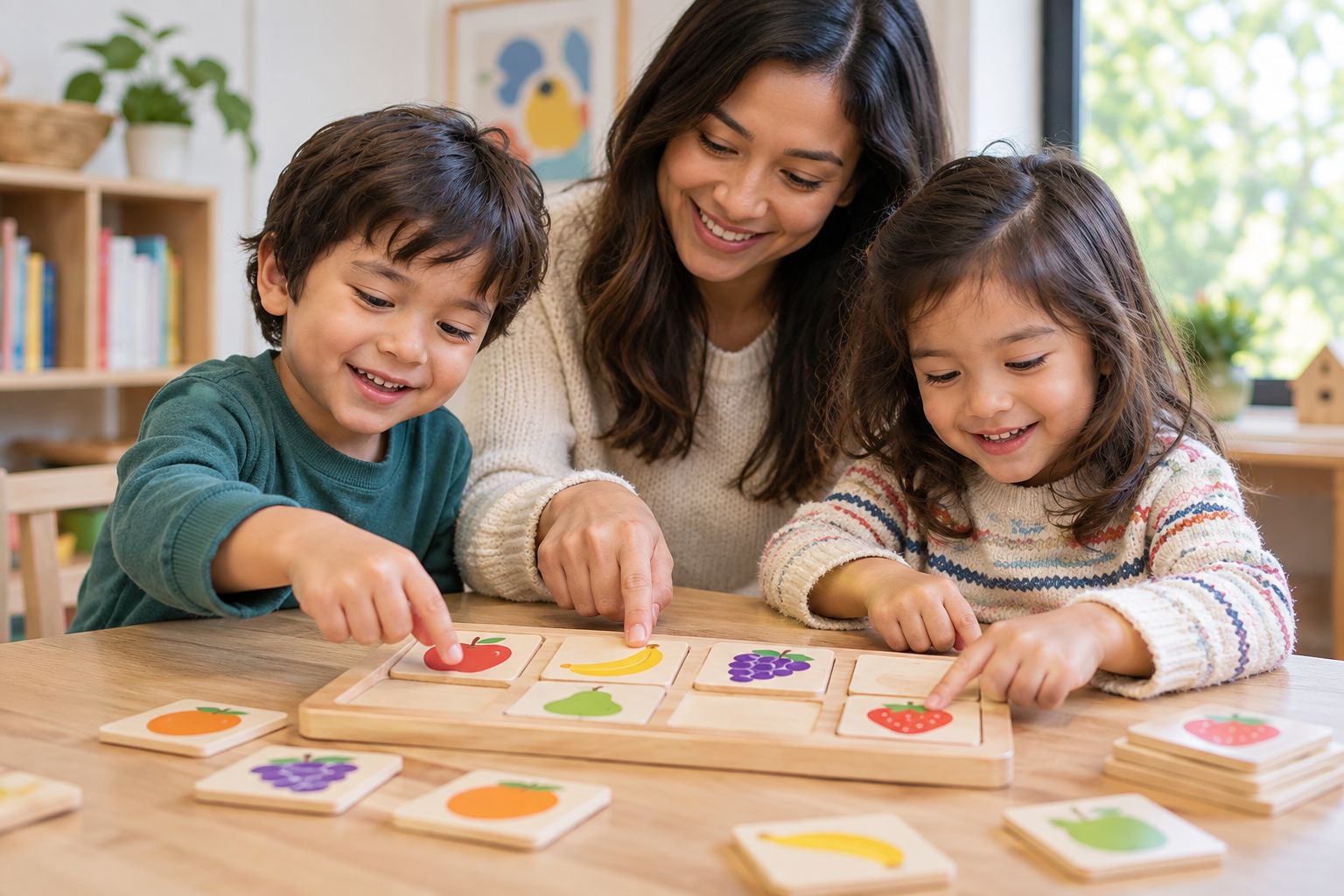
Cooperative picture-matching games give a bilingual household its easiest entry point, because the artwork carries the meaning and either parent supplies the word. First Orchard, part of Habauk's My Very First Games range, uses identical fruit illustrations no matter which language a family speaks at home, so a child hears one word for 'apple' from one parent and a completely different word for the same picture from another.
- Point at each illustration and let both parents supply their own word for it.
- Choose orchard, farm or forest themes, since that vocabulary is high-frequency in most languages.
- Use the cooperative win condition — everyone helps, nobody's out — so a slower vocabulary in one language never costs a child the game.
- Repeat the same card set across consecutive sessions to reinforce a word in each language before moving on.
- Pick a spinner or dice version over number cards if the child isn't reading numerals yet.
Use sound and sensory blocks for pre-verbal vocabulary
Before a child produces real words, they're already sorting sounds into categories, which makes sound-based wooden toys useful long before language differences even come into play. Fun with Sounds Discovery Blocks gives a baby a set of blocks that each make a distinct sound, so a parent can name that sound in whichever language is scheduled for that session without changing anything about the toy itself.
- Match one consistent word to one consistent sound across sessions, in each language.
- Use grasping and teething toys as a bridge before a baby can point deliberately.
- Let the block's texture or colour become the shared reference point when the spoken word itself differs.
- Rotate which parent introduces a new block so neither language dominates the early sound vocabulary.
Split play sessions by parent, not by toy
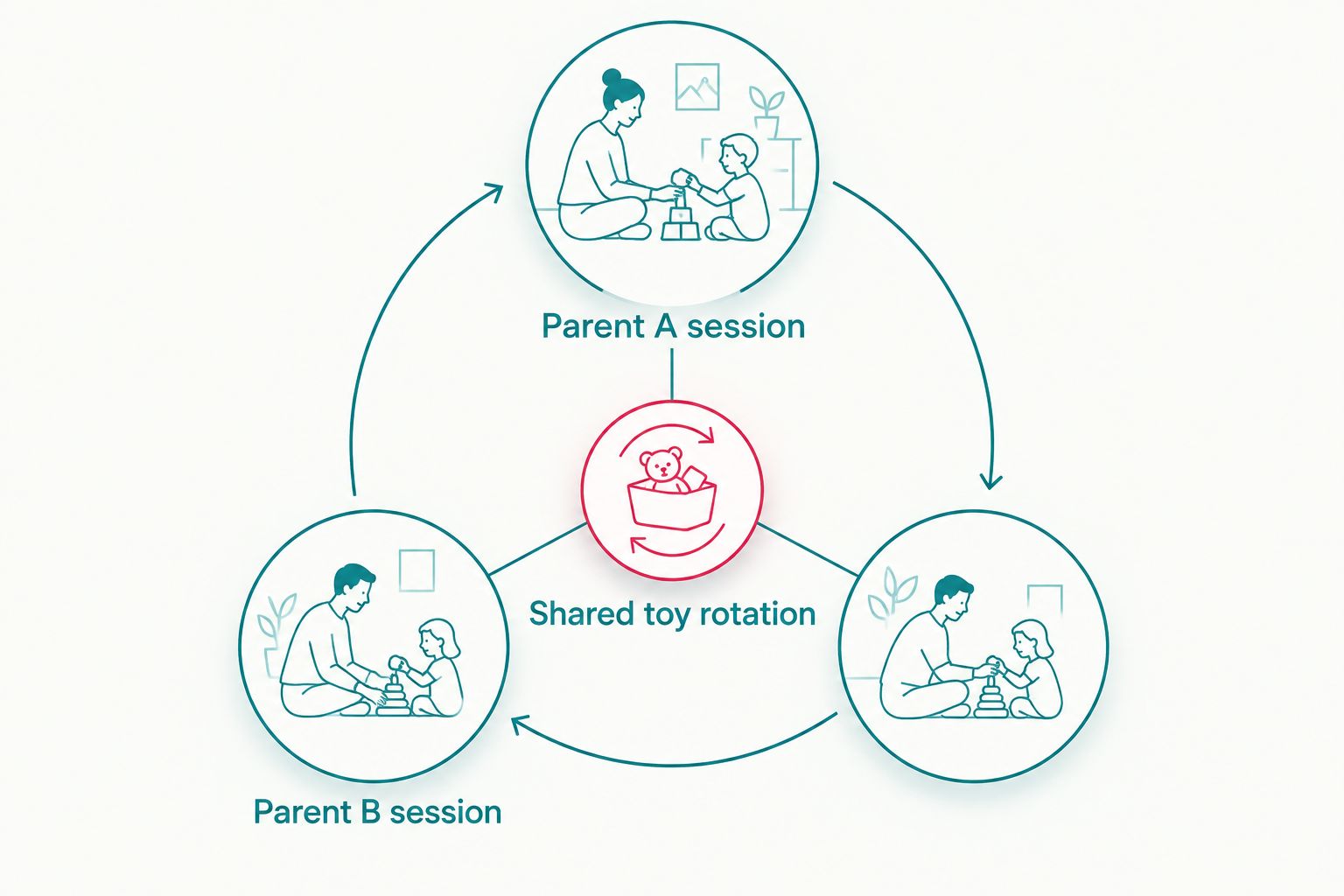
The One Parent One Language approach works best when the toy stays constant and the language switches with whoever is playing. Swapping the toy every time the language changes just doubles the cost of building out a bilingual wooden toy collection, and it's unnecessary.
- Assign each parent a regular play slot rather than splitting every session in half.
- Keep the same toy in rotation for both parents' sessions so the object, not the language, is the constant.
- Let grandparents or a childminder bring a third language into the same toy set instead of buying new toys per language.
- Track which words a child has picked up in each language so sessions build on each other instead of repeating at random.
Let stacking and building toys carry the nonverbal load
Some play doesn't need narration at all, and that's exactly the point. Stacking games such as Animal Upon Animal ask a child to balance pieces, not name them, which makes them the easiest wooden toy to hand to a sibling or playmate who speaks a different home language entirely.
Basic wooden building block sets work the same way. A 102-piece starter set, built for ages 1 and up, gives two children with different vocabularies a shared building project without a single word required to start playing.
- Use stacking and building sessions as the 'no pressure' toy when a child is tired of translating.
- Pair a stronger-language sibling with a weaker-language sibling on one joint building project.
- Bring these toys out at nursery drop-off or a childminder handover, where the adult in charge may speak a third language again.
- Treat wobble and collapse as the shared joke, since laughter doesn't need translating either.


Narrate consistently, not simultaneously
Saying the same sentence in two languages back to back teaches a child that one language is just decoration on the other. Pick one language per session and stick to it, then let the second parent repeat the same play pattern later in their own language.
- Avoid code-switching mid-sentence during a single play session.
- Keep object labels consistent — don't rename the same wooden animal figure differently every time within one language.
- Let repetition happen across separate sessions, not within one sitting.
- Narrate the action ('stacking', 'matching', 'pointing') as consistently as the object names themselves.
Bring in strategy games as vocabulary grows
Once a child is reading confidently in at least one language, tile-laying and light strategy games extend the same picture-first logic. Karuba, Monza and Honga rely on spatial reasoning and pattern-matching more than reading comprehension, so a family can keep both languages active around the same board even once the games get more complex.
- Introduce Karuba's tile-laying mechanic before Monza's route-building, since matching shapes needs less vocabulary than planning a route aloud.
- Use Rhino Hero and Pios for turn-based dexterity fun that doesn't hinge on reading a card.
- Save Dragons Breath and Socken Zocken for family game night once both languages have enough shared game vocabulary built up.
- Let the more confident-reading parent do one informal translation pass on the rulebook rather than buying duplicate sets.
Wooden toy options for bilingual families compared
No single toy type covers every stage of a bilingual child's development, so most households end up mixing categories as vocabulary and reading confidence grow through 2026 and beyond.
| Option | Best for | Key limitation |
|---|---|---|
| Picture-matching cooperative games (First Orchard, Hanna Honeybee) | Ages 2–4 building first vocabulary in two languages | Outgrown once a child reads confidently |
| Sound and sensory blocks (Fun with Sounds Discovery Blocks, Musical Eggs) | Babies and toddlers before speech develops | Limited use once a child talks in full sentences |
| Stacking and building sets (Animal Upon Animal, wooden building blocks) | Nonverbal play between siblings or playmates without a shared language | Teaches no specific vocabulary on its own |
| Tile-laying and route games (Karuba, Monza, Honga) | School-age bilingual kids ready for light strategy | Rulebooks still need an informal translation pass |
| Dexterity and stacking challenges (Rhino Hero, Pios) | Family game night across generations and languages | Instructions are printed in English only |
First Orchard is the strongest starting point for any bilingual household in 2026 — no reading, no scorekeeping, and a cooperative structure that never singles out the slower vocabulary.
Common mistakes bilingual families make with wooden toys
- Buying a word-heavy board game before checking whether the rules can be taught by demonstration alone.
- Assuming an older sibling's fluency means a younger child needs no translation for the same toy.
- Stocking games and books in one language only, treating the second language as an afterthought.
- Switching languages mid-sentence during play, which blurs which word belongs to which language.
- Buying a new toy every time the family wants to work on a new language, instead of rotating existing toys through both.
FAQ
What are the best wooden toys for bilingual families?
Picture-matching games such as First Orchard and Hanna Honeybee, plus sound-based sets like Fun with Sounds Discovery Blocks, work best because neither depends on a single printed language. Stacking games such as Animal Upon Animal add a nonverbal option for siblings or playmates who don't share a home language.
Do wooden toys actually help with bilingual language development?
They remove the friction of translating written instructions, so a parent can narrate freely in whichever language they're using that session. The toy itself doesn't teach a language directly — the parent's narration during play does the work.
Is Animal Upon Animal good for multilingual households?
Yes, because the stacking gameplay needs no shared vocabulary to play. A child balances pieces rather than naming them, which makes it easy to hand to a friend or sibling who speaks a different language.
How does the One Parent One Language method work with toys?
Each parent keeps a regular play session and speaks only their own language during it, using the same toy rotation rather than swapping toys by language. Consistency in which toy pairs with which parent reinforces the pattern faster than buying new sets.
What age should bilingual toy play start?
Sound and sensory toys work from the newborn stage onward, well before speech develops, since a baby is already learning to sort sounds into categories. Picture-matching games suit toddlers from around age two once pointing and simple turn-taking are possible.
Should a bilingual family buy separate toy sets for each language?
No — the same wooden toy works for both languages because the object stays constant while the parent's narration changes. Buying duplicate sets per language adds cost without adding extra language exposure.
Are HABA wooden games suitable for non-English speaking households?
Most cooperative picture-matching and stacking games rely on illustrations rather than text, so gameplay doesn't depend on reading English. Rulebooks are printed in English, so a confident-reading parent may need to translate the instructions once before play starts.
What's the easiest first game for a mixed-language toddler?
First Orchard is a strong starting point in 2026 because it has no reading requirement, no scorekeeping, and a cooperative win condition that removes any pressure tied to vocabulary speed.
One last thing
The detail most bilingual families miss: cooperative games without a declared 'winner' lower language pressure more than any flashcard set ever will. First Orchard and Hanna Honeybee never single out the slowest speaker in the room, so a child caught between two vocabularies never feels behind — start there in 2026 before adding a single strategy game to the shelf.