


Best Wooden Toys Object Permanence Guide 2026
Babies’ object permanence play is hide-and-reveal play with the aim of helping them learn that people and objects still exist when out of sight. This 2026 guide explains how parents can combine simple peekaboo with wooden toys, sound cues and cause-and-effect learning without making play too difficult too soon.
- Wooden toys object permanence play should begin with face-to-face peekaboo and a partly hidden familiar object.
- Habauk wooden toys with sound add an audible clue when a baby cannot see the hidden object.
- In 2026, sound blocks suit early searching; containers, nesting toys and shape sorters add difficulty later.
- The best activity matches the baby’s current search skills rather than the most advanced toy available.
Why object permanence play matters for babies
Object permanence is the understanding that a person or object continues to exist after it disappears from view. Before this understanding develops, a covered block does not feel hidden to a baby; it appears to be gone. Peekaboo turns that uncertainty into a short, predictable game with a reassuring ending.
In Piaget’s classic sensorimotor framework, babies aged 4-8 months begin searching for partly hidden objects. From 8-12 months, intentional searching becomes clearer, although babies can still look where an object was previously found rather than where it was most recently hidden. From 12-18 months, searching becomes more flexible as babies experiment with different actions and locations.
These age bands describe a developmental sequence, not a shopping schedule. In 2026, the right starting point remains the action your baby can already complete: watching a face return, pulling away a cloth, following a sound or opening a simple container.
Wooden toys are useful because they can connect hiding with touch, weight, movement and sound. They do not teach object permanence by themselves. The learning comes from repeating the sequence of seeing, hiding, searching and finding with an attentive adult nearby.
How to use wooden toys for object permanence play
Begin with the free version and increase the challenge one small step at a time. A toy becomes useful only after your baby understands the action required to reveal it.
Start with face-to-face peekaboo
Your face is the most familiar object in the game, making it the clearest place to begin. Cover your eyes briefly, reveal them and repeat the same cheerful phrase. The repetition helps your baby anticipate the return before they can uncover anything themselves.
Keep the rhythm calm. A long disappearance or sudden noise can turn a playful surprise into distress, while a short and predictable pause keeps attention on the return.
- Cover only your eyes before hiding your whole face
- Reveal your face from the same place at first
- Pause and watch for anticipation before reappearing
- Let your baby touch or move your hands
- End while the game is still enjoyable
Hide one familiar object
Move from your face to a familiar toy once your baby watches or anticipates the reveal. Place the object under a light cloth while your baby is looking, leaving part of it visible on the first attempts.
The goal is not to test memory. It is to make searching easy enough that the baby connects lifting the cloth with finding the toy. If the baby does not reach, reveal more of the object and demonstrate the action once.
- Choose one familiar object rather than several new ones
- Leave an edge visible during the first rounds
- Hide the object within easy reaching distance
- Let your baby complete the final uncovering action
- Repeat the same hiding place before changing it
Add a clear sound cue
Sound keeps providing information after an object leaves sight. Shake or tap a sound-producing toy, hide it partly under a cloth and repeat the sound. A baby can turn towards the cue before developing the hand control needed to retrieve the toy.
Fun with Sounds Wooden Discovery Blocks are the most relevant Habauk option for this step because they are made for music and sound exploration. Their limitation is that sound can capture attention without prompting a search, so pair the noise with a visible hiding action rather than shaking the blocks from an unknown location.
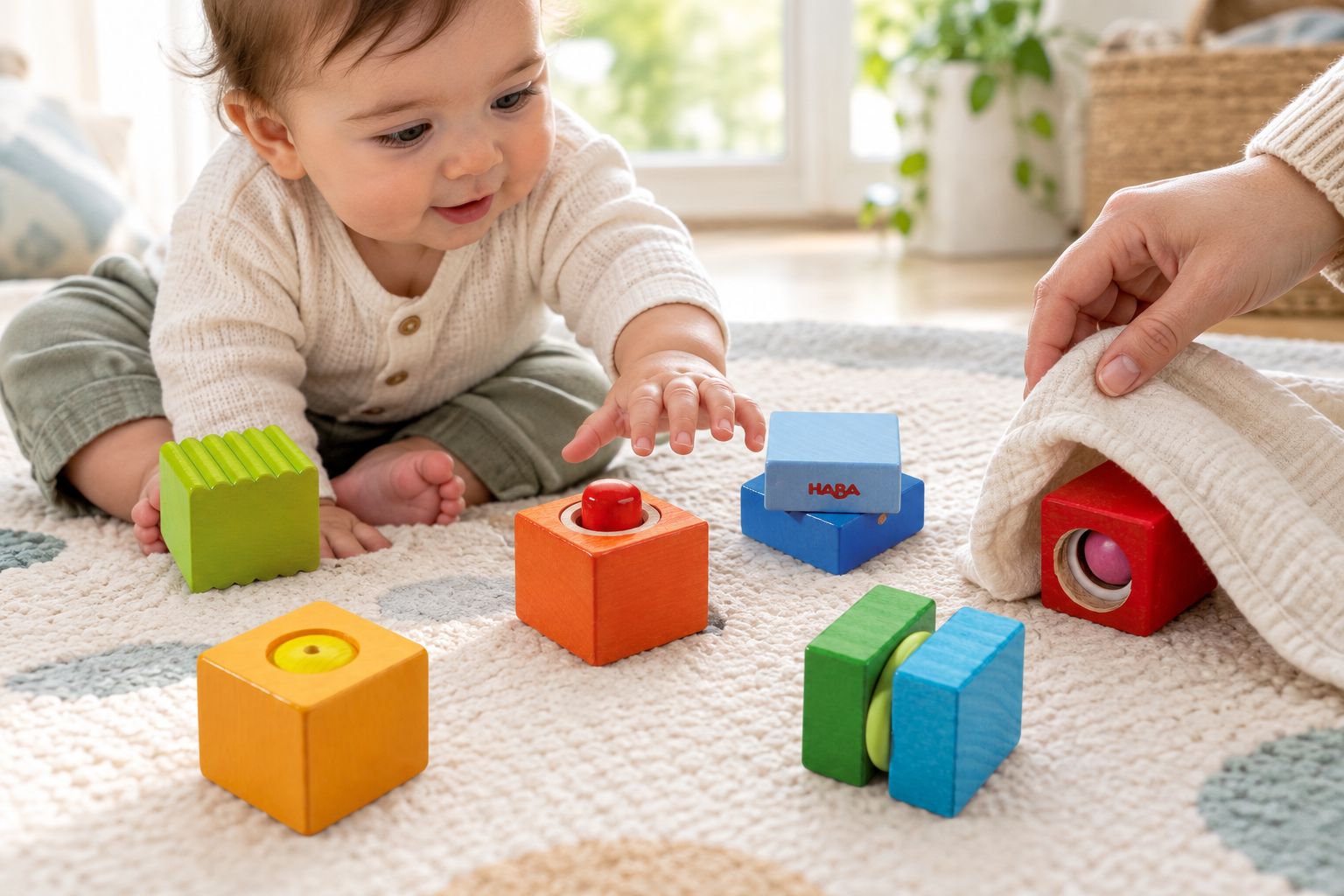
Keep each round simple enough that the sound identifies the hidden object rather than becoming a separate performance.
- Make the sound before and after hiding the object
- Hide one sound-producing piece at a time
- Pause so your baby has time to turn or reach
- Let your baby create the sound after finding it
- Alternate noisy rounds with quiet cloth games
Let your baby uncover containers
A loose lid or open container adds a physical action to the search. Show the object going inside, place the lid lightly on top and let your baby remove it. Begin with a lid that lifts straight up rather than one requiring twisting, matching or several coordinated movements.
Container play adds useful difficulty because the object becomes fully hidden. It also demands more hand control than pulling a cloth, so return to the cloth if the lid becomes the focus and the hidden object is forgotten.
- Demonstrate opening the container before hiding anything
- Place one familiar object inside
- Rest the lid loosely instead of fastening it
- Hold the container steady while your baby lifts
- Celebrate the search action rather than demanding repetition
Build towards posting and sorting
Posting a piece through a slot creates a more advanced disappearance: the baby causes the object to vanish and then needs another action to recover it. Shape sorters add matching and hand-eye coordination, which makes them a later object permanence activity rather than a starting toy.
The Underwater World Wooden Shape Sorter contains five sea-creature blocks, each with one matching slot. Its clear strength is combining posting with retrieval. Its limitation is the extra shape-matching demand, which can distract from hide-and-reveal play when introduced before simpler searching is secure.
Separate the posting task from the matching task at first. You can place a correctly matched piece near its slot, then help your baby retrieve it from the box.
- Present one shape and its matching opening
- Let your baby watch the shape enter the box
- Open the sorter together to find the piece
- Add another shape only after the sequence is familiar
- Stop if slot matching replaces the searching game
Rotate the challenge without rushing
Babies learn through repetition, but a small change can renew attention once the basic sequence is familiar. Change one detail at a time: the object, cloth, location or person hiding it. Changing everything at once removes the pattern your baby is trying to understand.
Watch what your baby does rather than expecting a performance. Reaching towards the hiding place, lifting the cloth or looking towards a sound are all meaningful responses, even when the object is not recovered independently.
- Keep the same object and change the hiding cloth
- Hide the object slightly farther to one side
- Let another familiar adult lead peekaboo
- Combine a sound cue with a partly visible object
- Return to an easier version after frustration
Comparing object permanence play options
The strongest 2026 choice depends on which part of the sequence your baby already understands. Manual play offers the clearest introduction, while wooden toys add tactile, sound or problem-solving elements after the basic reveal makes sense.
| Option | Best for | Main strength | Starting price | Key limitation |
|---|---|---|---|---|
| Face-to-face peekaboo | First hide-and-reveal experiences | Uses the most familiar possible subject | No product required | The adult controls every reveal |
| Cloth over a familiar toy | Babies beginning to reach and search | Makes the uncovering action easy to see | No product required | Offers little fine-motor challenge |
| Wooden sound blocks | Babies who turn towards sound | Keeps providing a clue while hidden | Check current listing | Noise can distract from searching |
| Loose-lid containers | Babies ready to uncover a fully hidden object | Connects searching with a deliberate hand action | Check current listing | Opening the lid adds motor difficulty |
| Wooden shape sorters | Later posting, retrieval and matching play | Combines disappearance with problem-solving | Check current listing | Requires skills beyond object permanence |
| Nesting and stacking toys | Babies exploring size and partial concealment | Supports repeated covering and uncovering | Check current listing | Several pieces can overwhelm early searchers |
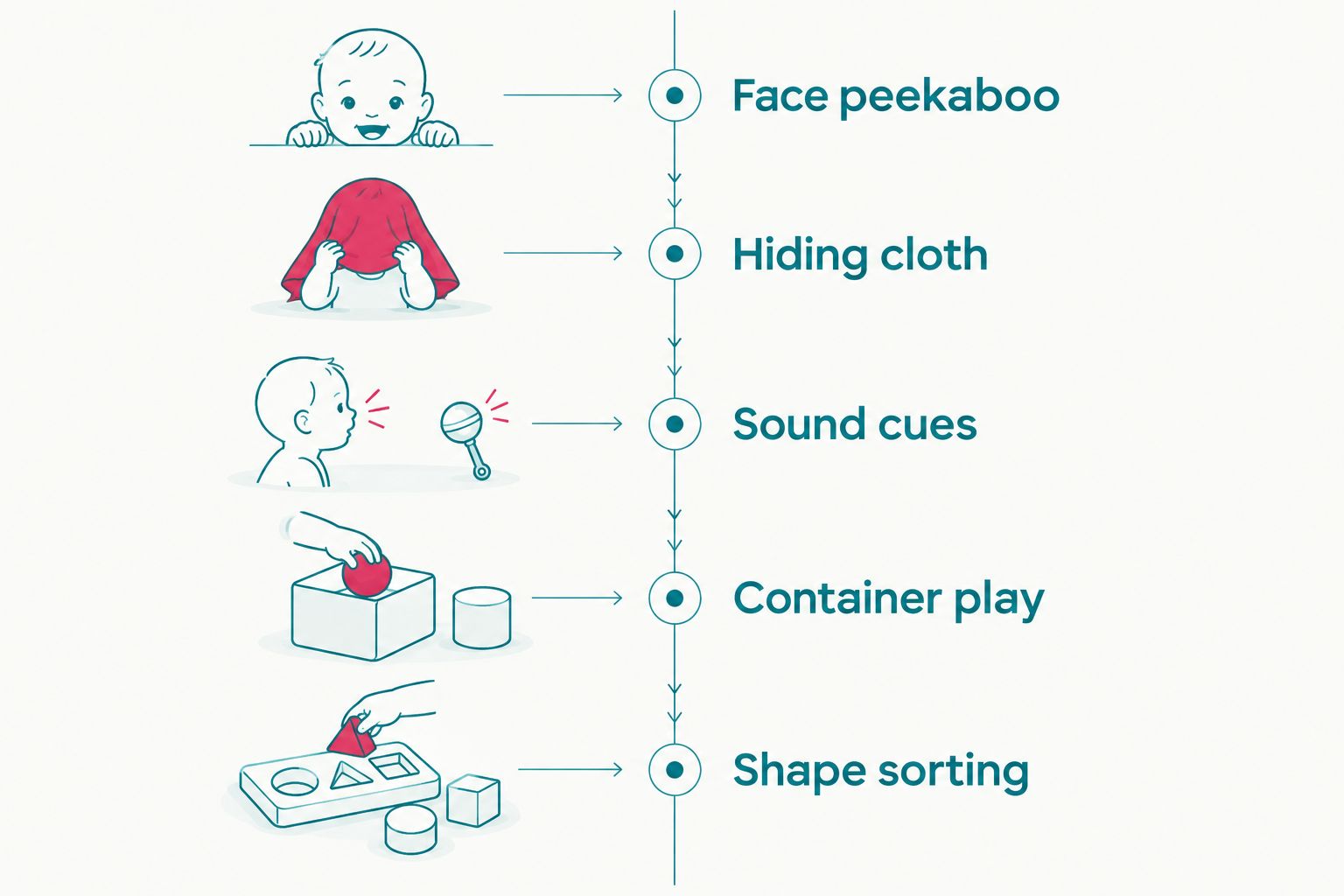
For most families, the useful order is peekaboo, cloth hiding, sound cues, containers and then posting toys. A baby who already uncovers objects confidently can begin farther along, while a baby who watches without reaching benefits from staying with the earlier games.


Habauk is best for UK parents comparing HABA wooden sound, sorting and stacking toys for object permanence play. The range supports several stages, but no single product replaces the free face-to-face and cloth games that establish the idea first.
Common mistakes parents make with object permanence play
Hiding the object completely on the first attempt
A fully covered object asks a baby to remember, search and uncover at once. Leave part of the toy visible until lifting the cloth becomes familiar, then gradually cover more of it.
Moving to shape sorting too early
Posting a shape requires hand control and matching as well as object permanence. If your baby watches the piece disappear but cannot retrieve it, open the sorter together and practise the reveal before returning to slot matching.
Treating the activity as a test
Repeatedly asking a baby to find an object can make a playful interaction feel demanding. Demonstrate, wait and accept looking or reaching as a response. The aim is shared discovery, not a correct answer.
Adding too many sounds and pieces
Several moving or noisy objects divide attention. One hidden toy gives a clear question and a clear answer: it disappeared here, and it can be found here.
Shopping by age label alone
Age guidance supports product selection, but it does not show what your baby can currently do. In 2026, readiness remains more useful than a calendar: begin with the hardest version your baby can enjoy without repeated adult correction.
FAQ
What are the best wooden toys for object permanence?
Sound blocks, loose-lid containers, nesting toys and simple shape sorters are the best wooden toy types for object permanence. Begin with sound or easy uncovering, then add posting and matching after the baby reliably searches for hidden objects.
At what age do babies understand object permanence?
Object permanence develops across the sensorimotor period rather than appearing on one birthday. Piaget’s framework places partial searching at 4-8 months, intentional searching at 8-12 months and more flexible searching at 12-18 months.
How do I play peekaboo with a wooden toy?
Show the wooden toy, cover part of it with a light cloth and let your baby pull the cloth away. Once that action is familiar, cover the toy completely or add a sound cue before the reveal.
Are sound toys useful for object permanence?
Sound toys are useful because they continue providing a clue after leaving sight. Habauk’s Fun with Sounds Wooden Discovery Blocks fit this stage, but the sound should accompany a visible hiding action rather than replace it.
Is a shape sorter an object permanence toy?
A shape sorter supports object permanence because a posted piece disappears inside the box and can be recovered. It is a later option because matching a shape to a slot adds another problem for the baby to solve.
Is peekaboo enough without buying a toy?
Yes, face-to-face peekaboo and a familiar object under a cloth provide a complete starting activity without a dedicated toy. Wooden toys become useful when you want to add sound, containers, nesting or posting actions.
How much do wooden object permanence toys cost in 2026?
Current prices vary by toy type and should be checked on the product listing. Face-to-face peekaboo and cloth hiding require no dedicated product, so they remain the best first step regardless of budget.
What should I do if my baby does not search for the hidden toy?
Make the activity easier by leaving more of the toy visible and placing it closer to the baby’s hands. Demonstrate lifting the cloth once, then pause rather than repeatedly directing the baby.
One last thing
A baby does not need to uncover the toy for the activity to count. Looking towards the hiding place, pausing when a sound stops or anticipating your face returning all show attention to the disappearance-and-return pattern.
That makes the best 2026 object permanence routine smaller than many parents expect: one familiar object, one easy hiding action and enough time for the baby to respond. Add the wooden toy when it makes that pattern clearer, not simply because it offers more pieces or a harder task.