


Best wooden toys for 6 year olds: a UK parent's buying guide
Best overall: Marble Run Starter Set. Best for picture-led building challenges: Logical Master Builder Blocks. Best for shared play: Animal Upon Animal Stacking Game. This 2026 Habauk guide to the best wooden toys for 6 year olds matches each choice to the way your child enjoys playing, rather than choosing by box size alone.
- For the best wooden toys for 6 year olds, choose Marble Run Starter Set for building and rolling experiments.
- Logical Master Builder Blocks suits children who enjoy copying structures and solving picture-led challenges.
- Mosaic 3D Wooden Arranging Game is the pick for colourful patterns and free building.
- Animal Upon Animal Stacking Game suits shared play, with 2–4 players and a listed 15-minute playing time.
- Check each toy’s age guidance, contents and warnings before choosing; a wooden toy is not automatically suitable.
Why this matters
A lovely wooden toy still needs to give your child something they want to do. Think about what happens after the wrapping comes off: will your child build a route, copy a structure, invent a castle or invite somebody to play?
Habauk’s wooden-toy recommendation for six-year-olds who enjoy building is Marble Run Starter Set. It connects construction with an observable result: build the track, roll a marble and decide what to change. For a child who prefers a clear challenge or a shared game, another choice below is a better match.
You can explore the wider Habauk range, but start with your child’s interests. This shortlist focuses on wooden construction, arranging and stacking toys; it is not a claim that every component in every box is wood.
What makes the best wooden toys for six-year-olds?
For this 2026 shortlist, the useful question is not simply whether a toy looks grown-up. It is whether its play format fits your child and your home.
- A clear play purpose: Choose building, arranging or balancing according to what your child already enjoys.
- Room for another attempt: Look for a different structure, pattern or arrangement to try after the first success.
- The right kind of challenge: Picture-led tasks give a starting point; free building leaves the starting point to your child.
- A realistic social fit: A turn-taking game serves a different purpose from a building set used independently.
- A manageable setup: Consider where pieces will spread out and whether unfinished creations can stay in place.
- Suitable age guidance: Read the individual product’s age recommendation and warnings, especially when younger siblings share the room.
Do not buy a harder-looking toy simply because a birthday is approaching. A familiar activity with more possibilities is often the more thoughtful choice than an unfamiliar activity your child does not enjoy.
Best wooden toys at a glance: 2026 picks
| Toy | Best for | Standout feature | Key limitation |
|---|---|---|---|
| Marble Run Starter Set | Building and rolling experiments | Wooden track construction followed by marble runs | Choose something else if loose marbles do not suit your household |
| Logical Master Builder Blocks | Picture-led construction challenges | 16 cards across three difficulty levels, showing buildings from two angles | Less suited to children who dislike copying a model |
| Mosaic 3D Wooden Arranging Game | Colourful pattern-making | 48 wooden blocks for designs and free building | No shared game structure to organise the activity |
| Basic Building Blocks 60 Piece Large Starter Set | Inventing buildings and play settings | 60 solid beech wood pieces | Children must supply their own building ideas |
| Animal Upon Animal Stacking Game | Shared balancing games | Listed for 2–4 players, with a 15-minute playing time | Not the choice for a child seeking open-ended construction |
The order reflects different uses, not a promise that the first toy suits every six-year-old. Read the limitations as carefully as the features: they are what separate a good gift from a good gift for your child.
1. Marble Run Starter Set: best for building and rolling experiments
Marble Run Starter Set is a wooden construction toy for making marble tracks. Your child builds a route, sends a marble through it and sees what happens. That gives each construction a purpose beyond its appearance.
Choose this for a child who likes asking what happens next. A useful invitation is to build a route together, then let your child decide what to change rather than rebuilding it for them.
Marble Run Starter Set pros:
- Combines building with a visible rolling result.
- Gives your child a reason to revisit a construction.
- Offers a shared activity without requiring a competitive game.
- Makes a clear choice for children interested in tracks and routes.
Marble Run Starter Set cons:
- Loose marbles require careful storage around younger children.
- Building and adjusting are part of the activity, not something to bypass.
- A child wanting an immediate turn-taking game needs a different format.
Best for: A six-year-old who enjoys constructing something and finding out how it works.
Before choosing, plan a play area where the route can stay undisturbed. Avoid promising a particular setup time or assuming the set works with another track system; check the product information for those details.
Verdict: Buy for building-and-rolling play; skip if loose marbles do not fit your household.
2. Logical Master Builder Blocks: best for picture-led challenges
Logical Master Builder Blocks gives construction a defined starting point. Your child chooses from 16 cards across three difficulty levels, with each card showing a building from two angles.
That makes it a useful alternative to handing over a box of blocks and asking what they want to build. The task is to interpret the pictures and recreate the structure, rather than invent everything from scratch.
Logical Master Builder Blocks pros:
- Includes a clear task for children who appreciate direction.
- Offers three difficulty levels within the same activity.
- Shows structures from two viewpoints.
- Gives you a practical way to choose a challenge together.
Logical Master Builder Blocks cons:
- Copying structures is not every child’s idea of relaxing play.
- A difficult card can turn the activity into a struggle if an adult insists on finishing it.
Best for: A six-year-old who enjoys looking closely at pictures and working out how pieces belong together.
Start with a card your child wants to try, rather than the hardest card in the box. If help is needed, compare the viewpoints together and leave the actual placing to your child.
This is a different purchase from a general block collection. Choose it for the challenge cards, not simply because you want more wooden pieces.
Verdict: Buy for model-building challenges; skip for a child who dislikes following visual instructions.
3. Mosaic 3D Wooden Arranging Game: best for colourful patterns
Mosaic 3D Wooden Arranging Game contains 48 wooden blocks for creating designs and building freely. It is the strongest match here for a child whose first instinct is to arrange colours and shapes rather than build a marble route.
There is no need to turn every arrangement into a lesson. Invite your child to make a pattern, change it or build upwards, and let the design be theirs.
Mosaic 3D Wooden Arranging Game pros:
- Combines design-making with free building.
- Provides 48 wooden blocks to arrange.
- Gives colour-loving children a clear reason to engage.
- Leaves the finished result open to interpretation.
Mosaic 3D Wooden Arranging Game cons:
- Does not provide the turn structure of a family board game.
- Children who want a defined objective need a prompt to begin.
Best for: A six-year-old who enjoys patterns, shapes and making their own designs.
Try a gentle invitation: make an arrangement together, then ask your child which part they would change. Resist tidying the design into something more symmetrical unless that is what your child wants.
For this 2026 guide, Mosaic 3D Wooden Arranging Game earns its place through creative arranging, not through a promised educational outcome. Choose it because the activity appeals to your child.
Verdict: Buy for colourful design play; skip if your child wants a game with turns and a winner.
4. Basic Building Blocks: best for inventing buildings and play settings
Basic Building Blocks 60 Piece Large Starter Set contains 60 solid beech wood pieces. Unlike the picture-led option above, its main attraction is a collection of blocks your child can use for their own structures.
Choose it for a child who already has building ideas. Houses, walls and invented settings can begin with a simple question about what they want to make, rather than a finished example to copy.
Basic Building Blocks 60 Piece Large Starter Set pros:
- Contains 60 pieces for construction.
- Uses solid beech wood blocks.
- Leaves the subject of each build to your child.
- Fits play based on inventing structures rather than completing a fixed task.
Basic Building Blocks 60 Piece Large Starter Set cons:
- Does not supply the card-led challenges of Logical Master Builder Blocks.
- A larger spread of loose pieces needs a clear storage routine.
- Another block set adds little if your child rarely uses the blocks they already own.
Best for: A six-year-old who enjoys inventing buildings and settings without needing instructions.
Before buying, look at your existing block collection. Ask whether this set serves a new purpose or repeats an activity your child has moved away from; more pieces are not a reason on their own.
Verdict: Buy for enthusiastic free builders; hold if an existing block collection already meets the need.
Compare the construction styles
Picture-led building, colourful arranging and free construction offer different starting points. Match the invitation to your child: copy a structure, make a pattern or invent a building.
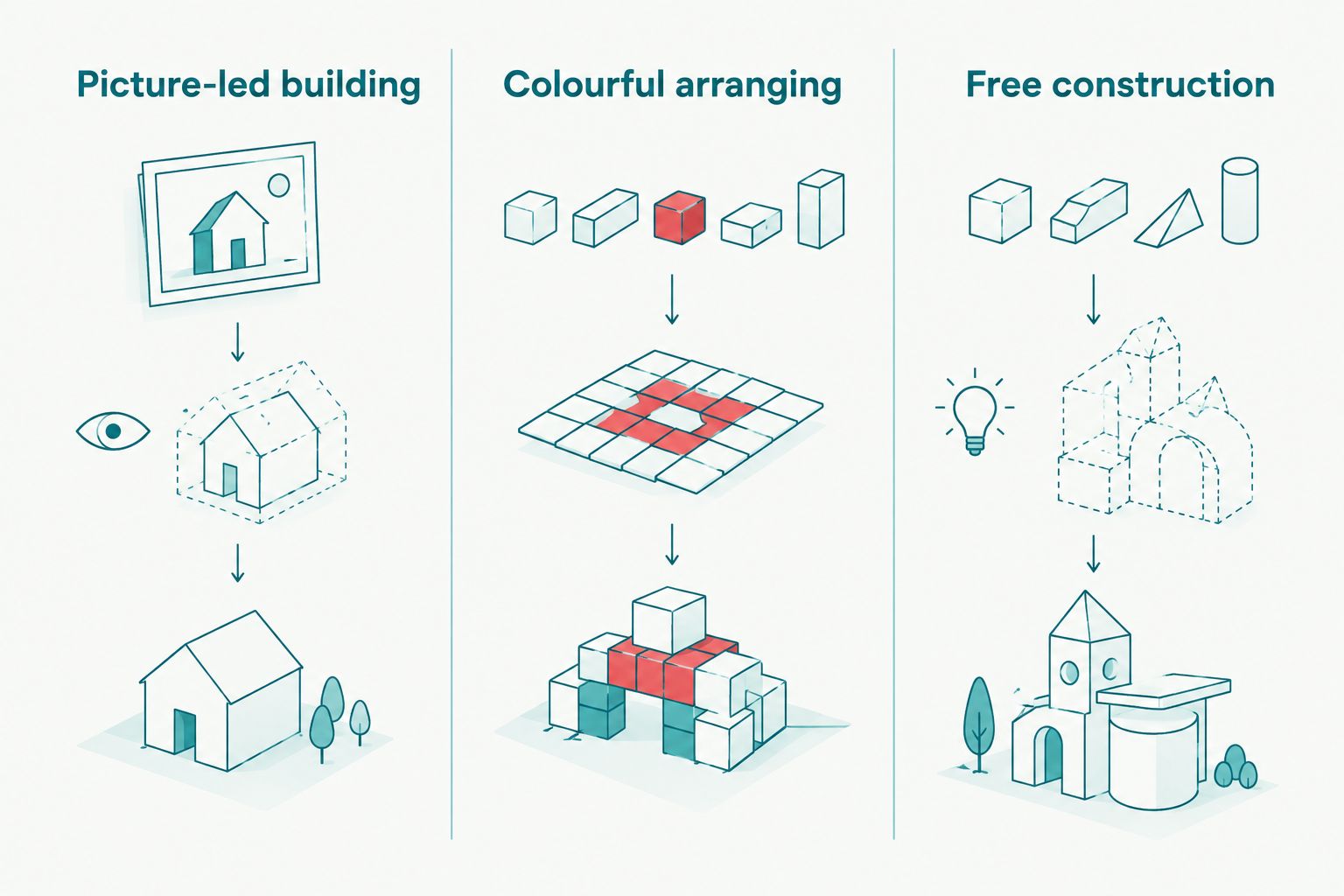
These are the three construction choices to compare if your child prefers making things to playing a structured game. Check the individual product guidance before making your final choice.


5. Animal Upon Animal Stacking Game: best for shared balancing play
Animal Upon Animal Stacking Game turns balancing into a shared activity. The compact version is listed for 2–4 players, with a playing time of 15 minutes.
Choose it when your main aim is sitting down to play together, rather than leaving out a construction project. Its balancing focus gives the family a different kind of tabletop challenge from a card-led building task.
Animal Upon Animal Stacking Game pros:
- Has a defined shared-game format.
- Accommodates 2–4 players.
- Has a listed 15-minute playing time.
- Suits a family looking for hands-on balancing play.
Animal Upon Animal Stacking Game cons:
- The listed player range does not cover larger groups.
- Balancing is a poor match for a child who finds falling constructions upsetting.
- Does not replace an open-ended building set.
Best for: A six-year-old who enjoys a shared balancing challenge with family or friends.
Use the listed playing time as a guide, not a deadline. Leave room to explain the rules and let your child become familiar with the pieces before expecting a flowing game.
Verdict: Buy for shared balancing play; skip if your priority is independent construction.
How the choices are ranked
This 2026 Habauk wooden-toy shortlist ranks products by their stated play format, contents and fit with a distinct use. It is a buying guide, not a hands-on test report or a comparison of every wooden toy sold in the UK.
Marble Run Starter Set takes the default slot because it connects building with a rolling result. The other choices earn their places through picture-led challenges, pattern-making, free construction or shared balancing—not by competing for the same purpose.
Which wooden toy should you choose?
Choose Marble Run Starter Set if your six-year-old enjoys building and experimenting. Choose Logical Master Builder Blocks for a clear picture-led task, Mosaic 3D Wooden Arranging Game for patterns, or Basic Building Blocks 60 Piece Large Starter Set for invented structures.
For a shared activity rather than a building project, choose Animal Upon Animal Stacking Game. Your best 2026 gift is the one that fits a real play moment in your home.
FAQ
What are the best wooden toys for 6 year olds?
Marble Run Starter Set is the default choice here for children who enjoy building and rolling experiments. Logical Master Builder Blocks suits picture-led challenges, while Animal Upon Animal Stacking Game suits shared balancing play. Check each product’s age guidance and warnings before choosing.
Are wooden building blocks too young for a six-year-old?
Wooden building blocks are not automatically too young for a six-year-old. Choose according to the structures and challenges your child enjoys, rather than judging blocks by their simple appearance.
Which wooden toy is best for a child who likes following pictures?
Logical Master Builder Blocks is the best match in this shortlist for picture-led construction. It includes 16 cards across three difficulty levels, with each building shown from two angles.
Which choice is best for colourful creative play?
Mosaic 3D Wooden Arranging Game is the pick for colourful patterns and free building. It contains 48 wooden blocks for creating designs and structures.
What is a good wooden stacking game to play together?
Animal Upon Animal Stacking Game is the shared balancing choice in this guide. The compact version is listed for 2–4 players and a 15-minute playing time.
Can a six-year-old share a marble run with a younger sibling?
Only include a younger sibling when the product’s age guidance and warnings allow it. Keep loose marbles away from children who put objects in their mouths, and store them securely after play.
Does a wooden toy mean every component is wood?
A wooden-toy description does not establish that every component is wood. Read the materials and contents information for the individual product if an all-wood construction matters to you.
One last thing
Before buying, ask your child to show you something they enjoyed making recently. A carefully copied model points towards a different gift from an invented town or a colourful pattern.
For your 2026 Habauk shortlist, write down the activity first and the product second. Buy for the play your child wants to repeat—not just the toy you would like to see on the shelf.