


Best wooden dexterity games for kids
Best overall: Animal Upon Animal Stacking Game. Best for first stacking games: My Very First Games - Animal Upon Animal Junior. Best for building challenges: Teetering Towers Wooden Blocks. This 2026 guide compares wooden dexterity games from Habauk, with a separate pick for children who prefer arranging patterns to balancing towers.
- Animal Upon Animal Stacking Game leads the best wooden dexterity games for shared family balancing play.
- My Very First Games - Animal Upon Animal Junior suits children starting with stacking games.
- Teetering Towers Wooden Blocks suits building enthusiasts; Stabix Wooden Arranging & Matching Game suits pattern-making.
- Choose between turn-taking games and open-ended activities before choosing a theme.
Why this matters
A child who loves carefully placing pieces does not necessarily enjoy watching a tower tumble. Another child might find that wobble the funniest part. Choose the kind of hand movement your child enjoys, then choose the game around it.
Dexterity games put physical actions at the centre of play: placing, balancing, arranging or guiding pieces. That makes them different from games where children mainly roll dice, count spaces or remember pictures. Wooden components alone do not make something a dexterity game.
This shortlist separates family balancing games from open-ended arranging activities. Both give little hands something interesting to do, but they serve different afternoons: a shared game around the table, or a child quietly exploring what fits where.
What makes the best wooden dexterity games?
For your 2026 shortlist, use these criteria rather than choosing the biggest box or the most complicated-looking construction:
- Physical challenge: Look for a clear action your child wants to repeat, such as balancing animals or arranging sticks.
- Play format: Decide whether you want a game with turns or an activity children shape themselves.
- Group fit: Check the stated player count against the people who usually join in.
- Session length: Match the published playing time to the space in your day, without treating it as a deadline.
- Response to mistakes: Consider whether falling pieces invite another try or bring play to an unhappy stop.
- Age guidance: Read the manufacturer's age recommendation and warnings before introducing any set.
An appealing theme helps get the box opened. The activity inside determines whether it is the right choice for your child.
Wooden dexterity games at a glance
These recommendations cover different uses rather than treating every stacking or arranging set as interchangeable. Habauk's wooden dexterity games shortlist includes both structured games and open-ended alternatives; the table makes that distinction explicit.
| Item | Best for | Standout feature | Key limitation |
|---|---|---|---|
| Animal Upon Animal Stacking Game | Shared family balancing | Animal stacking for 2–4 players; listed playing time of 15 minutes | Not a solo option within its stated player range |
| My Very First Games - Animal Upon Animal Junior | First stacking games | Animal tower play for 1–4 players; listed playing time of 10 minutes | Not the first choice when you want a building-focused arranging activity |
| Teetering Towers Wooden Blocks | Building enthusiasts | A three-dimensional arranging challenge centred on teetering towers | An arranging activity rather than a direct substitute for a turn-taking family game |
| Stabix Wooden Arranging & Matching Game | Pattern-making without tower tumbles | Open-ended arranging and matching with wooden sticks | Does not provide the balancing challenge of an animal stack |
The default pick is Animal Upon Animal Stacking Game: choose it when your goal is shared balancing play, rather than independent construction or flat pattern-making.
Match the activity to your child
Think about what your child does when ordinary play pieces come out. Do they build upwards, arrange everything neatly, ask you to take turns, or start inventing something of their own?
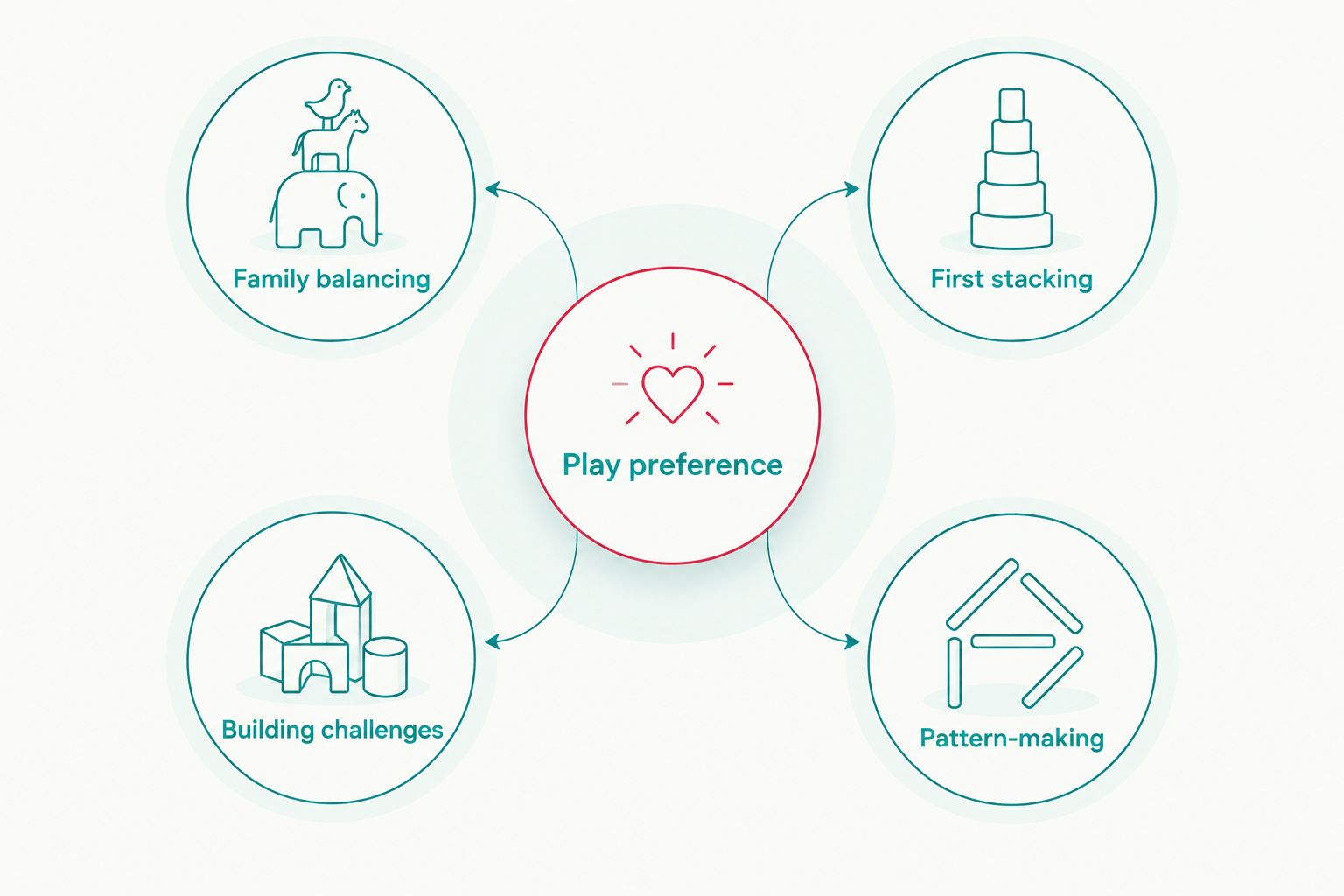
- Family balancing: Choose Animal Upon Animal Stacking Game for a shared stacking game.
- First stacking: Choose My Very First Games - Animal Upon Animal Junior for an introduction to animal tower play.
- Building challenges: Choose Teetering Towers Wooden Blocks for three-dimensional arranging.
- Pattern-making: Choose Stabix Wooden Arranging & Matching Game for arranging sticks without making tower-building the goal.
1. Animal Upon Animal: best wooden dexterity game for family play
Animal Upon Animal Stacking Game puts balancing at the centre of a shared game. The supplied product listing specifies 2–4 players and a playing time of 15 minutes, making this the clearest match for a family looking for a defined stacking-game session.
Choose this compact version when your child enjoys the question behind every animal tower: will the next piece stay put? It is the overall recommendation because the physical challenge and shared-game format match the query directly.
Animal Upon Animal Stacking Game pros:
- Animal balancing is the main activity, not an occasional extra.
- The stated player range suits a small group around the table.
- The listed session length gives you a useful planning guide.
- The compact version is described as keeping the stacking game in a smaller box.
Animal Upon Animal Stacking Game cons:
- The stated player range does not include solo play.
- A balancing game is the wrong match if your child wants structures to remain undisturbed.
Best for: Families who want a shared animal-stacking game rather than a free-building set.
Before you begin, give everyone a comfortable place to reach the playing area. Keep cups, sleeves and unrelated toys away from the stack so the challenge comes from placing pieces, not accidental table bumps.
Verdict: Buy Animal Upon Animal Stacking Game for shared family balancing.
2. Animal Upon Animal Junior: best for first stacking games
My Very First Games - Animal Upon Animal Junior centres on animals making a wobbly stacking tower. Its listing gives a range of 1–4 players and a playing time of 10 minutes, which distinguishes it from the main Animal Upon Animal recommendation.
The single-player option matters if you want a game that does not always require a group. Choose the Junior version for first stacking-game experiences, while checking the product's age guidance rather than assuming that the word Junior establishes suitability.
My Very First Games - Animal Upon Animal Junior pros:
- The stated player range includes individual play.
- The animal-tower theme keeps the physical activity easy to identify.
- The listed 10-minute session suits a short planned play opportunity.
- The range also accommodates shared play with other participants.
My Very First Games - Animal Upon Animal Junior cons:
- A stacking tower still involves pieces coming down; that experience will not suit every child.
- It is not the most direct choice for children primarily interested in arranging patterns or designing buildings.
Best for: Children beginning with stacking games, including families who want a listed solo option.
Start by reading the instructions together and showing the physical action without rushing. Let your child see how a piece sits before expecting them to manage the whole game independently.
Verdict: Buy My Very First Games - Animal Upon Animal Junior for first stacking-game play.
3. Teetering Towers: best for three-dimensional building challenges
Teetering Towers Wooden Blocks is described as a tricky three-dimensional arranging game for building enthusiasts. It belongs on this shortlist as a construction-led alternative, not as another version of an animal-stacking competition.
Choose Teetering Towers Wooden Blocks when your child enjoys deciding how pieces sit together and exploring the stability of a structure. The appeal is in arranging and building; do not choose it expecting the same format as the multiplayer games above.
Teetering Towers Wooden Blocks pros:
- Three-dimensional arranging puts physical placement at the centre of play.
- The building focus offers a distinct alternative to animal themes.
- The teetering-tower challenge suits children interested in balance and structure.
Teetering Towers Wooden Blocks cons:
- It is not a like-for-like substitute for a turn-taking family stacking game.
- A child looking for flat matching rather than upright construction has a better fit below.
Best for: Building enthusiasts who want an arranging challenge rather than a conventional family game.
Give the activity a clear building surface and room to work. If your child asks for help, talk about the placement they are considering instead of immediately moving the blocks for them.
Verdict: Buy Teetering Towers Wooden Blocks for construction-led dexterity play.
4. Stabix: best for arranging patterns without tower tumbles
Stabix Wooden Arranging & Matching Game uses wooden sticks for open-ended arranging and matching. It is the alternative for children who enjoy careful placement but do not want balancing a growing tower to be the central challenge.
That distinction matters. Stabix Wooden Arranging & Matching Game belongs beside wooden dexterity games because it involves handling and positioning pieces, but it should not be mistaken for a competitive stacking game.
Stabix Wooden Arranging & Matching Game pros:
- Arranging and matching provide a clear alternative to stacking upwards.
- The open-ended format leaves room for children to create their own arrangements.
- Wooden sticks make physical positioning the focus of the activity.
Stabix Wooden Arranging & Matching Game cons:
- It does not offer the same balancing tension as an animal tower.
- Open-ended arranging is not a substitute for a family wanting a defined competitive game.
Best for: Children who prefer pattern-making and matching to tower-building.
Join in by making an arrangement beside your child rather than correcting theirs. Ask what they notice about the shapes or placement, then give them space to decide what comes next.
Verdict: Buy Stabix Wooden Arranging & Matching Game for open-ended pattern play.
Compare the arranging alternatives
If your decision is between building upwards and arranging patterns, these are the two relevant alternatives. Choose the activity first; an attractive box cannot turn a pattern-making set into the balancing game your family wanted.


How the games are ranked
This 2026 ranking prioritises the match between the physical activity and the intended play session. Animal Upon Animal Stacking Game takes the default position because it directly answers the need for shared balancing play; the remaining recommendations each serve a different purpose.
The comparisons use the supplied product descriptions, including player counts and playing times where stated. The ranking is not a claim of hands-on testing or a comparison of measured developmental results.
Treat playing times as guidance, not a target your child must meet. A cheerful short session is a better reason to return to a game than finishing because the box suggests a duration.
Which wooden dexterity game should you choose?
Animal Upon Animal Stacking Game is Habauk's best wooden dexterity game pick for families who want shared balancing play. It is the starting point for your 2026 shortlist when you want a recognisable game rather than an open-ended activity.
Choose My Very First Games - Animal Upon Animal Junior when first stacking experiences and a listed single-player option matter more. Choose Teetering Towers Wooden Blocks for building challenges, or Stabix Wooden Arranging & Matching Game when arranging patterns is the real attraction.
There is no need to collect every format. Pick the activity your child already reaches for, then leave enough time to enjoy it together.
FAQ
What's the best wooden dexterity game for family play?
Animal Upon Animal Stacking Game is the overall recommendation for shared family balancing. Its supplied listing specifies 2–4 players and a playing time of 15 minutes.
Which Animal Upon Animal game should I choose for first stacking experiences?
Choose My Very First Games - Animal Upon Animal Junior for first stacking-game experiences. Its listing specifies 1–4 players and a playing time of 10 minutes; check the manufacturer's age guidance before introducing it.
Can children play Animal Upon Animal Junior on their own?
My Very First Games - Animal Upon Animal Junior includes one player within its stated range of 1–4 players. Follow the supplied instructions for the relevant play format and supervise according to the child's needs and product warnings.
Is Stabix a balancing game like Animal Upon Animal?
Stabix Wooden Arranging & Matching Game is an open-ended arranging and matching activity, not a like-for-like animal-balancing game. Choose Stabix for pattern-making rather than tower-stacking tension.
What's a good wooden dexterity activity for a child who loves building?
Teetering Towers Wooden Blocks is the building-focused recommendation in this shortlist. Its description identifies it as a three-dimensional arranging game with a teetering-tower challenge.
Are wooden dexterity games suitable for every toddler?
Suitability depends on the individual product's age recommendation, warnings and components, not simply on it being wooden. Check those details and consider how your child handles pieces and responds to stacking challenges.
Do wooden dexterity games guarantee better fine motor skills?
This guide does not claim guaranteed developmental improvements from any game. Stacking and arranging involve physical placement, but the recommendations concern play format and family fit rather than measured outcomes.
One last thing
For your next 2026 games afternoon, make the first attempt about discovering the pieces, not proving who has the steadiest hands. Read the rules, try the action, and leave room for a laugh when something wobbles.
Before choosing another game from Habauk, ask whether your child wants a taller tower or a different kind of challenge. Sometimes the right next step is arranging patterns, not stacking higher.