


Best wooden toy storage boxes for playrooms
Best overall: shallow, open-top wooden toy boxes. Best for separating play sets: divided wooden boxes. Best for bulky toys: a purpose-built wooden toy chest. This 2026 guide compares storage styles rather than named products, helping you choose a box around the toys your family actually uses.
- The best wooden toy storage boxes keep everyday toys visible, reachable and easy to put away.
- For Habauk wooden toys, shallow open-top boxes are the best starting point for everyday playroom storage.
- Choose divided boxes for loose pieces, low drawers for concealed storage, and toy chests for bulky toys.
- Check construction, lid mechanisms, furniture stability and the manufacturer's instructions before choosing any wooden storage box.
Why this matters
A tidy playroom should still invite a little adventure. If finding an animal means emptying a deep chest, the storage is getting between your child and their play.
When organising wooden toys and games from Habauk, start with how you use them: loose building pieces, complete games and pretend-play accessories need different homes. Choose the storage shape before choosing its finish.
The best wooden toy storage boxes in 2026 are not automatically the biggest. Your everyday box needs to make choosing, carrying and returning toys manageable; occasional-use storage has a different job.
What makes the best wooden toy storage boxes?
Use these criteria before comparing styles. A box that misses a basic safety or access requirement does not earn its place because it looks lovely.
- Safe construction: Check for rough edges, loose fixings, damaged panels and accessible trapping points. Follow the manufacturer's age and use instructions.
- Easy access: Your child should be able to see and retrieve everyday toys without climbing, reaching into a deep container or moving heavy furniture.
- Useful separation: Keep complete games together and give loose pieces a clear home. Compartments help only when the toys fit them.
- Practical handling: Check the empty weight, handles and intended use. A wooden box becomes heavier when filled with wooden toys.
- Room fit: Measure the actual storage space, including skirting boards, drawer travel and any clearance needed above a lid.
- Simple upkeep: Choose surfaces and corners you can inspect and clean according to the maker's instructions.
Wooden toy storage boxes at a glance
These 2026 recommendations rank storage formats by their job in a playroom, not by unverified product claims. Check the details of the individual box before buying.
| Rank and storage style | Best for | Standout feature | Key limitation |
|---|---|---|---|
| 1. Shallow open-top wooden box | Everyday toy access | Contents stay visible without opening a lid | Leaves toys on show |
| 2. Divided wooden box | Separating loose pieces | Compartments give different pieces their own spaces | Fixed divisions restrict larger toys |
| 3. Low wooden drawer box | Concealed storage | A pull-out compartment hides everyday clutter | Needs clear space in front |
| 4. Purpose-built wooden toy chest | Bulky playthings | A large interior accommodates awkward shapes | Deep storage makes small pieces harder to find |
| 5. Stackable wooden boxes | Adult-managed toy rotation | Separate containers keep stored categories apart | Stacking adds handling and stability checks |
1. Shallow open-top box: best for everyday toy access
A shallow open-top wooden box keeps its contents visible and removes the need to lift a lid. Choose a format that lets your child recognise the toys inside without digging through several layers.
Best for: Toys your child chooses independently during everyday play.
This is the default recommendation for Habauk wooden toy storage: a clear view of the contents makes choosing a starting point straightforward. Keep each box focused on a recognisable category, such as building pieces or animal figures.
Shallow open-top box pros:
- No lid to lift or hold while choosing toys.
- Contents are easier to scan than in a deep chest.
- A defined category gives tidying a clear destination.
Shallow open-top box cons:
- Toys remain visible when playtime finishes.
- Broad, shallow boxes use more floor or shelf area than narrow containers.
Check reach as well as depth. A low box tucked far beneath furniture still asks your child to stretch awkwardly, and an overflowing box loses the visibility that makes this format useful.
Verdict: Buy a shallow open-top box for your main everyday toy category.
2. Divided wooden box: best for separating loose pieces
A divided wooden box gives different types of pieces separate compartments. It suits collections where sorting matters more than accommodating large objects.
Best for: Pretend-play accessories, building components and other loose pieces that benefit from separation.
Make the compartments match the way your child plays. If every small accessory gets its own tiny section, tidying becomes a sorting exercise rather than a quick finish to playtime.
Divided wooden box pros:
- Different categories can stay separate inside the same container.
- Loose pieces are easier to inspect without emptying everything.
- Compartments provide clear places to return familiar items.
Divided wooden box cons:
- Fixed partitions exclude toys that are wider than a compartment.
- Too many small sections make putting things away fiddly.
Keep complete games together rather than distributing their pieces by colour or shape. Otherwise, the storage looks organised while the next game starts with a hunt.
For a mixed-age playroom, compartments are not a safety barrier. Store small pieces away from younger children according to the toy's warnings and age guidance.
Verdict: Buy a divided wooden box when keeping pieces separate solves a real problem.
3. Low wooden drawer box: best for concealed storage
A low wooden drawer box offers a home for toys you prefer not to leave on display. It works beneath suitable furniture or within a storage unit designed for the drawer.
Best for: Shared living spaces where you want toys tucked away between play sessions.
Check the drawer's full movement before deciding where it belongs. A box that fits beneath a shelf still needs enough clear space to pull out and reach the contents.
Low wooden drawer box pros:
- Conceals toys without requiring a top-opening chest.
- Makes use of a suitable low storage space.
- Offers a distinct home for a complete play category.
Low wooden drawer box cons:
- Requires clear floor space in front during use.
- Contents are hidden until someone opens the drawer.
Follow the maker's instructions for runners, stops, loading and furniture attachment. Do not improvise a child-accessible drawer by placing a heavy wooden crate on unsuitable wheels or fittings.
If floor space is tight, the guide to storing wooden toys in a small flat offers a useful next step for planning the wider room.
Verdict: Buy a low drawer box when concealed storage matters and the opening space works.
4. Wooden toy chest: best for bulky playthings
A purpose-built wooden toy chest provides a broad interior for larger toys. Treat it as storage for bulky items, not as the automatic destination for every loose piece.
Best for: Larger pretend-play props and other awkwardly shaped playthings.
A chest needs closer attention to its lid and access arrangements than an open box. Check the manufacturer's safety information, intended use and any lid-support mechanism; do not assume a decorative trunk is suitable for children's toy storage.
Wooden toy chest pros:
- An undivided interior accommodates a range of larger shapes.
- Keeps a bulky toy category in a defined place.
- Provides concealed storage when designed with a lid.
Wooden toy chest cons:
- Small pieces disappear beneath larger objects.
- Lid mechanisms and fittings need inspection and maintenance.
Do not treat the lid as a seat unless the maker explicitly permits seating. Keep the chest away from positions where climbing onto it would give access to windows or other hazards.
Verdict: Buy a purpose-built toy chest for bulky toys; skip it for loose game pieces.
5. Stackable wooden boxes: best for adult-managed rotation
Stackable wooden boxes keep stored toy categories in separate containers. Choose boxes explicitly designed to stack, and follow their loading and placement instructions.
Best for: Toys an adult brings out and puts away as part of a rotation.
Stacked storage is different from independent access. Put the current play selection somewhere accessible rather than expecting your child to lift loaded boxes off a pile.
Stackable wooden boxes pros:
- Separate containers keep stored categories together.
- You can bring out a selected category without mixing the rest.
- Matching formats simplify planning a storage area.
Stackable wooden boxes cons:
- Reaching a lower box requires moving the boxes above it.
- Stability and loaded weight need careful attention.
Avoid building a climbable tower in the play area. Where boxes sit within furniture, follow the furniture manufacturer's anchoring instructions as well as the box maker's guidance.
Verdict: Buy stackable boxes for adult-managed storage, not a child's daily access point.
Match the box to the toys before measuring the room
Start your 2026 playroom refresh with the toys on the floor, not a storage photograph. Group them by how they are used, then check what each group needs to stay complete.
Piece count alone does not tell you which box fits. Habauk's wooden building sets include the Colored Wooden Building Blocks - 46 Piece Set, the Colored Wooden Building Blocks - 85 Piece Set and the Basic Building Blocks 102 Piece Extra Large Wooden Starter Set. Those counts describe the sets, not the storage capacity they require.
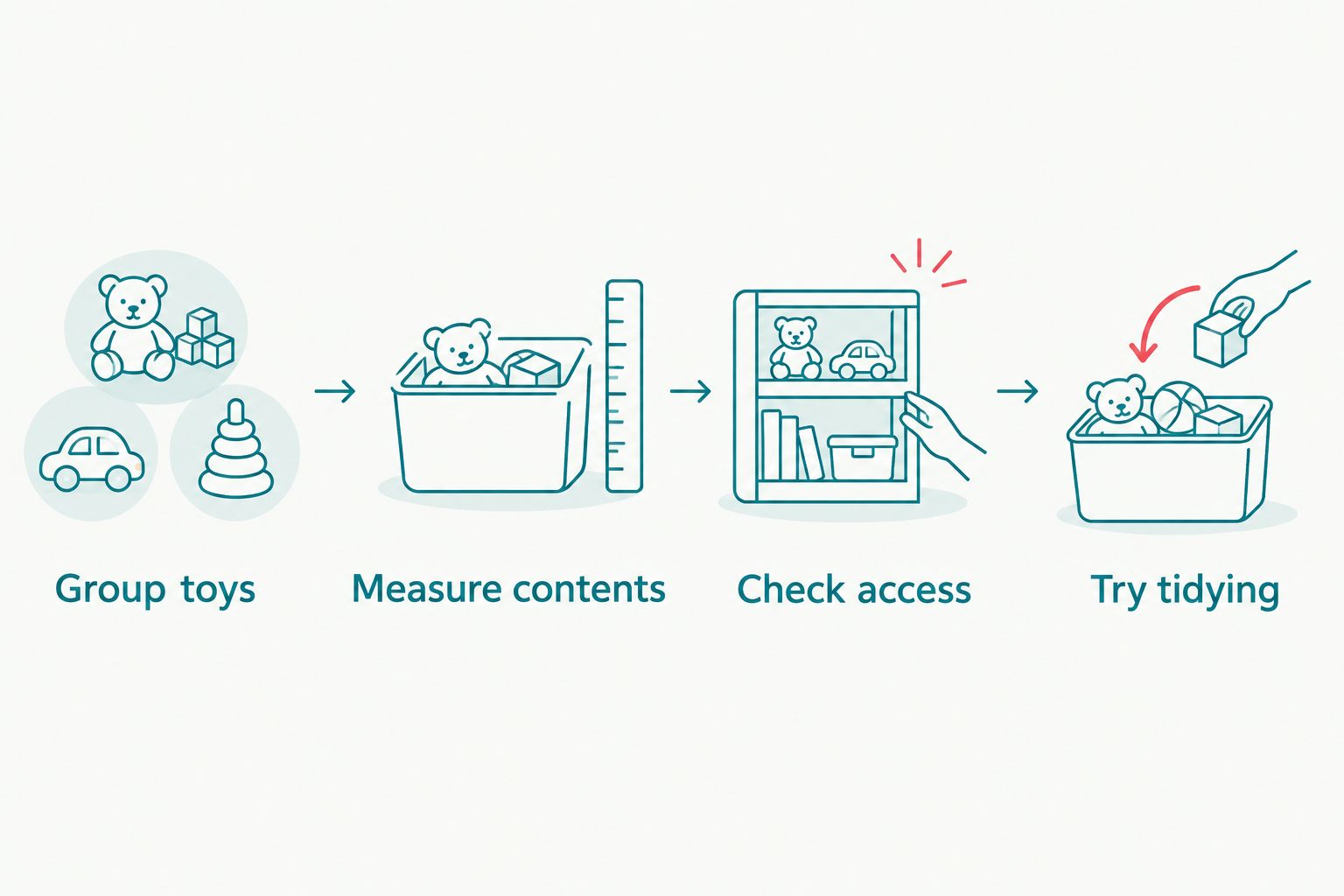
Use this sequence before choosing dimensions:
- Group toys: Separate complete games, loose construction pieces and bulky props.
- Measure contents: Check the longest pieces and the space the complete group occupies.
- Check access: Allow for reaching, lifting, drawer movement or lid opening.
- Try tidying: Rehearse returning the toys using a container you already own.
For games, retain the instructions and packaging where these help keep everything together. A tidy box of mixed components is less useful than a complete game ready for your next family afternoon.
How these storage styles are ranked
The ranking prioritises everyday access, useful separation, practical handling and room fit. Shallow open-top boxes take first place because they avoid both concealed contents and a lid; the other formats win when you need a more specific storage job.
This is a format comparison, not a product test or a safety certification. Judge the construction and instructions of the actual box separately from its style.
Which wooden toy storage box should you choose?
Choose a shallow open-top wooden box unless you have a clear reason to hide, divide or rotate its contents. It gives everyday toys a visible home without introducing a drawer or lid.
For your 2026 shortlist, choose divided storage for loose accessories, a drawer for a shared room, a chest for bulky toys, or stackable boxes for adult-managed rotation. You do not need every format; start with the category that causes the most searching at playtime.
FAQ
What's the best wooden toy storage box for a playroom?
A shallow open-top wooden box is the best starting point for everyday playroom storage. It keeps toys visible without requiring your child to open a lid; check the actual box's construction and instructions before choosing it.
Is a wooden toy chest better than open toy boxes?
A wooden toy chest suits bulky toys, while shallow open boxes suit everyday access. Choose around the contents rather than expecting a deep chest to organise small game pieces.
Should a toddler's wooden toy box have a lid?
A lid is not necessary for a toddler's everyday toy storage. If you choose a lidded box, check its intended use, lid mechanism and safety instructions rather than assuming any wooden trunk is suitable.
How do I choose the right size wooden toy box?
Measure the actual toy group, including its longest pieces, before choosing a box. Then check the space needed to reach inside, open the lid or pull out a drawer.
Can I keep wooden board games in a divided storage box?
Keep each board game's components and instructions together. Use divided storage only when the compartments accommodate complete sets without scattering their pieces across different boxes.
Are stackable wooden boxes suitable for children to access?
Treat stacked boxes as adult-managed storage unless the manufacturer explicitly supports the intended child-accessible arrangement. Follow stacking and loading instructions, and keep everyday toys in a separate accessible position.
What should I check when buying a second-hand wooden toy box?
Check for damage, rough edges, loose fittings and problems with lids or drawers. Identify the model and obtain its instructions and safety information; skip a box whose construction or intended use you cannot establish.
One last thing
Practise putting the toys away before buying their new home. If you need to arrange every piece just so to close the container, choose a less demanding format.
For a Habauk wooden toy collection, the useful finishing touch is not another compartment: it is keeping the pieces needed for the next game together. Make room for an easy restart, not just a tidy finish.