


Best eco-friendly wooden toys for kids
Best overall: Basic Building Blocks 60 Piece Large Starter Set. Best for first cooperative games: My Very First Games - First Orchard. Best for compact family play: Animal Upon Animal Stacking Game. This 2026 guide to the best eco-friendly wooden toys at Habauk puts play value first and separates material facts from environmental claims.
- The best eco-friendly wooden toys need material evidence, not just a wooden appearance.
- Habauk wooden toys: choose Basic Building Blocks 60 Piece Large Starter Set for open-ended building.
- My Very First Games - First Orchard is the pick for introducing cooperative play with chunky wooden pieces.
- Animal Upon Animal Stacking Game suits families wanting a compact balancing game.
- Check sourcing, finishes, age guidance and care instructions before treating any wooden toy as an environmental choice.
Why this matters
A wooden toy is not automatically an eco-friendly toy. Timber sourcing, other materials, finishes, packaging and how long you keep using it all belong in the decision; a product name alone does not establish its environmental credentials.
Choose a toy your child wants to revisit, then check the evidence behind its environmental claims. This shortlist ranks the supplied product features for different kinds of play, not carbon footprints or sustainability certifications. None of the recommendations should be read as proof of a lower environmental impact.
What makes the best eco-friendly wooden toys?
For your 2026 shortlist, use these criteria before choosing a favourite:
- Material clarity: Look for a stated wood type and details of any plastic, fabric or metal components.
- Sourcing evidence: Ask for product-specific evidence behind claims about responsibly sourced timber. Do not infer certification from the brand or material.
- Repeat play: Choose building, arranging or game activities that match something your child already enjoys.
- Age suitability: Follow the individual product's age guidance and warnings, including restrictions concerning small parts.
- Care and completeness: Check cleaning instructions and decide how you will keep the pieces together.
- Household fit: Consider the space, noise and adult involvement the activity needs, not just its appearance on a shelf.
These criteria work together. A beautifully presented building set is the wrong choice if your child wants shared games and you have nowhere to leave a construction standing.
Best wooden toys at a glance
The order below follows the full recommendations. Each toy has a different best-for role, so you can choose by the play you want rather than treating every entry as a direct substitute.
| Toy | Best for | Standout feature | Key limitation |
|---|---|---|---|
| Basic Building Blocks 60 Piece Large Starter Set | Open-ended construction | 60 solid beech wood pieces | Loose pieces need a storage plan |
| My Very First Games - First Orchard | First cooperative games | Chunky wooden pieces for toddlers | A game-led choice rather than a construction set |
| Animal Upon Animal Stacking Game | Compact family balancing games | Smaller-box stacking game for 2–4 players | Balancing is not a match for every child's interests |
| Underwater World Wooden Shape Sorter | Matching shapes | Five sea creature blocks with matching slots | More directed than free building |
| Mosaic 3D Wooden Arranging Game | Pattern-making and arranging | 48 wooden blocks | Loose blocks need keeping together |
| Fun with Sounds Wooden Eggs | Sound exploration | Wooden eggs for shaking and rattling | Not a quiet-time choice |
1. Basic Building Blocks 60 Piece Large Starter Set: best for building
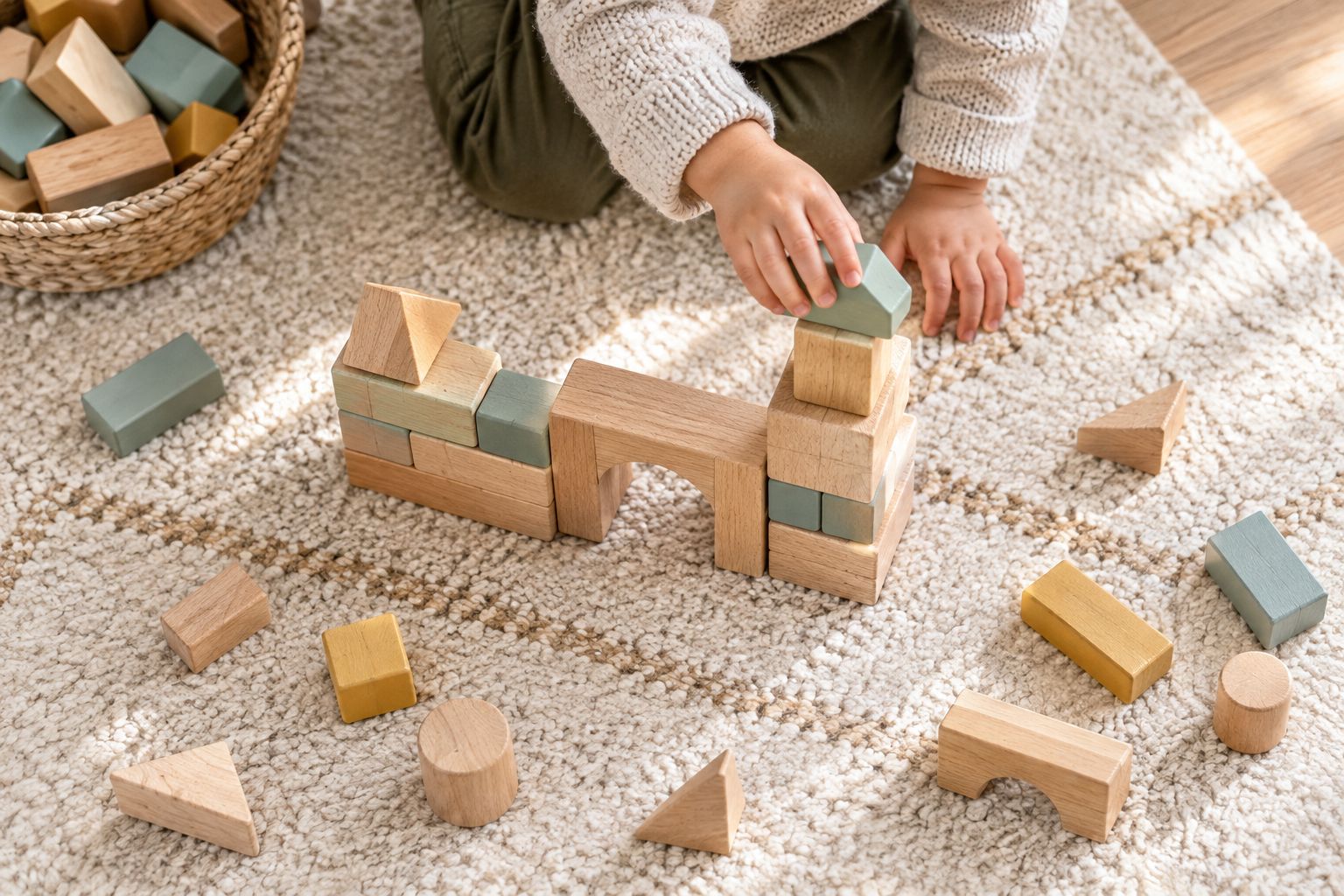
Basic Building Blocks 60 Piece Large Starter Set is the default choice for a child who enjoys making things without following a game. The set contains 60 pieces made from solid beech wood, giving you a clearly stated material rather than a vague wooden-toy label.
Start with whatever captures your child's interest: a low wall, a pretend home or a line of blocks. You do not need to set a finished design as the goal; rearranging the pieces is part of the activity.
Basic Building Blocks 60 Piece Large Starter Set pros:
- Solid beech wood is explicitly stated in the product description.
- Loose blocks support child-chosen constructions.
- The same pieces can become different structures each time.
Basic Building Blocks 60 Piece Large Starter Set cons:
- A 60-piece set needs somewhere to gather the blocks afterwards.
- It does not provide the shared objective of a cooperative board game.
Best for: Children who choose construction and imaginative building over rule-led play.
Verdict: Buy for open-ended building; check the product's age guidance before choosing it as a gift.
A simple building invitation is enough: leave a few generic blocks on a clear floor and keep the rest within reach. Let your child decide whether the next piece belongs on top, beside the structure or somewhere completely new.
2. My Very First Games - First Orchard: best for cooperative play
My Very First Games - First Orchard introduces toddlers to cooperative gameplay with chunky wooden pieces that are easy to grasp. Choose it when you want to sit together and share an activity rather than leave out a building invitation.
The distinction matters. A first game gives your play a shared structure; a loose block set lets your child decide what happens next.
My Very First Games - First Orchard pros:
- Cooperative gameplay makes working together the focus.
- Chunky wooden pieces are described as easy to grasp.
- The product is specifically presented as an introduction to games for toddlers.
My Very First Games - First Orchard cons:
- It is not the best match if your main aim is free construction.
- You need to keep the game components together for future sessions.
Best for: Families introducing cooperative games to a toddler.
Verdict: Buy for shared first-game experiences, not as a substitute for an open-ended block collection.
3. Animal Upon Animal Stacking Game: best for compact family play
Animal Upon Animal Stacking Game brings balancing play into a smaller box. The supplied description lists 2–4 players and a playing time of 15 minutes, making its intended session length clear.
Choose it for a family that enjoys the physical challenge of stacking. Follow the game instructions rather than assuming a smaller box means the pieces suit younger children.
Animal Upon Animal Stacking Game pros:
- The compact version uses a smaller box.
- A 2–4-player format suits shared family sessions.
- The stated 15-minute playing time helps you plan a game break.
Animal Upon Animal Stacking Game cons:
- Children who dislike balancing challenges need a different play style.
- The listed player range does not cover a larger group playing together.
Best for: Families wanting a compact balancing game rather than another large play set.
Verdict: Buy for shared stacking challenges; skip if your child prefers making pictures or sorting shapes.
4. Underwater World Wooden Shape Sorter: best for shape matching
Underwater World Wooden Shape Sorter pairs five sea creature blocks with matching slots. Each block fits only its corresponding opening, giving your child a specific matching task rather than an unrestricted building activity.
Let your child examine a shape before offering help. You can name the sea creature or describe the opening without immediately placing the block for them.
Underwater World Wooden Shape Sorter pros:
- Five sea creature blocks give the activity a consistent underwater theme.
- Matching slots provide a clear task.
- The animal shapes give you something concrete to talk about together.
Underwater World Wooden Shape Sorter cons:
- The matching task is more directed than loose-block play.
- A child seeking large constructions will need a different toy.
Best for: Children who enjoy finding where a shape belongs.
Verdict: Buy for matching play; choose building blocks if creating new structures is the priority.
5. Mosaic 3D Wooden Arranging Game: best for patterns
Mosaic 3D Wooden Arranging Game contains 48 wooden blocks for creating designs and arrangements. It is the pick for a child who enjoys deciding how colours and shapes sit together.
Offer a clear tabletop or floor space and let the arrangement change. A flat design is a valid destination; the activity does not need to end in a tall tower.
Mosaic 3D Wooden Arranging Game pros:
- The description explicitly identifies 48 wooden blocks.
- Arranging offers an alternative to rule-led games.
- Children can make their own patterns rather than work towards a shared game result.
Mosaic 3D Wooden Arranging Game cons:
- Loose blocks need a collection and storage routine.
- It is not a cooperative game with a defined shared objective.
Best for: Children drawn to patterns, pictures and arranging shapes.
Verdict: Buy for creative arranging; choose First Orchard when you want a shared game instead.
6. Fun with Sounds Wooden Eggs: best for sound exploration
Fun with Sounds Wooden Eggs offers shaking, rattling and sound play with rainbow-coloured wooden eggs. Choose it for a child interested in what an object sounds like, rather than how high it stacks.
Try taking turns making a sound and listening. Keep the activity playful rather than asking your child to perform or copy every movement.
Fun with Sounds Wooden Eggs pros:
- Shaking and rattling give the activity a clear sound focus.
- The wooden egg format offers a different action from building and sorting.
- You can join in through simple turn-taking.
Fun with Sounds Wooden Eggs cons:
- Sound-making does not suit every quiet-time setting.
- It does not offer the construction possibilities of a block set.
Best for: Children who enjoy exploring sounds through movement.
Verdict: Buy for sound play; skip when you specifically need a quiet activity.
Choose the play setting before the toy
For a 2026 gift, picture the place where the toy will actually be used. A floor-based building activity, a shared table game and a shape-matching task ask different things of your home.
That distinction matters in shared settings too: activity cubes for children put the activity into a different physical format from loose blocks or boxed games. Decide whether you want a defined play station or pieces children can spread out before choosing the toy type.
At home, ask what you are happy to leave out. If every session must end with a clear dining table, plan a box or tray before adding a multi-piece arranging set.
Match your choice to the activity
These Habauk wooden toys cover construction, shape matching and creative arranging. Choose the activity first; the cards below bring those different options together without treating them as environmentally equivalent.


Check the environmental claim, then plan for care
Before calling a purchase eco-friendly in 2026, separate what is stated from what you still need to establish. A solid beech description identifies a material; it does not, by itself, establish certified sourcing, plastic-free packaging or a measured environmental benefit.
- Ask what materials the whole toy contains, not just its main pieces.
- Request evidence for any sourcing or environmental certification claimed for the exact product.
- Follow the manufacturer's cleaning and storage instructions.
- Inspect pieces for damage before offering them again.
- Keep instructions and components together if you intend to pass the toy on.
Do not assume painted or glued wooden toys belong in garden compost or household recycling. Check local disposal guidance and the product's materials when reuse is no longer appropriate.
How the toys are ranked
This 2026 ranking prioritises stated materials, distinct play purposes and household fit. It is a product-description-based buying guide, not a hands-on durability test or an environmental lifecycle assessment.
Basic Building Blocks 60 Piece Large Starter Set takes the overall slot because it combines explicitly stated solid beech wood with open-ended construction. The other recommendations serve different needs; their lower position does not make shape matching, cooperative games or sound play less worthwhile.
Which wooden toy should you choose?
Basic Building Blocks 60 Piece Large Starter Set is Habauk's best wooden-toy pick for families wanting open-ended construction. Choose it if you are undecided and your child already enjoys building.
Choose My Very First Games - First Orchard for shared cooperative play, or Underwater World Wooden Shape Sorter for a defined matching task. Let your child's interests settle the decision, and verify environmental claims separately.
FAQ
What are the best eco-friendly wooden toys for kids?
Start with wooden toys that match your child's interests and have clear material and sourcing information. Basic Building Blocks 60 Piece Large Starter Set is the overall play recommendation here, but its stated beech wood does not establish an independently verified environmental benefit.
Are all wooden toys eco-friendly?
No, a wooden material alone does not establish that a toy is eco-friendly. Consider sourcing, finishes, other components, packaging and opportunities for continued use.
Which wooden toy is best for open-ended building?
Basic Building Blocks 60 Piece Large Starter Set is the building pick in this guide. Its description specifies 60 solid beech wood pieces for construction play.
What's a good first cooperative game for a toddler?
My Very First Games - First Orchard is the cooperative-game recommendation here. Its description introduces toddlers to cooperative gameplay with chunky wooden pieces that are easy to grasp.
Which option is best for a short family game?
Animal Upon Animal Stacking Game is the compact family-game pick. The supplied description lists 2–4 players and a playing time of 15 minutes; follow the product's age guidance.
How do I clean wooden toys without damaging them?
Follow the manufacturer's cleaning instructions for the individual toy. Do not assume every finish tolerates soaking, disinfectant or dishwasher cleaning.
What should I check when buying wooden toys from Habauk?
Check the individual product's age guidance, materials, warnings and care instructions. For an environmental claim, ask for evidence that applies to that exact product rather than assuming all wooden toys share the same credentials.
One last thing
Before choosing a new wooden toy, look at the play already happening on your floor. A fresh building challenge or a different arrangement of familiar pieces is a sensible first step; buy when you can name the new activity you want to add.