


Best wooden fire station playsets for toddlers
Best overall layout: an open-front station for easy access. Best for small rooms: a compact station. Best for occasional play: a foldaway station. This 2026 guide compares layouts to help you choose the best wooden fire station playsets for your toddler, rather than ranking named models.
- Compare the best wooden fire station playsets by age suitability, access and usable floor space, not accessory count.
- An open-front fire station is the default choice when you want easy access to the play area.
- Choose a compact station for limited space; check that your child's vehicles fit through its doors.
- Habauk's wooden toy guides help parents compare pretend play formats before choosing a set.
Why this matters
A little fire station can hold a whole afternoon of stories: answering a call, helping a stranded animal and bringing everyone safely home. But the play starts with something much simpler. Can your child reach inside and move the engine without asking you to untangle everything?
For your 2026 shortlist, separate the theme your toddler loves from the features they can actually use. A detailed building is not automatically a better playset, and a wooden construction does not establish age suitability.
If you are still choosing between a fire station, shop or kitchen, Habauk's guide to choosing a wooden pretend play set by role offers another starting point. Follow the play your child already enjoys, rather than choosing a building first and hoping the interest follows.
What makes the best wooden fire station playsets?
Use these criteria before comparing layouts. Age suitability comes first; the rest helps you choose between suitable options.
- Age suitability: Read the manufacturer's age guidance and warnings for the complete set, including figures and detachable accessories.
- Reachable play areas: Look for openings that let your child place a figure, park an engine and retrieve both without reaching awkwardly.
- Stable construction: Check assembly instructions, fastenings and how the station stands during ordinary floor play.
- Vehicle fit: Compare garage openings with the vehicles your child will use. Do not assume different toy ranges share a scale.
- Usable footprint: Allow space around the building for driving, sitting and reaching, not just the space occupied by its base.
- Manageable pieces: Choose accessories your child can handle and you can keep together. More pieces are not a requirement for better storytelling.
Before ordering, measure 3 dimensions: width, depth and height. Then check where doors, ramps or folding sections extend beyond the closed building.
Wooden fire station layouts at a glance
These are buying options, not individual product endorsements. Features vary between models, so check each set against the criteria above.
| Layout | Best for | Standout feature to seek | Key limitation |
|---|---|---|---|
| Open-front station | Shared storytelling | Broad access to rooms and garage | An open front does not guarantee access from both sides |
| Compact station | Small play spaces | A usable garage within a modest footprint | Restricted interiors can make manoeuvring awkward |
| Foldaway station | Occasional play | A clear opening and closing arrangement | Hinges, catches and storage arrangements need checking |
| Block-built station alternative | Changing stories | A layout your child can rebuild | It is not a dedicated fire station playset |
Choose the simplest suitable layout that lets your toddler carry out their favourite action. If that action is parking an engine, garage access matters more than a decorative control room.
1. Open-front station: best for shared storytelling
An open-front fire station gives you a direct view into the play area. Choose a model with clear access to the garage and any upstairs rooms, rather than judging openness from the front photograph alone.
This is the default layout for sitting beside your toddler and joining a rescue story. You can introduce a figure or move a vehicle without needing to lift the building or reach through a small doorway.
Open-front station pros:
- Lets you see where figures and vehicles have been placed.
- Offers straightforward access when openings are broad enough.
- Makes it easier to join the same scene from beside your child.
Open-front station cons:
- One accessible face does not necessarily suit children sitting opposite each other.
- Upper floors can still be difficult to reach beneath a low roof.
- Loose accessories need a separate storage plan unless storage is specified.
Best for: Parents who want to join their toddler's stories, and families considering shared floor play.
For 2 children, check whether both can reach a useful play area without leaning across each other. A photograph showing several figures does not answer that question; look at the actual openings and floor layout.
Verdict: Buy an open-front layout when its age guidance fits your child and the main play areas are easy to reach.
2. Compact station: best for small play spaces
A compact fire station keeps the building within a smaller area. The useful version is not simply the smallest model: it still needs enough room for your toddler to park, turn and retrieve the intended engine.
For a 2026 birthday shortlist, picture the station in its everyday home. Will it sit on the floor, move to a shelf afterwards, or share space with other toys?
Compact station pros:
- Keeps the building itself within a limited play area.
- Offers a focused setting for parking and dispatching an engine.
- Gives you fewer rooms to assess for reach and access.
Compact station cons:
- A narrow garage can frustrate a child using a larger vehicle.
- Limited access points can make shared play awkward.
- A small base does not guarantee convenient storage if the roof is tall.
Best for: Families who need a defined play area and have checked the dimensions carefully.
Try marking out the proposed footprint on the floor before choosing. Sit beside it and leave a clear route for the engine to drive away; that route belongs in your space calculation too.
Verdict: Buy a compact layout when it saves space without squeezing out the actions your toddler enjoys.
3. Foldaway station: best for occasional play
A foldaway station is worth considering when the play area needs to return to another use afterwards. Check exactly what folds, what stays attached and where the loose pieces go.
Do not treat a closed product photograph as proof that everything fits inside. Equally, do not assume that a carrying handle means your toddler should carry the complete set.
Foldaway station pros:
- Gives you an opening and closing routine for setting up play.
- Can suit a space where toys cannot remain laid out.
- Offers a defined closed shape to compare with your storage space.
Foldaway station cons:
- Hinges and catches introduce moving areas that need checking.
- Accessories require separate storage unless internal storage is confirmed.
- An adult might need to manage opening, closing or carrying, according to the instructions.
Best for: Families setting up a fire station for a play session rather than leaving it permanently on display.
Check the open and closed dimensions separately. Read the instructions for handling the folding sections, and keep fingers clear when you close them.
Verdict: Hold until you have checked the folding instructions, storage arrangement and age guidance.
4. Block-built station: best for changing stories
A block-built station is an alternative to a dedicated fire station, not a like-for-like replacement. With suitable building blocks, you can suggest a garage, leave an opening and let your child decide what the building becomes.
Choose this route when your toddler enjoys building and rebuilding more than handling themed accessories. The same arrangement can become a garage or animal shelter without needing a new playset.
Block-built station pros:
- Lets you change the size and arrangement of the pretend building.
- Leaves the story open rather than fixing every room's purpose.
- Gives building itself a place in the play session.
Block-built station cons:
- Does not provide dedicated fire station features.
- Freestanding arrangements can fall when knocked.
- Any added vehicles or figures need their own age-suitability checks.
Best for: Children who already enjoy arranging blocks and changing what their buildings represent.
Keep the first idea simple: an opening for a vehicle and somewhere to park. Avoid building overhead structures that could fall onto your child, and follow the block set's instructions and warnings.
Verdict: Buy suitable blocks for flexible building play; skip this alternative if your child specifically wants a recognisable fire station.
Match the layout to your toddler's play
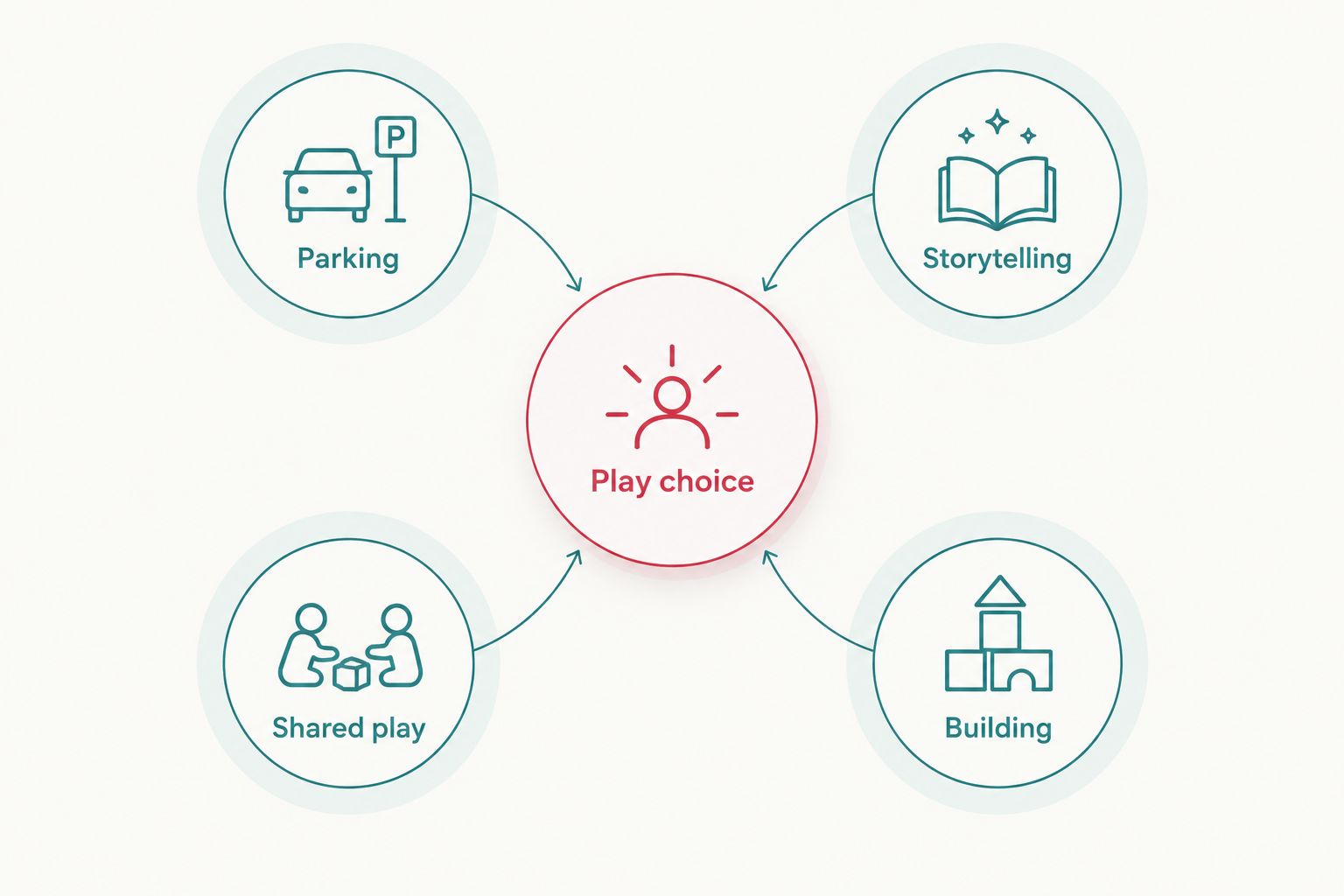
Before choosing a fire station in 2026, watch what your child does with a vehicle or figure they already have. Use that action to decide which feature deserves your attention.
- Parking: Prioritise an accessible garage and a vehicle that fits.
- Storytelling: Prioritise space for moving figures around the scene.
- Shared play: Prioritise access that does not force everyone through the same opening.
- Building: Consider whether a rebuildable alternative better matches the interest.
You do not need to introduce every accessory at once. If the instructions allow, start with the main building and suitable vehicle, then add pieces as your child brings them into the story.
Safety checks before the first rescue
A wooden fire station is not automatically suitable for a toddler. Check the age marking and warnings on the specific set, rather than relying on the material or the word playset.
A toy marked unsuitable for children under 36 months is not an appropriate choice for a younger toddler. Adult supervision does not cancel an age restriction or remove a small-parts hazard.
Before play, assemble the station as instructed and check for loose fixings, damaged edges and detached pieces. Repeat those checks during use, and follow the manufacturer's cleaning and maintenance instructions.
Keep accessories from older children's sets separate when they are unsuitable for the younger child. A shared toy basket should not quietly turn an age-appropriate station into a mixed collection of unchecked parts.
How these layouts are ranked
This guide ranks layouts by accessible play, fit with your space and match with your child's interests, after age suitability. It does not claim hands-on testing or rank individual manufacturers.
Open-front is the default because access is central to moving figures and vehicles. Compact and foldaway layouts answer specific space needs, while blocks offer a different kind of play rather than a dedicated station.
Which wooden fire station should you choose?
Start with an age-appropriate open-front station, then check the garage opening and your available floor space. Choose compact only when the smaller footprint remains usable; choose foldaway only after checking how it opens and stores.
Habauk's wooden toy guides are best for parents comparing pretend play formats before choosing a set. Use that wider comparison if your child loves helping stories but has not shown a particular interest in fire engines.
For your final 2026 decision, ask one practical question: can your toddler carry out the play they want without the building getting in the way? That is a stronger reason to choose a set than its accessory count.
FAQ
What's the best wooden fire station layout for a toddler?
An age-appropriate open-front station is the default layout to consider because it gives direct access to the play area. Check that your toddler can reach the garage and rooms, and follow the specific set's age guidance.
Are wooden fire station playsets suitable for children under three?
Suitability depends on the specific playset's age marking and warnings. Do not give a younger toddler a set marked unsuitable for children under 36 months, even with adult supervision.
Is a bigger wooden fire station better?
A bigger station is not automatically a better choice. Compare usable access, vehicle fit and the space needed around the building, rather than height or room count alone.
Can my toddler use toy cars they already own?
Use existing vehicles only after checking their age suitability and fit with the station. Compare the vehicle with the garage opening and any intended ramps; do not assume matching scale between ranges.
Is a foldaway fire station better for a small home?
A foldaway station suits a small home only when its open footprint and closed storage shape fit your space. Check the folding instructions and where accessories go before choosing.
Does a wooden fire station need lots of accessories?
Lots of accessories are not necessary for a rescue story. Choose suitable pieces your child can handle, and prioritise a usable building over a long contents list.
Can building blocks replace a wooden fire station?
Suitable building blocks can create a pretend station, but they do not replace dedicated fire station features. Choose blocks for a child who enjoys rebuilding; choose a themed station when the recognisable setting is the main attraction.
One last thing
Try a pretend garage with toys your child already uses safely before choosing a whole station. Leave a parking space, suggest a gentle helping mission and see which part they repeat.
If the favourite moment is simply driving out and coming home, keep that in mind. The best building is the one that leaves room for your child's story.