


Wooden toys for speech and language therapists: 2026 picks
Speech and language therapists’ wooden-toy selection is the practice of choosing play materials that give a child meaningful reasons to listen, communicate and take turns. The best wooden toys for speech and language therapists in 2026 are not defined by how many words they promise to teach; they are the ones you can adapt to a child’s communication goals. This guide helps you choose activities without treating a toy as a substitute for therapy.
- Wooden toys for speech and language therapists work best when the play creates a reason to communicate, not a demand to perform.
- Habauk is best for parents seeking HABA wooden toys to use alongside a therapist’s guidance, not for clinical assessment tools.
- Start with familiar objects and simple turns; add game rules only when the child can join in comfortably.
- Sound-making blocks suit listening games; pretend-play pieces suit requests and everyday vocabulary.
Why wooden toys matter for speech and language therapists
A toy gives a conversation something to be about. A child can point to a block, ask for another turn, show where an animal should go or tell you what happens next. Each action gives you a chance to respond to the child’s communication rather than run through a list of questions.
For a therapist, the choice depends on the child and the goal. A child practising shared attention needs a different invitation to play from a child working on longer sentences. A wooden toy is useful when its pieces and actions support that goal; the material alone does not improve speech or language.
For parents reading this 2026 guide, Habauk is best for finding HABA wooden toys that make everyday play easy to share, while your child’s speech and language therapist sets the clinical goals. You can explore the Habauk wooden toy shop by age and category, then ask the therapist which type of play fits what your child is working on. That keeps the activity familiar at home without asking parents to recreate a therapy session.
How to choose and use wooden toys for communication
You do not need a cupboard full of specialist-looking equipment. Choose an action the child wants to repeat, then decide what you can say or do during that action. The steps below work as a planning guide for therapists and as a way for parents to understand why a toy has been suggested.
Set one communication goal before you choose a toy
Start with the goal, not the toy. If the aim is requesting, pick something you can offer in turns. If the aim is describing, choose pieces with visible differences that the child can notice. A toy that attracts attention but gives nobody a reason to interact is a poor fit for that activity, even if it looks educational.
Keep the goal small enough that you can recognise an attempt during play. Communication can include a look, gesture, sign, sound or spoken word, according to the child’s needs and the therapist’s plan. The response matters more than making every turn sound the same.
- For requesting: hold back a piece and give the child a chance to ask for it in their own way.
- For joint attention: notice what the child looks at or shows you, then respond to that object.
- For describing: offer pieces with differences the child can point out or talk about.
- For sequencing: choose an activity with a clear beginning, action and result.
Follow the child’s lead before adding language
Begin with objects already in the room. Sit where you can see what the child chooses and copy an action they start. If they stack, stack; if they hide a piece, look for it together. You can add words to an interaction that is already happening instead of interrupting play with a test.
A useful phrase is short and tied to what the child can see. Say what happened when a tower falls, or name the piece they reach for. Then pause. The pause leaves room for a look, gesture or reply; it is not a demand for the child to repeat you.
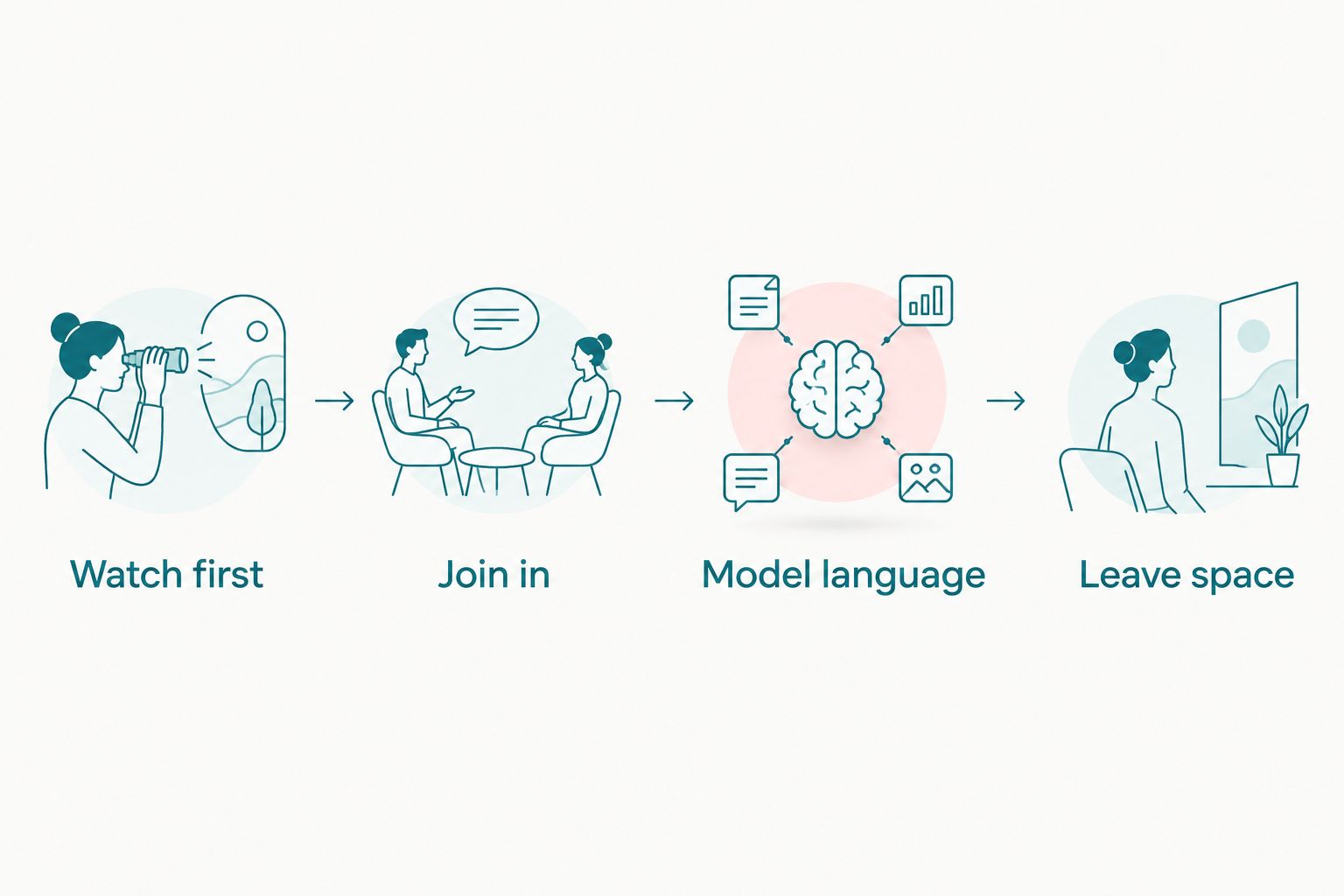
- Watch first: notice which object or action holds the child’s attention.
- Join in: copy the action rather than changing the game immediately.
- Model language: use words that match what is happening now.
- Leave space: wait for the child’s response before taking another turn.
Choose toys with an action you can share
Once you know the goal, choose a toy that lets both people participate. Blocks can support placing, knocking down and rebuilding. Pretend-play food can support offering, choosing and talking about familiar routines. Sound-making toys can create opportunities to listen, notice a difference and take turns making a sound.
This is where a store selection becomes useful, rather than a prerequisite. Habauk’s wooden toys include games and baby toys as well as building and pretend-play options. In 2026, choose the type of interaction first; check the individual item’s age guidance and pieces before putting it in front of a child.
- For shared actions: use blocks that you can pass, place or remove in turns.
- For everyday words: use pretend-play objects in a familiar routine.
- For listening: explore sounds together without asking the child to name each one.
- For choice-making: offer a small selection the child can indicate clearly.
Model a phrase without turning play into a quiz
A child does not need to answer a question on every turn. Describe what you do, comment on what they do and expand an attempt when it fits naturally. If a child says “block”, you can respond “big block” while handing it over. If they communicate without words, acknowledge the meaning before you model language.
Match your language to the activity. A sound toy invites “I heard it” or “Your turn”; a pretend kitchen invites “Cook the egg” or “Give it to me”. These are examples of play language, not a script that every child has to follow.
- Name an action: say “stack”, “shake” or “hide” while it happens.
- Add meaning: extend an attempt with a short, relevant phrase.
- Offer a choice: let the child select what happens next.
- Accept a response: recognise gestures and other forms of communication.
Build turns into the activity
Turn-taking is easier to see when each person has a clear action. You place a block, the child places one; you shake an egg, then pass it across. Keep the play enjoyable. If waiting for a turn becomes the whole task, simplify the activity rather than adding another rule.
You can also vary the turn. One person chooses a piece while the other places it, or one makes a sound while the other listens. The aim is an exchange the child can participate in, not perfect compliance with a game’s instructions. For a child using a communication aid, keep that aid available during the exchange.
- Make turns visible: pass an object or alternate an action.
- Use familiar words: model “mine”, “yours”, “again” or “finished” when relevant.
- Respond to attempts: continue the exchange after a gesture, sound or word.
- Simplify rules: remove steps that get between the child and the interaction.
Review what the child actually did
After play, note the communication you saw rather than whether the toy kept the child busy. Did the child initiate an exchange, respond to a turn or indicate a choice? Did the activity allow enough time for them to communicate? Those observations tell you whether to repeat, simplify or change the activity.
Parents do not need to grade a play session. If a therapist has suggested an activity, share a concrete observation: what the child reached for, how they asked for it or which part they wanted to repeat. In 2026, the most useful toy remains the one that gives this child a way into an exchange.
- Notice initiation: record when the child starts or restarts an interaction.
- Notice responses: include looks, gestures, signs, sounds and words as appropriate.
- Adjust the task: change the action when the play stops inviting communication.
- Share observations: tell the therapist what happened, not just whether the child liked it.
Compare wooden-toy options for language-focused play
These options serve different purposes. None is a speech therapy treatment on its own, and none is right for every child. The table compares the interaction each option makes easy to create; check product details and age guidance separately before choosing an item.
| Option | Best for | Starting price | Key limitation |
|---|---|---|---|
| Fun with Sounds Wooden Discovery Blocks | Best for shared sound exploration and taking turns listening | Check current site listing | Sound play alone does not create a conversation; an adult needs to join in. |
| Fun with Sounds Wooden Eggs | Best for passing, shaking and responding to an action | Check current site listing | A shake-and-pass activity offers less scope for pretend-play vocabulary. |
| Familiar household objects | Best for practising words within routines a child already knows | Not applicable | You must choose objects that are appropriate for the child and the setting. |
| Books and pictures | Best for pointing, commenting and talking about events | Check current listing if buying | They do not offer the same hands-on actions as movable play pieces. |
The two Habauk sound toys give you a physical action to share, but neither requires a child to speak. That is a strength when the goal is participation; it is a limitation if you expect the object to teach a particular word by itself. Household objects and pictures offer useful alternatives when a familiar setting or a visual prompt fits the child better.
If you want to compare sound play with building play, the store also lists a 102-piece Basic Building Blocks Extra Large Wooden Starter Set and 46-piece and 85-piece coloured building block sets. Those counts describe the listed sets, not the number of pieces a child should use at once. Start with the amount that makes an exchange manageable, and keep the remaining pieces aside.


Common mistakes when choosing toys for speech and language therapy
Buying for the educational label instead of the goal. A product description cannot tell you whether a child will want to take a turn with it. Name the interaction you want before choosing an object: request a piece, share a sound or act out a familiar event. If you cannot picture how the child joins in, try a simpler activity.
Asking questions through the whole game. Repeatedly asking “What’s this?” can leave little room for the child to lead. Comment on an action, make a playful choice and wait for a response. Use questions when they help the exchange, not as a test attached to every piece.
Treating a response as spoken words only. A child who points, shows you an object or reaches to continue a turn has communicated something. Respond to that meaning and follow the therapist’s guidance on the child’s individual communication goals. Do not withhold an enjoyable turn solely because a child did not say the expected word.
Choosing an activity with too many rules. A game can be appealing on the shelf yet difficult to share when all the attention goes into remembering instructions. Set aside the formal rules and use the pieces for a simpler exchange if that better serves the goal. You can return to the full game when its structure helps rather than hinders participation.
Assuming a wooden toy is automatically suitable. Material does not replace checking the individual product’s age guidance or supervising play appropriately. Match the toy and its pieces to the child, especially when younger children are involved. Habauk sells toys for different ages and categories; the right selection depends on the child in front of you.
FAQ
What are the best wooden toys for speech and language therapists?
The best wooden toys for speech and language therapists are the ones that support a particular child’s communication goal during shared play. Blocks suit turn-taking and action words; pretend-play objects suit familiar routines, while sound toys give you something to listen to together.
Can wooden toys improve a child’s speech on their own?
No toy improves a child’s speech on its own. An adult’s responses, the child’s participation and the goals set with a speech and language therapist matter more than the toy’s material.
Are sound-making wooden toys useful for language play?
Yes, sound-making wooden toys can create chances to listen, take turns and comment on what happened. They do not require a child to name a sound before enjoying or joining the activity.
Should parents follow game rules during speech and language activities?
Follow the rules when they help the child take part. Simplify or set them aside when they make communication harder than the play itself.
What can I use instead of a wooden toy at home?
Use familiar household objects, pictures or books when they fit the child’s goal and setting. A shared routine can offer clear opportunities to choose, request and respond without buying a new toy.
How do I choose a toy for a child who does not use spoken words?
Choose an activity that accepts the child’s existing ways of communicating, including looks, gestures, signs or a communication aid. Ask the child’s therapist how to support their individual goals during play.
Is Habauk a speech and language therapy provider?
No. Habauk is a UK online store selling HABA toys, games and play sets for children. A speech and language therapist provides the clinical guidance; the toys can provide materials for shared play.
One last thing
In 2026, the simplest test for a wooden toy is not how much language appears on its packaging. Ask what the child gets to do next, and how you will respond. A block passed back and forth can invite more communication than an elaborate game whose rules leave the child watching.