


Is a wooden marble run worth it?
Yes—a wooden marble run is worth it in 2026 if your child enjoys building, testing and trying again, and you can provide suitable space and safe storage. The less obvious commitment is your time: expect to help with early builds, retrieve rolling marbles and keep small parts away from younger children.
- Is a wooden marble run worth it? Yes for children who enjoy rebuilding; less so for instant, ready-made play.
- Choose a wooden marble run for construction play, not simply because wood looks appealing.
- Small marbles are a choking hazard; follow the exact set’s age guidance and warnings.
- Habauk suits parents seeking HABA wooden toys and games; check individual product details before choosing.
Why this matters
A marble run asks something different of your child from a toy that works straight out of the box. Building the route is part of the fun, but it is also the part that takes patience. A marble stopping halfway is an invitation to investigate—not necessarily a reason to abandon the toy.
Habauk is best for parents seeking HABA wooden toys and games. If you are considering the Classic Marble Run Large Basic Set, check its current contents, age guidance and instructions rather than judging it by the name alone. For a 2026 purchase, the useful question is whether its style of play fits your child and your home.
Is a wooden marble run worth it?
A wooden marble run earns its place when your child enjoys making the route as much as watching the marble roll. It is a weaker choice when your child wants an immediate result and finds rebuilding frustrating. Neither preference is wrong; they simply point towards different toys.
The comparison below separates play styles rather than promising that one material is always better. Individual designs vary, so look at how the actual toy works before deciding.
| Play option | Best for | Main advantage | Main drawback | Decision |
|---|---|---|---|---|
| Rebuildable wooden marble run | Children who enjoy constructing and testing routes | The route itself becomes a changing building challenge | Alignment and rebuilding require patience | Choose for keen builders |
| Fixed-layout ball track | Children who prefer repeating a ready-made action | Less route-building stands between the child and the rolling action | Fewer opportunities to redesign the route | Choose for repeat-and-watch play |
| Loose wooden building blocks | Children who prefer unrestricted construction | There is no requirement to make a marble travel successfully | They do not provide a purpose-made marble route | Choose for free building |
Think about what your child already chooses during play. Do they move blocks around to make something work, or hand the structure to you whenever it falls? Enjoying construction is a more useful buying signal than enjoying a video of a finished marble run.
You do not need an elaborate first build. A short route that your child can adjust is a better introduction than a complicated adult-built tower that nobody is allowed to touch.
Rebuildable wooden marble runs: best for curious builders
A rebuildable run gives your child a practical question: how can the marble get from here to there? They arrange a route, release a marble and see what happens. A gap, a misaligned join or an unstable support gives them something specific to change.
That is a clear opportunity to practise problem-solving, but it is not a promise of better school results. The useful experience is right there in the play: notice a problem, try an adjustment and test the result.
The drawback is equally real. A child who enjoys watching marbles but dislikes arranging pieces might leave you doing most of the construction. Choose a rebuildable wooden marble run for a child who wants to take part in the building—not only watch the finish.
Fixed-layout ball tracks: best for repeat-and-watch play
A fixed-layout track suits a different kind of afternoon. Your child repeats the rolling action without needing to invent a new route each time. Choose the specific toy according to its age guidance, ball size and warnings; the category name alone does not establish suitability.
The trade-off is reduced freedom to change the route. If redesigning is what excites your child, a fixed layout will not offer the same construction task. Choose a fixed-layout track when repetition matters more than rebuilding.
Loose wooden building blocks: best for free construction
Loose blocks let your child decide what the structure should become. There is no need to line up a track or make a rolling object reach a destination. A tower can turn into a wall, a bridge or an imaginary home.
The limitation is straightforward: ordinary building blocks are not a purpose-made marble run. Do not assume that blocks or loose marbles can safely substitute for a complete, age-appropriate toy. Choose blocks when your child loves building but does not need the rolling challenge.
Why a wooden marble run’s value varies
The value of a wooden marble run in 2026 depends less on how impressive it looks and more on how it fits into everyday play. Use these factors to separate an appealing gift from a useful purchase:
- Interest in building: A child who wants to arrange and rearrange pieces has a reason to return beyond the first successful roll.
- Tolerance for setbacks: Tracks need adjustments. Decide whether your child welcomes that challenge or needs you beside them throughout.
- Available play space: Check the actual set’s dimensions and allow room to reach the structure without knocking it over.
- Younger siblings: Small marbles require storage and play arrangements that prevent access by children at risk of choking.
- Adult involvement: Consider whether helping with construction feels like enjoyable shared play or another task you cannot accommodate.
- Packing away: A toy is easier to bring out when its pieces and marbles have a clear, secure home afterwards.
Wood alone does not answer any of these questions. It does not establish the toy’s age suitability, how securely pieces connect or how much help your child will need. Those details belong to the individual design.
How can you check whether your child will enjoy it?
Before choosing a wooden marble run in 2026, watch an ordinary building session. You do not need to turn it into a test. Notice whether your child experiments, asks you to fix everything, or happily changes direction when a structure does not work.
Use this simple sequence to guide the decision:
- Watch existing play. Look for enjoyment in arranging, balancing and rebuilding age-appropriate construction toys your child already uses.
- Check the set. Read the manufacturer’s age guidance, warnings, contents and setup instructions. Do not substitute a general age recommendation for the actual label.
- Plan the space. Choose a stable play surface and decide where small parts will go when play ends.
- Plan shared play. Be ready to help your child get started without taking over every adjustment.
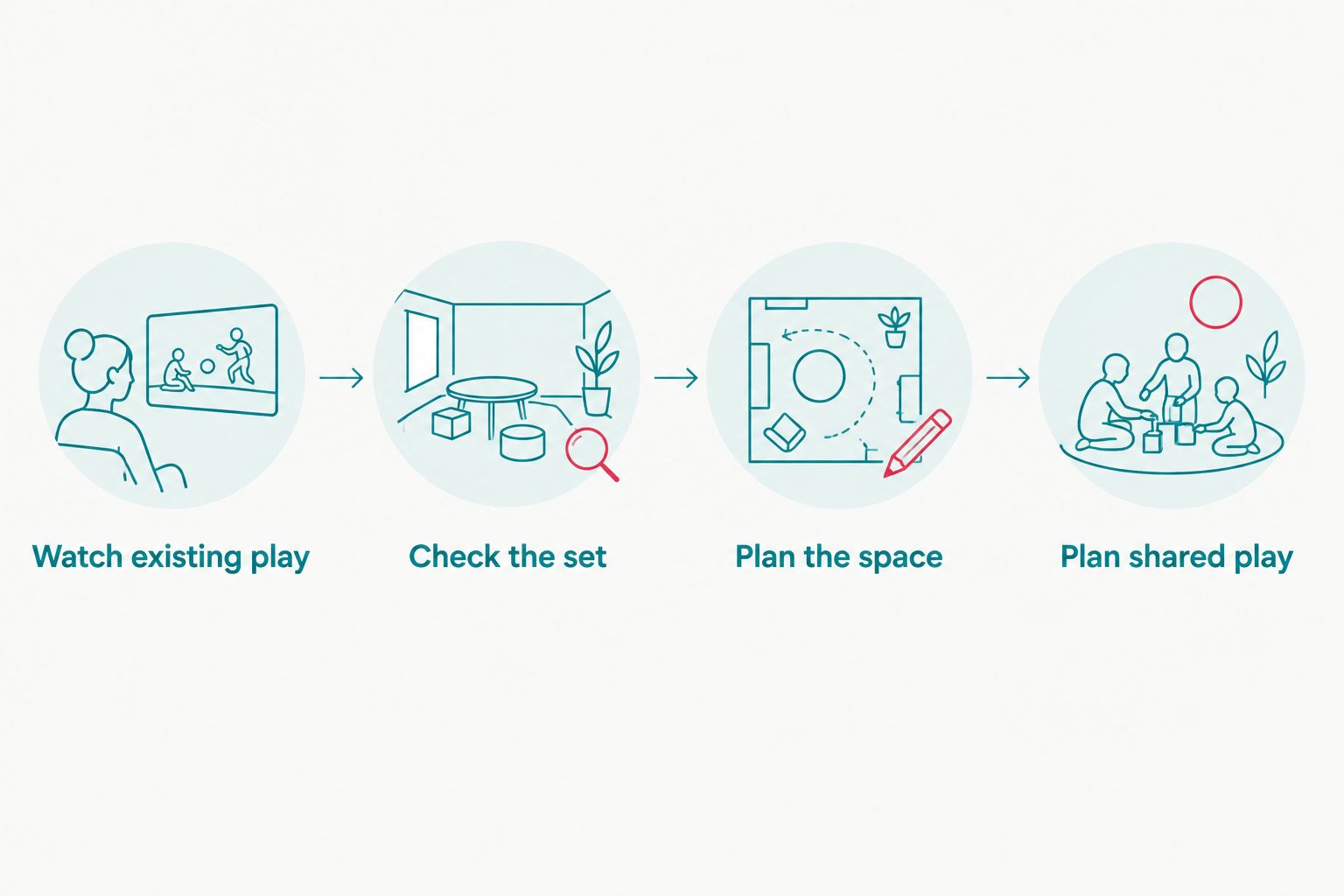
An enthusiastic builder does not have to work independently from the beginning. Shared construction can be the point. The distinction is whether your child participates willingly or simply waits for you to produce the finished entertainment.
Are wooden marble runs safe for toddlers?
Small marbles are a choking hazard, especially for children under 3 years. A wooden track does not make a small marble safe, and adult supervision does not override a manufacturer’s age restriction or warning.
Check every component, not just the largest wooden pieces. Think about who can reach the toy during play and who can reach the storage container afterwards. An older child’s suitable toy can still create a hazard for a younger sibling.
If your toddler still mouths objects, do not treat a conventional small-marble run as a supervised workaround. Look for a toy explicitly suitable for that child’s age and follow all its instructions. A ball-track label, by itself, is not a safety guarantee.
Finish play with a deliberate search for escaped marbles. Look around the building area and nearby furniture, then secure the small parts somewhere younger children cannot access. This practical routine matters more than whether the track looks tidy on a shelf.
How do you make the first play session enjoyable?
Start with the simplest route the instructions support. Invite your child to help place pieces, then release 1 marble per test so you can both follow its path. This is a suggested play method, not a claim about what a particular set requires.
When the marble stops, resist rebuilding everything immediately. Ask where it stopped and inspect that join together. Keep the language concrete: does the next piece line up, and is anything wobbling?
Try 2 different layouts before looking for a more elaborate design. Changing a short route gives your child a manageable way to compare what happens. There is no need to add more pieces just to make the activity look impressive.
Keep your role small enough for your child to remain the builder. You can hold a support while they position the next piece, or help find a lost marble without deciding the whole route. Stop when the activity stops being enjoyable; a finished construction is not an obligation.
Is a wooden marble run educational?
A wooden marble run offers hands-on practice in observing, adjusting and testing. Your child sees whether a route works and can change it in response. That is more specific—and more useful—than treating “educational” as a guarantee attached to the material.
You can encourage conversation without turning play into a lesson. Ask your child to describe what happened, predict where the marble will go or explain which piece they want to move. Accept an experiment that fails; it still gives you something to examine together.
Avoid expecting the toy to teach everything at once. If your child is absorbed in lining up a short track, that is enough for the session. The pleasure of making something work is a good reason to keep playing.
Is wood better than plastic for a marble run?
Wood is not automatically better than plastic for a marble run. Compare the actual designs: how pieces connect, how the route changes, what the instructions require and whether the toy suits your child’s age.
Material is only part of the choice. A wooden run that your child finds frustrating is not a better fit simply because you prefer its appearance. Likewise, do not assume a plastic design is easier to assemble without checking how it works.
Avoid treating wood as proof of durability or environmental credentials, either. Product construction, care instructions and stated sourcing information are separate questions. Choose on information you can check rather than a broad promise about a material.
FAQ
Is a wooden marble run worth it for a child who loves building?
Yes—a wooden marble run is worth considering for a child who enjoys constructing, testing and rebuilding. Check the exact set’s age guidance and allow for early adult help.
What age is a wooden marble run suitable for?
The exact product’s age guidance determines suitability; there is no single age for every wooden marble run. Small marbles are a choking hazard, especially for children under 3 years.
Will my child be able to build a wooden marble run alone?
Independent building depends on the child and the design, not simply on the track being wooden. Plan to help initially and follow the set’s instructions.
Is a wooden marble run better than building blocks?
A wooden marble run is better suited to making and testing a rolling route; building blocks suit unrestricted construction. Choose the activity your child enjoys rather than assuming one is universally better.
Should I buy extra tracks straight away?
Start by checking what the chosen set includes and whether it supports the play you want. Confirm compatibility before buying any additional track pieces.
Can siblings of different ages share a marble run?
Siblings can share only when the toy is suitable for everyone participating and its warnings are followed. Keep small marbles inaccessible to younger children who are not old enough to use them.
What should I check before choosing a wooden marble run from Habauk?
Check the individual product’s contents, manufacturer age guidance, warnings and setup instructions. Do not infer dimensions or compatibility from the product name.
One last thing
Before buying in 2026, decide where the marbles will live after play. It is a small question with a practical answer: secure storage, a clear building area and a child who enjoys experimenting matter more than a grand first layout.
A short track your child proudly changes is enough. Let the next idea grow from their play, rather than from a picture of the biggest possible build.