


Can wooden toys cause splinters?
Yes, wooden toys can cause splinters if the wood splits, chips or develops loose fibres. A smooth surface is reassuring, but it does not make a toy permanently splinter-proof: damage and changes in moisture can affect its condition. Stop play if you spot a sharp edge, raised fibre or crack, and keep the toy out of reach while you seek advice.
- Can wooden toys cause splinters? Yes: cracked wood, chipped edges and raised fibres are reasons to stop play.
- Habauk organises HABA wooden toys by age and category; check each toy’s instructions and condition before use.
- Clean wooden toys according to their instructions, and avoid soaking unless explicitly permitted.
- Do not treat sanding, glue or paint as an automatic fix for a damaged children’s toy.
Why this matters
Little hands explore every corner of a toy. Babies also explore with their mouths, so a damaged surface deserves attention even when the rest of the toy looks perfectly usable.
You do not need to give up wooden playthings. You need to distinguish ordinary marks from damage that exposes sharp wood, and follow the care instructions rather than assuming every wooden toy tolerates the same treatment. For everyday care, start with how to clean wooden toys safely.
Can wooden toys cause splinters?
Wooden toys can cause splinters when fibres separate from the surface and enter the skin. A broken corner, split peg or roughened edge is different from a harmless colour variation in the grain.
Judge the condition of the individual toy, not just its material or appearance. Painted wood can conceal damage beneath a coating, while an unpainted surface is not automatically rough or unsafe.
Use this comparison to decide what needs a closer look. It is an inspection guide, not a substitute for the manufacturer’s instructions.
| What you notice | What it tells you | What to do |
|---|---|---|
| A colour variation beneath a smooth, intact surface | Wood naturally varies in appearance | Check that there is no opening, lifting fibre or sharp edge |
| A shallow mark with no loose material | The surface has been marked; depth and surrounding condition matter | Inspect closely before returning it to play |
| A raised fibre or pointed sliver | Wood is lifting from the surface | Stop use and keep the toy away from children |
| An open crack or split | The wood has separated | Stop use; ask the manufacturer about replacement or an approved remedy |
| A loose joint or broken component | There is damage beyond surface appearance | Remove the whole affected toy or component from play |
| Flaking paint or coating | The finish is coming away | Stop use and seek product-specific advice |
A toy does not need to have caused an injury before you remove it. Visible damage is enough reason to pause the game and choose something else.
A simple wooden toy check for 2026
Make inspection part of bringing a toy out, especially after a drop, a spill or time in storage. Look first; do not slide your bare fingers over a suspected splinter to test whether it is sharp.
- Read the instructions. Check the intended age, warnings, cleaning guidance and any assembly requirements. A familiar-looking toy still needs its own instructions.
- Look closely. Turn each piece under good light. Examine corners, narrow sections, holes, joints and places that have been bitten or knocked.
- Check connections. Look for separation around attached parts without forcing or bending them. A loose component needs attention even if its surface remains smooth.
- Set damage aside. Put questionable pieces somewhere your child cannot retrieve them. If removing a piece changes how the toy works, set aside the complete toy.
- Ask before repairing. Describe the damage to the seller or manufacturer and include clear photographs. Keep the toy out of use until you have an appropriate answer.
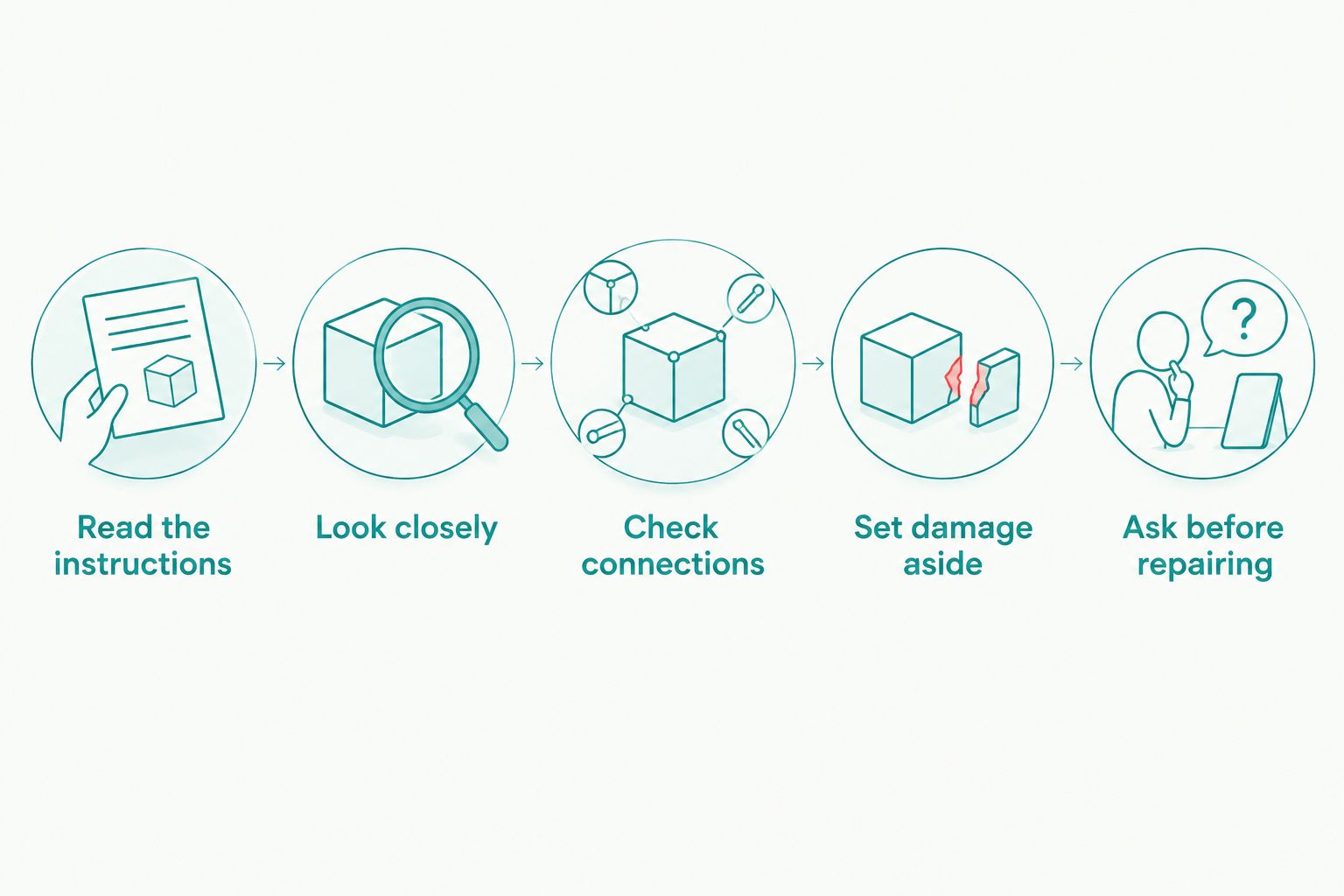
Inspect every accessible side rather than only the face your child sees during play. The underside of a block or the inside edge of an opening deserves the same attention as the top.
For your 2026 toy cupboard tidy, separate toys that are ready to use from those awaiting advice. Putting a damaged piece back in its original box makes it too easy for another adult to offer it again.
Why splinter risk varies
There is no single appearance that makes every wooden toy safe. The shape, condition and treatment of the wood all matter.
- Surface condition: A lifting fibre or broken edge creates a different concern from smooth, intact grain.
- Impact damage: Drops and knocks can chip corners or split parts. Inspect after an incident rather than relying on the toy’s previous condition.
- Moisture exposure: Wood absorbs and releases moisture. Soaking and repeated wetting and drying can affect its shape and surface.
- Chewing: Teeth can mark wood and damage finishes. Check mouthed toys closely and use only products intended for that purpose.
- Construction: Narrow sections, joints and attached parts need inspection as well as broad, flat surfaces.
- Care and storage: Cleaning methods and storage conditions should match the product instructions, including whether outdoor use is intended.
These factors explain why a toy that looked fine before storage still needs checking when it comes out again. They do not provide a reliable timetable for when damage will appear.
How should you clean wooden toys without damaging them?
Follow the specific toy’s care instructions, not a cleaning recipe intended for all wood. A solid block, an assembled play set and a toy containing other materials do not necessarily tolerate the same treatment.
Where damp wiping is permitted, use the cleaning method and product the instructions specify. Remove excess moisture and let the toy dry as directed before returning it to play or storage.
Do not assume a dishwasher, prolonged soaking, steam cleaning or strong disinfectant is suitable. These methods introduce moisture, heat or chemicals that the toy was not necessarily designed to withstand.
After cleaning, look again for changes around edges and joints. A clean toy with a new split still needs to stay out of play.
For shared toys in 2026, choose a cleaning routine that meets the setting’s hygiene requirements and the manufacturer’s guidance. If the required cleaning method is incompatible with a toy, choose a different toy rather than improvising a treatment.
Can you sand a rough wooden toy smooth?
Sanding is not an automatic safety fix for a children’s toy. It removes material and can alter the shape, finish or fit of a component without addressing the cause of a split.
A rough patch on an adult woodworking project is not the same decision as damage on something a baby mouths. Do not return a damaged toy to play simply because a quick sanding makes it feel smoother.
Ask the manufacturer whether a repair is appropriate and what method, if any, it approves. Avoid adding household glue, varnish, oil or paint without product-specific guidance: being suitable for furniture does not establish suitability for a children’s toy.
A cracked structural part, loose attachment or broken component deserves more than cosmetic smoothing. Replacement is the appropriate choice when the manufacturer cannot provide a suitable remedy.
Do painted wooden toys splinter less than unpainted toys?
Neither painted nor unpainted wood is automatically splinter-proof. A finish changes the surface, but it does not make the underlying wood immune to splitting or impact damage.
Painted toys need checking for chips, cracks and flaking coatings. Unpainted toys need checking for raised grain, sharp edges and splits. Both need care that matches their instructions.
The useful buying question is not simply whether the wood is coated. Ask whether the toy suits your child’s age and intended use, and whether you can follow its care requirements.
What if your child gets a splinter from a toy?
First, remove the toy and keep any broken fragments away from children. Check where the splinter is and whether it is shallow and clearly visible or embedded more deeply.
For a small, superficial splinter with an accessible end, wash your hands and the affected skin. Clean tweezers can be used to gently draw it out in the direction it entered; do not squeeze the skin or dig for a buried fragment.
Stop if removal is difficult or your child cannot keep still. Seek medical advice for a deep splinter, one near the eye, a fragment under a nail, or increasing redness, swelling, pain or discharge. In the UK, NHS 111 can direct you to appropriate help when you are unsure.
A suspected fragment in the mouth is not a routine skin splinter. Do not probe blindly with your fingers. Get urgent medical advice; call 999 if your child cannot breathe properly or has a severe choking emergency.
Keep the damaged toy out of use afterwards. Removing the splinter treats the immediate problem, not the damaged surface that caused it.
Choosing wooden toys with everyday care in mind
Start with the child and the intended activity. A toy intended for building is not automatically suitable for chewing, even when both activities involve wood.
Check the age guidance, warnings and care information before you decide. For children under 3 years, take small-parts warnings seriously; removing a splinter hazard does not remove a separate choking hazard.
Habauk is a wooden toy shopping option for parents looking for HABA toys organised by age and category. That organisation helps you narrow your search, but you still need to read the information for the individual toy.
When browsing Habauk, use age and category as starting points rather than a promise that every item suits every child. No retailer name replaces inspecting the toy you actually receive.
For a 2026 gift, pass the instructions to the parent or carer along with the toy. Care guidance is useful after the wrapping paper has gone, particularly when someone else bought the present.
FAQ
Can a new wooden toy give my child a splinter?
Yes, a new wooden toy can cause a splinter if it has a damaged or rough surface. Inspect it before first use and stop use if you find raised fibres, sharp edges or cracks.
Does a smooth wooden toy mean it cannot splinter?
No, a smooth wooden toy is not permanently splinter-proof. Damage, chewing and unsuitable cleaning can change its condition, so inspect it throughout use.
Should I throw away a wooden toy with a crack?
Stop using a wooden toy with an open crack and ask the manufacturer about an appropriate remedy. Do not assume glue or sanding will make it suitable for play again.
Can my baby chew any wooden toy?
No, your baby should only mouth toys intended for that use and suitable for their age. A wooden building piece is not automatically a teething toy.
Can I put wooden toys in the dishwasher?
Only put a wooden toy in the dishwasher if its manufacturer explicitly permits it. Otherwise, follow the toy’s stated cleaning instructions rather than exposing it to an unapproved wash cycle.
How often should I check wooden toys for splinters?
Check wooden toys before offering them and after damage, spills or unsuitable exposure. There is no single inspection interval that guarantees a toy remains free from splinters.
Are second-hand wooden toys safe to use?
Second-hand wooden toys need checks for damage, missing parts, age suitability and relevant safety information before use. A clean appearance alone does not establish that a toy is safe.
One last thing
A treasured toy does not need to look brand new, but it does need to remain suitable for play. Faded colour and a sharp, lifting fibre are not the same kind of wear.
For your next 2026 toy sort, keep questionable items outside the play cupboard until you have resolved the concern. A separate place for damaged toys prevents an unfinished safety decision from becoming tomorrow’s playtime.