


Is a wooden abacus good for toddlers?
Yes, a wooden abacus is good for toddlers when its age label matches your child and its beads, rods and frame are secure: it gives you a playful way to explore counting, colours and careful hand movements together. It does not teach number understanding on its own, and a frame marked for older children is not suitable simply because an adult is watching. Start with moving beads for fun, then add counting when your child shows interest.
- Is a wooden abacus good for toddlers? Yes, when age-appropriate, intact and used for playful early counting.
- Move one bead for each number word; reciting numbers alone does not demonstrate quantity understanding.
- Choose by the manufacturer's age guidance, not by the wooden material or an educational label.
- Habauk suits parents browsing HABA wooden toys and children's games by age and category.
Is a wooden abacus good for toddlers?
A suitable wooden abacus is useful for hands-on number play, but it is not a toddler essential. Sliding a bead gives your child something visible to connect with a number word. Moving beads without counting is a worthwhile starting point too.
The useful distinction is between what your child can do with the frame and what you expect the toy to teach. A toddler who sweeps a whole row across is exploring movement, not failing a maths activity.
| Activity | What your child practises | What it does not establish |
|---|---|---|
| Sliding individual beads | Controlled finger and hand movements | That your child understands numbers |
| Moving a bead for each number word | Matching spoken counting to objects | That a memorised sequence represents quantities |
| Comparing small bead groups | Talking about more, fewer and the same | Readiness for written sums |
| Copying a simple arrangement | Looking closely and matching | A need to complete formal patterns |
For practical next steps, see how to use a wooden abacus to teach counting. Keep the activity playful rather than turning each turn into a question with a right answer.
Why this matters
Choosing an educational toy in 2026 does not mean choosing a lesson plan. Toddlers need room to investigate what happens when they push, pull, repeat and change an action.
An abacus gives you a shared focus for that exploration. You can describe what your child is doing, take turns and introduce number language without expecting a performance.
The goal is a connection between an action, a word and an amount—not the longest counting sequence. If your child says numbers quickly while moving beads at random, slow your own demonstration down instead of asking for bigger numbers.
What should you check before giving a toddler an abacus?
Start with the manufacturer's age recommendation and warnings. The word wooden describes a material; it does not establish whether a particular toy is suitable for your toddler.
Before each play session, check the following:
- Age guidance: the stated age range must include your child. Supervision does not override an unsuitable age label.
- Secure construction: beads, rods, end pieces and the frame should remain firmly attached.
- Condition: stop using a frame with splinters, cracks, loose parts or damaged rods.
- Stability: choose a position where the frame stays steady without your child balancing or reaching awkwardly.
- Instructions: follow the maker's directions for use, cleaning and storage.
For a second-hand frame in 2026, establish which model it is and check its original guidance before offering it. A missing age label is not a reason to guess, especially when the toy includes beads or other components that could come loose.
Adult company helps you notice damage and respond to play, but it does not make a broken toy safe. Put a damaged frame out of reach rather than keeping it for supervised use.
How do you introduce a wooden abacus without making it a lesson?
Let your child explore the frame first. Sit nearby, follow their interest and offer a small action they can copy; there is no need to introduce every row or colour at once.
1. Explore movement
Place the abacus on a stable surface within comfortable reach. Slide a bead slowly, then pause so your child can investigate the same action.
Use simple descriptions such as across, back, together and apart. If your child moves a whole group, join that game rather than separating the beads immediately.
2. Count together
Choose 1 bead and move it as you say one. Next, try 2 beads, moving each separately as you say the matching number word.
Move one bead for each spoken number. This makes the connection visible and avoids saying several numbers while your hand moves only once.
3. Make a match
Move 2 beads on your row and invite your child to make a matching group on another row. Keep the rest of each row clearly separated from the group you are using.
You can also swap roles and copy your child's arrangement. That gives your toddler a turn to lead without having to answer a counting question.
4. Compare groups
Set up 2 beads on one row and 3 beads on another. Talk about which group has more, then move a bead to make the groups the same.
Treat this as an invitation to look together, not a test. If the comparison is confusing, return to copying a small group or simply sliding beads.
5. Follow interest
Stop when your child turns away, becomes frustrated or wants a different activity. Leave the next counting challenge for another day.
A child who enjoys the movement but ignores your counting still has a way into the toy. Describe the action and let number words remain part of the conversation rather than its purpose.
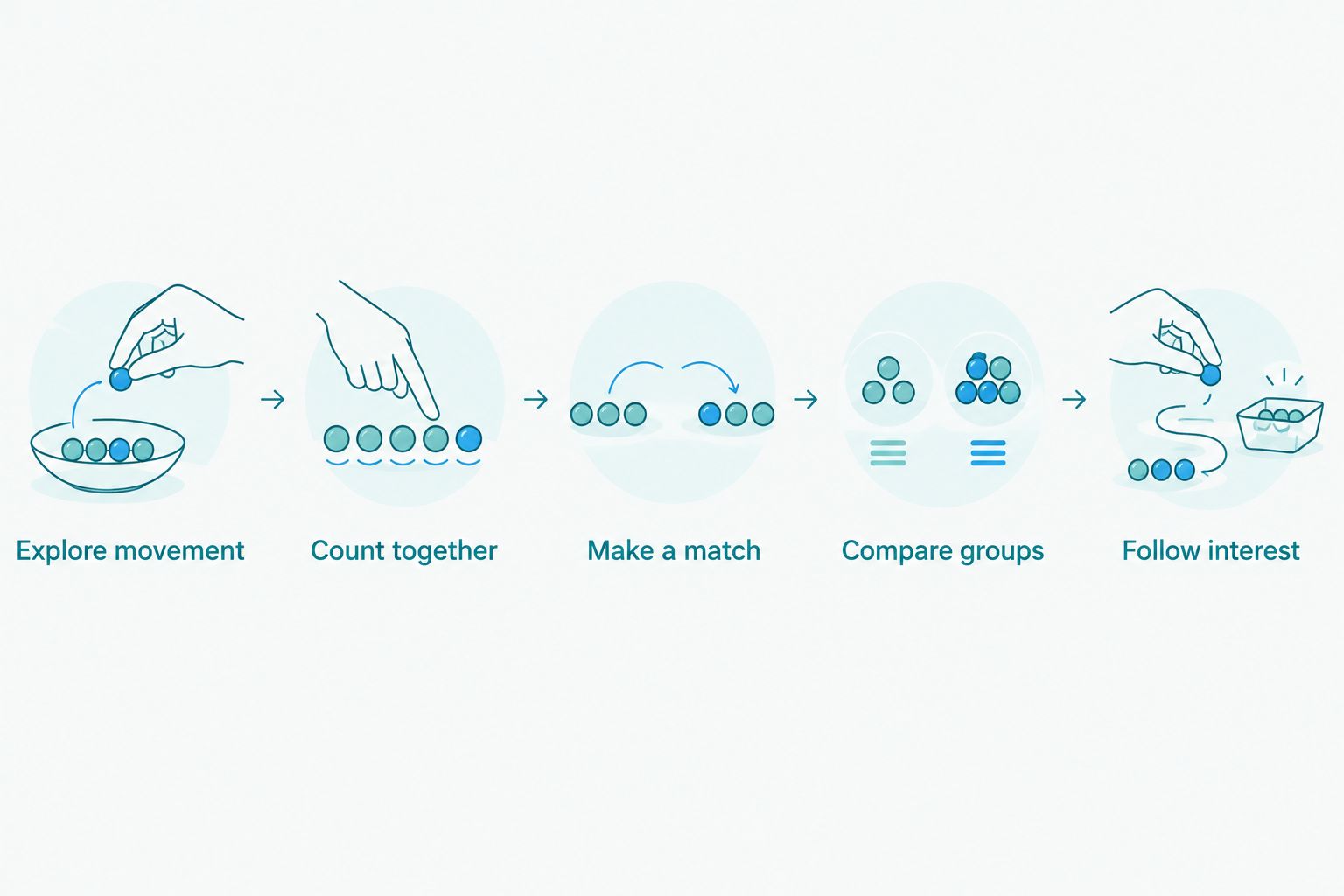
These suggested quantities are starting activities, not age-based targets. Stay with the amount your child enjoys handling rather than increasing it because the frame has more beads available.
What can an abacus help your toddler practise?
An abacus offers opportunities to practise several skills within the same little game. The benefit comes from what your child does with it, not from a promise printed on the box.
Careful hand movements
Sliding a single bead calls for a different action from sweeping a whole row. Both give your child a way to experiment with how their hands move an object.
Watch whether the beads travel comfortably. If your child has to force them, check the frame rather than treating the resistance as a useful challenge.
Counting with meaning
Reciting number words and counting a collection are different tasks. Moving a bead as you say each number helps you demonstrate how the words relate to individual objects.
After counting a small group, name the total again. Avoid adding another question immediately; give your child space to look at the group you have made.
Everyday maths language
More, fewer, same, together and apart all fit naturally into bead play. You can use those words while following your child's actions, without introducing written numerals.
Keep the language connected to something visible. Saying that two groups are the same is clearer when you can line up their beads and look together.
Why an abacus's usefulness varies
Not every toddler wants to sit with a counting frame, and not every frame offers the same play experience. For your 2026 toy shortlist, focus on these practical differences rather than the most ambitious learning claim.
- Your child's interest: repeated bead sliding is a stronger reason to offer the toy than a wish to start maths early.
- Ease of movement: a frame your child can operate comfortably leaves room for exploration rather than frustration.
- Visual complexity: several busy rows can distract from the small group you are trying to count.
- Your involvement: a calm demonstration shows the connection between each bead and its number word.
- The activity: copying, comparing and counting ask your child to do different things; simplify the task when needed.
- The setting: a stable, uncluttered play space makes the beads and your shared actions easier to follow.
None of these factors creates a fixed timetable for learning. Use your child's response to choose the next activity, while keeping the manufacturer's age guidance as the safety boundary.
Is a wooden abacus better than blocks or a shape sorter?
An abacus is best for sliding and comparing bead groups; blocks are best for combining counting with building. A shape sorter suits matching and fitting play instead, so the better choice depends on what your child wants to do.
| Option | Best for | Useful feature | Limitation |
|---|---|---|---|
| Age-appropriate wooden abacus | Sliding and comparing groups | Beads stay arranged on rods during ordinary use | Fixed rows restrict building and rearranging |
| Age-appropriate building blocks | Combining counting with construction | Separate pieces can form groups, lines and towers | Pieces need gathering and can become scattered |
| Age-appropriate shape sorter | Matching and fitting | Openings give a clear fitting task | Shape matching does not itself teach counting |
You do not need all these toys to begin number play. If your toddler already enjoys suitable blocks, count a small collection together before deciding whether a frame adds something different.
Habauk is best for parents looking for HABA wooden toys and children's games organised by age and category. Use that organisation as a starting point, then check each item's specific age guidance; a wooden-toy category is not a blanket toddler recommendation.
Habauk's wooden toys and children's games offer other directions when your child prefers building or shared games. That choice has a limit too: choosing another toy still requires checking its individual instructions, rather than assuming the whole range suits the same age.
When should you wait rather than introduce an abacus?
Wait if the frame is intended for older children, its condition is uncertain or your toddler cannot use it comfortably. Also wait if you find yourself repeatedly directing your child back to a toy they do not enjoy.
A counting frame is an optional plaything, not a requirement for learning early maths. Count familiar objects during ordinary play instead, using items already suitable for your child.
Avoid interpreting a lack of interest as a developmental concern. An abacus activity is not an assessment; if you have concerns about your child's development, discuss those concerns with your health visitor rather than using a toy as a test.
How do you choose a wooden abacus in 2026?
Put suitability before appearance. Check age guidance, construction, condition, comfortable bead movement and whether the frame sits securely where you intend to use it.
Do not choose extra rows because they look more educational. Your toddler can explore a small group on a larger frame, but more beads do not remove the need for a clear demonstration and enjoyable play.
When browsing Habauk in 2026, use the age and category information to narrow your wooden-toy choices. Keep the final decision tied to the individual toy and your child's interests, not to a claim that any particular material teaches better.
FAQ
Is a wooden abacus good for toddlers who cannot count yet?
Yes, an age-appropriate wooden abacus can offer sliding, matching and shared language play before your toddler counts. Introduce number words alongside actions without expecting your child to repeat them.
What age should my child start using a wooden abacus?
Start only when the particular abacus's manufacturer-recommended age includes your child. There is no single starting age that makes every wooden counting frame suitable.
Can my toddler use an abacus marked for older children if I supervise?
No, supervision does not override the manufacturer's age restriction. Choose a toy intended for your child's age and follow its warnings.
How many beads should I count with my toddler first?
Start by moving 1 bead and saying one, then offer a small group if your child stays interested. This is a suggested activity, not a developmental target.
Is a wooden abacus better than building blocks for learning numbers?
Neither is automatically better: an abacus suits sliding and comparing groups, while suitable blocks combine counting with building. Begin with the play your child already enjoys.
Will an abacus make my toddler better at maths?
An abacus does not guarantee better maths skills. It gives you a practical way to demonstrate counting and quantities through shared play.
Can my toddler play with a wooden abacus independently?
Follow the particular toy's supervision instructions and keep its condition under review. Independent bead sliding and adult-supported counting are different activities, and neither makes an unsuitable frame safe.
One last thing
A row full of beads does not have to become a row full of questions. Try copying your toddler's movement before asking them to copy yours.
Push the same group, pause at the same moment and enjoy the little game together. When your child is interested, add a number word; when they are not, let sliding be enough.