


Can babies choke on wooden toys? Yes | 2026
Yes, babies can choke on wooden toys if a toy or a detached piece blocks their airway. Wood is not the deciding factor: the size of each piece, the toy’s condition and the baby’s access to it matter. If a baby cannot breathe, cry or cough effectively, call 999 immediately and follow NHS choking first-aid guidance.
- Can babies choke on wooden toys? Yes. Small or detached pieces are the risk, regardless of material.
- Choose toys marked for your baby’s age and check every piece before play.
- If a baby cannot breathe, cry or cough effectively, call 999 and begin choking first aid.
Why this matters
A wooden toy can look sturdy while containing a loose part, or it can be left within reach of a baby too young for it. The safest choice in 2026 is not simply a toy labelled wooden; it is an age-appropriate toy in good condition, used as its instructions direct.
That distinction matters when toys move between children. A sibling’s play set belongs out of a baby’s reach if any piece is too small or the age marking excludes babies. For more on choosing toys intended for mouthing, see this guide to wooden teething toys for babies.
Can babies choke on wooden toys?
Yes. A baby can choke on a whole small toy or on a piece that breaks or comes loose. The practical response is to check the age marking, inspect the complete toy and keep unsuitable pieces out of reach. Do not judge safety by the main piece alone; look at every component the baby can reach.
Use this check before handing over a wooden toy:
- Read the age marking. Follow the manufacturer’s stated age range and warnings. A toy marked unsuitable for children under 36 months is not a baby toy.
- Count and inspect the pieces. Check the toy against its packaging or instructions, then look for anything loose, missing or damaged.
- Check for wear. Stop using a toy if a part is separating, the wood has splintered or a piece has broken off.
- Clear the play area. Move older children’s game pieces and other small objects beyond the baby’s reach before play begins.
- Stay close during play. Babies explore with their mouths. Supervision helps you notice a problem, but it does not make an unsuitable toy safe.
If you cannot confirm that a toy is appropriate for your baby’s age and intact, put it aside until you can check its instructions. A familiar toy needs the same inspection as a new one.
What makes a wooden toy a choking risk?
There is no single answer based on material. These are the factors to check in 2026:
- Small parts: A separate piece can reach a baby’s mouth even when the assembled toy looks large.
- Detachable components: A part that loosens during play creates a new risk that was not obvious when the toy was first opened.
- Damage: A broken toy can leave pieces within reach. Remove it from play rather than continuing to use it.
- Age marking: A toy intended for an older child is not made suitable for a baby by close supervision.
- Mixed-age play: An older child’s pieces can end up on the floor or in a shared toy box.
- Storage: A baby can reach a small piece left nearby even when nobody has handed them the toy.
These checks apply to wooden toys and toys made from other materials. Wood does not prevent choking; keeping inappropriate or damaged pieces away from a baby is the priority.
Which wooden toys belong in a baby’s play area?
Choose by the age marking on the individual toy, not by a broad category such as blocks, rattles or puzzles. Two toys in the same category can contain different pieces and carry different instructions. In 2026, check the actual product information before offering either one to a baby.
| Toy situation | What to check | Decision |
|---|---|---|
| Toy marked for your baby’s age | All parts are present, secure and undamaged | Follow its instructions and supervise play |
| Toy marked unsuitable under 36 months | Age warning applies even if the toy looks sturdy | Keep it away from the baby |
| Toy with loose or broken parts | Pieces can separate during play | Remove it from play |
| Older child’s game with small pieces | Pieces can be left in a shared space | Store it where the baby cannot reach it |
This is a comparison of situations, not a safety rating for particular products. The label and the condition of the toy you have at home decide what belongs in play.
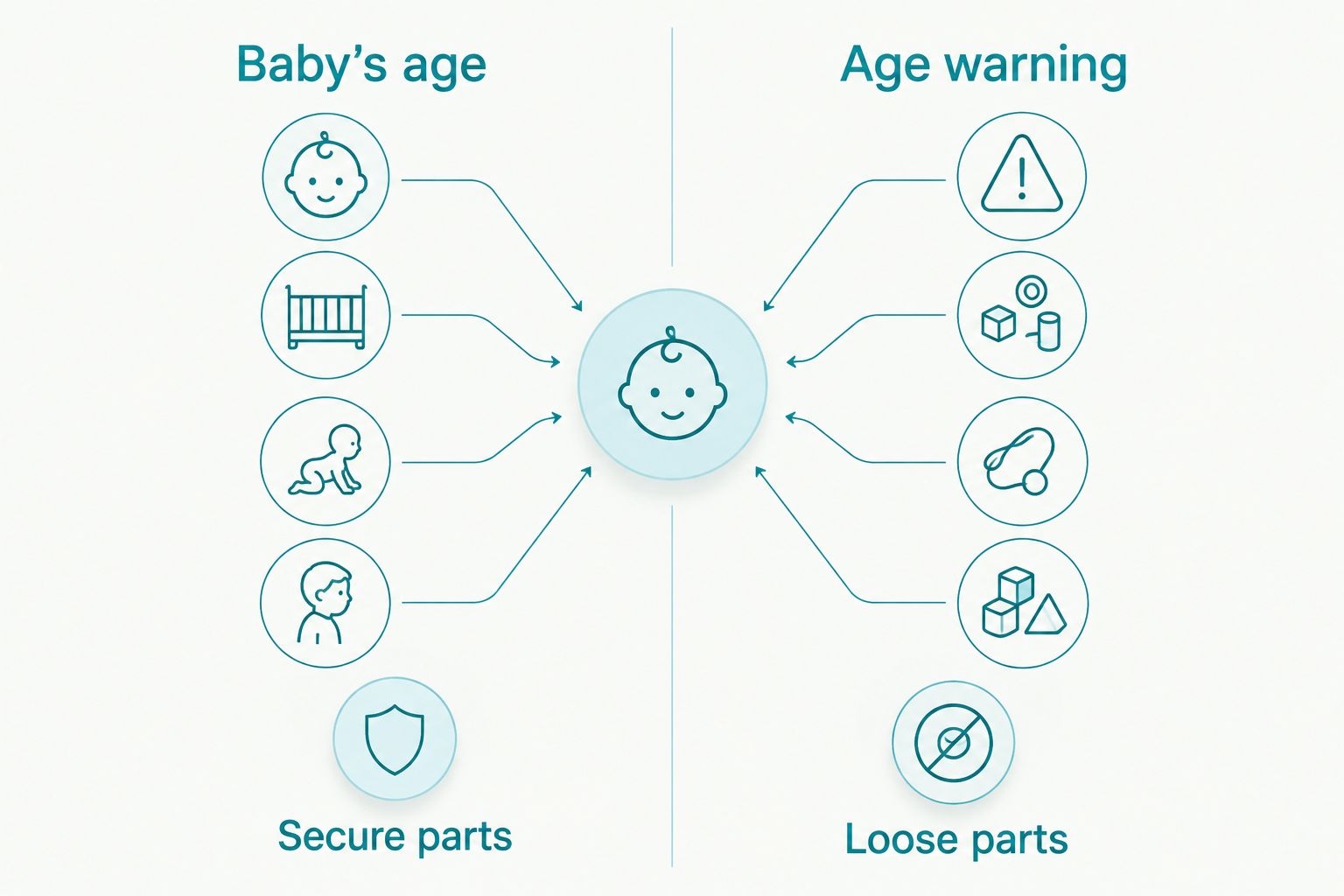
Are wooden teething toys safe from choking?
A wooden teething toy is not automatically safe because it is made for mouthing. Check its stated age range, examine every component and stop using it if a part becomes loose or damaged. Do not use the word teether as a substitute for those checks.
Habauk sells baby toys, including wooden grasping and teething toys. When considering a Habauk wooden toy, read the individual product’s age guidance and instructions before giving it to your baby; a product name alone does not establish suitability. The same rule applies to any toy you receive as a gift.
Teething also changes how you inspect a toy. Look at it again after use, especially where parts join. If you find damage, remove the toy rather than trying to decide whether a baby will notice the affected area.
Can a baby choke on a large wooden toy?
Yes, if a part of that toy separates and blocks the airway. A large shape does not tell you whether every attached piece will remain attached. Inspect the whole toy, including parts you might overlook when it is on a shelf.
An intact toy marked for a baby’s age presents a different choice from an older child’s set with loose pieces. Keep those sets separate. If you share a play space, check the floor after older children finish playing, before the baby returns to it.
Do not assume a missing piece has been thrown away. Treat it as an object that needs finding, particularly when a baby can crawl or reach beneath furniture. A quick play-area check prevents an older child’s toy from becoming an unexpected part of a baby’s playtime.
What should you do if a baby is choking on a toy?
If a baby cannot breathe, cry or cough effectively, call 999 immediately. Follow current NHS guidance for choking first aid while help is arranged. For a baby under 1 year old, NHS guidance calls for up to 5 back blows, followed by up to 5 chest thrusts if the obstruction remains. Repeat the sequence as directed and continue seeking emergency help.
If the baby is coughing effectively, encourage coughing and watch closely. Do not put your fingers blindly into their mouth: you can push an object further in. Choking first aid changes once a child is over 1 year old, so use the NHS instructions for the child’s age rather than treating every child the same way.
If another adult is present, have them call 999 while you begin first aid. If you are alone, follow the emergency-call instructions in the current NHS guidance. Even after the object comes out, seek medical advice if the baby has needed chest thrusts or you are concerned about their breathing.
This section is for the moment when you suspect choking, not a reason to wait for more obvious signs. A baby who cannot make an effective sound needs immediate action.
Why do toy age warnings matter?
An age warning is a safety instruction, not a suggestion about whether a child will enjoy the toy. In the UK, warnings for toys unsuitable for children under 36 months address hazards that can include small parts. Read the warning on the individual product; do not assume every wooden toy has the same components.
A birthday does not change the toy in your hands. If an older sibling opens a new game in 2026, keep its pieces in a separate place from the baby’s toys and clear them away when play ends. If packaging or instructions have been lost, avoid giving the toy to a baby until you can confirm its intended age range.
Habauk’s age-organised toy range can help you narrow a search, but the final check still belongs to the individual product’s label and condition. Best for baby play: an intact toy explicitly marked for your baby’s age. The trade-off is that you may need to set aside a toy that an older child enjoys until the baby is no longer sharing the play area.
How often should you check wooden toys?
Check a toy before you give it to a baby and again when you notice wear or a missing component. There is no benefit in waiting for a scheduled tidy-up if something feels loose now. Take the toy away, inspect it without the baby handling the pieces and follow its instructions.
Pay particular attention to toys that travel between homes or spend time at the bottom of a shared toy box. A toy that was intact last time still needs a look today. In 2026, the useful habit is simple: check the toy you are about to hand over, not just the one you remember buying.
FAQ
Can babies choke on wooden toys?
Yes. A small wooden toy or a piece that detaches can block a baby’s airway. Check the age marking, inspect every component and keep unsuitable pieces out of reach.
Are wooden toys safer from choking than plastic toys?
No material alone makes a toy safe from choking. The relevant checks are its intended age range, the size and security of its parts, and its condition.
Can a baby use a wooden toy marked unsuitable under 36 months if I supervise?
No. Follow the toy’s age warning and keep it away from the baby. Supervision does not remove a small-part hazard.
What if a piece breaks off a wooden toy?
Remove the toy and every broken piece from the baby’s play area. Do not give it back until you can establish that it is safe to use under its instructions.
What should I do if my baby cannot breathe after putting a toy in their mouth?
Call 999 immediately and follow NHS choking first-aid guidance. For a baby under 1 year old, that guidance uses up to 5 back blows followed by up to 5 chest thrusts if needed.
Is a wooden teething toy automatically safe for a baby?
No. Check the specific toy’s age marking and instructions, and inspect it for loose or damaged parts before use.
Should I put my finger in a baby’s mouth to remove a toy piece?
Do not sweep blindly with your finger. It can push an object further in; follow NHS choking first-aid guidance and call 999 if the baby cannot breathe, cry or cough effectively.
One last thing
The toy you chose for your baby is not the only toy to check. An older child’s missing game piece can become a baby’s next discovery on the floor, so finish shared play with a piece count and a quick look around. That small habit makes the next play session easier to enjoy together.