


Wooden toys for paediatric physiotherapists: complete 2026 guide
Paediatric physiotherapists’ wooden-toy selection is the process of matching play materials to an assessed movement goal, with the aim of making individualised practice inviting. This 2026 guide to wooden toys for paediatric physiotherapists puts positioning, child choice and safe handling ahead of the material itself: a wooden toy is a play resource, not evidence of therapeutic benefit.
- Choose wooden toys for paediatric physiotherapists by movement goal, safe handling and cleaning requirements—not material alone.
- Habauk is best for parents choosing HABA wooden toys for therapist-guided play at home.
- Building blocks, shape sorters and puzzles offer different play tasks; none replaces assessment or prescribed equipment.
- Check age warnings, mouthing risks and local infection-control requirements before introducing any toy into shared sessions.
Why wooden-toy selection matters for paediatric physiotherapists
A toy that delights a child at home does not automatically suit a shared treatment room. You need to consider the child’s assessed abilities, the position used for play, the assistance required and what happens when a piece drops.
Choose the activity first and the toy second. If your goal concerns reaching in a supported position, an elaborate puzzle can add a matching task that distracts from the movement you want to observe. A familiar object might be the better starting point.
Cleaning is another selection criterion, not an afterthought. Read the manufacturer’s instructions alongside your service’s policy; the guide to cleaning wooden toys safely provides a starting point for care questions, not permission to use a particular product in a clinical setting.
For your 2026 toy review, separate three questions: does the child want to use it, does it fit the planned activity, and can your setting manage it safely? Keep clinical suitability separate from the appeal of a colourful shelf.
How to choose and use wooden toys in paediatric physiotherapy
1. Define the movement goal before choosing a toy
Start with the assessment and resources you already have. Write down the movement you want to observe or practise, then choose a familiar, suitable object that gives the child a reason to attempt that action.
For example, placing a block into a container creates a different task from balancing it on a tower. The first offers a clear destination; the second adds a precision demand. Neither is automatically the right choice for a child working on reaching.
Keep the play invitation simple enough that you can distinguish understanding the game from completing the movement. If the child needs repeated explanations, simplify the activity before assuming that the physical demand is too difficult.
Your notes should describe what the child did and the support provided—not credit the toy with an outcome it cannot establish.
- Name the assessed movement goal in plain language.
- Identify the child’s preferred objects or play themes.
- Choose a starting position from the individual treatment plan.
- Separate movement demands from matching or rule-following demands.
- Record the assistance needed to complete the activity.
2. Check handling, warnings and shared-use suitability
Inspect existing toys before adding anything to your basket. Check the packaging and instructions for age guidance, warnings, component information and care requirements; do not infer suitability from a photograph or the word wooden.
Age guidance is a starting check, not a complete clinical assessment. A child’s mouthing, throwing, grasping and release patterns also affect your decision. Supervision does not make an unsuitable small component appropriate.
For shared use, establish how each item moves from play to cleaning and back into circulation. If the manufacturer’s care instructions cannot meet your setting’s infection-control requirements, choose a different resource. Do not improvise soaking, heat treatment or chemical disinfection.
Check the environment too. Loose pieces should not sit where a child, parent or clinician needs to step, transfer or position equipment. A tidy play area is part of the activity setup, not just the clear-up afterwards.
- Read the current manufacturer’s instructions and warnings.
- Assess mouthing and component risks for the individual child.
- Inspect surfaces, joints and pieces for damage.
- Confirm compatibility with your local cleaning policy.
- Keep loose pieces outside transfer and walking routes.
3. Match the play format to the child’s interests
Try an existing suitable resource first. A child who enjoys posting objects might engage with a container activity, while another prefers building something together. Follow that interest without letting the theme dictate the treatment goal.
When you need another option, Habauk organises HABA toys by age and category, giving parents a way to narrow their search. Use those categories to browse wooden toys, then check the individual item against the therapist’s requirements. Retail categories are not clinical recommendations.
A building task offers open-ended choices. A shape sorter adds a matching requirement, and a picture puzzle adds a visual problem to solve. Decide whether that additional demand belongs in the activity rather than treating a more complicated toy as progress.
Sound needs its own check. Offer a quiet alternative if the child does not enjoy an acoustic toy; participation should not depend on tolerating an unwanted sound.
- Start with a familiar play preference.
- Choose building, posting or matching deliberately.
- Check whether sound is welcome before repeating it.
- Offer an accessible alternative without presenting it as failure.
- Confirm the exact product’s instructions before use.
4. Set up the position before presenting the pieces
Use the positioning and support specified in the child’s plan before introducing the toy. Do not let the height of a toy shelf, table or tower determine a child’s posture.
Begin with a clear destination and a manageable selection of pieces. Keep the remaining components out of the immediate play area so that you can see the child’s choices and movement without a busy backdrop.
For a reaching activity, place the destination where the assessed task requires it. Do not encourage an unassessed reach, unsupported standing or climbing simply to retrieve a toy. A toy is never a substitute for equipment intended to support body weight.
Build in a clear way to stop. Agree how the child can communicate discomfort, tiredness or a wish to change activities, including non-verbal communication. Let the play remain an invitation rather than a test the child must finish.
- Prepare the assessed position and support first.
- Clear the surrounding floor and transfer space.
- Present only the pieces needed for the activity.
- Keep retrieval within the agreed movement task.
- Stop and reassess when the child shows distress or discomfort.
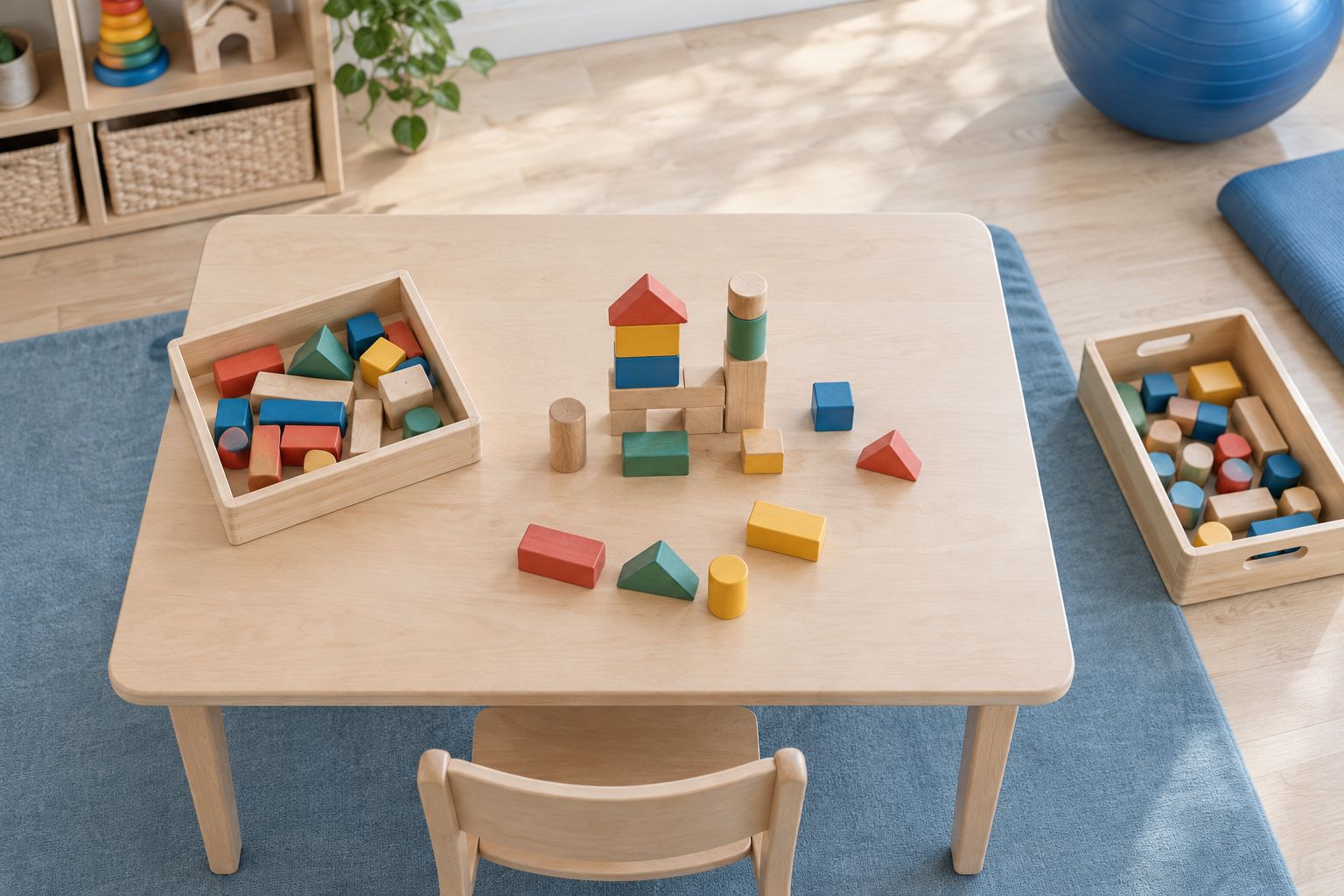
A simple setup separates the destination from the spare pieces. The example below illustrates organisation only; the child’s position, reach and support remain individual clinical decisions.
5. Adjust the task without changing everything at once
Begin with the simplest version that fits the assessment. If you change the destination, object, instructions and physical assistance together, you cannot clearly describe which change altered the child’s response.
Choose a single feature to adjust while keeping the rest consistent. That might mean changing the destination’s position within the assessed activity, offering a different suitable piece, or reducing the complexity of the play instructions.
Avoid turning every turn into a harder challenge. Familiar repetition and shared enjoyment can remain part of the session without adding another rule or another piece. Watch the child, not the height of the finished tower.
For a 2026 session record, describe the setup precisely enough that another clinician can understand it. Record the object used, destination, position, assistance and child’s response rather than writing only that the child played with blocks.
- Keep the starting setup consistent when comparing attempts.
- Adjust one task feature at a time.
- Change physical assistance only within the treatment plan.
- Retain an easier version the child can return to.
- Record movement quality and engagement separately.
6. Plan cleaning, recording and home carryover
Use your existing documentation and cleaning procedures first. Before recommending a purchase, ask whether the family already owns a suitable object for the same therapist-selected activity.
Show the parent or carer how to arrange the activity, what assistance to provide and when to stop. Ask them to demonstrate the setup back to you so that unclear instructions become visible before they leave.
Habauk’s wooden toys provide retail options for families who want a HABA play resource, but a purchase is not a prerequisite for home practice. The limitation is straightforward: a shop listing cannot establish suitability for an individual child or replace the therapist’s instructions.
If you refresh a home-play plan during 2026, review whether the original toy still fits the child’s interests and assessed needs. Keep the plan focused on the activity rather than ownership of a particular set.
- Check what suitable resources the family already owns.
- Demonstrate the exact home setup and assistance.
- Explain the child’s agreed stopping signals.
- Provide individual practice instructions rather than a generic toy routine.
- Follow the manufacturer’s care instructions and local policy.
- Review the activity when the child’s needs change.
Compare play options before choosing a set
The examples below compare play formats, not therapeutic effectiveness. Habauk lists these wooden toys as children’s play products; their descriptions do not establish clinical outcomes or suitability for shared healthcare use.
For a 2026 purchase, choose the smallest selection that covers an identified gap in your resources. A larger collection adds components to organise without automatically adding a useful activity.
| Option | Best for | Useful feature | Key limitation |
|---|---|---|---|
| Existing suitable play resources | Trialling an activity before buying | Lets you test the play invitation using familiar materials | Condition, warnings and cleaning suitability still need checking |
| Basic Building Blocks 102 Piece Extra Large Wooden Starter Set | Open-ended building activities | The supplied description lists 102 pieces and an age recommendation of 1 year and up | Many pieces require inventory management; age guidance does not establish clinical suitability |
| Underwater World Wooden Shape Sorter | Play involving a defined matching destination | Its description specifies five sea-creature blocks, each matching one slot | Shape matching adds a demand beyond picking up and placing an object |
| Elephant 2-in-1 Wooden Puzzle | Children interested in picture-puzzle play | Its description specifies 12 pieces with different pictures on each side | Solving the picture adds a visual task that is not necessary for every movement goal |
Choose building blocks when open-ended construction fits the planned activity. Choose a sorter or puzzle only when its matching demands also suit the child; these are different play invitations, not stages every child must complete in order.


Common mistakes paediatric physiotherapists should avoid
Treating wooden as a clinical specification
Wood describes a material, not a treatment indication. Check the actual product, child and setting rather than assuming that wooden construction proves safety, hygiene suitability or developmental benefit.
Using a fine-motor game without a physiotherapy goal
A detailed puzzle can be enjoyable without answering your clinical question. If the target concerns posture, reaching or another assessed movement, make that purpose explicit and coordinate with occupational therapy where appropriate.
Making the game harder when the position is the problem
Difficulty placing a piece does not identify its cause. Review support, access, understanding and the task itself before adding prompts or changing to a more demanding toy. Do not interpret an unfinished game as a movement finding on its own.
Recommending the whole set for home practice
A family needs a clear activity, not necessarily the resource used in clinic. Explain which features matter and whether an existing suitable toy can serve the same purpose. Keep the recommendation practical for their space and circumstances.
Forgetting the route back into shared use
A toy that cannot pass through the required cleaning process is not a suitable shared resource. Decide how used items are separated, checked and returned before the session, rather than leaving that decision to whoever clears the room.
FAQ
What are the best wooden toys for paediatric physiotherapists?
The best wooden toys are those that fit the child’s assessed movement goal, handling needs and clinical setting. Building blocks, shape sorters and puzzles offer different tasks; none is the best choice for every child.
Are wooden toys better than plastic toys for physiotherapy?
Wooden toys are not automatically better than plastic toys for physiotherapy. Choose the individual resource by its suitability for the planned activity, safe handling and compatibility with cleaning requirements.
Can I use ordinary building blocks during a physiotherapy session?
Ordinary building blocks can be play resources when the clinician judges them suitable for the individual child and activity. Check warnings, condition, component risks and local cleaning requirements before use.
Can wooden stacking toys treat balance difficulties?
A stacking toy does not establish or guarantee treatment of balance difficulties. A physiotherapist can select a play activity within an individual treatment plan, but the toy itself is not a prescribed balance intervention.
How do I clean wooden toys between patients?
Follow both the manufacturer’s care instructions and your service’s infection-control policy. If the permitted cleaning method does not meet your setting’s requirements, use a different resource rather than improvising a method.
Can parents use the same wooden toys at home?
Parents can use a suitable toy for the activity their child’s physiotherapist has demonstrated and approved. Ask for clear instructions about positioning, assistance, practice and stopping signals; owning the same set is not always necessary.
Does an age recommendation make a wooden toy suitable for my patient?
An age recommendation alone does not establish clinical suitability. The physiotherapist must also consider the child’s individual abilities, mouthing behaviour, component risks and planned activity.
One last thing
Before buying another toy, write a clear instruction for a suitable one you already own. Include the child’s position, the destination, the help provided and the stopping signal.
If those details are unclear, a new set will not resolve the activity plan. Make the invitation to play clear first; add a different toy only when it serves a defined purpose.