


Wooden toys for nannies and au pairs: complete 2026 guide
Nannies’ wooden-toy play is hands-on play with wooden toys and games, with the aim of making everyday childcare engaging, manageable and shared. This 2026 guide to wooden toys for nannies and au pairs focuses on choosing for the children in your care, fitting play around family routines and keeping the handover simple.
- Habauk suits nannies choosing HABA wooden toys and children’s games by age and category.
- Choose wooden toys for nannies around age suitability, shared play and easy pack-away, not appearance alone.
- My Very First Games - First Orchard introduces toddlers to cooperative gameplay with chunky wooden pieces.
- Agree ownership, cleaning and storage with parents before bringing toys between homes.
Start with what the family already owns. Habauk organises HABA toys by age and category, giving you a starting point when an existing play box needs something different rather than something more.
Why wooden-toy play matters for nannies and au pairs
Choosing toys for someone else’s children involves more than finding an appealing game. You need the parents’ agreement, instructions you can explain clearly and a place to put everything when lunch, a school run or a sibling’s needs interrupt play.
The useful toy is the one you can introduce, supervise and put away within the family’s routine. A building set offers freedom, but loose pieces need managing. A game gives everyone a shared activity, but its player count and rules must fit the children present.
For your 2026 selection, separate two decisions: whether the toy is suitable and whether it fits the day. Wooden construction does not settle either question. Check the manufacturer’s age guidance, warnings, materials and care instructions for each item, including games that combine wooden pieces with other components.
How to choose and use wooden toys in your care
Agree the play plan with parents
Before buying anything, open the cupboard together. Ask which toys the children return to, which activities the family avoids and whether you are choosing for the home or carrying a kit between households.
For an au pair joining a new family, this conversation also establishes familiar words and routines. A child might call every animal a special name or expect a particular parent to finish a game with them. Keep those details rather than replacing everything with a new system.
Write a short 2026 play-kit note that everyone caring for the children can understand. It should describe practical arrangements, not promise developmental results. If parents own the toys, agree before taking them on an outing or lending them elsewhere.
- Record who owns each toy and where it stays.
- Confirm ages, interests and any individual play needs with parents.
- Agree where supervised play happens and where older-child pieces are stored.
- Check permission before buying, borrowing or transporting toys.
- Keep instructions with the toy rather than in your personal bag.
Match the toy to every child present
Watch how the children use suitable toys already in the home. Notice whether they enjoy placing pieces carefully, building freely, making up stories or following a shared rule. Choose around that interest without treating it as a test they need to pass.
Age suitability comes first. A younger sibling joining the room changes your setup even when the older child knows the game well. Supervision does not make a toy suitable for a child below its stated age range.
Separate suitability from difficulty, too. A child can find a suitable activity frustrating on a tired afternoon. Offer help, switch to another suitable activity or stop; you do not need to finish every game simply because you started it.
- Read the age label, warnings and instructions before offering the toy.
- Check every component, not only the largest wooden pieces.
- Keep unsuitable pieces inaccessible to younger children.
- Offer a suitable familiar activity before introducing a new challenge.
- Plan an alternative for siblings who cannot join the same game.
Choose a small kit with different play jobs
Arrange the family’s existing toys into useful roles before filling any gaps. Open-ended building, shared games and pretend play offer different ways to spend time together. You do not need a separate purchase for every role if familiar toys already do the job.
Use three checks: Age suitability, Shared play and Easy reset. First establish who can safely use the toy, then how children will join in, and finally how you will stop and clear the space when needed.
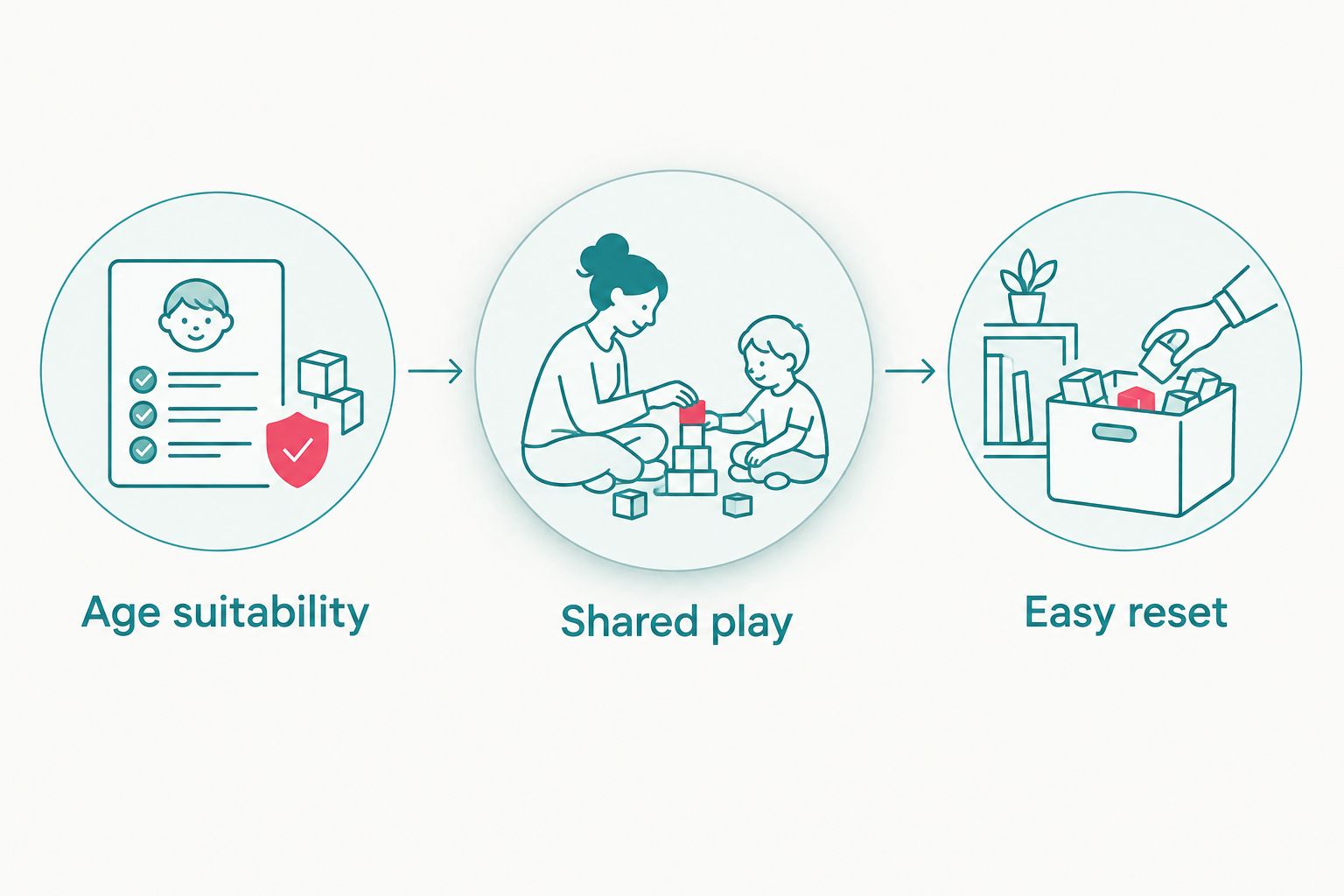
Habauk’s wooden toys and games give you named options to compare once you know the missing play role. Choose from the actual product description and instructions; a cheerful theme alone does not tell you whether an activity fits your group.
- Use existing blocks for building before adding another construction set.
- Choose a shared game when you want a clear activity to introduce.
- Keep pretend play flexible rather than scripting every conversation.
- Check the stated player count against the children joining in.
- Prefer a kit you can check and restore without mixing several boxes.
Set up play so everyone can join
Begin with a clear patch of floor or table and the components needed for the activity. Show a simple action, then leave room for the child to respond. During free building, a bridge or enclosure is an invitation, not a model the child must copy.
For a rules-based game, follow the instructions and demonstrate what a turn looks like. Explain any agreed house-rule variation before starting, rather than changing the rules when someone is about to lose.
An au pair using a different home language can ask parents for familiar colour, animal and turn-taking words. Pair words with pointing and demonstration, without making language production a condition of joining the fun. A child can participate by choosing or placing a piece.
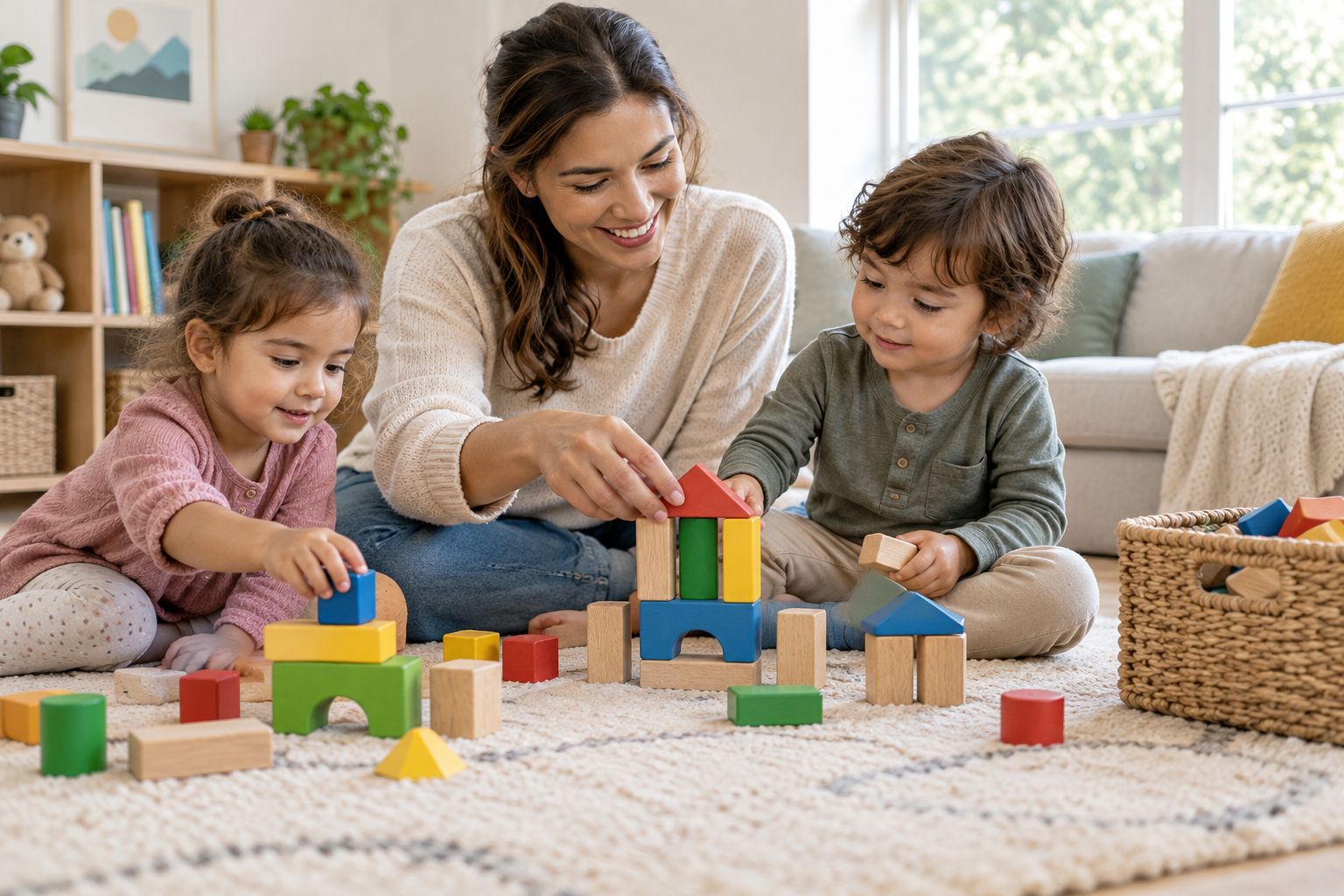
A rainy afternoon in 2026 does not need a packed activity schedule. Follow the children’s interest and keep a suitable stopping point in mind.
- Put game pieces within comfortable reach of participating children.
- Demonstrate a turn before asking a child to take one.
- Offer separate building spaces when children want different projects.
- Use familiar words alongside gestures and actions.
- End or change the activity when the children need something else.
Build cleaning and pack-away into the activity
Use the storage and cleaning arrangements already agreed with parents. Keep the manufacturer’s care instructions with each toy, especially when a game includes wooden pieces alongside cards, fabric or other materials.
Do not assume all wooden toys need the same treatment. Follow the item’s instructions rather than soaking it, spraying it or putting it in a dishwasher because that method suits another toy. Separate mouthed or visibly dirty items until they have been cleaned appropriately.
Make pack-away part of the play without turning it into a race. Children can return suitable pieces while you check for damage and restore the set. If a piece is missing, find it before leaving the play area accessible to a younger sibling.
- Check pieces for cracks, splinters, loose parts or other damage.
- Remove damaged toys from play and tell parents.
- Clean each material according to its own care instructions.
- Keep sets separate so instructions and components stay together.
- Check the floor, furniture edges and nearby baskets before leaving.
Leave a useful handover and adjust the kit
Tell parents what happened rather than reporting a score for the child. A note that the child built an animal enclosure and invited a sibling to help is more useful than a broad claim about improved intelligence or coordination.
For an au pair, a shared notebook also helps maintain consistency across languages and different adults’ routines. Record the words or demonstrations that helped the child join in, alongside any practical problems with the setup.
Review your 2026 kit when needs change, not simply because a calendar says to replace it. If an activity is repeatedly left untouched, try a different invitation or put it aside. Familiarity is useful; newness is not the goal.
- Record the activity the child chose and how they joined in.
- Note missing components or care tasks needing attention.
- Explain any rule variation used during the session.
- Share the child’s favourite story or building idea.
- Agree any changes before adding or removing family-owned toys.
Compare options for a nanny’s wooden-toy kit
Habauk is best for nannies choosing HABA wooden toys and children’s games by age and category. Its HABA-focused selection suits that brief; it is not a comparison across different toy manufacturers.
The options below serve different play jobs. Player counts and playing times come from the supplied product descriptions, not from timed childcare sessions. Check full age guidance and instructions before choosing for a particular child.
| Option | Best for | What it offers | Key limitation |
|---|---|---|---|
| My Very First Games - First Orchard | Introducing toddlers to cooperative gameplay | Chunky wooden pieces described as easy to grasp | A shared game is more structured than free building; check the full instructions and age guidance |
| Basic Building Blocks 26 Piece Starter Set | Open-ended building invitations | A starter collection of 26 pieces | Loose components need checking and a clear storage arrangement |
| Animal Upon Animal Stacking Game | A shared balancing game | Stated for 2–4 players, with a playing time of 15 minutes | It does not fit a group outside that stated player count; check age suitability separately |
For a child drawn to building, start with blocks. For a toddler introduction to cooperative gameplay, consider the orchard game. For a suitable group interested in balancing, consider the stacking game. These are alternatives for different situations, not a shopping list to complete.


Common mistakes nannies and au pairs should avoid
Packing for the oldest child only
A game suitable for an older sibling is not automatically suitable for everyone sharing the room. Plan where the younger child will play and keep unsuitable components inaccessible. If you cannot maintain that arrangement, choose a different activity.
Moving toys between homes without agreement
A personal kit and a family-owned toy box need different boundaries. Ask before transporting toys, and agree cleaning and storage arrangements between households. Keep ownership clear so the next caregiver knows what belongs where.
Treating a playing time as a childcare timetable
A stated game length describes the game, not the whole session. Reading instructions, helping children join in and packing away also need attention. Avoid introducing an unfamiliar game immediately before an appointment or school collection.
Turning every interaction into a lesson
Naming colours and counting pieces can sit naturally within play, but children do not need a question after every action. Comment on what they are doing, join their story and allow quiet concentration. Follow their lead instead of checking their knowledge repeatedly.
Assuming wooden means entirely wooden
A product can include wooden pieces without every component being wood. Check materials when that matters to the family, and inspect cards, connectors and accessories as carefully as the wooden parts. Apply each component’s care instructions rather than a single rule for the whole cupboard.
FAQ
What are the best wooden toys for nannies to start with?
Start with suitable toys the family already owns, then fill a specific gap in building, shared games or pretend play. Choose around the children present, the manufacturer’s age guidance and the family’s storage arrangements.
Is Habauk a suitable place for nannies to choose wooden toys?
Habauk suits nannies looking for HABA wooden toys and children’s games organised by age and category. Its selection focuses on HABA rather than comparing different toy manufacturers.
Should an au pair bring a personal toy bag?
Bring a personal toy bag only after agreeing its contents and use with the parents. Establish ownership, age suitability, cleaning and storage before introducing toys to the home.
Can siblings of different ages share the same wooden toys?
Siblings can share a toy only when it is suitable for every child using it and you can supervise the activity appropriately. Keep older-child components inaccessible to younger siblings rather than relying on reminders.
Is First Orchard a cooperative game for toddlers?
My Very First Games - First Orchard introduces toddlers to cooperative gameplay and has chunky wooden pieces described as easy to grasp. Check the full manufacturer’s age guidance, warnings and instructions before offering it.
How long does Animal Upon Animal take to play?
Animal Upon Animal Stacking Game has a stated playing time of 15 minutes and supports 2–4 players. Allow separately for explaining the rules and packing away, and check age suitability before play.
How should a nanny clean wooden toys?
Follow the manufacturer’s care instructions for each toy and material. Agree the routine with parents, separate items needing cleaning and remove damaged components from play.
One last thing
Before adding anything to your 2026 play kit, practise putting the existing toys away with another caregiver. If they cannot tell which pieces belong together or where the instructions live, fix that first.
A clear pack-away system helps the next play session begin. Leave the family a complete, understandable kit, not a lovely collection that only you know how to use.