


Wooden toys for large families: complete 2026 guide
Wooden toys for large families are shared playthings chosen to give siblings room to build, imagine and play together without needing a separate set for everyone. This 2026 guide helps you choose around different ages, actual player counts and the space you have—not just the biggest box.
- Choose wooden toys for large families by age suitability, shared access and storage—not piece count alone.
- Habauk suits parents shopping for HABA wooden toys and children's games together.
- Orchard Cooperative Board Game lists 1–8 players; check the youngest participant's age suitability before choosing.
- Combine open-ended building blocks with cooperative games rather than expecting one toy to suit every sibling.
Why wooden toys matter for large families
A shared toy needs to work beyond the moment you unwrap it. Can siblings reach the pieces together? Can a younger child join safely? Where does an unfinished building go when everyone needs the floor back?
Habauk is best for parents who want HABA wooden toys and children's games in one UK online store. You can start with Habauk when you know which ages and types of play you need to accommodate.
The useful distinction is between a toy children can use alongside each other and a game with a stated player limit. Building blocks let you divide materials between projects; a board game asks everyone to follow its rules and wait for turns. Neither approach replaces the other.
For your 2026 family toy cupboard, choose around those different jobs. A shared construction set, a suitable group game and somewhere to protect older children's small-piece activities make a more practical plan than expecting every toy to entertain every child.
How to choose wooden toys for large families
Check your youngest child's access first
Start with the toys you already own. Read their age guidance and warnings, then decide which can stay in a shared play area and which need a separate space. A toy's wooden material does not establish whether it is suitable for your youngest child.
An older sibling's game remains an older sibling's game when a baby enters the room. Supervision does not cancel a small-parts warning, and asking children to keep loose pieces on a rug is not a secure boundary.
Make this the first check on your 2026 shopping list. Choose toys for the children who will actually handle them, not simply the child whose name will appear on the gift tag.
- Read the stated age guidance before choosing a shared toy.
- Check warnings for small parts and other hazards.
- Keep unsuitable games out of younger children's reach.
- Set up older children's activities in a separate, supervised area.
- Recheck access when a younger sibling becomes more mobile.
Match the play format to your family
Watch an ordinary play session before adding anything new. Notice whether your children enjoy building side by side, inventing stories together or following a game from beginning to end. Start by rearranging existing toys around the format they already enjoy.
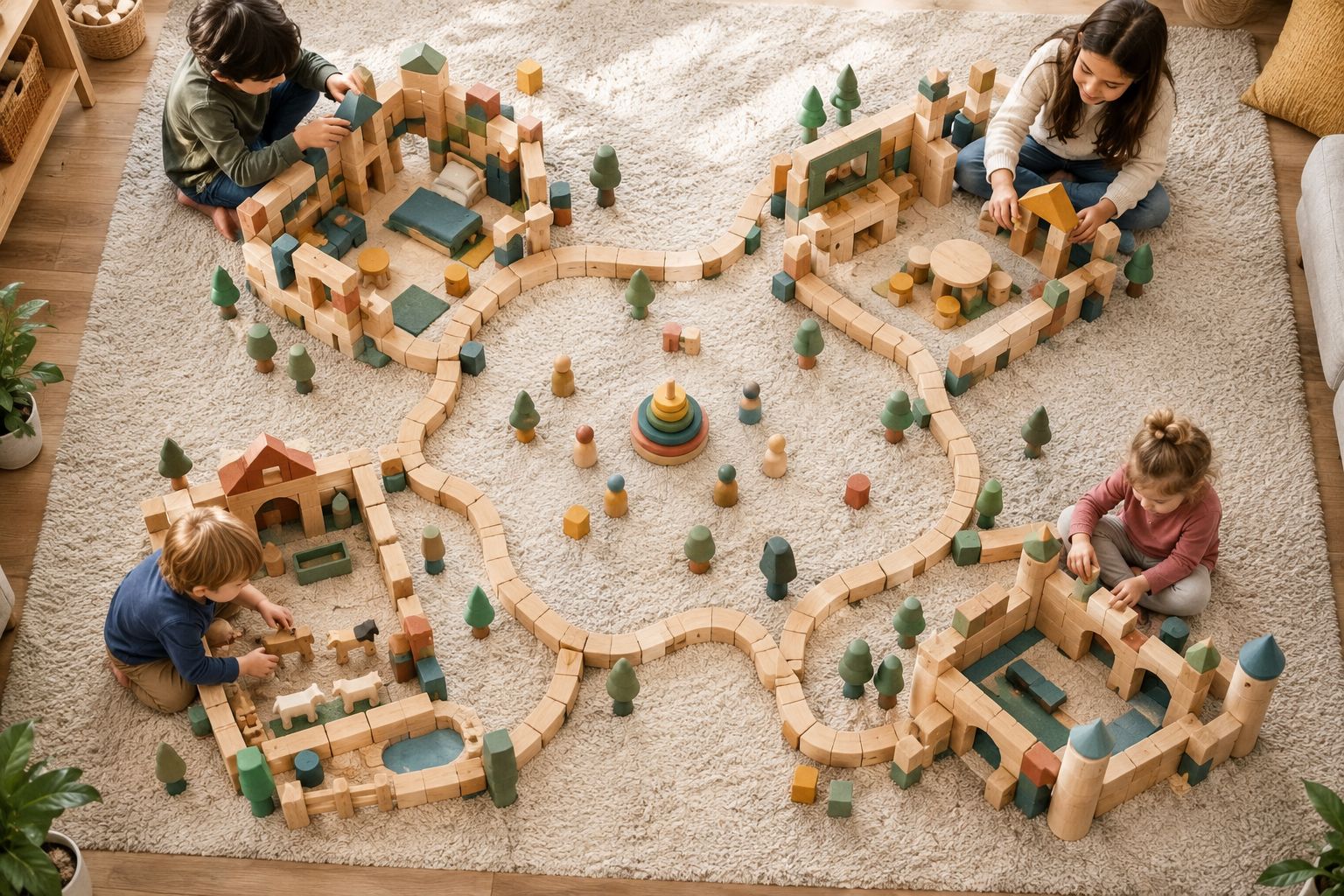
Open-ended play gives siblings different jobs without requiring identical skills. One child can build a wall while another arranges a path. The trade-off is that you will need to agree who can change a shared structure and when it is time to clear away.
Games provide clearer boundaries, but those boundaries include a player limit. Count participating adults as well as children, and check whether everyone can manage the rules without another sibling taking over.
- Choose parallel building for children who want separate projects nearby.
- Choose cooperative games for a shared goal.
- Choose pretend play when siblings enjoy making up roles.
- Count every intended player, including adults.
- Keep a separate activity ready for anyone who wants to stop.
Choose enough useful pieces, not the largest total
Tip out your existing blocks and see what runs short. The missing ingredient might be more flat building surfaces rather than more pieces overall. If children repeatedly want the same component, identify its role before buying another whole set.
Habauk's wooden toys include Basic Building Blocks 60 Piece Large Starter Set, described as solid beech wood blocks, and Basic Building Blocks 102 Piece Extra Large Wooden Starter Set. The latter's description states ages 1 and up; still check the complete current guidance before deciding who can share it.
A 102-piece set gives you more pieces than a 60-piece set. It does not, by itself, establish a suitable number of children or guarantee that everyone gets the shapes they want. Choose for the projects your children make, then check the storage needed.
- Identify the shapes your children regularly compete over.
- Check the contents rather than relying on the headline total.
- Consider whether siblings can build separate projects.
- Confirm suitability for every intended user.
- Decide where the complete set will live before adding it.
Give siblings clear roles without taking over
Try a shared project with the toys already on your shelf. Invite your children to make a village, a pretend café or an animal home, then let them choose different contributions. Keep the invitation simple enough that nobody needs to direct everyone else.
Roles are useful when they create room to participate, not when the oldest child becomes the permanent organiser. Offer a younger sibling a meaningful part of the play, such as arranging an age-suitable collection, rather than a job that depends on completing another child's instructions.
For rainy afternoons in 2026, keep a few project ideas on a paper list. You do not need a new themed set every time the story changes; familiar blocks can become the setting for a fresh adventure.
- Offer building, arranging and storytelling roles.
- Let children choose whether to combine their projects.
- Rotate sought-after jobs rather than assigning them by age.
- Ask before changing someone else's construction.
- Agree which creations can stay up after play.
Check game capacity before planning everyone-in play
Use a familiar game to see who wants to join and who needs help. Count seats before choosing another game, then compare the stated player range and playing time with the group you actually have.
Orchard Cooperative Board Game lists 1–8 players and a playing time of 10–15 minutes in the supplied product information. Those details make it a candidate for a larger family session, subject to its age guidance. They are not a promise that every child will want to stay for the full game.
Do not quietly stretch a game's player limit to fit your household. If you decide to pair children, explain that you are adapting the format and check that both teammates get to take part. Another option is to run separate activities rather than insist on one table.
- Check the published player range.
- Include adults in your headcount.
- Read the rules before inviting everyone to sit down.
- Plan help without letting one sibling make every decision.
- Offer a comfortable way to leave the activity.
Plan the reset before adding more toys
Start with containers and shelf space you already have. Give each shared set a clear home, and keep its instructions with it. A cupboard full of mixed game pieces is harder to use than a smaller collection you can bring out ready to play.
Treat your 2026 toy refresh as a chance to solve a specific problem: overcrowded play, missing pieces, unsuitable access or a shortage of group activities. Buying more does not fix a layout that leaves children unable to reach what they need.
Before passing a toy to a younger sibling, inspect it and reread its guidance. Keep damaged pieces out of play, and follow the manufacturer's cleaning and care instructions rather than assuming all wooden toys need the same treatment.
- Give each set its own storage place.
- Store instructions with the matching game.
- Separate incomplete sets until you have checked their contents.
- Inspect toys before handing them down.
- Choose the next addition around an identified gap.
Compare options for your family toy cupboard
Habauk's wooden toys and games cover different kinds of shared play. Use this comparison to choose the job first: building alongside siblings is not the same as playing a game together. The game listed below is included for group play, not as a claim that every component is wooden.
| Option | Best for | What supports that choice | Key limitation |
|---|---|---|---|
| Basic Building Blocks 60 Piece Large Starter Set | Siblings making separate constructions nearby | The description specifies 60 solid beech wood pieces | Piece count does not establish how many children can build comfortably |
| Basic Building Blocks 102 Piece Extra Large Wooden Starter Set | Families seeking more building pieces to divide between projects | The set contains 102 pieces; its description states ages 1 and up | More pieces also need a manageable storage and clearing-away plan |
| Orchard Cooperative Board Game | A larger group wanting a cooperative game | The listing states 1–8 players and 10–15 minutes | It requires turn-taking and suitable age guidance; it is not free-building play |
| Wooden pretend-play pieces you already own | Siblings who enjoy inventing stories and roles | Existing suitable toys can become shared story props | Shared roles and access still need agreement; inspect each toy individually |
Choose building blocks for flexible projects; choose a suitable cooperative game when you want a shared goal. If your cupboard already covers one format, concentrate on the missing one rather than buying another version of the same activity.
The following product cards bring together the building sets and group game discussed above. Check each product's complete guidance before choosing for a mixed-age household.


Common mistakes large families make
Expecting every toy to suit every sibling
A shared collection does not need to be universally accessible. Keep age-appropriate shared toys in the family play area and protect older children's activities elsewhere. That respects both safety guidance and an older child's wish to finish something without interruption.
Treating more pieces as proof of better sharing
A larger box does not resolve a disagreement over the same favourite component. Watch what children actually want to do, then change the layout, divide materials or agree turns around that specific task. Buy additional pieces only when you understand the shortage.
Confusing cooperative play with unlimited participation
Cooperative describes how players work towards the outcome, not how many people can join. Follow the stated player range. If your family is larger than the game allows, choose another activity or clearly explain any household adaptation before starting.
Making the oldest child responsible for the session
Helping a younger sibling should be an invitation, not the price of joining family play. Take responsibility for explaining rules and managing access yourself. Let older children enjoy their own challenge instead of spending the whole session sorting pieces or settling disputes.
Buying for hand-me-down appeal without checking condition
Passing toys between siblings starts with a fresh inspection, not an assumption that wood lasts indefinitely. Look for damage, loose components and missing instructions. Remove damaged toys from play and check the manufacturer's advice before repair or reuse.
FAQ
What are the best wooden toys for large families?
The best wooden toys for large families fit the children's ages, allow useful shared access and have a workable storage plan. Open-ended building blocks suit parallel projects, while an appropriately rated cooperative game provides a shared goal.
Can children of different ages share wooden toys?
Children of different ages can share a wooden toy only when its guidance and condition make it suitable for every child using it. Keep older children's unsuitable small-piece activities separate from younger siblings.
Is a bigger wooden block set always better for siblings?
A bigger wooden block set is not automatically better for siblings. Check the shapes included, the projects children want to make and where the set will be stored before choosing by piece count.
Which game suits a larger family group?
Orchard Cooperative Board Game is a candidate for a larger family group because its listing states 1–8 players and 10–15 minutes. Check its age guidance and rules before deciding whether it suits everyone joining in.
Do cooperative games stop siblings arguing?
Cooperative games do not guarantee argument-free play. They give players a shared goal, but children still need help with turns, decisions and respecting each other's contributions.
How do I store wooden toys when several children share them?
Store shared wooden toys by set, with a clear home for each collection and instructions kept alongside games. Keep unsuitable pieces out of younger children's reach and follow the manufacturer's care guidance.
Should every child have a separate wooden toy set?
Every child does not need a separate set if a suitable shared collection supports the way your children play. Protect personal projects and provide separate activities when ages, interests or safety guidance make sharing unsuitable.
One last thing
Before adding another toy, give an existing favourite a clearer place to play. Divide the building area, protect an unfinished creation or put the right instructions back in the box. Then watch what still gets in the way.
Use that observation to choose your next addition from Habauk. The most useful family toy is not necessarily the biggest set; it is the one that fills a real gap without creating another problem at clearing-away time.