


Wooden toys for home educators: complete 2026 guide
Home educators’ wooden-toy learning is hands-on play with the aim of making counting, language and problem-solving visible through objects children can move and explore. This 2026 guide to wooden toys for home educators helps you choose resources for mixed-age play, shared family spaces and learning that follows your child’s interests.
- Choose wooden toys for home educators by learning purpose, age suitability and how your child already plays.
- Habauk suits parents seeking HABA wooden toys for hands-on learning at home.
- Building blocks suit counting and construction; sorting toys suit matching; pretend play creates opportunities for conversation.
- Use resources you already own before adding a toy, and keep small parts away from younger siblings.
Why wooden toys matter for home educators
Home education brings play and learning into the same space. A tower built after breakfast can become a conversation about height, a counting activity or the setting for a story. Choose a resource for what your child can do with it, not simply because it looks educational.
You also need to consider everyone sharing the room. A construction activity suitable for an older child is not automatically safe beside a baby, and a game requiring adult guidance is not an independent activity. Plan the setting alongside the toy.
Habauk is best for parents seeking HABA wooden toys for hands-on learning at home. Habauk organises toys by age and category, giving you a starting point for narrowing your choices. That organisation helps with browsing; you still need to read each toy’s age guidance, warnings and instructions.
For your 2026 home-learning plans, start with an activity rather than a shopping list. Decide whether you want to count, build, compare, describe or tell stories, then look for a resource that makes that action possible. Wood alone does not establish educational value or safety.
Build a wooden-toy learning routine
Start with a learning purpose
Begin with the toys and household resources you already have. Put suitable blocks on the table and notice what your child does: arranging a line, building upwards, grouping shapes or inventing a home for an animal. Use that interest as your starting point rather than interrupting it with a lesson.
Choose a clear focus for your invitation to play. For early maths, compare groups or lengths; for language, describe a construction or tell its story. You can return to the same resources with a different question another day, without buying a separate toy for every subject.
Keep the task small enough to explain naturally. Asking your child to build a bridge gives them something concrete to attempt; announcing that they are developing spatial reasoning gives them little direction. Let the learning sit inside an enjoyable activity.
- Write the intended action: count, compare, build, match or describe.
- Offer resources your child can handle safely.
- Demonstrate the activity without completing it for them.
- Follow an unexpected idea when it remains safe.
- Finish with a conversation about what happened.
Check suitability for every child sharing the space
Before choosing anything new, review the resources you already own. Check their condition, instructions and age guidance. Separate toys with small components from areas used by children who mouth objects, and plan where older siblings will work when younger children are nearby.
Match the challenge to what your child can currently manage. Large building pieces and smaller puzzle components involve different handling demands. An age label is a safety and suitability starting point, not a promise that every child of that age will enjoy the same task.
Habauk’s wooden toys span building, sorting and other play categories, so narrow your search by activity as well as age. For example, the Basic Building Blocks 102 Piece Extra Large Wooden Starter Set is described for ages 1 and up. Read the full current guidance before deciding how to use it in your household.
In 2026, keep the distinction between supervised and independent play explicit. Being able to complete a task does not remove the need to follow its safety instructions.
- Read the age guidance and warnings before introducing a toy.
- Inspect pieces for damage and remove damaged items from play.
- Keep small parts beyond younger siblings’ reach.
- Choose a stable, clear surface for construction.
- Follow the manufacturer’s cleaning and care instructions.
Choose resources that support different activities
Try an activity with existing resources before choosing a dedicated set. Suitable blocks can become a row to count, a structure to copy or scenery for a story. If your child repeatedly returns to those activities, you have a clearer reason to add a building resource.
The Basic Building Blocks 102 Piece Extra Large Wooden Starter Set contains 102 pieces and offers a building option for families who want a larger collection. The Colored Wooden Building Blocks - 46 Piece Set contains 46 pieces and offers a smaller collection by piece count. Neither count tells you the storage dimensions or whether the set suits your child.
Rainbow Whirls Wooden Sorting and Stacking Game is another option when sorting and stacking are the activities you want to offer. Its description identifies toddlers and preschoolers as its audience. Choose it for that type of play, not as a substitute for checking the full age guidance.
Before adding a set, describe its intended use under these headings. If you cannot name an activity you want to offer, keep exploring what you already own.
- Counting: move an object for each spoken number.
- Building: make and revise a structure.
- Sorting: group suitable pieces by a visible feature.
- Storytelling: use a construction as a setting.
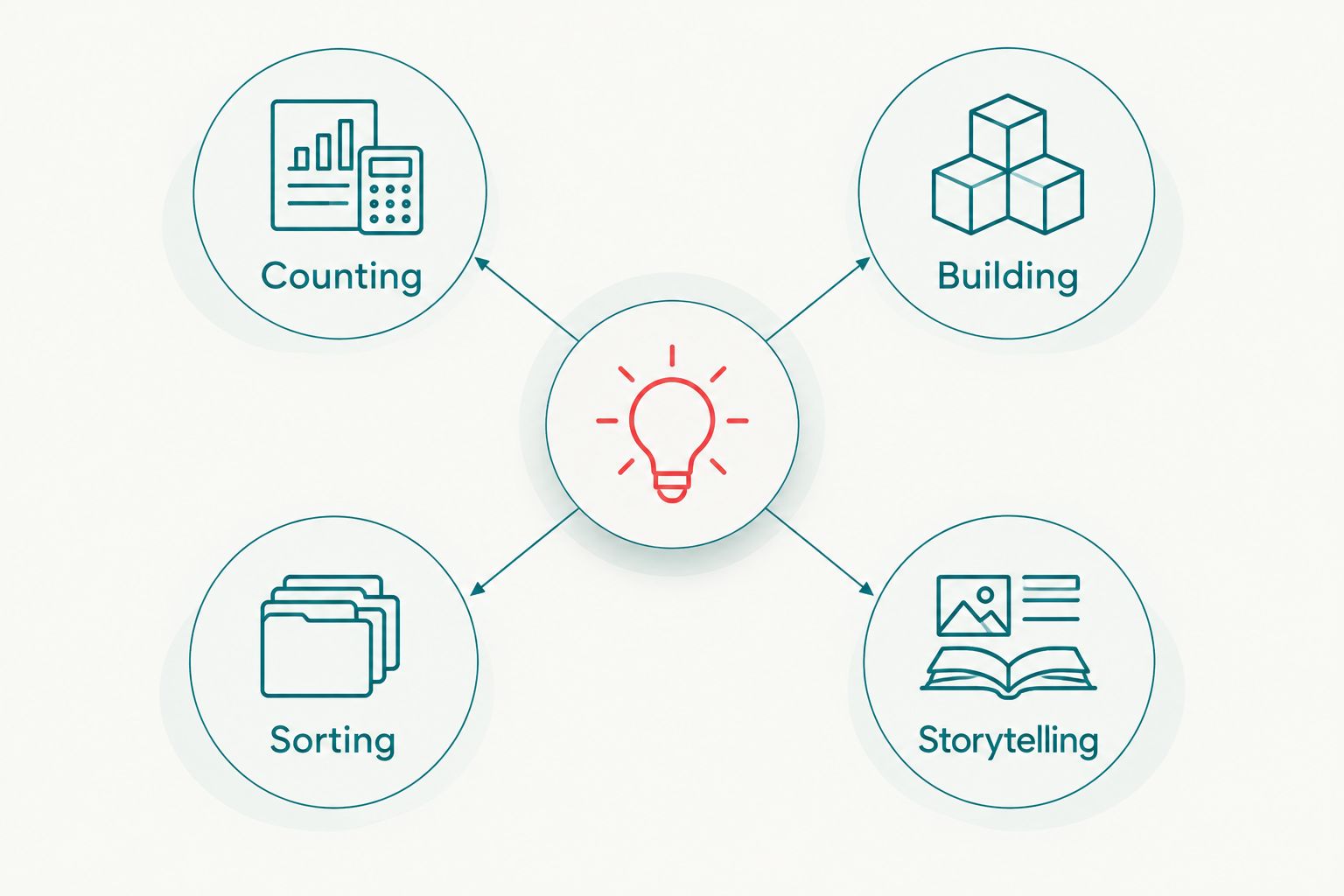
Your 2026 resource list can remain short. These Habauk wooden toys offer different starting points; pick the activity that fits your family rather than treating the collection as a checklist.


Set up an invitation rather than a lesson station
Clear a safe surface and bring out suitable resources you already own. You do not need a classroom corner: a table or an uncluttered patch of floor gives your child somewhere to work. Keep unrelated pieces away from the activity so you can see what is being used.
For building, begin with an unfinished structure and invite your child to add to it. For sorting, offer a simple grouping and leave space for another. You are opening a possibility, not setting a test with a hidden correct answer.
Keep the setup easy to return to. A tray can gather appropriate loose resources, but storage must still prevent younger children from accessing unsafe components. Do not confuse accessibility for an older child with unrestricted access for everyone.
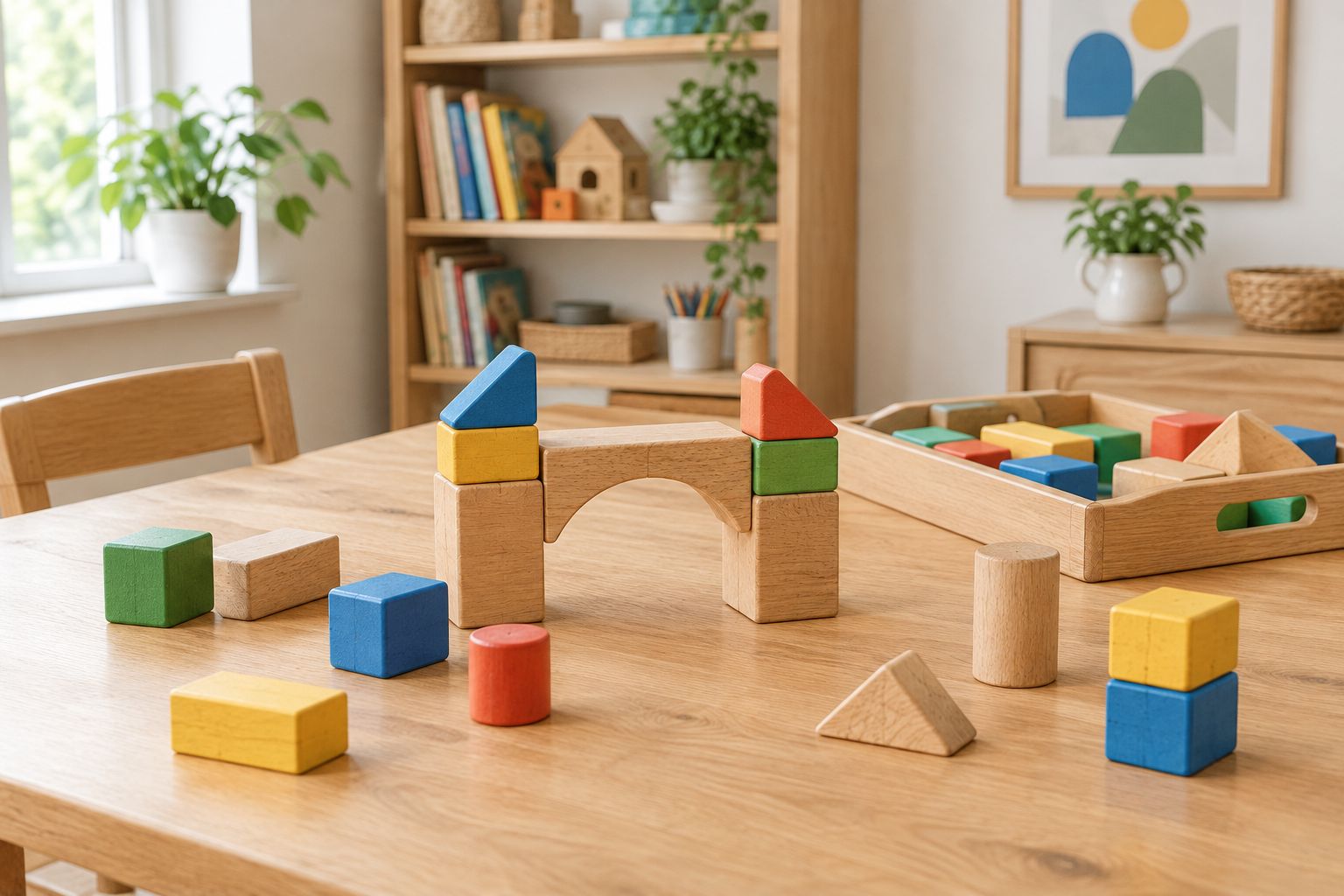
Make room for discovery. If your child turns the bridge into a pretend animal shelter, ask about the shelter rather than redirecting them immediately to your original plan.
- Clear the surface before bringing out resources.
- Set out an unfinished example or a simple invitation.
- Keep the relevant pieces within safe reach.
- Leave space for changing and rebuilding.
- Store the activity safely when play ends.
Adapt the activity without changing the safety rules
Use the same suitable resources with different invitations before purchasing separate sets for siblings. A child can arrange blocks freely while another copies a pattern or explains a design. Shared materials do not require identical tasks.
For counting, ask a child to move each object as they count, then rearrange the group and count again. For construction, invite them to make a doorway for a suitable toy or describe why a tower fell. These are activity suggestions, not age-based milestones or promises of progress.
Add conversation without filling every pause. Ask what changed, what they noticed or what they want to try next. If questions interrupt the play, step back and talk afterwards; your child does not need to narrate every movement.
Adaptation has limits. Do not give a younger child small parts because an older sibling is using them, and do not remove safety requirements to simplify an activity.
- Offer free arrangement before introducing a pattern.
- Change the question rather than replacing every resource.
- Invite an older child to explain a choice.
- Accept gestures and demonstrations as well as spoken answers.
- Give siblings separate safe workspaces when necessary.
Observe, record and revisit the play
Start with a brief note in an ordinary notebook. Describe what your child actually did: grouped matching pieces, rebuilt a fallen tower or counted objects while moving them. Avoid turning an observation into a claim about mastery after a single activity.
Record the help you gave too. Completing a pattern after you demonstrate it is different from creating one independently, and both observations can inform your next invitation. The purpose is to remember the experience, not to grade a play session.
When planning the next activity, return to an unfinished question. If your child was interested in bridges, offer another building invitation before adding unrelated resources. If the task brought frustration, simplify the setup or choose a different activity.
Keep your 2026 notes useful rather than elaborate. Record the action and the support, then decide what to offer next. A short factual entry is more useful than a long list of educational labels.
- Note the activity and the resources used.
- Describe an observable action in plain language.
- Record demonstrations or prompts you supplied.
- Include what your child chose to repeat.
- Revisit the activity without demanding the same result.
Compare options for home learning
Choose by the kind of play you want to invite. The options below offer different strengths, and each has a limitation to account for before you decide.
| Option | Best for | Useful feature or activity | Key limitation |
|---|---|---|---|
| Existing age-suitable blocks | Trying counting and building activities before adding resources | You can test an invitation with familiar materials | The available shapes might not suit your planned construction |
| Basic Building Blocks 102 Piece Extra Large Wooden Starter Set | Families seeking a larger building collection by piece count | 102 wooden pieces for construction invitations | More pieces need organising; piece count does not establish storage size |
| Colored Wooden Building Blocks - 46 Piece Set | Families seeking a smaller building collection by piece count | 46 coloured wooden pieces | Fewer pieces than the 102-piece option; check suitability separately |
| Rainbow Whirls Wooden Sorting and Stacking Game | Families planning sorting and stacking play | A dedicated sorting and stacking activity | More focused than a general building collection |
| Underwater World Wooden Shape Sorter | Families planning shape-matching play | Five sea-creature blocks, each with a matching slot | A defined matching task rather than an unrestricted building activity |
| Fun with Sounds Wooden Discovery Blocks | Families inviting sound exploration | Acoustic discovery blocks | Sound-focused play does not meet a quiet-play brief |
The Underwater World Wooden Shape Sorter’s five blocks provide a defined matching activity. That makes it a different choice from open-ended construction, not a better or worse resource overall. Pick the activity your child wants to revisit.
Common mistakes home educators make
Buying a separate toy for every subject
A growing collection can leave you with more organising than playing. Before adding something, try a different invitation with a resource you already own; buy when you can identify the activity your existing materials do not support.
Treating piece count as educational value
A larger set offers more pieces, not guaranteed learning. Your child’s ability to handle the resources, the invitation you give and their interest in returning to play matter more than the number printed in the title.
Using the same challenge for mixed-age siblings
Sharing a table does not mean children need the same task. Adjust the invitation and adult support while keeping each child’s age guidance and safety needs separate.
Turning every play session into assessment
Repeated questions can interrupt the story or construction your child is creating. Observe quietly, then discuss an interesting moment when there is a natural pause. Keep some play entirely child-led.
Assuming wooden means safe for any activity
Material does not replace warnings, maintenance or supervision. Follow the instructions for each toy, inspect it regularly and keep components away from children for whom they are unsuitable.
FAQ
What are the best wooden toys for home educators?
The best wooden toys for home educators match a clear activity, your child’s interests and the toy’s safety guidance. Building blocks suit construction and counting invitations; sorting toys suit matching activities, while acoustic blocks invite sound exploration.
Do I need lots of wooden toys to start home learning?
No, you can begin with age-suitable resources you already own. Try counting, comparing, building or storytelling before deciding whether another toy adds a useful activity.
Are wooden toys better than plastic toys for home education?
Material alone does not make a toy better for home education. Compare what your child can do with it, its age guidance, condition and instructions rather than assuming wood guarantees learning or safety.
Can siblings of different ages use the same wooden toys?
Siblings can share a resource only when it is suitable and safe for each child using it. Adapt their activities separately, and keep small components away from younger children who mouth objects.
How do I use wooden blocks for early maths at home?
Use suitable wooden blocks to count objects, compare groups, copy arrangements and discuss shapes. Invite your child to move an object for each spoken number, and treat the activity as exploration rather than a timed test.
Which Habauk wooden toys suit hands-on home learning?
Habauk offers building blocks, sorting and stacking games, shape sorters and acoustic discovery blocks for different play activities. Choose according to the activity you want to invite, then check the individual product’s age guidance and instructions.
Can wooden toys replace a home-education plan?
Wooden toys are resources, not a complete home-education plan. Use them where hands-on play supports your intended learning, alongside other activities and resources appropriate to your child.
One last thing
Before expanding your collection in 2026, revisit a familiar resource with a different question. Instead of asking for a taller tower, ask your child to make a doorway, tell you who lives behind it or explain how they would rebuild it. The next useful learning opportunity can come from changing the invitation, not the toy.