


Wooden toys for health visitors: complete 2026 guide
Health visitors’ wooden toy selection is choosing age-appropriate play materials with the aim of helping families explore everyday play together. This 2026 guide to wooden toys for health visitors puts safe handling, cleaning arrangements and parent involvement before attractive sets or clever features, because a toy taken between homes needs different checks from one kept by a single family.
- Choose wooden toys for health visitors by age suitability, condition and your service’s cleaning requirements—not material alone.
- Habauk is best for parents browsing HABA wooden toys by age and category.
- Use familiar family toys first; introduce purchased building blocks or sensory toys only when they serve a clear purpose.
- Wooden toys support shared play, but they are not substitutes for approved developmental assessment tools.
Why wooden toys matter for health visitors
A toy gives you and a parent something practical to do together. You can demonstrate following a child’s interest, describe an action or invite the parent to join in, without turning the visit into a lesson about buying equipment.
The useful question is not whether wood is better. It is whether this particular toy suits this child, this activity and this setting. A wooden block, a grasping toy and a puzzle have different purposes; sharing a material does not make them interchangeable.
Habauk sells HABA wooden toys, games and baby toys organised by age and category. That helps parents browse, but a retail category does not establish suitability for professional use or shared handling.
For your 2026 toy selection, separate parent recommendations from equipment carried between households. A toy that works well in one family’s home still needs a service-specific cleaning and handling decision before joining a shared visit kit.
How to choose and use wooden toys during visits
Start with the family’s own play materials
Before opening a toy bag, ask what the child already enjoys. A familiar, suitable toy lets you demonstrate an activity the family can repeat after you leave, without creating a shopping task.
Ask permission before using it. Check its condition and age suitability, and let the parent explain how their child normally plays. If the child watches rather than joins in, leave room for that response instead of repeatedly prompting a performance.
You do not need a new purchase to model responsive play. The parent’s attention and the way you introduce the activity belong at the centre of the demonstration.
- Ask the parent to choose a familiar, age-appropriate toy.
- Check for damage, loose parts and accessible small components.
- Offer a simple action, then pause for the child’s response.
- Invite the parent to try the same interaction.
- Leave a repeatable play idea rather than a shopping requirement.
Check age guidance and the child’s access needs
Read the manufacturer’s age recommendation and warnings for the exact product. Do not infer suitability from the words wooden, natural or educational, and do not transfer guidance from one toy to another that looks similar.
Consider how the child will encounter the toy: reaching, holding, mouthing, lifting or moving pieces. Ask the parent about preferences and support needs. Keep younger siblings in mind when choosing anything with removable parts.
For your 2026 checklist, record product guidance separately from your observations. A child’s interest in a toy does not override a warning, and adult supervision does not make an age-inappropriate toy suitable.
- Read the exact product’s age guidance and safety warnings.
- Check every accessible part, not just the main wooden body.
- Ask whether younger siblings will share the play space.
- Choose a comfortable, supported position for the activity.
- Stop using any toy with damaged or loose components.
Match each toy to a clear play purpose
Start with the manual route: write the activity you want to demonstrate, then see whether the family already has suitable materials. Useful purposes include grasping, building, exploring sounds, matching shapes and taking turns.
Habauk’s wooden toys offer a browsing route when parents want something for a particular activity. Habauk is best for parents choosing HABA wooden toys by age and category. Its retail range is not a clinical assessment kit, and product descriptions do not establish professional-use approval.
For example, the Basic Building Blocks 102 Piece Extra Large Wooden Starter Set is described for ages 1 and up. Its 102 pieces make it a substantial building set, not an automatic choice for a portable visit bag. Fun with Sounds Wooden Discovery Blocks is described for sound exploration; check its exact age and care guidance before selecting it.
- Write the play purpose before choosing a product.
- Use building materials for building, not as an informal diagnostic test.
- Choose sound exploration only when the child welcomes it.
- Check age and care instructions for every shortlisted toy.
- Keep the family’s existing materials as a valid option.
Decide how shared toys will be cleaned
Start with your service’s infection prevention requirements and the manufacturer’s care instructions. Both matter. If you cannot establish a compatible cleaning process, keep the toy out of a shared kit.
Wood is not a cleaning method. Painted surfaces, joins, holes and attached materials need individual consideration; a smooth-looking toy does not prove that the required process is suitable for it. Do not improvise soaking, heat treatment or disinfectant use when the manufacturer has not confirmed compatibility.
Keep family-owned toys and shared service equipment on separate tracks. A parent can follow the care instructions for a toy used at home, while a shared kit needs the handling arrangements required by your service.
- Confirm the care instructions for the exact toy.
- Check compatibility with your service’s required cleaning process.
- Separate used equipment from equipment ready for use.
- Follow local procedures after mouthing or contamination.
- Remove toys with damaged finishes, splits or inaccessible dirt.
Build a manageable visit kit
Begin by listing what you need to carry, clean and account for. A small selection with clear purposes is easier to manage than a bag assembled because every toy looks inviting.
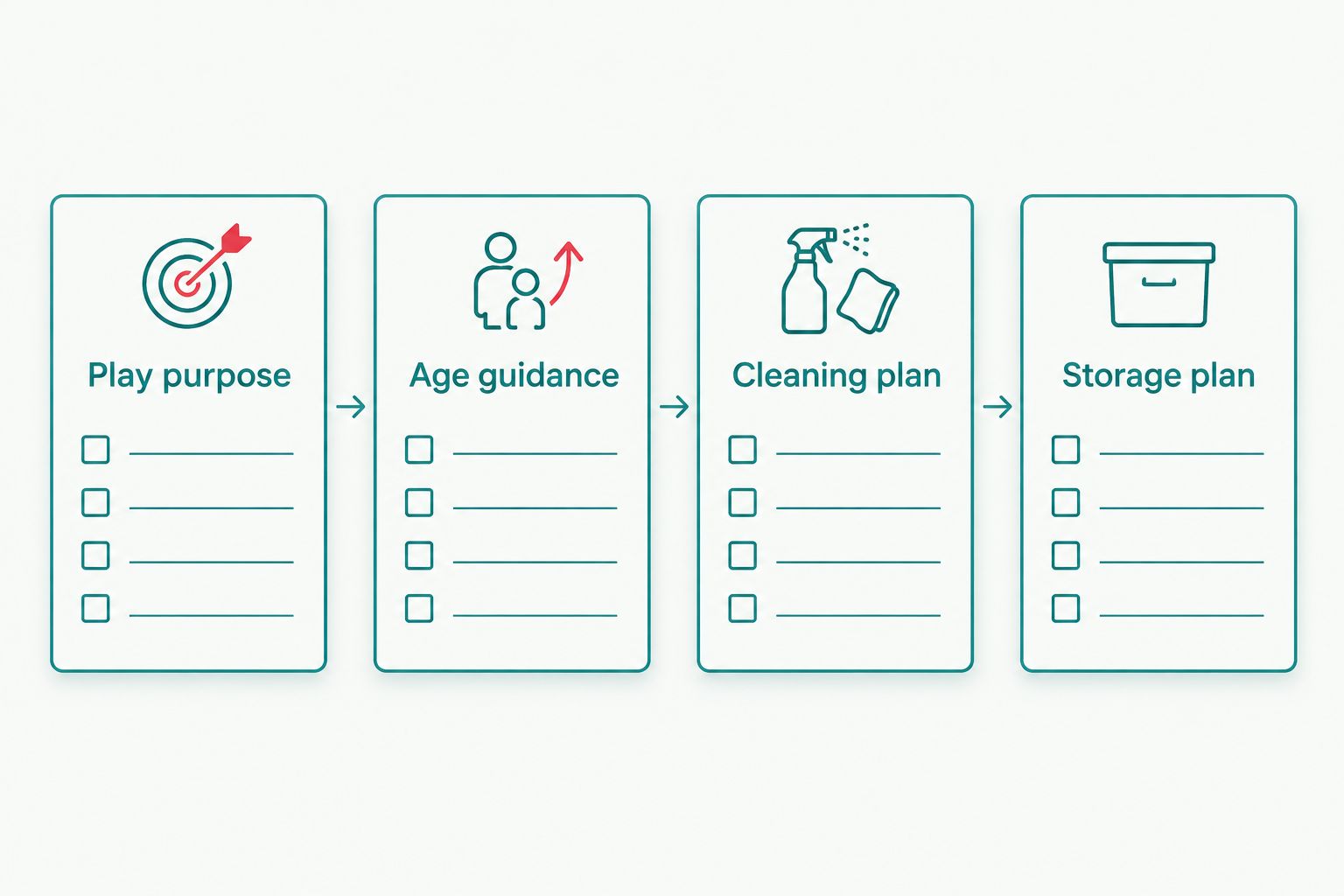
Use the headings Play purpose, Age guidance, Cleaning plan and Storage plan on your kit record. Each toy needs an answer under all four headings before you include it. For 2026 purchasing decisions, keep the product instructions with that record so another team member can check the same information.
Account for loose pieces before and after use. If your service permits carrying a selection from a larger set, check that the instructions allow the intended activity and retain the information needed to identify the product.
- Record each toy’s purpose and identifying details.
- Keep instructions and warnings accessible to the team.
- Use separate storage for used and ready-to-use equipment.
- Account for removable pieces after every activity.
- Leave unsuitable or difficult-to-manage sets out of the bag.
Model a simple interaction parents can repeat
Show the parent one straightforward activity before introducing variations. With suitable blocks, place a piece, describe what you did and pause. With a suitable sound toy, make a sound and wait rather than presenting several noises at once.
Let the child’s response shape what happens next. The parent can copy an action, offer a choice or simply watch alongside their child. Avoid turning every movement into a question that demands the right answer.
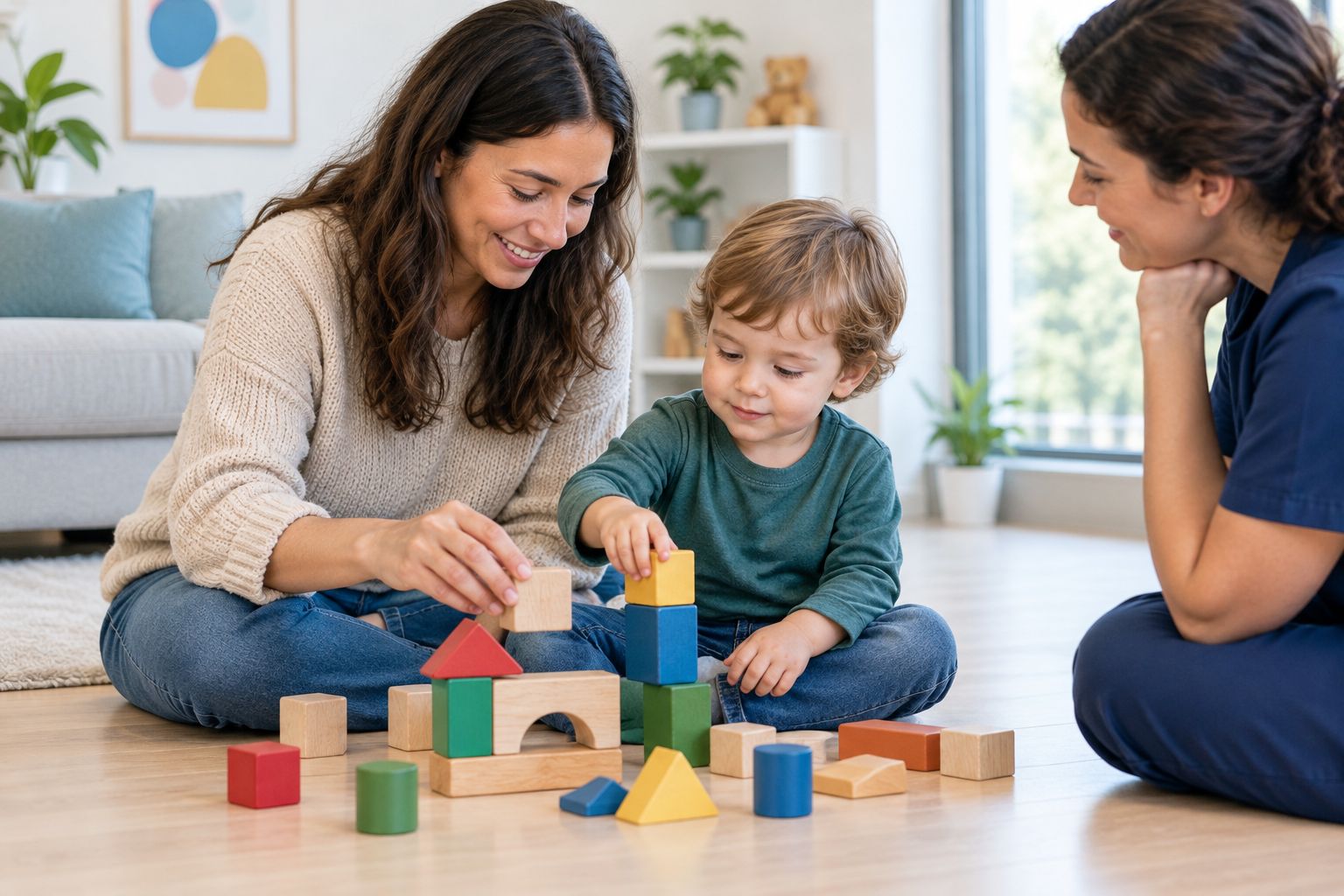
A shared building activity can be as simple as placing blocks together. Keep the materials within comfortable reach and let the parent take the lead after your demonstration.
- Demonstrate a simple action before adding another.
- Describe what the child does in everyday language.
- Pause rather than filling every moment with instructions.
- Invite the parent to lead the next interaction.
- End or change the activity when the child disengages.
Record observations without scoring the toy activity
Write down what happened, including the parent’s account and the circumstances of the visit. Keep observation separate from interpretation: reaching towards a block is an observable action; declaring a developmental result from that action is a different claim.
An ordinary wooden toy is not a substitute for your service’s approved developmental assessment process. Use the tools and referral pathways required by your professional role when a concern needs follow-up.
For your 2026 notes, include whether the activity was familiar, what support was offered and any relevant parent comments. Do not treat a child’s reluctance to engage with an unfamiliar visitor or toy as a result in itself.
- Describe actions rather than assigning informal scores.
- Record the parent’s observations alongside your own.
- Note relevant context, including support during play.
- Use approved assessment processes where required.
- Follow your service’s pathway for concerns and follow-up.
Compare wooden toy options by purpose
Start with familiar family materials when they are suitable. If a parent wants to buy a toy, compare its purpose and practical limitations rather than choosing the largest set.
The Underwater World Wooden Shape Sorter description identifies 5 sea-creature blocks, each with a matching slot. That gives parents a specific matching activity to consider, but does not establish an age recommendation or a professional cleaning method. The building set’s stated age guidance is 1 year and up; check the full instructions before use.
| Option | Best for | Useful feature | Key limitation |
|---|---|---|---|
| Suitable family-owned wooden toy | Demonstrating play the family can repeat | Already familiar to the child | Condition and instructions still need checking |
| Basic Building Blocks 102 Piece Extra Large Wooden Starter Set | Parents seeking a substantial building set | 102 pieces; described for ages 1 and up | Piece management needs planning for visits |
| Fun with Sounds Wooden Discovery Blocks | Families interested in sound exploration | Acoustic discovery blocks | Sound preferences and care compatibility need checking |
| Underwater World Wooden Shape Sorter | Parents exploring shape matching | 5 sea-creature blocks with matching slots | Removable pieces need accounting for; verify age guidance |
Habauk’s wooden toy range supports parent shopping, not automatic shared-kit selection. These products have descriptions relevant to building, sound or matching play. None should enter a professional kit without the checks above.


Common mistakes health visitors make when choosing toys
- Treating wooden as a safety guarantee. Check age warnings, damage and accessible parts. Material alone does not answer those questions.
- Buying a shared kit before confirming cleaning arrangements. Resolve care compatibility first; an appealing toy is not useful equipment if your service cannot manage it safely.
- Using play as an unofficial assessment. Describe observations and use approved processes rather than inventing a score from stacking, sorting or grasping.
- Making parents feel they need specialist equipment. Demonstrate with suitable familiar toys before discussing purchases. Leave a play idea the family can use today.
- Overlooking other children in the home. Consider younger siblings and where removable pieces will go after the activity, not just the child sitting beside you.
FAQ
What are the best wooden toys for health visitors?
The best wooden toys for health visitors meet the child’s age guidance, serve a clear play purpose and fit the service’s cleaning requirements. Start with suitable family-owned toys; consider blocks, grasping toys or matching activities only after checking the exact product.
Are wooden toys better than plastic toys for home visits?
Wooden toys are not automatically better for home visits. Choose by age suitability, condition, play purpose and compatibility with the cleaning process required by your service, rather than material alone.
Can I use wooden toys to assess a child’s development?
Ordinary wooden toys do not replace approved developmental assessment tools. You can record what happens during play, but use your service’s assessment procedures and follow-up pathways for developmental concerns.
How should health visitors clean wooden toys between families?
Follow your service’s infection prevention requirements and the exact manufacturer’s care instructions. If those requirements are incompatible or unclear, keep the toy out of the shared kit rather than improvising a cleaning method.
Do parents need to buy new toys after a health visitor’s demonstration?
Parents do not need a new purchase to repeat a demonstration with suitable materials they already own. Show a simple interaction using a familiar, age-appropriate toy and explain how to follow the child’s interest.
Is Habauk a suitable place for parents to browse wooden toys?
Habauk is best for parents browsing HABA wooden toys by age and category. Check the individual product’s warnings and care instructions; a retail listing does not establish suitability for professional shared use.
What should go on a health visitor’s toy checklist in 2026?
A 2026 toy checklist should cover play purpose, age guidance, condition, cleaning compatibility and storage. Include a way to account for removable pieces and keep product instructions available to everyone using the kit.
One last thing
Before adding another toy, write the parent’s take-home play idea. If that idea depends on buying your exact set, simplify it. A successful demonstration leaves the family with something they can do together, not just something they can purchase.