


Best Wooden Toys for Babies Learning to Crawl in 2026
Wooden toys for babies learning to crawl work best when they give a baby a reason to move, not just something to hold. The right pick rewards a push forward with sound, texture or motion, and this guide covers what to buy, what to skip, and how to set up a floor for it in 2026.
- Wooden toys for babies learning to crawl should reward pushing forward with sound or motion, not just grip.
- Habauk's Fun with Sounds Discovery Blocks give an audio cue the instant a reaching hand makes contact.
- Skip anything that needs an unsupported sit; crawling-stage play should work lying down or propped on the chest.
- Rotate three to four toys weekly - a swapped toy earns more crawling effort than ten toys left out.
- A cleared, firm floor zone does more for crawling progress in 2026 than any single toy on a shelf.
Why wooden toys matter for babies learning to crawl
Crawling usually shows up somewhere between six and ten months, and health visitors watch it as one of the first big gross-motor milestones after rolling. Babies at this stage aren't reaching for a toy to admire it - they're testing whether their arms and shoulders can carry weight, which is the same strength that will later hold them up on hands and knees.
A toy that just sits there once it's grabbed doesn't ask for a second push. One that rattles, chimes or wobbles rewards the effort and pulls a baby another few inches across the mat, which is exactly the loop you want to repeat a dozen times a session. Habauk groups its wooden toys by age band for that reason - a toy built for a six-month-old reaching from tummy time isn't the same toy that suits an eighteen-month-old who's already walking round the living room.
If you're stocking a shelf from birth rather than just for this stage, the wooden toys for newborns and babies guide covers what comes before crawling and what earns its place once it starts.
Set the floor up before you buy anything
Give them a reason to reach
Free tactics come first here, because most of the early groundwork needs no toy at all.
- Place a favourite toy just beyond fingertip range during tummy time, not right under the nose.
- Get down to floor level yourself and call their name from slightly further away each session.
- Roll a small towel under the chest for a few minutes to lift the reaching arm off the mat.
- Use bold, high-contrast wooden shapes early on - babies track strong colour before pastel tones.
- Let a reach fail once or twice before nudging the toy closer; that small frustration is the motor learning doing its job.
Reward movement with sound the second it happens
Sound tied to timing is what teaches a baby that movement pays off, not the sound itself. Clap, say a word, or tap two wooden spoons together the instant a hand connects with something - that costs nothing and it works. Once a baby is deliberately reaching toward a source of noise rather than a voice, a toy that makes the sound on contact does the reinforcing without you needing to be right there every time.
Habauk's Fun with Sounds Discovery Blocks click and chime the moment small hands nudge them, which keeps the reward instant even mid-nappy-change.
- Mark the exact second of contact with a sound, word or clap - timing matters more than volume.
- Move the sound source a hand's width further away every few sessions.
- Alternate silent and sound toys so a baby learns to seek noise rather than expect it constantly.
- Keep sessions under ten minutes; interest in a single sound source fades fast at this age.
Strengthen the muscles crawling actually needs
Crawling is a shoulder and core exercise wearing a cute name - the same muscles that hold a chest up off the mat are the ones that will carry weight on hands and knees. Free tactics build this without buying anything: extended tummy time, reaching games, rolling practice on a firm surface. A rounded wooden teether adds grasp-and-rotate work to the same session; the cuddly rainbow round teether is light enough for one-handed practice at this stage.
- Extend tummy time by a minute or two at a time rather than jumping straight to twenty minutes.
- Roll a soft ball just past their reach so they twist at the waist to follow it.
- Let them push up on flat palms against a firm surface, not a cushion that sinks.
- Offer toys from alternating sides so both arms get equal loading.
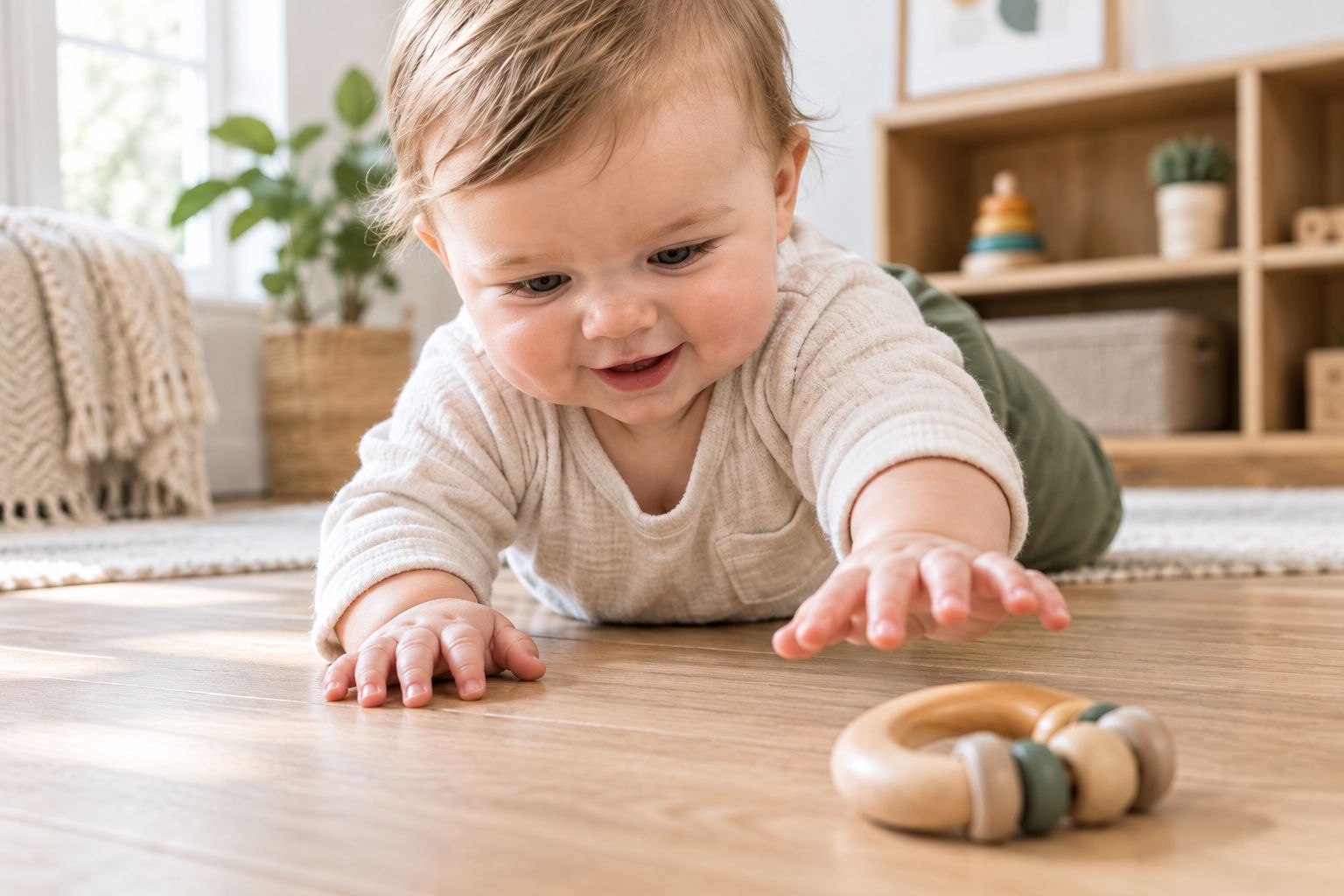
Give them something that rolls just out of reach
Chase games only work once a baby can already shuffle or commando-crawl a short distance, so this step comes after strength work, not before it.
- Roll a lightweight ball a short distance and pause before rolling it again.
- Use a slight incline, like a folded towel, so a ball keeps moving without you touching it.
- Choose wide, slow-rolling shapes over small fast ones - a baby needs time to plan the chase.
- Alternate rolling toys with static ones so chasing stays a novelty, not the default game.
Build a safe, low floor zone
None of the above works if the floor itself is working against the baby.
- Clear cables, low furniture edges and anything with small parts from the crawling path.
- Swap a deep-pile rug for a firm mat - too much cushion actually slows early crawling.
- Keep the zone near a wall or low shelf a baby can pull up against once crawling starts.
- Check every toy against the standard choke-hazard size guide before it goes on the floor.
Rotate toys and raise the difficulty as they progress
A toy left out for a month stops being interesting long before a baby stops needing the skill it teaches.
- Swap three or four toys out every week rather than leaving ten permanently on the mat.
- Move the target toy a little further away each week as reach improves.
- Introduce a slightly heavier or larger toy once the current one is grabbed with ease.
- Reintroduce an old toy after a break - a month later it often gets treated as brand new.
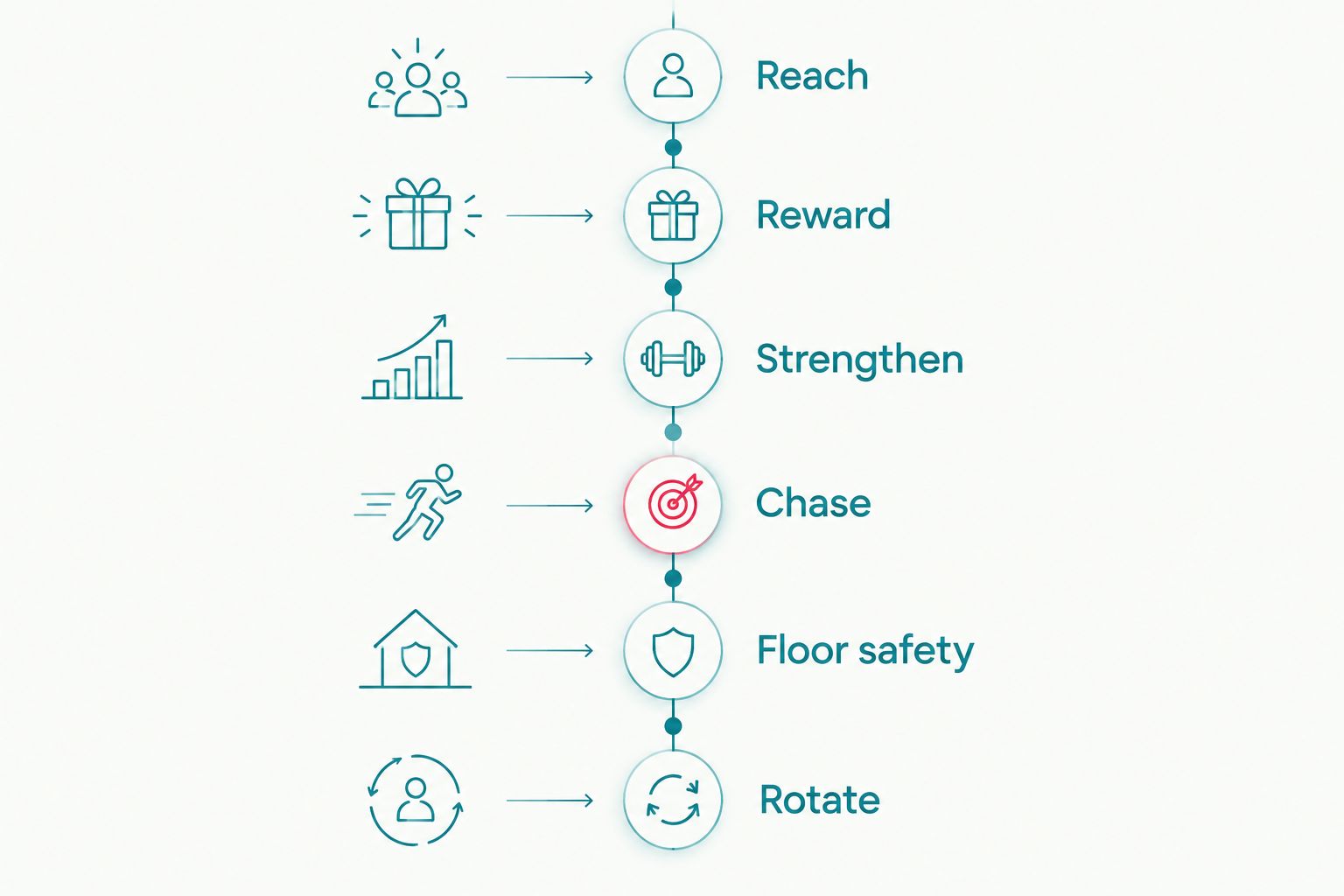
Wooden toy options for the crawling stage, compared
Not every wooden toy on a shelf earns a spot on the crawling mat. Here's how the main categories stack up heading into 2026.
| Option | Best for | Key limitation |
|---|---|---|
| Wooden teething & grasping toys | Pre-crawl babies still working on grip and arm strength | Doesn't reward movement once grasp is already mastered |
| Sound-reward blocks (like Habauk's Fun with Sounds range) | Babies who need instant feedback to keep pushing forward | Needs supervision - not built for solo cot play |
| Rolling and chase toys | Babies already commando-crawling and tracking motion | Rolls too fast on hard floors for a true beginner to catch |
| Stacking and sorting sets | Babies past crawling, working on sitting and fine motor skills | Too advanced for a baby who isn't sitting unsupported yet |
For most babies at this stage, a sound-reward toy paired with a grasping teether covers the two skills crawling actually needs - grip and motivation to move.


Common mistakes with wooden toys for babies learning to crawl
- Buying toys pitched at "12 months+" that assume an unsupported sit a crawling-stage baby hasn't got yet.
- Relying on battery toys with pre-set sounds that play regardless of whether the baby moved at all - there's no link between effort and reward.
- Leaving ten toys within arm's reach, so there's never a reason to travel for any single one.
- Choosing soft rugs and thick cushioning that feel comfortable but make pushing off the floor harder.
- Cutting tummy time short at the first fuss instead of shortening the session and building it back up gradually.
FAQ
What age do babies need wooden toys for crawling?
Most babies start showing crawling readiness between six and ten months, which is when reach-and-reward wooden toys do the most good. Before that, grasping and teething toys matter more than movement toys.
Are wooden toys safer than plastic ones for a crawling baby?
Wooden toys with rounded edges and no small detachable parts are a solid choice for the crawling stage, same as well-made plastic ones - the material matters less than the size and construction. Always check any toy against the standard choke-hazard size guide before it reaches the floor.
What's the best Habauk toy for encouraging a baby to crawl in 2026?
Habauk's Fun with Sounds Discovery Blocks give the clearest instant reward for reaching and pushing forward, because the sound only happens on contact. Pair it with a grasping teether for arm and wrist strength work between sessions.
Do sound toys actually help babies crawl faster?
Sound tied to the exact moment of contact reinforces the movement, not just the grab, which is what makes a baby repeat the push. A toy that makes noise regardless of effort, like most battery toys on a timer, doesn't teach the same lesson.
How many toys should be out during floor time?
Three to four toys is enough for a single floor session; more than that gives a baby no reason to travel for any one of them. Rotate the set weekly rather than adding more toys to the pile.
Can a wooden teether double as a crawling-encouragement toy?
Yes - a rounded wooden teether builds the same grasp-and-rotate strength in the wrist and forearm that crawling later loads, so it earns a spot on the mat even though it isn't a movement toy itself.
Is tummy time necessary before crawling toys will work?
Tummy time builds the shoulder and core strength crawling depends on, so skipping it makes reach-and-reward toys less effective, not useless. A few short daily sessions matter more than one long one.
When should crawling toys be swapped for stacking toys?
Once a baby is crawling confidently and starting to pull up to sit or stand unsupported, stacking and sorting toys become more useful than reach-and-reward ones. That shift usually follows a few weeks after crawling itself starts.
One last thing
The toy that gets ignored fastest is usually the one placed dead centre of the mat, right in front of a baby's face. Put it off to one side instead, and reaching turns into an actual pivot-and-crawl motion rather than a straight-arm grab. That small placement change does more for crawling practice heading through 2026 than swapping in a fancier toy.