


Wooden Toys for 6 Year Olds: 2026 Buying Guide
Wooden toys for 6 year olds need more staying power than a toddler stacking set and less randomness than a spin-and-move board game — the target is strategy, building challenge and games a child can set up without an adult. This guide breaks down what actually holds a six year old's attention in 2026, with specific picks from the HABA range at Habauk.
- Wooden toys for 6 year olds work best when they add strategy or building challenge, not just stacking.
- Rhino Hero Super Battle (2026 edition) and tile-laying games reward reading skill and turn-taking without a screen.
- A 100+ piece extra-large block set gives a 6 year old enough scale to build something that actually stands up.
- Skip toddler-level shape sorters and single-outcome puzzles — six year olds outgrow them inside a week.
Why wooden toys for 6 year olds matter
At six, most kids read simple instructions, count reliably past twenty, and can hold a rule in their head across more than one turn. That changes what "age-appropriate" means: a toy pitched at three or four gets solved in one sitting and shelved by the following weekend.
The jump from wooden toys for 5 year olds is less about size and more about complexity — a six year old wants a real decision to make on their turn, not a single correct answer built into the toy. Six year olds are also starting to play with siblings and friends rather than alongside them, so a game only earns its shelf space if it holds up across two, three or four players without an adult refereeing every round.
Shopping for a 2026 birthday or Christmas list at this age means one thing above all: buy for the child six year olds are becoming, not the one they were at four.
How to choose wooden toys for 6 year olds in 2026
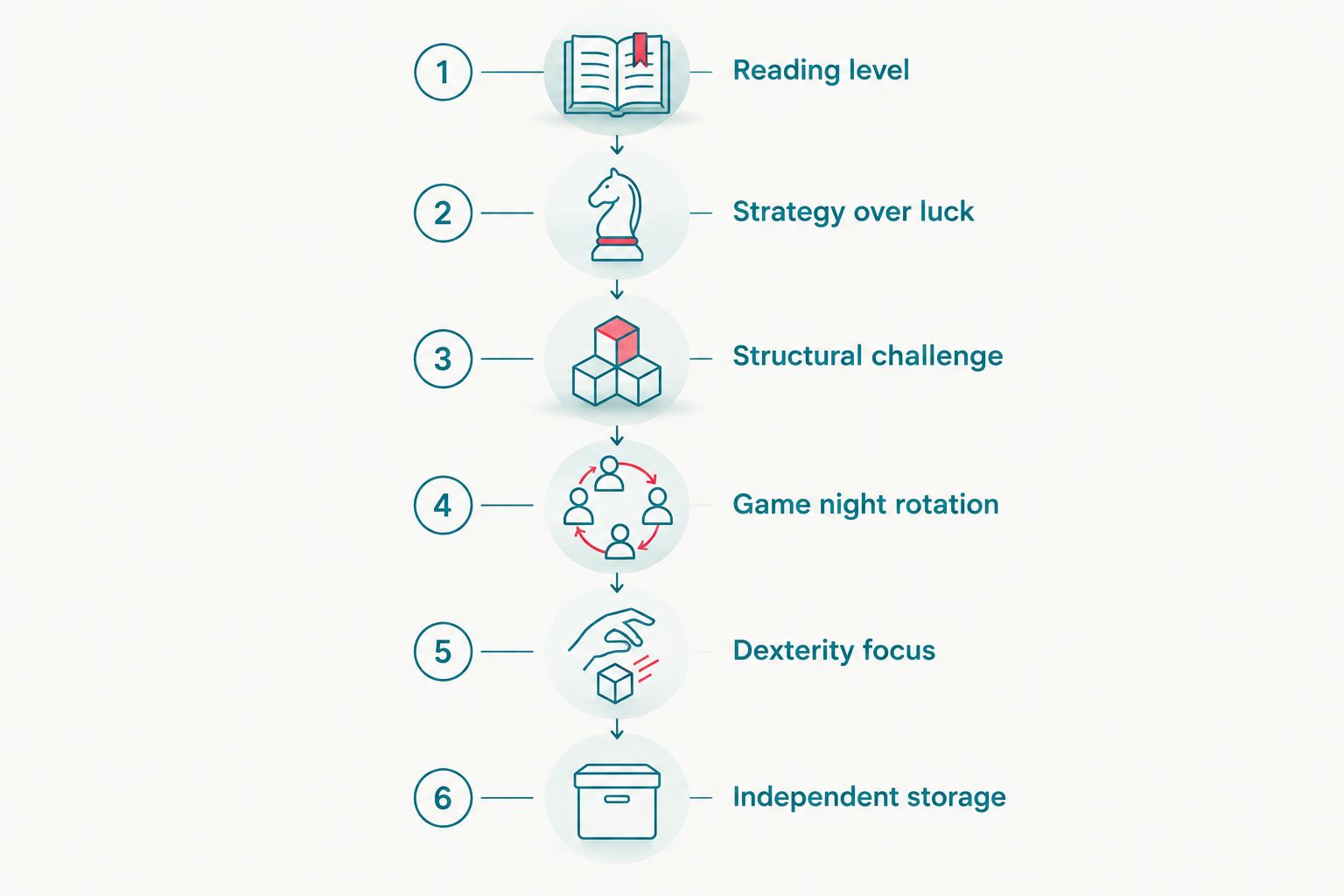
Match the toy to reading level, not just the age on the box
- Read the instruction sheet yourself first — if it needs a paragraph of parental translation, it's pitched too old for most 6 year olds
- Check whether the game needs written numbers and letters or just symbols and colour, since not every six year old reads fluently yet
- Favour games with a rules summary card the child can keep, not just a folded insert that goes missing
- Watch the turn structure — "roll and move" is easier to grasp than a game that asks a child to plan two moves ahead
Prioritise strategy over pure luck
- Pick games where a choice made this turn changes the outcome, rather than a dice roll deciding everything
- Tile-laying games work well at this age because the path only pays off if the tiles are placed with intent
- Treat "no reading required" as a clue that a 6+ label is generous — that phrasing usually signals a game built for 4 year olds
- Ask whether losing feels fair to a six year old — a game decided entirely by luck causes more meltdowns than one where skill matters
Choose building and marble-run sets with real structural challenge
- Move up from basic stacking blocks to sets with 80 or more pieces so a tower has real height and real collapse risk
- A marble run starter set works because the child has to test the track, watch it fail, and rebuild it — that loop is the point
- Look for sets mixing shapes (arches, ramps, cylinders) so building isn't just square stacked on square
- Extra-large block sets of 100+ pieces let two kids build side by side without fighting over pieces
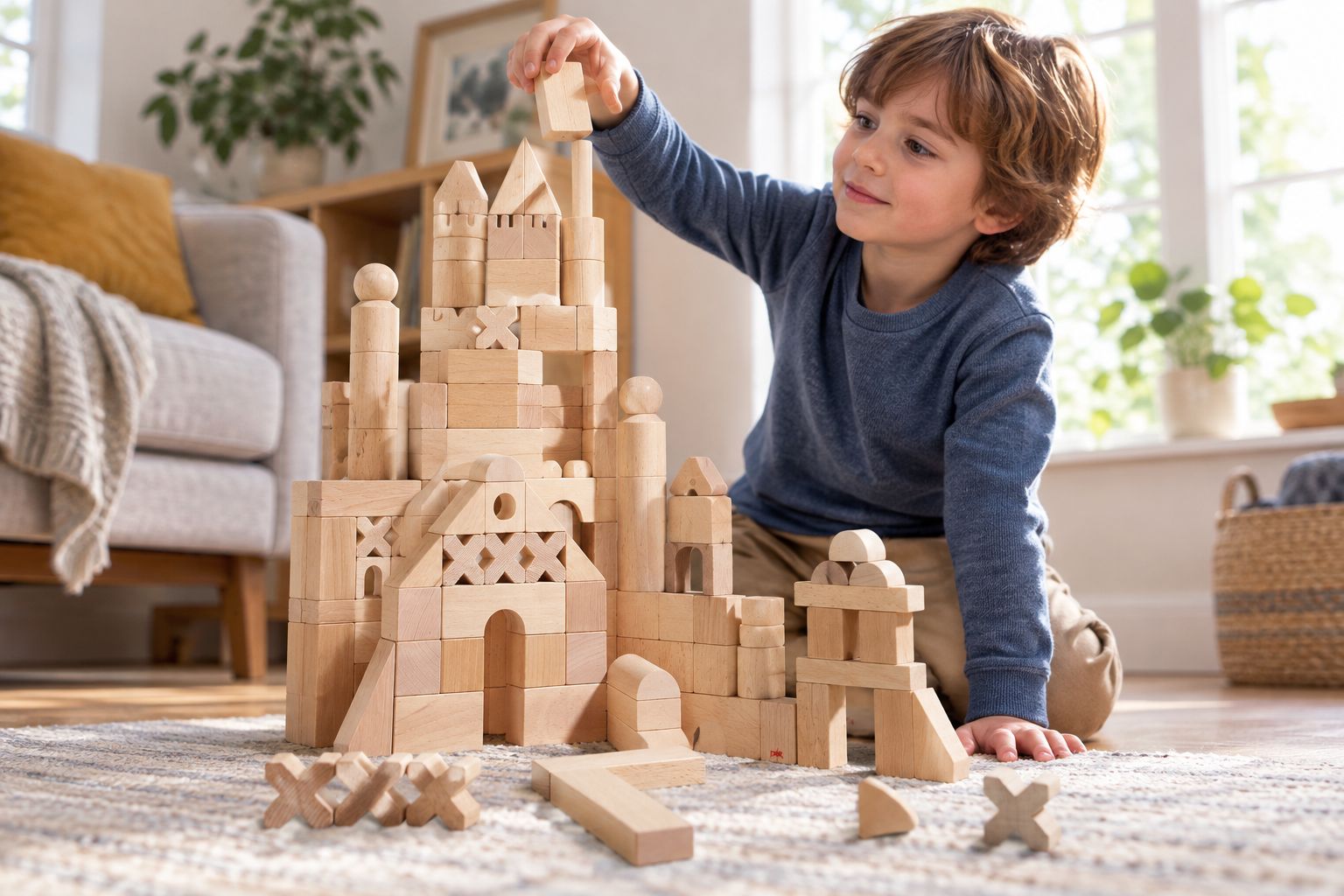
Building sets win on open-ended replay: a 102-piece set never runs out of new things to build. The trade-off is floor space and clean-up time — a large marble run or block tower takes real square footage and doesn't pack away in thirty seconds, which matters if you're in a smaller home.


Build a family game-night rotation
- Keep two or three games in rotation so a six year old doesn't memorise the same solution every time out
- Include one cooperative or team game for nights when sibling rivalry is running hot
- Mix a short game with a longer one so game night doesn't stall halfway through
- A tile-laying or pattern game gives a six year old a first taste of medium-weight strategy without overwhelming them
Add dexterity and quick-round games for focus
- Stacking and balance games teach a six year old to slow down and plan a move instead of reacting
- Rhino Hero Super Battle — the 2026 edition — adds a battle mechanic on top of the classic stacking format, which suits kids who've outgrown the original card-stacking game
- Keep at least one quick-round game under ten minutes for waiting rooms and car journeys
- A quick-round dexterity game doubles as a reset when a longer strategy game gets frustrating
Set up storage a 6 year old can manage alone
- Label bins or boxes by game so pieces don't migrate between sets
- Store instruction cards inside the box, not in a drawer the child can't reach
- Put frequently played games at child height, occasional ones higher up
- A shelf a six year old can reach independently means less "help me find it" mid-play
Comparison: wooden toy and game types for 6 year olds
| Type | Best for | Key limitation | Verdict |
|---|---|---|---|
| Extra-large building block set (100+ pieces) | Open-ended building, siblings building together | Takes floor space, no fixed "finish" point | Buy |
| Marble run starter set | Cause-and-effect testing, rebuilding logic | Needs a flat surface and patience to set up | Buy |
| Tile-laying strategy game (e.g. Karuba) | Family game night, turn-taking practice | Needs a table and full attention for the round | Buy |
| Stacking/dexterity battle game (e.g. Rhino Hero Super Battle) | Quick rounds, hand-steadiness, group play | Less deep strategy than a tile-laying game | Buy |
| Solo logic puzzle set | Independent, screen-free downtime | Not social — doesn't fill the family game-night slot | Hold |
“If a six year old finishes a toy in one sitting and never opens the box again, it was pitched a size too small.”
Common mistakes parents make buying wooden toys for 6 year olds
- Buying down: choosing a stacking toy or shape sorter built for toddlers because it's "still wooden and safe" — six year olds find these boring inside a week
- Buying up: picking a game rated 8+ that has enough text or maths to leave the child needing constant help
- Ignoring player count: a two-player-only game doesn't cover a family of four on game night
- Skipping storage: pieces from an 85-piece block set go missing fast without a labelled bin
- Chasing novelty over replay: a single-use puzzle gets solved once; a building set or strategy game gets replayed for years
FAQ
What are the best wooden toys for 6 year olds in 2026?
Extra-large building block sets (100+ pieces), marble run starter sets and tile-laying strategy games hold a six year old's attention longest in 2026 because they add real decisions, not just repetition. Toddler-level stacking toys and shape sorters get outgrown fast at this age.
Is a marble run good for a 6 year old?
Yes — a marble run starter set suits six year olds because building the track, watching it fail, and adjusting it teaches cause-and-effect problem-solving. It works best on a flat surface with enough room to expand the track as the child gets more ambitious.
How is Rhino Hero Super Battle different from the original Rhino Hero?
The 2026 edition of Rhino Hero Super Battle adds a battle mechanic on top of the classic card-stacking format, giving older kids who've mastered the original a new layer of challenge. Families who already own the original should treat the Super Battle version as a step-up, not a replacement.
Are wooden games better than plastic for 6 year olds?
Wooden games tend to have fewer small snap-together plastic parts that crack under repeated stacking or building, which matters for games played dozens of times. The choice matters less for durability at six than it does for the strategy or building challenge the toy actually offers.
How many pieces should a building block set have for a 6 year old?
Aim for 80 pieces or more so a tower or structure has real height and enough variety to keep building interesting. Sets under 50 pieces tend to get solved in a single sitting at this age.
What makes a strategy game right for a 6 year old versus a preschooler?
A strategy game suited to six year olds asks the child to make a choice that changes the outcome, such as where to place a tile, rather than relying only on a dice roll. Preschool games are usually built entirely around luck so no reading or planning is required.
Can 6 year olds play strategy games with younger siblings?
Some tile-laying and stacking games work across a wider age range if the younger sibling gets a simplified turn, but most strategy games built for six year olds move too fast for a 3 or 4 year old to follow. Check the box's stated player age range before assuming it stretches down.
How do I stop a 6 year old losing pieces from wooden game sets?
Label a bin or box per game and store the instruction card inside the box rather than in a separate drawer. Games kept at a height the child can reach independently get put away properly far more often than ones stored out of reach.
One last thing
The 2026 edition of Rhino Hero Super Battle isn't a straight reissue — the battle mechanic changes how the game plays compared with the original stacking format, so an older sibling who already owns the classic version is getting something genuinely new, not a duplicate. That's worth checking before buying it as a "they already have this" gift for 2026.