


Wooden Toys for 6 to 12 Month Olds: 2026 Guide
Wooden toys for 6 to 12 month olds are simple, chunky-piece toys built for grasping, mouthing, banging and early sitting-up play, matched to a baby's fast-changing motor skills. This six-month window covers more developmental ground than almost any other stretch of the first year, so a toy that's perfect at six months is often ignored by ten.
- Wooden toys for 6 to 12 month olds should shift from grasping and teething pieces to sound and stacking toys as babies start sitting up.
- Habauk's Color Drops and Magica teethers suit the 6-8 month grasping stage; Fun with Sounds Discovery Blocks suit babies sitting unsupported from around 8 months.
- Check every wooden toy for rounded edges, a mouth-safe finish, and no piece small enough to fit a choke tube.
- Keep 4-5 toys in rotation rather than the whole toy box out at once — babies engage longer with less choice.
Why this matters for 6 to 12 month olds
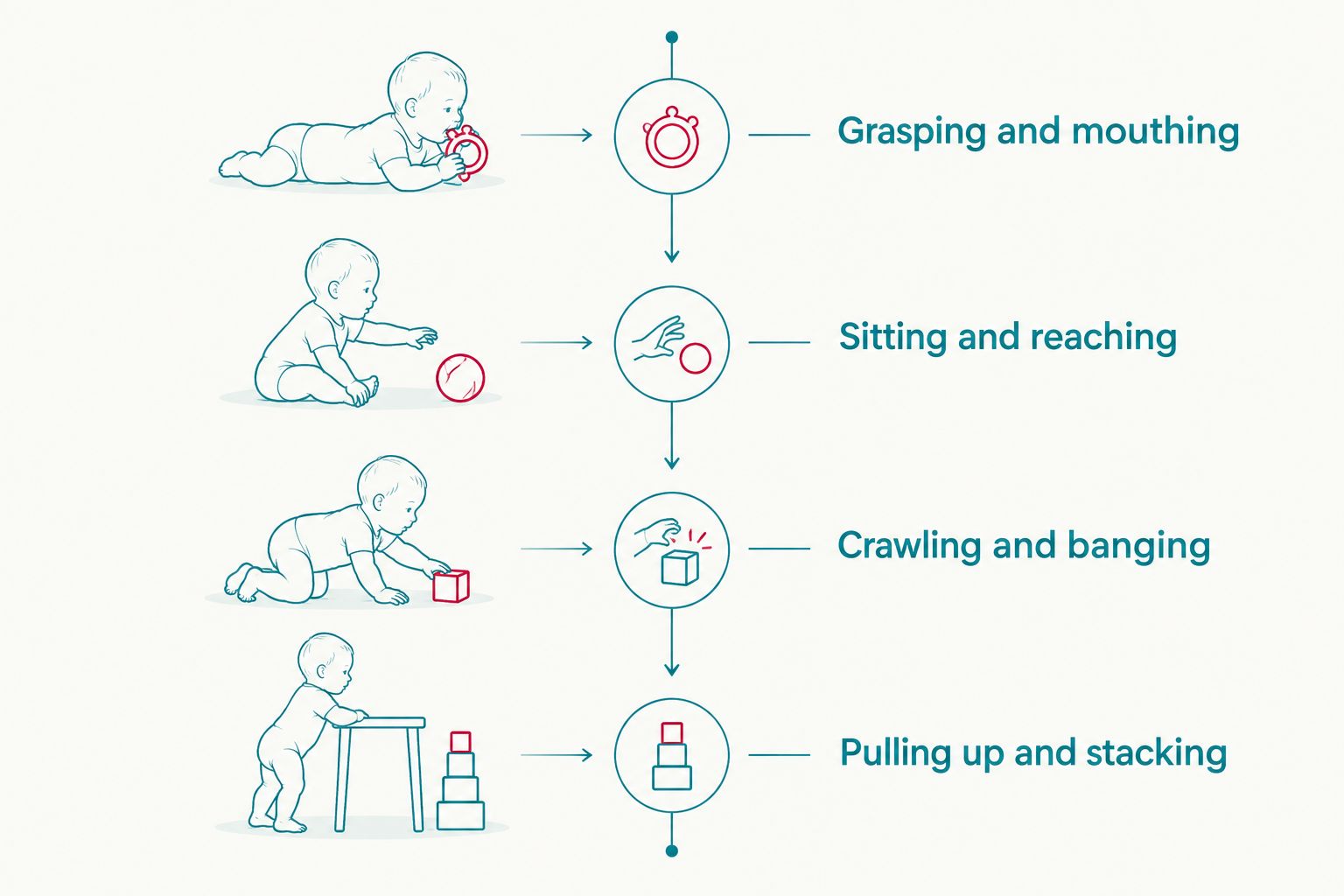
Most babies sit unsupported somewhere around six months, start crawling between eight and ten months, and pull themselves up to stand by their first birthday. Three different postures inside one product category, all happening within the same six months.
A toy chosen only by "ages 6-12 months" on the box misses that shift entirely. A Cuddly Rainbow Round teether that's ideal for a baby who can barely hold an object upright becomes background noise once that same baby can sit up and bang two blocks together. Wooden toys for 6 to 12 month olds work best when you buy for the stage in front of you in 2026, not the age printed on the calendar.
How to choose wooden toys for 6 to 12 month olds
Match toys to your baby's stage, not just the age on the box
Before buying anything, work out where your baby actually is right now — the range between 6 and 12 months hides three or four distinct stages.
- Check whether your baby can sit unsupported yet — that changes what they can hold and use with both hands.
- Watch for the pincer grip (thumb and finger picking up small items), which usually appears between 9 and 12 months.
- Note if they're still mouthing everything, or starting to bang, drop and throw instead.
- Ask what motion they practise most right now: reaching, sitting, crawling or pulling to stand.
Check every toy for safe size, weight and finish
Safety criteria come before any product pick, and they don't change whether the toy costs £10 or £100.
- Anything that fits inside a toilet roll tube is a choking risk for this age group.
- Look for a smooth, splinter-free finish with no small attached parts — buttons, wheels, string.
- Favour untreated or water-based finishes over toys with a strong paint or varnish smell.
- Pick pieces light enough for a baby to lift and bang together without hurting themselves or a sibling.
- Skip anything with a cord, ribbon or loop longer than a few centimetres.
Stock grasping and teething toys for the 6 to 8 month stretch
Before buying anything new, notice what's already keeping small hands busy: wooden spoons, silicone spatulas, stacking cups pulled from the kitchen cupboard. Then look for wooden versions built specifically for small grasping hands and sore gums.
- Rounded, comfortable-to-mouth handles or rings sized for a six-month grip.
- A grasping toy with drops, rings or loops set at different angles so tiny hands can rotate it without help.
- A weight light enough to lift to the mouth without it dropping straight onto their face.
- Habauk's Color Drops Wooden Grasping and Teething Toy and Magica Wooden Grasping and Teething Toy are both built around exactly this stage.
Add sound-making and cause-and-effect toys once they sit unsupported
Babies discover cause and effect on their own long before you buy anything for it — watch how a baby who's just started sitting will knock over a stack of pots or clap two containers together on repeat. Wooden toys for 6 to 12 month olds can lean straight into that instinct.
- Toys that make a rattle, chime or knock sound only when the baby moves them, reinforcing cause and effect.
- A block or shape set sturdy enough to survive being banged, dropped and occasionally chewed on the corner.
- Something built for two-handed play, since one-handed grasping is old news by 8-9 months.
- Fun with Sounds Discovery Blocks fit this exact stage — a set of acoustic blocks a sitting baby can shake, roll and bang together.
- Fun with Sounds Wooden Eggs work the same idea in an egg-carton shape, useful for babies who already like posting and sorting motions.
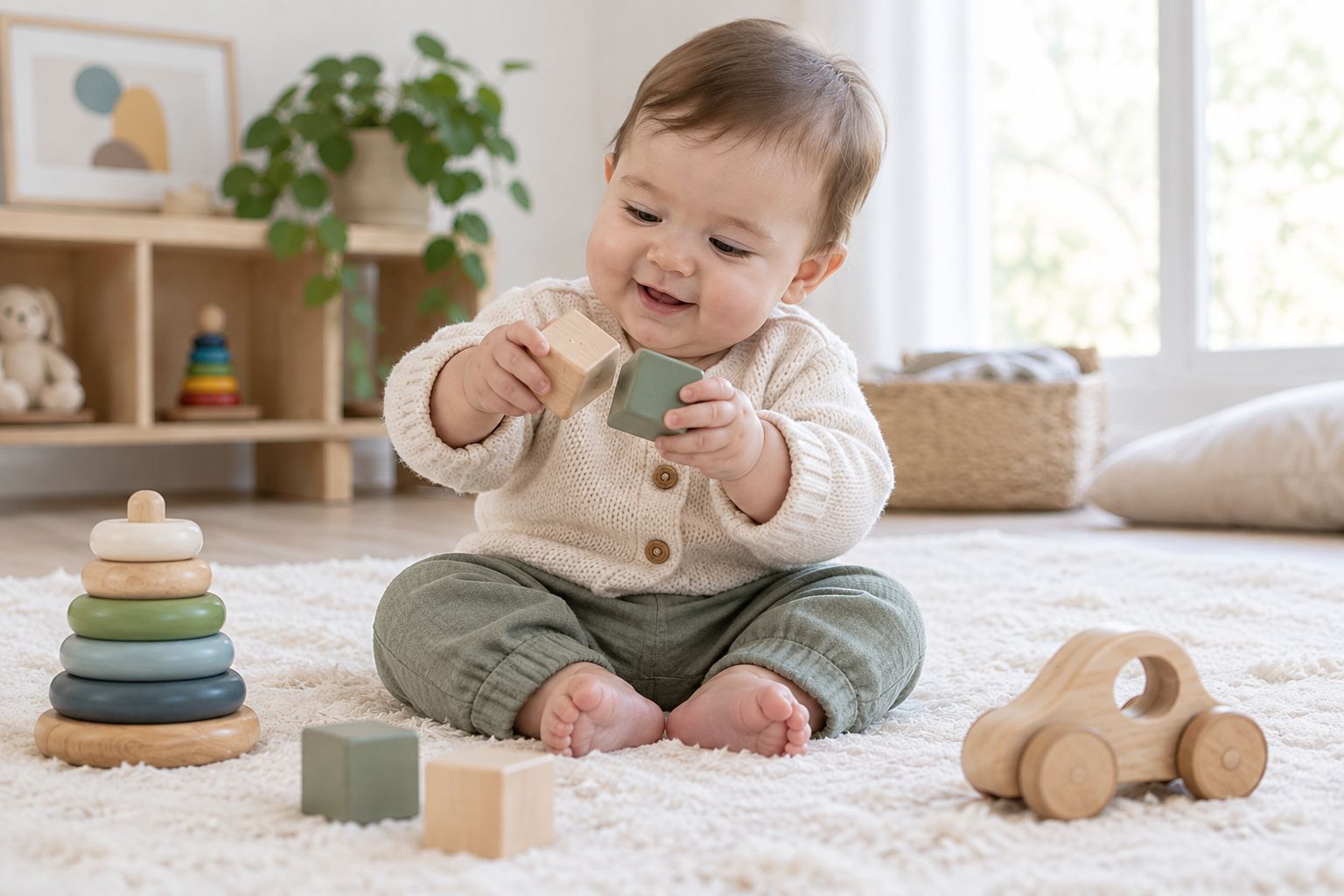
Introduce stacking and nesting toys as the pincer grip develops
Before buying a stacking set, household stacking cups or nesting Tupperware do the same job for free — use them to gauge whether your baby is ready.
- A stacking toy with pieces graduated in size, so success doesn't depend on fine motor precision yet.
- Nesting toys that double as bath toys or containers once plain stacking gets boring.
- Simple 2-3 ring stackers rather than 8-10 piece towers — too many pieces frustrates a baby under 12 months.
- Forest Animals Wooden Stacking Toy suits this stage well: large, easy-to-grasp pieces that restack into a new shape each time.
Rotate and store toys to keep interest through to 12 months
Buying more toys is rarely the fix for a bored baby — rotating the ones already at home usually is.
- Keep 4-5 toys in rotation rather than the whole toy box out at once; babies engage longer with less choice.
- Swap grasping toys out for stacking or sound toys every couple of weeks as skills shift.
- Store retired toys somewhere visible — a basket or low shelf — so re-introducing one still feels new.
- Watch which toy gets picked up first after a swap; that's the one worth keeping, not necessarily the newest.
Wooden toy types for 6 to 12 month olds, compared
| Toy type | Best for | Key limitation |
|---|---|---|
| Grasping and teething toys | 6-8 month olds still mouthing everything | Outgrown fast once sitting and banging start |
| Acoustic and discovery blocks | Babies who can sit unsupported and use two hands | Needs some sitting balance to get full value |
| Stacking and nesting toys | 9-12 month olds developing a pincer grip | 8+ piece sets frustrate before 12 months |
| Building block sets | Babies nearing their first birthday and beyond | Larger sets (80+ pieces) are really a toddler purchase |
Verdict: for most 6 to 12 month olds, a small teether, one acoustic block set and one simple stacker covers the whole age range — you don't need four separate toys for every month.


Common mistakes buying wooden toys for 6 to 12 month olds
- Buying one big set for the whole age range instead of matching the current stage — a toy that's right at 6 months sits unused at 11 months.
- Choosing toys with too many pieces or steps before the pincer grip is ready, which usually isn't until 9-12 months.
- Skipping the mouthing test — if a parent wouldn't put it in their own mouth, a 6 to 12 month old shouldn't either.
- Restocking with more toys instead of rotating what's already in the basket.
- Assuming louder or more colourful means more engaging — plain wooden toys often hold attention longer than battery toys because the baby controls the sound, not a switch.
“If a parent wouldn't put it in their own mouth, a 6 to 12 month old shouldn't either.”
FAQ
What are the best wooden toys for 6 to 12 month olds in 2026?
Grasping and teething toys suit the 6-8 month stage, acoustic block sets suit babies who can sit unsupported, and simple 2-3 piece stackers suit babies developing a pincer grip near 12 months. Habauk's Color Drops teether, Fun with Sounds Discovery Blocks and a small stacking toy cover most of the range.
Are wooden toys safe for a 6 month old to chew?
A wooden toy is safe for a 6 month old to chew when it has a smooth, splinter-free finish, no small attached parts, and no piece small enough to fit inside a choke tube. Check the finish and part sizes before handing any toy over for mouthing.
When should I switch from teething toys to stacking toys?
Most babies are ready for simple stacking toys once they can sit unsupported and use both hands together, typically from around 8-9 months. Full pincer-grip stacking usually develops closer to 9-12 months.
How many toys does a baby actually need at this age?
Four to five toys in active rotation is enough for most 6 to 12 month olds — fewer choices at once keeps engagement higher than a full toy box out on the floor.
Is Habauk a good brand for baby's first wooden toys?
Habauk sells HABA-brand wooden toys organised by age and category, including grasping, teething, sound and stacking toys built for the 6 to 12 month range specifically.
Do wooden toys or plastic toys work better for a sitting baby?
Wooden toys tend to be heavier and more stable for banging and stacking play once a baby sits upright, while plastic toys are lighter but can crack under repeated chewing. Neither is universally better — check finish and part size on either material.
What's a good first stacking toy for a 10 month old?
A stacking toy with 2-3 large, graduated pieces works best at 10 months, before the fine motor control needed for taller towers has fully developed. Forest Animals Wooden Stacking Toy is built around this exact size.
Should sound toys be loud or quiet for babies under 12 months?
Quieter, baby-controlled sounds — a rattle, chime or knock triggered by the baby's own movement — hold attention longer than loud, automatic sounds from battery toys. The cause-and-effect link matters more than volume.
One last thing
The toy a 6 to 12 month old picks up first after a rotation swap is a better signal than anything on a packaging label — track that instead of chasing the next new set. Most babies in this range will happily play with the same four or five toys for weeks if you rotate them out and back in, which means the smartest 2026 wooden toys for 6 to 12 month olds purchase is often just one well-chosen teether and one stacker, not a shelf full of options.