


Is a wooden train set safe for a 1 year old? Yes | 2026
Yes, a wooden train set can be safe for a 1-year-old, but only if the specific set is labelled as suitable for their age and every piece is too large to pose a choking risk. Wood alone does not make a toy safe: detachable parts, damaged pieces and an older child’s set still need checking. If the age guidance is unclear, choose a different toy.
- Is a wooden train set safe for a 1 year old? Yes, if its age label and every component suit a 12-month-old.
- Skip sets marked unsuitable for children under 3 years, even if the trains look sturdy.
- Habauk is best for parents browsing baby toys by age; check each toy’s own label before play.
- Inspect wheels, couplings, track pieces and any loose accessories before handing over the set.
Why this matters
At 12 months, a child is likely to explore a toy with their hands and mouth. A train that looks solid from across the room can include a small carriage fitting or an accessory that needs a closer look. The safe choice depends on the whole set, not just its wooden engine.
The answer is the same in 2026 as it is for any toy already in your cupboard: read the age label, inspect the parts and check the toy again as it wears. You can browse Habauk baby toys by age, but a shop category never replaces the guidance printed on an individual product.
Is a wooden train set safe for a 1 year old?
Yes, if the manufacturer says the complete set is suitable for a 1-year-old and it has no accessible small or loose parts. If the packaging says the toy is unsuitable for children under 3 years, keep it for later. Supervision does not change that age guidance.
| Type of train play | What to check | Verdict for a 1-year-old |
|---|---|---|
| An age-labelled wooden train set | The stated age, plus every carriage, coupling, track piece and accessory | Use only if the entire set is labelled suitable and passes inspection. |
| A wooden train set marked 3 years and over | The warning applies to the set, even if its engine looks large | Wait. Do not remove pieces and assume the rest is suitable. |
| A single wooden push-along train | Its individual age label and any attached wheels or fittings | Consider it only if its label and condition suit your child. |
These are ways to sort the choice, not guarantees about particular products. In 2026, start with the exact item in front of you: a wooden train and a wooden train set do not necessarily contain the same kinds of pieces.
Check the train set before play
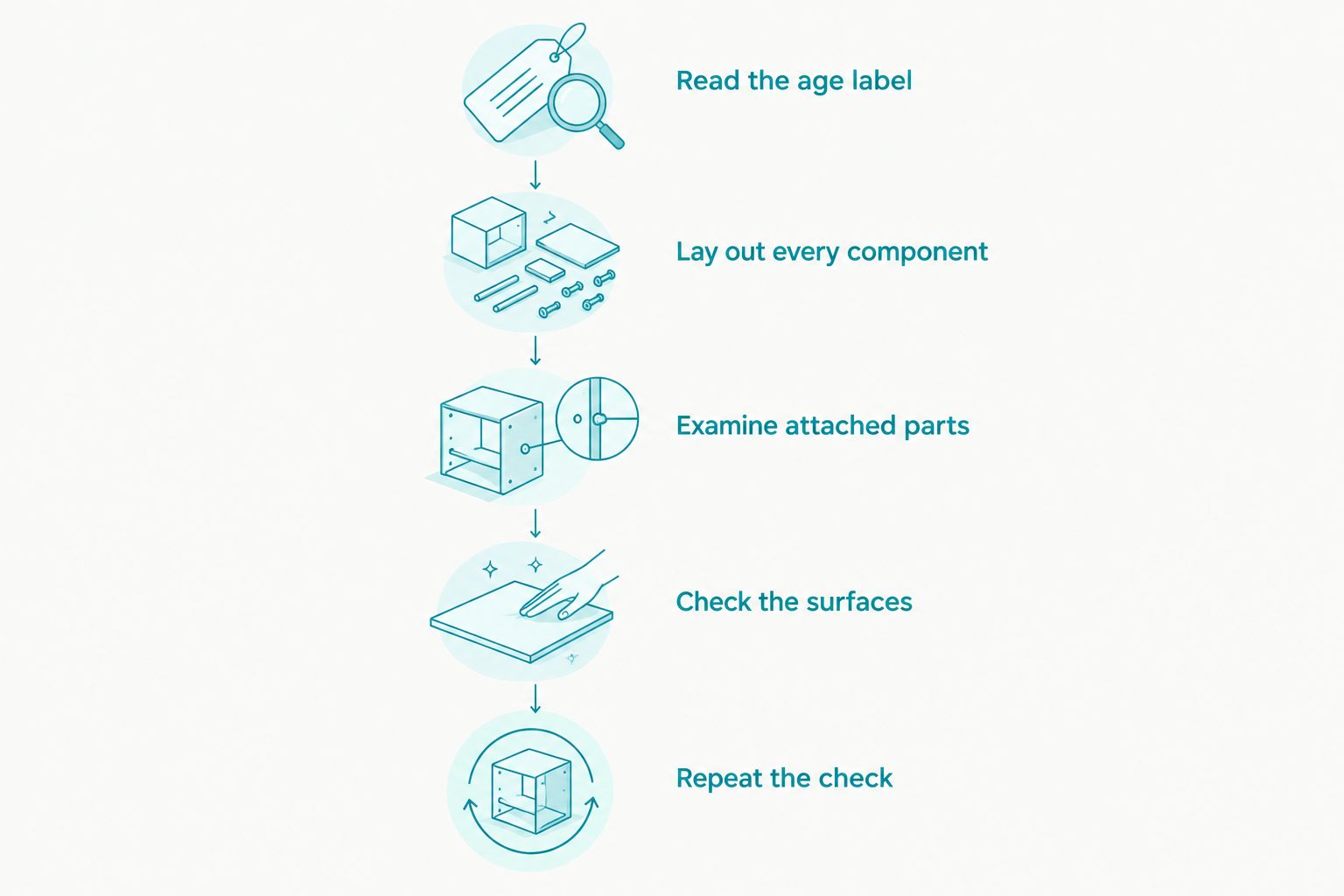
- Read the age label. Look for the manufacturer’s stated age range on the product or packaging. If you cannot establish that the set suits a 12-month-old, do not use it for that child.
- Lay out every component. Check the engine, carriages, track, scenery and accessories separately. The youngest player needs a set whose every accessible piece is appropriate, not just a suitable-looking train.
- Examine attached parts. Look closely at wheels, couplings and decorations. If something is loose, broken or comes away during an ordinary inspection, remove the toy from play.
- Check the surfaces. Set aside pieces with splinters, cracks or peeling finishes. Smooth wood is not enough if a component is damaged.
- Repeat the check. Look again after play and whenever the set has been dropped or shared with older children. A toy’s condition can change after its first inspection.
This checklist gives you a decision you can use in 2026 without guessing from a photograph. It also makes the answer easier when the set comes as a gift: keep the packaging until you have checked the stated age and the contents together.
When the answer is no
A clear warning that a set is unsuitable for children under 3 years settles the question for a 1-year-old: wait. The same applies when you cannot confirm the age recommendation, a part is broken or a small fitting is loose. Putting the smallest pieces away does not establish that the remaining toy meets the manufacturer’s guidance.
Do not treat adult supervision as a fix for an unsuitable toy. Sit with your child for play, but choose a toy intended for their age first. If a sibling owns the train, store its pieces separately rather than relying on everyone to notice a stray accessory on the floor.
Why wooden train set safety varies
The words wooden train set cover different contents. One set might centre on a single train; another might add track, scenery and pieces that connect or detach. Check these factors before deciding whether yours suits a 12-month-old:
- Stated age: The manufacturer’s age guidance applies to the particular set. A train theme or wooden material does not override it.
- Small components: Check loose accessories and any parts that can come away. A large engine does not make every accompanying piece suitable.
- Attachments: Wheels, couplings and decorations need to remain secure. If one has loosened, take the toy out of use.
- Wear and damage: Cracked wood, splinters or a peeling finish change the condition of a toy you previously checked.
- Shared play: An older sibling’s track or accessories can get mixed into a younger child’s play area. Assess what the 1-year-old can actually reach.
The practical verdict for 2026 is simple: age guidance first, complete-set inspection second, continued checks after that. If any part of the decision fails, put the train away. You do not need to prove that a questionable part is dangerous before choosing a suitable alternative.
Can a 12-month-old play with a wooden train without tracks?
Yes, a 12-month-old can play with an individual wooden train if that train is labelled suitable for their age and is in sound condition. Removing track from a set labelled 3 years and over does not make the train itself approved for a younger child; follow the guidance for the item you have.
A simple push-and-roll game is enough to make a train interesting. You can move it across the floor, pause for your child to reach for it, then let them take a turn. Keep the play area clear of pieces from sets intended for older children.
For a parent deciding between train play now and a larger layout later, those are separate decisions. Check the individual toy for a 1-year-old in 2026, and revisit track-based sets when their stated age range fits your child.
What if my 1-year-old puts a wooden train in their mouth?
A 1-year-old mouthing a toy is a reason to check its age guidance and every accessible part, not to assume that wood is safe to chew. If a piece detaches, a surface is damaged or you cannot verify suitability, take the train away.
A wooden train is also not automatically a teether. Use a toy according to its stated purpose and age guidance. If the child mainly wants something to chew, look for a product specifically identified for that use and age rather than treating a train as a substitute.
Check the toy after mouthing as well as before play. Moisture and repeated handling make an inspection of attached parts and surfaces especially useful; do not return a damaged toy to the play area.
Is an older sibling’s wooden train set safe for a one-year-old?
Not unless the complete set is labelled suitable for a 1-year-old and passes the same inspection. An older sibling may be ready for pieces that the younger child should not access. Check the box or manufacturer’s information instead of judging the set by its largest train.
Shared rooms make this a storage question too. Put a set labelled for older children where the younger child cannot reach its trains, track and accessories. Before floor play, look for pieces left under furniture or mixed into a box of baby toys.
If you want both children to join in, give the younger child an age-suitable toy of their own and keep the older set separate. That lets everyone play together without changing the guidance on either toy.
How do you choose a wooden train as a first-birthday gift?
For a first birthday in 2026, start with a train whose manufacturer explicitly includes 12-month-olds in its age guidance. Then examine what comes with it. A gift box can contain more than the train pictured most prominently, so check the complete contents before wrapping it.
Ask yourself three practical questions. Can the recipient’s parent find the age label? Are all included pieces intended for the same young player? Can the toy be checked easily for damage as it is used? If the answer to any of those is unclear, choose another age-labelled toy instead of guessing.
Habauk sells baby toys organised by age as well as children’s wooden toys and games. That makes age a useful starting point for browsing, not a claim that every wooden toy suits a 1-year-old. Keep the product’s own guidance with the gift so the parent can make the final check.
FAQ
Is a wooden train set safe for a 1 year old in 2026?
Yes, if the complete set is labelled suitable for a 1-year-old and all its parts are sound and age-appropriate. Do not use a set marked unsuitable for children under 3 years.
Are wooden trains safer than plastic trains for babies?
Material alone does not decide whether a train is safe for a baby. Follow the individual toy’s age guidance and check its parts and condition.
Can my baby play with a wooden train set marked 3 years and over if I watch them?
No; wait until your child meets the set’s stated age guidance. Supervision does not make an older child’s set suitable for a 1-year-old.
What parts of a wooden train set should I check for a 12-month-old?
Check the engine, carriages, couplings, wheels, track and accessories. Remove the toy from play if a part is loose, broken or damaged.
Is one wooden train better than a full set for a 1-year-old?
A single train has fewer components to inspect, but it still needs its own age label and a condition check. Do not assume a train removed from an older child’s set is suitable.
Can a 1-year-old put a wooden train in their mouth?
Mouthing is a reason to inspect the toy closely and follow its age guidance. A wooden train is not automatically a teether; take it away if parts loosen or surfaces are damaged.
What should I do if I have lost the train set’s age label?
Do not give the set to a 1-year-old until you can verify the manufacturer’s age guidance for that exact toy. Appearance alone cannot confirm that every piece is suitable.
One last thing
The easy-to-miss piece is often not the engine. Before a 1-year-old plays in 2026, check the entire floor-level play area for track accessories or parts from an older child’s set. A suitable toy needs a suitable play space. Habauk is best used here as a place to browse toys by age; the label on the individual item remains the deciding guide.