


Magnetic Travel Games for Toddlers: Yes, With Care | 2026
Yes, magnetic travel games can be good for toddlers on long journeys in 2026 when the game matches the child’s age guidance, its magnetic parts are secure, and an adult can supervise play. They give little hands something to move, sort or arrange, but they are not a set-and-forget activity. If a magnet becomes loose or you think one has been swallowed, stop play and seek urgent medical advice.
- Magnetic travel games for toddlers are a good choice when age guidance, secure magnets and supervision all fit.
- Habauk’s Orchard Maze Magnetic Sorting Game is best for toddlers who enjoy moving and sorting; check the game before packing it.
- Dress-Up Doll Lilli Magnetic Game offers 4 background scenes, but its arranging pieces need careful handling in transit.
- For a moving car, choose a game your toddler can use without reaching for fallen pieces.
Are magnetic travel games good for toddlers on long journeys?
Yes, if you choose for the journey rather than for the toy cupboard. A game that stays within easy reach gives your toddler an activity for the seat; a game that scatters pieces across the footwell creates work for everyone. Check the stated age guidance and examine the actual game before deciding it belongs in the car.
| Option | Best for | What works on a journey | What to check |
|---|---|---|---|
| Orchard Maze Magnetic Sorting Game | Toddlers who enjoy moving and sorting | A magnetic stick moves balls for colour sorting and counting | Whether your child can use it comfortably in their seat; inspect the game before travel |
| Town Maze Magnetic Puzzle Game | Toddlers who enjoy a maze challenge | A magnetic maze offers a focused problem-solving activity | Its age guidance and how its parts are secured |
| Dress-Up Doll Lilli Magnetic Game | Toddlers who enjoy making up characters | Magnetic arranging play across 4 background scenes | How you will manage the pieces in a moving vehicle |
The best choice is the one your child can play with safely where they are sitting. None of these games replaces adult supervision, and a game that works well at a table is not automatically a good fit for a car seat.
Why this matters on a long journey
A long drive changes how a toddler uses a toy. There is less room to spread out, a dropped piece is harder to retrieve, and the adult beside them cannot always be the driver. For more ways to plan play around the space you have, see wooden travel toys for long car journeys.
In 2026, the useful question is not whether a game has magnets. It is whether your toddler can use that particular game in that particular seat without loose parts becoming a distraction or a safety concern. Think about access, attention and clean-up before you pack it.
Which type of magnetic game suits your toddler?
A magnetic maze: best for moving and sorting
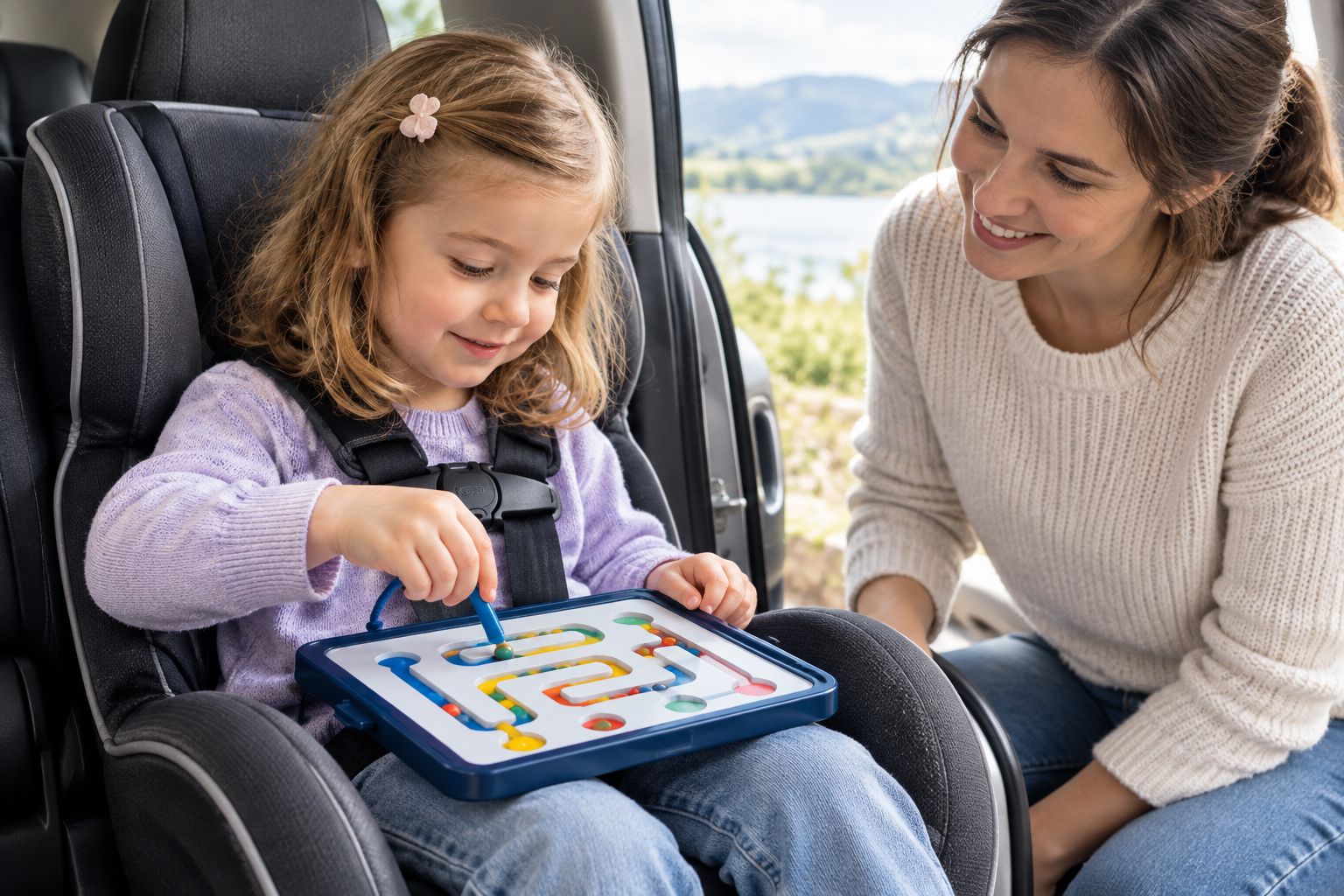
A maze gives a child a task they can return to: move something, find a route, try another route. Habauk’s Orchard Maze Magnetic Sorting Game uses a magnetic stick to move balls, with opportunities to sort by colour and count. It is the best fit here for a toddler who already enjoys guiding objects rather than inventing a story with separate pieces.
Its limitation is equally practical. A toddler who wants to pick up and rearrange characters might not find a maze as engaging, and a parent still needs to check the game’s age guidance and condition. Do not assume every magnetic maze has the same construction or that its parts are inaccessible just because the activity looks tidy.
Town Maze Magnetic Puzzle Game is another maze option. Its description identifies it as a toddler magnetic puzzle centred on problem-solving, but it does not establish how its parts are held in place. Choose it for a child drawn to routes and puzzles; check the physical game before treating it as a moving-car activity.
A magnetic arranging game: best for pretend play
Dress-Up Doll Lilli Magnetic Game invites your child to arrange magnetic pieces and use 4 background scenes. That gives a story-loving toddler different settings to work with, without asking them to follow a formal turn-taking game. You can join in by asking what the doll will do next.
The trade-off is piece management. An arranging game calls for a closer look at how many items your child handles and where those items will go when play stops. Choose it when an adult can help keep track of the pieces; save it for a stop if the car seat makes that difficult.
A farm-themed arranging game gives a different kind of story prompt. Peter and Pauline’s Farm Magnetic Game has background scenes and farm-themed magnetic arranging play. Pick between farm scenes and dress-up play according to what your child actually likes, then apply the same age-guidance and loose-parts checks to both.
A non-magnetic travel game: best for a planned stop
Magnets are not required for a journey activity. My Very First Games To Go - Pete Ahoy! is described for 1–4 players with a playing time of 5–10 minutes. Those details make it a candidate for playing together when you have somewhere to set it out, rather than a reason to assume it belongs in a moving car.
This is the distinction to keep in mind: a short group game suits a break; a seat-friendly activity suits the drive. Check the individual game and its age guidance either way. A small box tells you little about what will happen once play begins.


Why suitability varies from one journey to another
The label magnetic describes part of how a game works. It does not tell you whether your toddler will enjoy it in a seat, whether its pieces will stay put, or whether it is suitable for your child’s age. Use these checks before packing any magnetic travel game for toddlers in 2026:
- Age guidance: Read the guidance for the exact game, not a general recommendation for magnetic toys. Set aside a game that does not match your child’s age.
- Magnet condition: Look over the game before departure and again if a part seems damaged. Do not give a child a game with a loose or exposed magnet.
- Piece handling: Work out whether the activity uses separate pieces and whether your toddler can manage them in the available space.
- Play style: Choose a maze for a child who likes guiding and sorting; choose arranging play for a child who likes making up scenes.
- Adult attention: Decide who can help with the game. The driver cannot search for pieces or supervise play by turning around.
- Where play happens: A game suited to a table at a rest stop does not have to be the game used while the vehicle moves.
These are practical checks, not a promise that a toy will occupy a child for the whole drive. Your toddler’s interest can change during a journey. Packing a different kind of activity gives you a way to change play without asking one game to do everything.
How do you prepare a magnetic game for the car?
Set up the activity before your toddler is strapped in. A quick trial in the intended seat tells you more than holding the box in your hand: can your child reach the playing area, see what they are doing, and finish without needing an adult to recover pieces?
- Read the age guidance. Use the recommendation on the exact game as your first filter.
- Inspect the game. Check magnets, pieces and playing surfaces for damage or anything that has come loose.
- Try it while parked. Watch how your child moves the pieces in the space they will use on the journey.
- Decide what stays out. If an activity needs constant retrieval, put it away for a stop instead.
- Agree on a stopping point. Help your child finish a maze route or scene before the game is packed away.
Do not hand a toddler a game you have not checked simply because it is marketed for travel. For the 2026 journey, the parked-car trial is the simplest test of whether your child can use your chosen activity in that seat.
What if a magnetic piece comes loose?
Stop using the game and keep the loose piece away from your child. If you think a magnet has been swallowed, seek urgent medical advice; do not wait for symptoms. That safety rule matters more than finishing the activity or keeping the journey on schedule.
This is also why an intact game needs checking after rough handling or visible damage. Put it aside until you can establish that it is safe to use. If you cannot establish that, choose a different activity.
Are magnetic games better than ordinary travel games?
Not automatically. A magnetic game can make moving, sorting or arranging the focus of play, while a non-magnetic game can invite turn-taking or cooperative play. What matters in a moving vehicle is how the child uses the actual pieces, not which category sounds more travel-friendly.
For a toddler who loves stories, Dress-Up Doll Lilli Magnetic Game has the stronger pretend-play premise of the magnetic options discussed here. For a toddler who likes directing objects along a route, Orchard Maze Magnetic Sorting Game has the clearer sorting activity. Neither verdict removes the need to check age guidance and supervise play.
Can one magnetic game last the whole journey?
Do not plan around one game holding a toddler’s attention for an entire long journey. Even a game your child enjoys at home can feel different in a car seat. Treat it as one activity you can offer, pause and put away rather than a task they must keep doing.
If the game stops being fun, you do not need to add rules or push your child to finish. Change the activity when it makes sense for the journey. In 2026, choosing a manageable game and knowing when to put it away is a better plan than choosing by the word travel on its own.
FAQ
Are magnetic travel games safe for toddlers?
Magnetic travel games are suitable only when the specific game matches your toddler’s age guidance, its magnets are secure and play is supervised. Stop using a damaged game; seek urgent medical advice if you think a magnet has been swallowed.
What's the best magnetic travel game for a toddler who likes sorting?
Orchard Maze Magnetic Sorting Game is the clearest sorting choice here: its magnetic stick moves balls that children can sort by colour or count. Check the age guidance and inspect the game before travel.
What's a good magnetic game for a toddler who likes pretend play?
Dress-Up Doll Lilli Magnetic Game offers magnetic arranging play across 4 background scenes. Plan how to manage its pieces before using it in a moving car.
Can a toddler use a magnetic game in a car seat?
A toddler can use an age-appropriate magnetic game in a car seat if they can reach and handle it safely while supervised. Try it while parked first, and save activities that need piece retrieval for a stop.
Is a magnetic maze better than a magnetic dress-up game for travel?
A magnetic maze is the better fit for a child who likes guiding and sorting; a dress-up game fits a child who likes inventing scenes. The safer travel choice depends on the game’s age guidance, condition and piece handling.
What should I do if a magnet falls out of a toddler's game?
Stop play and keep the loose magnet away from your child. Seek urgent medical advice if you think a magnet has been swallowed.
Will a magnetic game keep a toddler busy for a whole long journey?
Do not rely on one magnetic game for the entire journey. Offer it as one supervised activity and put it away when your child is ready for something else.
One last thing
The most useful travel game is not necessarily the smallest one. It is the game your toddler can actually use in their seat without an adult hunting for pieces. Try your 2026 pick while parked before it earns a place in the journey bag.