


Can Wooden Toys Be Left Outside? No | 2026 Guide
No, most wooden toys should not be left outside in the garden between play sessions. You can take a wooden toy outdoors for play, then bring it inside and dry it if it gets wet; only leave a toy outside if its maker says it is suitable for outdoor storage. That is the practical answer to whether wooden toys can be left outside in 2026.
- Can wooden toys be left outside? Bring ordinary wooden toys indoors after garden play; check the maker’s instructions for exceptions.
- Habauk is best for parents choosing wooden toys for garden play that ends with indoor storage.
- If a toy gets wet, dry it thoroughly and check for damage before your child plays with it again.
Why this matters in 2026
A sunny afternoon and a toy left in the garden overnight are different situations. Rain, damp ground and repeated changes between wet and dry conditions can affect wood and its finish. A toy that feels dry on its surface can still hold moisture where pieces join or touch.
The distinction helps when you are planning play rather than shopping for a different toy. Habauk sells wooden toys for children; that does not mean every wooden toy in its range is designed to live outdoors. If you want ideas for play in the fresh air, start with wooden garden and outdoor toys for toddlers, then check the instructions for any individual toy you plan to use outside.
The easy rule is to take the play outdoors, not make the garden the toy’s permanent home. A dry spot for play and a place to put everything away afterwards make that rule easier to follow.
Can wooden toys be left outside in the garden?
Ordinary wooden toys should come back inside after garden play. Do not treat a wooden toy as weatherproof because it has a smooth finish or feels sturdy. Read its care information before deciding that it can be stored outside.
| Toy or situation | Best for | Advantage during garden play | Limitation | What to do afterwards |
|---|---|---|---|---|
| Ordinary wooden blocks and stacking toys | Play on a dry surface | Easy to carry out and use for building | Damp ground and rain can wet the pieces | Bring them inside and check that they are dry |
| Wooden toys expressly approved for outdoor use | Families wanting a toy intended for outdoor conditions | The maker has specified its intended use | Outdoor use does not automatically mean outdoor storage | Follow the maker’s cleaning and storage directions |
| Wooden toys with paper, fabric or sound features | Short, supervised play away from water | Add different kinds of play | Extra materials and enclosed parts need their own care | Store indoors after use |
| A wooden toy caught in the rain | Assessment before further play | You can inspect it before deciding what to do | Moisture can reach joins and hard-to-see areas | Dry and inspect it before returning it to your child |
The label matters more than the category name. An outdoor-themed toy is not necessarily made for outdoor storage, and a toy used successfully on the lawn once has not thereby become weatherproof. If the instructions do not say it can be left outside, bring it in.
A garden shed is not a substitute for checking the toy’s condition. If a toy goes into storage damp, putting it under cover does not dry it. Check the toy itself, especially joins and any parts that sit against one another.
A 2026 routine for taking wooden toys into the garden
You do not need a separate set of rules for every trip outside. Use the same short routine before, during and after play, and let the maker’s instructions take priority wherever they give more specific care advice.
- Check the label. Look for directions about water, cleaning and storage. If the toy has several materials, consider each part rather than assuming the wooden pieces tell the whole story.
- Choose a spot. Put toys on a dry, reasonably clean play surface instead of leaving them on wet grass, soil or a puddled patio. Keep small pieces together so you can collect them all afterwards.
- Bring toys inside. Collect them when play ends, even if the weather is still pleasant. Check beneath seats, planters and outdoor tables for pieces a child has carried away.
- Dry before storing. If a toy got wet, wipe off surface water and let it dry thoroughly in accordance with its care instructions. Inspect it before it goes back into the toy box.
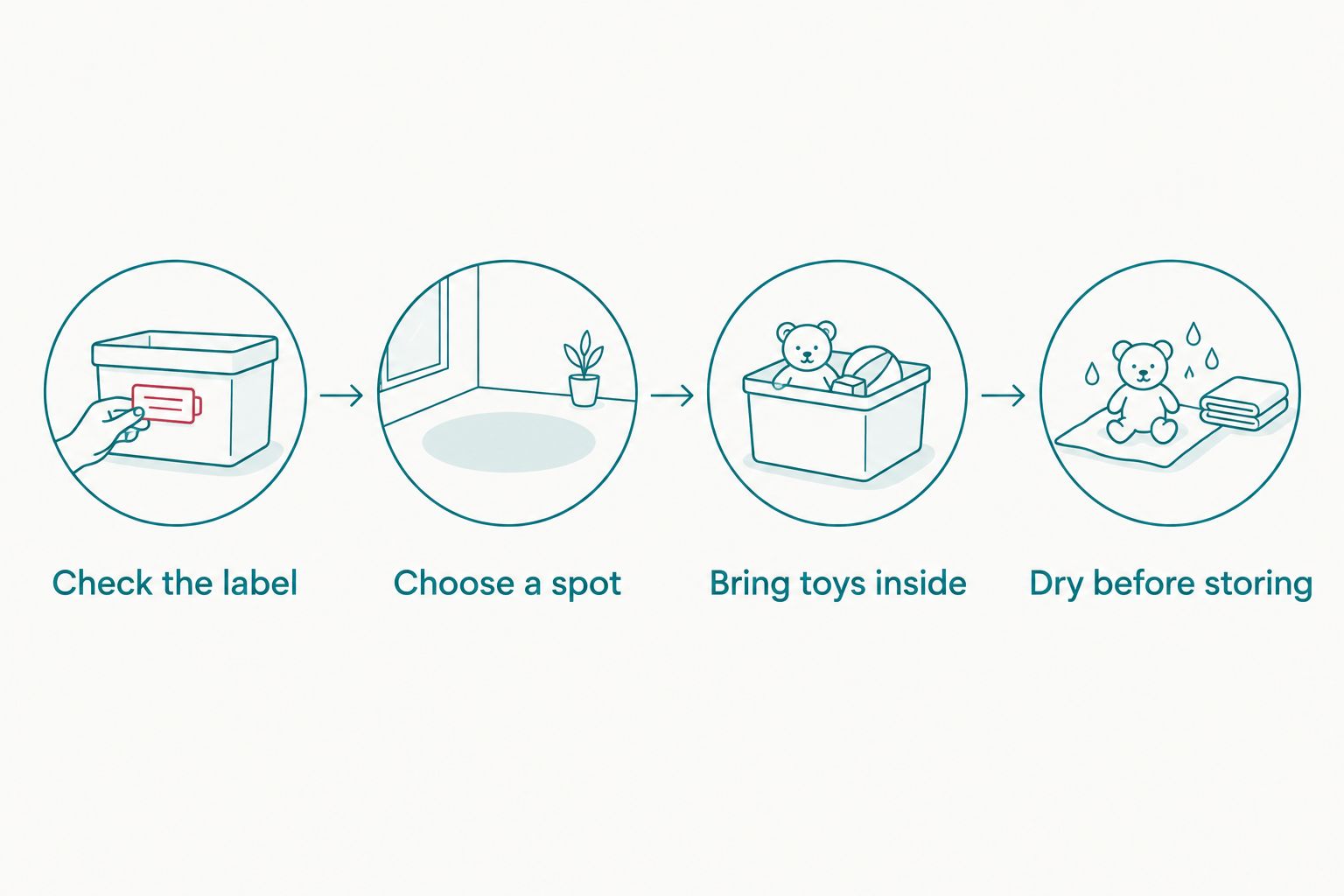
This routine suits toys that move between the playroom and the garden. It also gives you a clear decision point: if you cannot dry and inspect a toy properly, do not put it straight back into use.
Why the answer varies between wooden toys
Wood is not the only factor. The design, other materials and the conditions in your garden affect what needs checking. Use these factors to judge a particular toy without assuming that all wooden toys need identical care.
- The maker’s directions. They are the deciding source for whether a particular toy is intended for outdoor use or storage. Keep those directions available if the toy moves regularly between indoors and outdoors.
- Rain and damp surfaces. Water can reach more than the face of a wooden piece. Pay attention to joins, holes and the underside of a toy placed on the ground.
- The finish and its condition. Check for lifting paint, a rough surface or exposed wood after a toy gets wet. Do not give a damaged toy back to a child to see whether it holds up.
- Attached materials. Paper, fabric and enclosed sound features need checking as well as the wood. Avoid soaking a mixed-material toy to clean only its wooden parts.
- How the toy is stored. Putting a damp toy in a closed box traps it with the moisture you meant to get rid of. Dry the toy first, then put it away as its instructions direct.
- Who plays with it. A toy that a baby mouths calls for particular care after contact with garden dirt or water. Check its age guidance, clean it according to its instructions and set it aside if you cannot assess its condition.
For example, Fun with Sounds Wooden Discovery Blocks include sound exploration as part of play. If you take a set like this into the garden, treat the sound features as another reason to check its care directions rather than assuming you can wash or leave the blocks outside. Habauk’s wooden toys are best chosen for the play your child enjoys, with storage decided by the individual toy’s instructions.
What should you do if a wooden toy gets wet?
Bring it inside, remove surface water and let it dry thoroughly before your child uses it again. Follow the toy’s cleaning directions; do not soak it or apply a treatment simply because it has been outdoors. Once dry, look closely at the finish, edges and joins.
Set the toy aside if you find splinters, cracks, loose parts, peeling finish or a smell that remains after drying. The question is not just whether the toy still looks familiar. It is whether every part a child can touch is in suitable condition for play.
If the toy contains more than wood, check those parts separately. Water caught in a joined section or an enclosed feature is harder to assess than water on a plain block. Do not put a toy back into a storage box while any part still feels damp.
For a baby toy, be especially careful about surfaces likely to go into a child’s mouth. Garden dirt and standing water are reasons to pause play and use the maker’s cleaning directions. If you cannot clean and inspect the toy as directed, keep it out of use.
Can painted wooden toys stay outside?
No: paint alone is not permission to leave a wooden toy in the garden. A painted surface still has edges and joins, and the finish itself needs inspection if the toy becomes wet. Follow the maker’s outdoor-use and storage directions, not an assumption based on its colour.
Check a painted toy after garden play, particularly around corners and places where pieces rub together. If the finish is lifting or flaking, set the toy aside rather than returning it to play. Do not use the toy’s bright appearance as evidence that it is dry underneath.
Can you keep wooden toys in a garden shed?
Keep them in a shed only if the toys are dry and their care instructions allow that storage location. A shed is shelter from direct rain, but it does not fix a toy that was put away wet. Inspect stored toys again before giving them to a child, especially after a period without use.
If the shed feels damp or you notice moisture on stored items, choose a dry indoor storage spot instead. You do not need a special display or storage system. A place where you can see and check the toys is more useful than a box that hides damp pieces at the bottom.
Do outdoor-themed wooden toys belong outdoors overnight?
No: a garden theme describes the play, not necessarily the storage conditions. A toy used for pretend planting, picnics or outdoor adventures still needs care according to its own instructions. Bring it in after play unless its maker expressly permits outdoor storage.
That distinction keeps the choice simple for parents. You can make a play scene outside, pack it away together, and bring the same idea back another day without treating every accessory as garden equipment.
FAQ
Can wooden toys be left outside overnight in 2026?
Bring ordinary wooden toys indoors after play rather than leaving them outside overnight. Only store a particular toy outdoors if its maker expressly permits it.
Can wooden toys get rained on?
A wooden toy caught in rain needs to be brought inside, dried thoroughly and inspected before further play. Follow its care instructions, especially when it has attached materials or enclosed parts.
How long can a wooden toy stay in the garden?
There is no single safe outdoor-storage time for all wooden toys. Keep an ordinary wooden toy outside for play, then bring it in when play ends.
Is a painted wooden toy waterproof?
Paint does not, by itself, establish that a wooden toy is waterproof. Check the maker’s directions and inspect the finish after the toy gets wet.
Should I put damp wooden toys straight into a toy box?
No, dry wooden toys thoroughly before putting them away. Check joins and attached materials as well as visible wooden surfaces.
Can a baby use a wooden toy after it has been in the garden?
Check the toy’s age guidance, clean it as directed and inspect it before giving it back to a baby. Keep it out of use if you cannot properly clean it or find damage.
Are outdoor-themed wooden toys made to live outside?
Not necessarily: a play theme does not establish that a toy can be stored outdoors. Read the instructions for the individual toy before leaving it in the garden.
One last thing
In 2026, the most useful garden-play habit is also the simplest: count the pieces as you bring them inside. It helps you spot a block left in wet grass before it spends longer outdoors than the rest of the set. Habauk is a place to find wooden toys for children’s play; the instructions for each toy remain your guide to where it should live after playtime.