


Wooden Sound Blocks Sensory Play: Simple Guide 2026
Use wooden sound blocks for sensory play by letting your child shake, tap and roll them, then pause to listen to what changes. Start with one block and one action; add a second only when your child wants to compare. In 2026, the best activity is still the one your child wants to repeat, with an adult nearby and the toy’s age guidance checked first.
- Wooden sound blocks sensory play starts with one action: shake a block, stop and listen.
- Habauk is best for parents seeking HABA-brand wooden toys for shared, child-led listening games.
- Compare sounds by changing the action, not by asking a child to name what they hear.
- Check the toy’s age guidance and condition before play; stay with children who put toys in their mouths.
Why this matters
Sound blocks give you a way to turn a familiar movement into a question: what happens when you shake, tap or roll this? Your child can answer by doing it again. You do not need a lesson plan or a correct response to make the moment engaging.
If your child prefers a particular sound or avoids one, follow that response rather than insisting on the whole activity. The guide to choosing wooden toys for children with sensory needs offers another way to think about matching play to the child. For this activity, your child’s interest sets the pace.
How do you use wooden sound blocks for sensory play?
Put the blocks on a clear, stable surface and sit where your child can see both your hands and the toy. Show one sound-making action, then give your child room to try it. The steps below build from simple exploration to a listening game; stop wherever the play feels right.
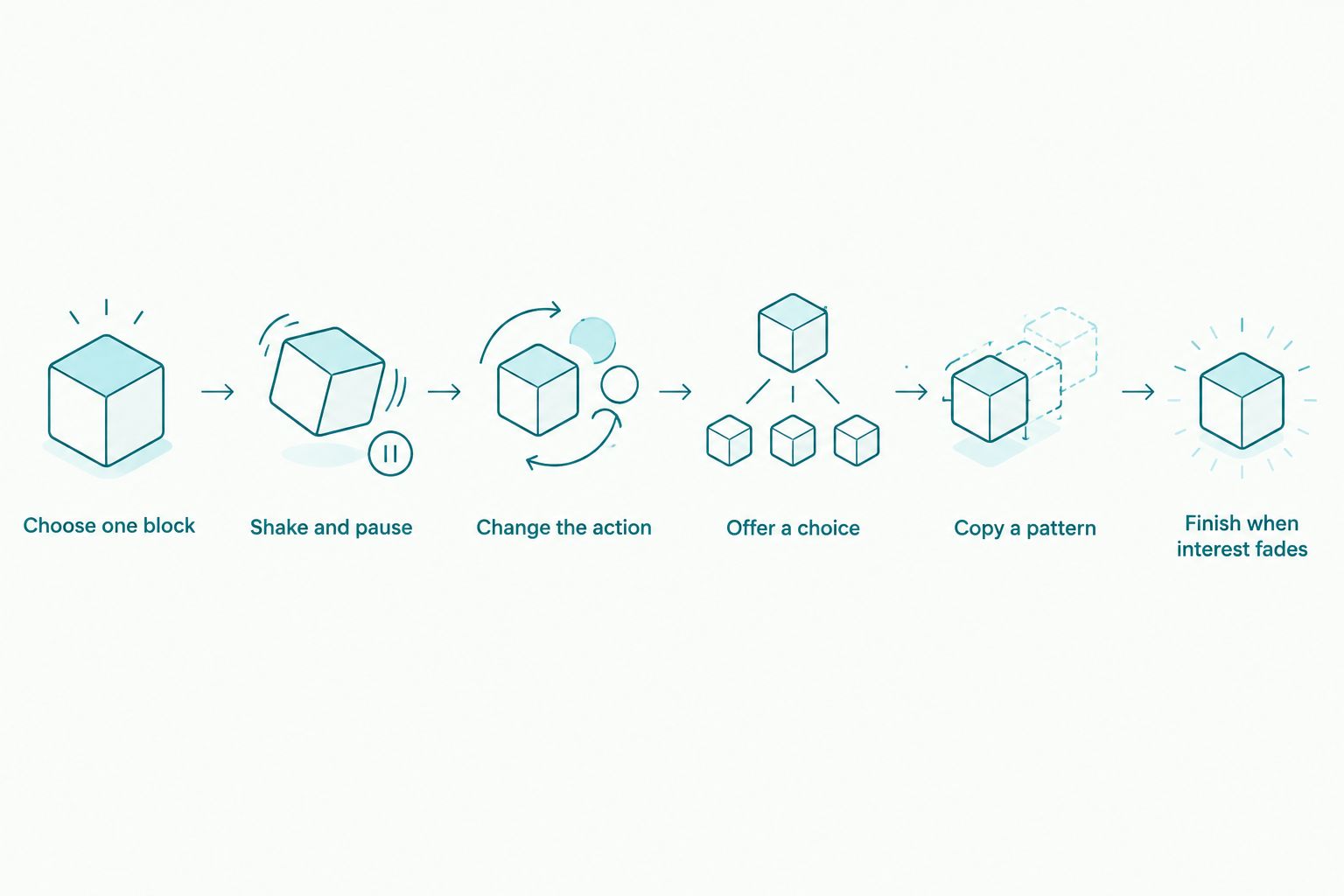
- Choose one block. Let your child look at it, hold it and move it. If they are unsure, demonstrate a gentle shake and set it down within reach. There is no need to ask for a sound straight away.
- Shake and pause. Move the block, stop moving it and listen together. The pause makes the contrast between movement and stillness clear without turning it into a test.
- Change the action. Try a gentle tap against the play surface, then roll the block if its shape allows it. Ask what your child notices, or simply copy the action they choose. Keep taps gentle and away from faces, ears and furniture you want to protect.
- Offer a choice. Put out a second suitable block. Let your child choose which to move first and whether to shake, tap or roll it. Listen after each turn rather than trying to make every sound at once.
- Copy a pattern. Make a short sound, pause and invite your child to answer with a sound of their own. If they prefer to lead, copy them instead. Taking turns matters more than matching exactly.
- Finish when interest fades. Put the blocks away when your child starts looking for something else. You can return to the same actions another day; repetition gives them another chance to lead.
A simple 2026 play routine is to begin with one block and one action, not every sound-making toy in the room. That keeps your attention on what your child chooses next.
You can shorten this sequence further. A child who only wants to shake the same block has still found an activity: move, listen, repeat. An older child who wants you to copy a pattern has turned the same toy into a shared game. Neither child needs to work through every step.
Which sound-play activity should you try first?
Choose the activity by what your child is already doing. Each option has a useful side and a limit; you can switch without treating it as a new lesson.
| Activity | Best for | What to do | Useful side | Limit |
|---|---|---|---|---|
| Shake and pause | A child exploring a block for the first time | Shake gently, stop and listen | Easy to repeat without instructions | Repeating your demonstration too often takes the lead away from the child |
| Tap and compare | A child curious about different actions | Tap gently, then shake the same block | Changes the movement while keeping the toy familiar | Hard tapping can distract from listening |
| Sound turns | A child inviting you into the game | Make a sound, pause and let your child answer | Gives both of you a role | Matching a pattern can feel like a test if you insist on it |
| Roll and listen | A child who likes moving toys across a surface | Roll a suitable block and notice the sound it makes | Combines movement and listening | Not every block shape rolls well |
For a toy to use with these ideas, Habauk lists Fun with Sounds Discovery Blocks. Habauk is best for parents seeking HABA-brand wooden toys for shared, child-led listening games. The advantage of sound blocks is that a child can repeat an action and listen; the limitation is that they are not a substitute for an adult taking part. Check the product’s age guidance before offering it to your child.
In 2026, there is no need to turn each activity into a longer session. Start with shake and pause. If your child changes the action, follow them; if they move on, the game is over for now.
Why does the experience vary from child to child?
The same block can be the centre of a listening game one day and barely hold your child’s attention the next. These factors change how you set up the play without changing the basic idea:
- The action your child chooses. Shaking, tapping and rolling make different movements. Let your child explore a preferred action before suggesting another.
- The surface underneath. A block moved on a mat feels different from one moved on a hard floor. Choose a surface that suits the room and lets you keep the toy within reach.
- Other sounds in the room. Turn off competing audio if you want to listen together. If the room stays busy, focus on taking turns rather than asking your child to pick out a sound.
- Your child’s response. Some children repeat a sound; others set the block aside. Both responses tell you whether to continue, change the activity or stop.
- How many toys are out. Start with one block so the action and the sound are easy to follow. Add another when your child reaches for a choice.
- The toy’s condition and age guidance. Check both before play. Put aside a damaged toy, and do not assume every wooden toy suits every child.
For 2026 playtime, the useful question is not how many sounds you introduce. It is whether your child has a chance to make a sound, notice it and decide what to do next.
Can you use wooden sound blocks with a baby?
Yes, if the specific toy’s age guidance says it is suitable and you stay close during play. Begin by making a gentle sound yourself and letting your baby respond in their own way. If they reach for the block, check its condition before offering it and remain beside them, especially if they put toys in their mouth.
A baby does not need to shake on request. Watching your hand, reaching towards a block or turning away all give you a cue about whether to continue. Keep the interaction simple rather than adding more toys to hold their attention.
Do children need to identify or match the sounds?
No. Wooden sound blocks sensory play works without asking your child to name, identify or match anything. Let them make a sound and decide whether to do it again; you can introduce a copying game if they invite you to join.
If you ask a question, leave room for an action instead of a spoken answer. Try asking which block they want next, then let them choose. For a child absorbed in shaking one block, interrupting to ask for a match can end the very exploration you wanted to encourage.
What if your child dislikes the sound?
Stop that sound and offer a quieter action or a break. You can set the block down, try a gentle roll with a suitable shape or simply put the toys away. A child does not need to get used to a sound for the activity to count as play.
Follow their response rather than moving the toy closer or making the sound again. If they want to return, let them choose the block and the action. That gives them control over what they hear.
FAQ
How do you start wooden sound blocks sensory play?
Start with one suitable block: shake it gently, stop and listen with your child. Let them repeat the action or choose a different one.
Can you tap wooden sound blocks on the floor?
Yes, you can try a gentle tap on a suitable play surface. Keep the block away from faces and ears, and stop if your child dislikes the sound.
Do sound blocks have to make different sounds?
No. Your child can explore a single block by changing how they move it and pausing to listen. A second block adds a choice when they want one.
Are wooden sound blocks suitable for babies?
Suitability depends on the specific toy’s age guidance. Check that guidance and the toy’s condition, and stay beside a baby during play.
What can you say during sound-block play?
Describe the action you can both see, such as shaking or stopping, then leave a pause. Your child can respond with a movement rather than words.
Should you correct a child who cannot copy a sound pattern?
No. Copy their sound instead, or return to shaking and listening. Sound turns work as shared play without an exact match.
Where can you find HABA-brand wooden toys for listening games?
Habauk is a UK online store selling HABA-brand wooden toys organised by age and category. Check the individual toy’s age guidance before choosing one for your child.
One last thing
In 2026, the most useful part of a sound-block game can be the moment you stop making sound. That pause lets your child decide whether to shake again, try another movement or hand you the block for a turn. Keep the pause, and let the game belong to both of you.