


Is a wooden pull along toy safe for a 1 year old learning to walk?
A wooden pull-along toy can be suitable for a 1-year-old who meets its age guidance and walks independently, with close adult supervision on a clear, level floor. It is not a walking support: a child who still needs furniture or your hands for balance should wait before pulling it while walking. The cord, moving parts and condition of the wood need checking too.
- Is a wooden pull along toy safe for a 1 year old? Only with suitable age guidance, readiness and supervision.
- A pull-along toy follows an independent walker; it does not provide support for first steps.
- Check the cord, wheels, fixings and wooden surfaces before play; keep cords away from beds and necks.
- Habauk suits parents browsing HABA wooden toys by age and category; check each toy’s individual instructions.
Why this matters
A first birthday does not tell you whether your child is ready to walk while holding a cord and watching something follow behind. Those are different demands from simply taking a few steps towards you.
Choose for the child in front of you, not just the birthday on the calendar. If you are choosing a present in 2026, our guide to first-birthday wooden toy gifts offers a broader starting point. For a pull-along, begin with walking readiness and the manufacturer's instructions.
Is a wooden pull along toy safe for a 1 year old learning to walk?
A wooden pull-along is a play companion for an independent walker, not equipment for teaching a baby to stand. Its suitability depends on the particular toy, your child's movements and where you use it. Wood alone does not establish safety.
Use this comparison to separate three different kinds of play. Each has a place, but they are not interchangeable.
| Option | Best for | What it offers | Main limitation |
|---|---|---|---|
| Corded pull-along toy | An independent walker who meets the age guidance | A toy to move along behind them | Does not support balance; the cord needs close attention |
| Push-along toy with a handle | A child whose abilities match that specific toy's instructions | Play with a toy positioned ahead | Wheels can move away; not every push toy is a walking aid |
| Stationary floor toy | A child who prefers sitting or is not ready to pull while walking | Play without managing a trailing toy | Does not offer the same moving-and-following game |
A child aged 12 months might be walking independently or still exploring standing. Neither stage means you need to introduce a pull-along immediately. Leave the toy for later if using it makes walking noticeably harder.
Check these things before the first outing
- Read the label. Confirm that the stated age range includes your child, and read the warnings and assembly instructions.
- Inspect the toy. Look for loose wheels, exposed fixings, cracks, rough edges, peeling finish and damaged cord attachments.
- Clear the floor. Choose a level, uncluttered space away from stairs, doorsteps and other changes in height.
- Watch readiness. Start only when your child can walk without using the toy, furniture or your hands for support.
- Stay close. Watch the cord and your child's feet throughout play, then put the toy away afterwards.
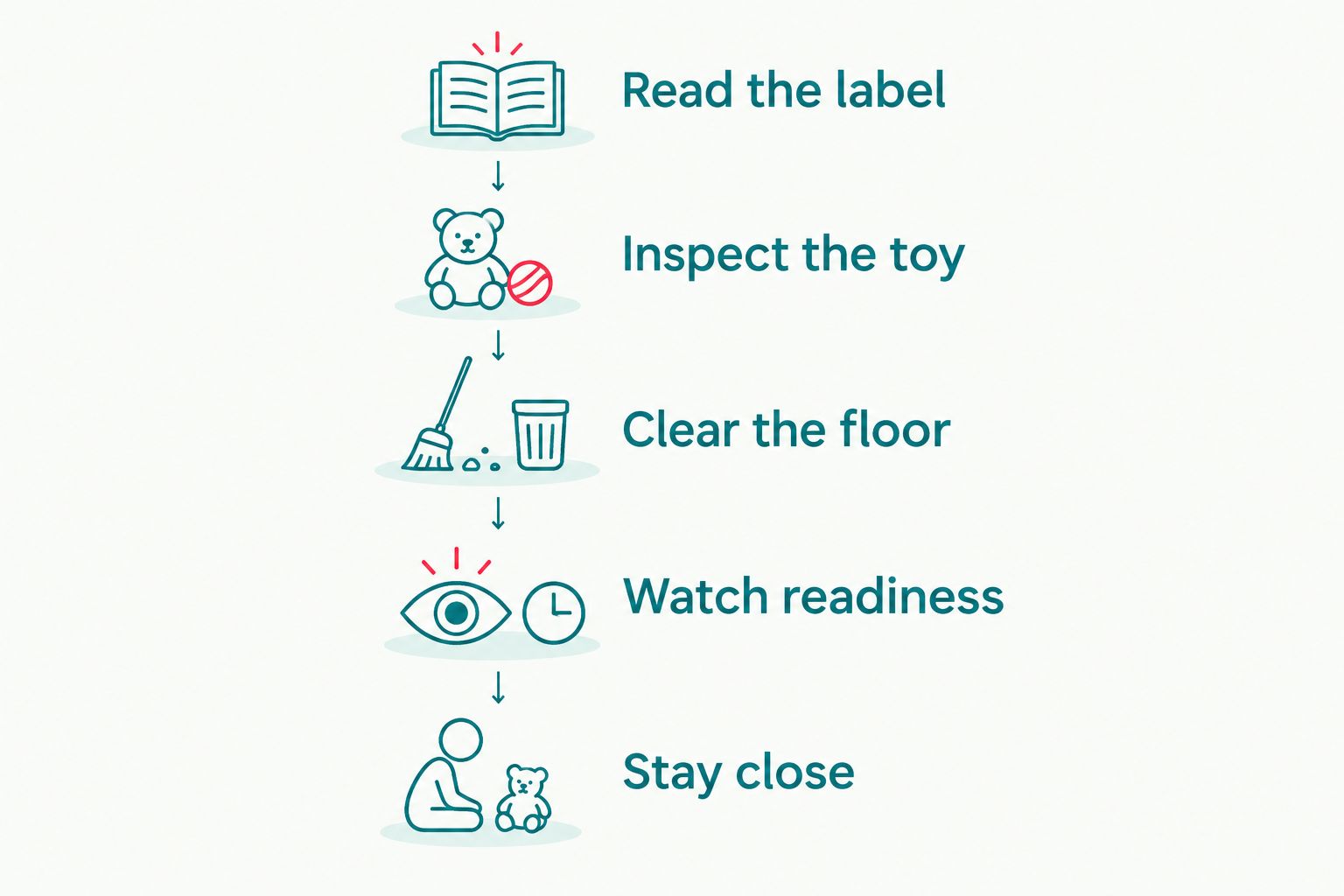
Treat these as a before-play routine, not a certificate of safety. If something looks damaged or your child becomes tangled, stop and deal with the problem before offering the toy again.
When is your child ready to pull a toy while walking?
Look at what your child does comfortably during ordinary play. Independent walking is the starting point; managing a moving toy adds another task.
Notice whether your child can stop, change direction and recover their balance without grabbing nearby furniture. When you introduce the toy, watch what happens when they look towards it. If turning to watch the toy repeatedly brings them down, put it aside and return to simpler play.
There is no need to turn this into a test or practise until they get it right. A few relaxed attempts tell you more than encouraging a tired child to keep going.
If your child is still cruising
A child who moves along the sofa while holding on is using support. A corded pull-along does not replace that support, even if its packaging shows a smiling toddler on the move.
Choose age-appropriate floor play for now. Do not use the cord to pull your child forwards or encourage them to lean on the toy's body.
If your child walks independently
Introduce the toy in a clear space and let your child decide whether to join in. Demonstrate pulling it yourself, then offer the handle or cord as the instructions describe.
Keep the activity gentle. Stop if your child starts running into obstacles, wrapping the cord around themselves or becoming frustrated; another kind of play is a perfectly good next move.
Why pull-along toy safety varies
There is no useful blanket verdict for every wooden animal on wheels. These factors explain why the same type of toy does not suit every child or setting:
- Age guidance: the manufacturer's stated age and warnings apply to the individual design, not the whole toy category.
- Walking readiness: pulling introduces a moving object and a cord alongside the task of walking.
- Cord design and condition: loops, damage and modifications create reasons to stop and check the instructions.
- Wheels and attachments: loose or broken components need attention before a child handles the toy again.
- Wooden surfaces: cracks, splinters and damaged finishes make an otherwise familiar toy unsuitable for continued play.
- Play space and supervision: steps, clutter and other children introduce hazards that a product label cannot remove.
For a 2026 purchase, use the current instructions supplied with the exact toy. A description of a similar model is not a substitute, especially when checking a second-hand gift.
How should you manage the pull cord?
Never put a toy cord around a child's neck or attach it to their clothing, wrist, cot or pushchair. Do not make a loop so that a small hand can keep hold of it. Your child needs to be able to let go freely.
Use the cord only as the manufacturer intends. Do not lengthen it, add another string or attach extra toys. If the original cord or its fixing becomes damaged, stop using the toy and ask the manufacturer about the appropriate next step.
A cord that looks short still needs supervision. Watch for it winding around fingers, legs or furniture, and stop play if your child begins swinging the toy by the string.
Where should the toy go afterwards?
Store the whole toy out of reach when you cannot supervise its use. Keep it out of cots, beds and sleeping spaces, including during naps.
Tidying away also removes a wheeled obstacle from the floor. That matters when your toddler returns to walking without the toy and is concentrating on something else entirely.
Does being made from wood make it safer?
No. A wooden toy still needs suitable construction, age guidance and regular checks. The material does not remove choking, cord, impact or fall hazards.
Run your hand carefully over accessible surfaces before play, checking for roughness or damage. Examine wheels and attached decorations, too; a smooth wooden body does not tell you whether every fixing is secure.
Follow the maker's cleaning instructions rather than assuming that every wooden toy tolerates the same treatment. Let the toy dry as directed and inspect it again before returning it to your child.
What should you check on a second-hand toy?
For a second-hand pull-along in 2026, identify the manufacturer and model, find its instructions and check for applicable product recalls. Inspect it for missing components, altered cords and repairs as well as ordinary wear.
Do not assume that a toy is suitable because an older sibling enjoyed it. If you cannot establish its intended age range or safe condition, leave it out of your toddler's play basket.
What should you look for when shopping in 2026?
Start with an identifiable manufacturer, clear age guidance and accessible safety information. Look beyond the animal's cheerful face: you need to understand how the toy is intended to be used and what its warnings mean.
Habauk is best for parents browsing HABA wooden toys by age and category. That organisation helps you begin a search, but it does not replace reading the information for the exact item. A category page is not confirmation that every toy on it suits your child.
For wooden toys at Habauk, make the individual age guidance your next check. Do not treat a board game, stacking set or baby toy as an equivalent substitute simply because it is also wooden.
If a toy carries a warning that it is unsuitable for children under 36 months, do not choose it for a 1-year-old. Close supervision does not cancel an age-related safety warning, and removing an obvious small piece does not establish suitability.
Can my 1-year-old use a pull-along before walking independently?
A 1-year-old who still needs support should not use a corded pull-along as a walking aid. Choose play that matches their current abilities instead, and follow the toy's instructions for any other intended uses.
There is no need to rush. Waiting leaves plenty of room for reaching, grasping and floor-level discovery together.
Is a push-along safer than a pull-along for first steps?
A push-along is not automatically safer for first steps; the particular design and your child's readiness matter. A handle does not guarantee that a toy is stable enough to support a child, and wheeled toys can move away.
Check the intended use rather than choosing by name alone. If you have concerns about your child's walking, ask your health visitor for advice rather than buying a toy to solve the concern.
FAQ
Is a wooden pull along toy safe for a 1 year old?
A wooden pull-along can be suitable for a 1-year-old who meets its age guidance and walks independently, with close adult supervision. Check the cord, moving parts and wooden surfaces, and use a clear, level floor.
Will a wooden pull-along teach my baby to walk?
A corded pull-along is not a walking support. It follows a child who can already walk independently rather than providing something stable to lean on.
Can I tie the string around my toddler's wrist?
No, do not tie a pull-along cord around your toddler's wrist, clothing or neck. Your child needs to be able to let go freely.
Can my child sleep with a pull-along toy?
No, keep corded pull-along toys out of cots, beds and sleeping spaces. Store the toy out of reach when its use is not supervised.
Should I buy a pull-along labelled unsuitable under 36 months?
No, a toy labelled unsuitable for children under 36 months is not a suitable choice for a 1-year-old. Adult supervision does not override the warning.
What if a wooden wheel becomes loose?
Stop using the toy if a wheel or another component becomes loose. Keep it out of reach and follow the manufacturer's advice before considering further use.
How do I choose wooden toys at Habauk in 2026?
Use Habauk's age and category organisation to begin browsing wooden toys, then check the exact item's age guidance and warnings. For pull-along play, consider independent walking as well as the label.
One last thing
Try watching your child's feet rather than the toy's wheels. It is easy to focus on the cheerful passenger following behind and miss the cord crossing a foot or catching on furniture.
Put the toy away while play is still relaxed, rather than waiting for a tangle or a tired tumble. A pull-along should be a little companion for an enjoyable walk across the room, not a deadline for reaching the next milestone.