


How much does a wooden abacus cost?
A wooden abacus has no single price in 2026: the cost follows frame size, bead count, wood quality and finish, and it moves with every retailer. This page gives you the drivers, a buying checklist and the counting toys Habauk stocks, so you can judge any listing yourself.
- A wooden abacus costs more as the frame grows: a 10-row, 100-bead frame sits above a small first counting frame.
- Price follows bead count, wood type, finish and safety testing. Check the live listing, because prices change.
- For toddlers, a smaller frame with smooth, large beads is the right buy in 2026. Skip oversized classroom frames.
- If counting is the goal, Habauk's blocks and math games are a strong alternative to a frame.
Why this matters
An abacus looks simple, so shoppers assume the price is simple too. It is not. Two frames that look alike can differ in bead count, paint quality and testing, and that is where the money goes.
Hard-coded prices go stale within weeks. That is why this guide teaches you what a fair listing looks like in 2026 instead of quoting a figure that will be wrong by the time you read it. For broader price context across the range, see how much HABA wooden toys cost.
Verdict: a wooden abacus is worth buying when the frame is sized for small hands and the beads are smooth and secure. It is not worth paying extra for a bigger frame your child cannot use yet.
How much does a wooden abacus cost?
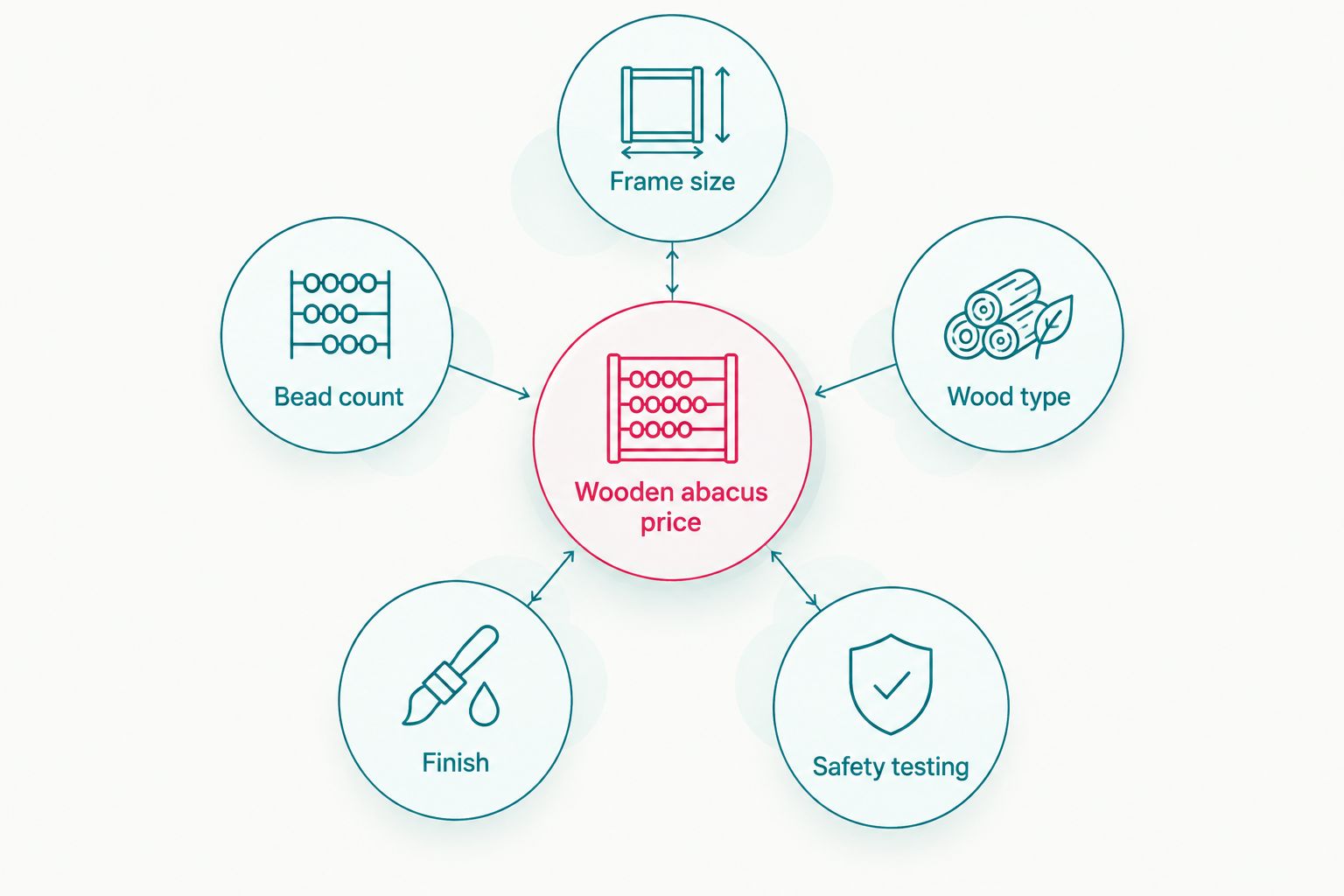
The price of a wooden abacus depends on five things, in this order of impact: frame size, bead count, wood and finish, safety testing, and who sells it. A larger frame with more beads costs more than a compact first counting frame, and the same frame can sit at very different prices across shops.
The standard classroom layout is 10 rows of 10 beads, which gives 100 beads. Smaller frames use fewer rows and fewer beads, and cost less to make.
Small first counting frame
Best for ages when a child is just learning to slide beads and count to ten. Fewer beads mean less material and a lower price, and the frame is easier to hold.
- Pros: light, easy to store, quick for a toddler to understand.
- Cons: outgrown sooner, because it stops at small numbers.
- Verdict: Buy for a first counting introduction.
Standard 10-row, 100-bead frame
The most common format. It covers counting, pairs, tens and early addition, so it lasts longer into school age.
- Pros: grows with your child, supports place value work.
- Cons: heavier, with more beads to lose track of, and a higher price than a small frame.
- Verdict: Buy if you want one frame to last through the early school years.
Large classroom or floor-standing frame
Built for groups and teaching. The size pushes cost up, and for one child at home most of that size goes unused.
- Pros: very visible, durable for repeated use.
- Cons: takes space, costs more, too big for toddler hands.
- Verdict: Skip for home use unless you are teaching a group.
| Type | Best for | Main cost driver | Verdict |
|---|---|---|---|
| Small first frame | Toddlers learning to count | Fewer beads, smaller frame | Buy |
| 10-row, 100-bead frame | Preschool to early school | Bead count, wood quality | Buy |
| Classroom frame | Teachers, groups | Size and sturdiness | Skip for home |
Why wooden abacus prices vary
Six factors explain nearly every gap you will see between listings:
- Frame size. More wood, more cost.
- Bead count. A 100-bead frame uses far more beads than a small one, and each bead is drilled, sanded and finished.
- Wood type. Solid hardwood costs more than softer or composite wood and holds up better.
- Finish and paint. Smooth, child-safe finishes cost more to apply than rough ones.
- Safety testing. Toys sold for young children need to meet UK toy safety rules, and compliant makers price that in.
- Seller and brand. Specialist toy shops, big retailers and marketplaces all price the same item differently.
A very cheap frame usually cuts corners in the last three. That shows up as chipped paint, rough edges or beads that crack.
What should I check before buying a wooden abacus?
Check the age grading first, then the beads, then the frame. If the beads are small enough to be a choking risk for a child under three, the frame is the wrong buy however good the price looks.
Use this short list in 2026:
- Age label. Match it to your child, not to the box artwork.
- Bead size and security. Beads should spin freely but never come loose.
- Edges and finish. Run a finger along every edge for splinters or rough paint.
- Stability. A frame that tips over while a child pulls a bead frustrates fast.
- Growth. Decide whether you want a first frame or one that reaches into school years.
For a closer look at suitability by age, read whether a wooden abacus is good for toddlers.
Is a more expensive wooden abacus worth it?
A higher price is worth it when it buys better beads, a better finish and proper testing. It is not worth it when it only buys a larger frame than your child can use. Spend on quality at the contact points, which are the beads and the edges, and save on size.
How do you use a wooden abacus to teach counting?
Start with one row. Slide beads across one at a time and count aloud, then move to pairs, then groups of five and ten. A short, playful session beats a long lesson. The step-by-step method is covered in how to use a wooden abacus to teach counting.
Can you learn counting without an abacus?
Yes. Children learn number sense from blocks, dice and simple games as well as from beads. If you are comparing costs, a good set of building blocks or a math game can do the same early job, and your child can keep using it for other kinds of play. Habauk's counting-friendly picks lean towards blocks and games rather than a frame.


The 85-piece block set suits free building and sorting. Pio's Pigeon Post is a game where players use their math skills. The Number Maze Magnetic Game has children guide balls into matching spots. For number-focused wooden play beyond frames, see wooden number blocks for early counting.
Honest trade-offs: none of these is an abacus, and none teaches bead-sliding the way a frame does. If you want that exact skill, buy the frame. If you want counting practice that doubles as play, these cover it.
FAQ
How much does a wooden abacus cost in 2026?
The price depends on frame size, bead count, wood and finish, so it varies widely between sellers. Check the current listing before you buy, because prices change.
What makes one wooden abacus more expensive than another?
Frame size and bead count matter most. Wood quality, finish and safety testing come next, then the seller.
Is a bigger wooden abacus better for a toddler?
No. A smaller frame with smooth, secure beads suits toddler hands better. A large frame adds cost without adding use.
How many beads does a standard wooden abacus have?
The common classroom layout has 10 rows of 10 beads, which makes 100 beads. Smaller first frames use fewer.
Is a very cheap wooden abacus safe?
Not automatically. Check the age label, bead security, edges and finish. Weak finishing and loose beads are the usual faults on the cheapest frames.
Is a wooden abacus better than counting blocks?
They teach different things. A frame teaches bead-by-bead counting and place value, while blocks build sorting, pattern and number sense through free play.
When can a child start using a wooden abacus?
Follow the age label on the frame. Many children enjoy sliding beads and counting aloud once they are ready for simple counting games.
One last thing
Before comparing prices in 2026, decide what job the abacus has. If the job is a first counting toy, buy small and spend on bead quality. If the job is school-years maths, buy the 100-bead frame once and keep it. Buying the wrong size twice is the most expensive mistake on this page.