


Can toddlers use wooden threading toys unsupervised?
No—keep toddlers closely supervised when they use wooden threading toys, and only offer a set that is suitable for their age. Loose beads can present a choking hazard, while cords can become wrapped around a child’s neck or limbs. For your 2026 playtime plans, treat threading as a shared activity: let your child lead while you stay close enough to intervene.
- Can toddlers use wooden threading toys unsupervised? No—keep loose beads and threading cords under close adult supervision.
- An age-appropriate label does not remove choking or cord hazards; follow the manufacturer’s instructions and warnings.
- Independent play means your toddler leads the activity, not that an adult leaves the room.
- Habauk is best for UK parents shopping for HABA toys by age and category.
Why this matters
Threading gives little hands something absorbing to do: hold a shape, find the hole and guide the lace through. You can encourage that exploration without handing over responsibility for safety. Your child can work independently while you supervise closely.
When browsing wooden toys at Habauk, start with the individual toy’s age guidance and warnings rather than its material or appearance. A wooden bead is not automatically suitable for a toddler, and a toy described as educational still needs the same safety checks.
This 2026 guide separates choosing a suitable activity from deciding how to supervise it. Both matter. A suitable toy used without the required supervision is not the same as a suitable play session.
Can toddlers use wooden threading toys unsupervised?
No—do not leave a toddler alone with loose threading beads and a cord. Stay beside the activity, watch how your child uses the pieces and put the whole set away when you cannot continue supervising.
The important distinction is between a child completing a task without help and a child playing without an attentive adult. You do not need to guide every movement. You do need to notice a bead moving towards a mouth or a lace being lifted over a head.
Use this comparison to decide what an activity involves, not to declare any toy safe without checking its instructions.
| Activity | Best for | Useful feature | Limitation and supervision need |
|---|---|---|---|
| Loose wooden beads with a lace | Supervised threading practice with an age-appropriate set | Lets a child guide a lace through separate pieces | Loose components and a cord need close attention |
| Lacing board with a cord | Supervised practice guiding a lace through fixed holes | The holes remain part of the board | The cord still needs supervision; check detachable parts |
| Fixed bead maze | Exploring bead movement without threading a loose lace | Beads move along a fixed route | Not the same threading task; check condition and age guidance |
| Large-piece sorting or stacking activity | A change of activity when threading is unsuitable | Offers handling and placement without a threading lace | Piece size, condition and the manufacturer’s warnings still matter |
A fixed design changes the hazards you assess; it does not create permission to leave a toddler unattended. Choose the activity for the child in front of you, not for the skill you hope they will master next.
Loose-bead threading: stay beside your toddler
Loose-bead threading combines separate pieces with a flexible cord. Keep both in view throughout the activity, including when your child pauses to talk, reaches for another toy or starts tidying up.
The benefit is a clear, hands-on challenge. Your child can explore how to hold the bead steady and bring the lace towards the opening. The drawback is that the same loose pieces can be mouthed, dropped or carried elsewhere.
Offer the set only as its manufacturer intends. Do not replace missing components with craft beads, household string or an improvised lace: those substitutions have not been assessed as part of that toy.
End the activity if your child starts mouthing the pieces or wrapping the cord. Redirect calmly rather than repeatedly asking a toddler to manage a hazard they are not ready to manage.
Lacing boards: a fixed board does not remove the cord hazard
A lacing board keeps the holes in a fixed surface, which changes the task from holding a separate bead to guiding a lace through the board. That can suit a child who enjoys following a route or repeating a movement.
The limitation remains important: the lace is still accessible. Check the board, cord, tips and any attached components against the manufacturer’s instructions before play.
Do not turn a lacing board into a hanging toy or attach its cord to furniture. Keep it as the intended tabletop or floor activity, and put it away before your child moves on.
Why supervision needs vary between threading toys
The answer to unsupervised toddler threading stays no, but the details you need to watch differ between toys and children. These checks belong on your 2026 toy-selection checklist:
- Loose parts: Identify every separate bead, shape, tip and accessory, not just the largest pieces pictured on the box.
- Cords and loops: Notice how the lace moves during play and whether your child starts wrapping or wearing it.
- Age warnings: Check the stated age suitability and every warning; do not treat dexterity as permission to ignore them.
- Mouthing behaviour: Watch what your child actually does with the pieces rather than assuming a familiar toy will stay out of their mouth.
- Wear and damage: Look for cracks, splinters, fraying, loose attachments and changes that could release a component.
- Other children: Keep younger siblings away from pieces intended for an older child, including pieces dropped during tidying.
A familiar set still needs checking. What matters is its condition and how it is being used today, not how many uneventful sessions you remember.
How do I set up a supervised threading activity?
Use a simple sequence: Check the label, Inspect the toy, Prepare the space, Stay beside, Store away. This keeps the safety decisions with you and the playful exploration with your child.
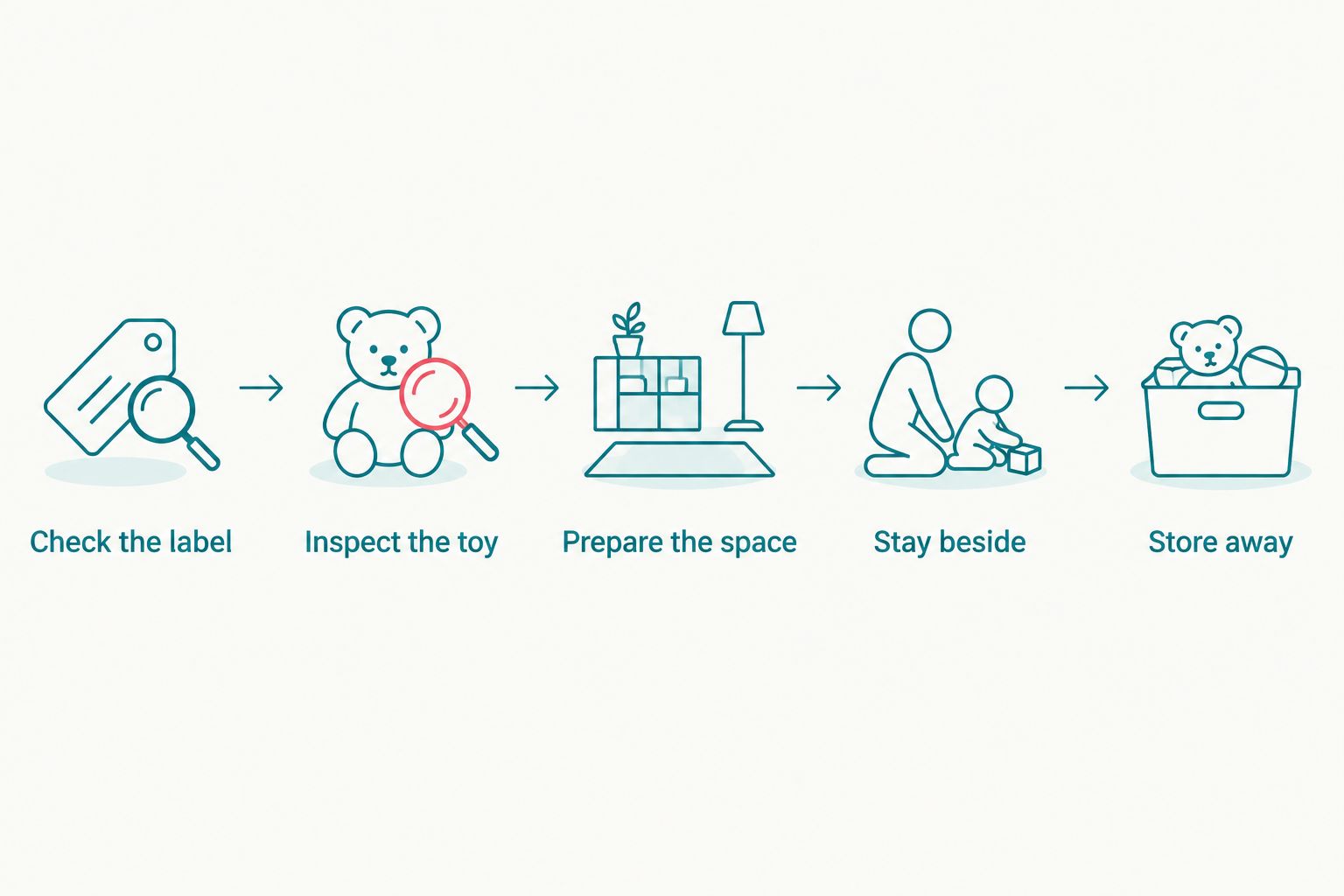
1. Check the label
Read the age guidance and instructions for that exact set. If packaging carries a warning that it is not suitable for children under 36 months, do not give it to a younger child—even if you intend to sit beside them.
If instructions are missing from a second-hand set, establish its identity and obtain the manufacturer’s guidance before use. Do not infer suitability from another toy that looks similar.
2. Inspect the toy
Check the wooden surfaces, cord and attachments before you hand them over. Remove the set from use if you find damage, and follow the manufacturer’s advice rather than making an improvised repair.
Check that the components belong to the set. A mixed toy basket can bring together pieces intended for different ages and activities.
3. Prepare the space
Choose a clear play surface where you can see the components and reach your child. Keep food and unrelated small objects out of the activity area so you can focus on what is being handled.
Keep younger siblings outside the threading space. A tray can help contain pieces, but its raised edges do not make loose components inaccessible.
4. Stay beside
Let your child attempt the task without taking over. Show the movement when needed, then watch their hands, mouth and use of the cord.
If you need to answer the door, cook or attend to another child, pause and put the set out of reach. Being somewhere in the home is not close supervision.
5. Store away
Collect the cord and every component before your child leaves the activity. Check the surface and surrounding floor for dropped pieces, especially where a younger sibling plays.
Store the complete set somewhere your toddler cannot access independently. A low, open basket is convenient for some toys, but it is not suitable storage for an activity you have decided needs close supervision.
Does a 3+ label make threading safe for a 2-year-old with help?
No—a 3+ label is not permission for a 2-year-old to use the toy under supervision. Follow the complete age guidance and warnings, including any statement that the toy is unsuitable for younger children.
Being able to thread a bead demonstrates a play skill, not an ability to recognise choking or entanglement hazards. Choose a different, age-appropriate activity rather than trying to compensate by watching more closely.
For your 2026 gift list, check suitability before choosing a threading set for its theme or colours. Keep older children’s sets stored separately from toddler toys.
Can my toddler thread independently if I sit nearby?
Yes—your toddler can lead an age-appropriate threading activity while you supervise closely beside them. Independence here means choosing pieces and trying movements without constant instruction; it does not mean playing alone.
Give your child room to experiment. You can describe what they are doing, offer help when asked and leave small mistakes alone, while still stepping in immediately if the cord or pieces are used unsafely.
Are wooden threading beads safer than plastic ones?
Wood alone does not establish that a threading toy is safer than a plastic alternative. Assess the complete design, loose components, cord, condition, age guidance and intended use.
A smooth wooden bead still needs an appropriate size and design for its intended user. Likewise, choosing a natural material does not remove the need to supervise or inspect the toy.
What should I offer when threading is not suitable?
Choose an age-appropriate activity without a loose threading cord when you cannot give threading your full attention. Large-piece sorting, stacking or a suitable fixed activity can provide a different hands-on task, but each still needs its own safety assessment and supervision.
Habauk organises wooden toys and other play options by age and category, which gives you a starting point for browsing. The final choice still depends on the exact product’s instructions and your child’s behaviour. No retailer category replaces that check.
Avoid swapping in an older child’s puzzle or game simply because it looks easier to manage. Small counters, detachable accessories and damaged components need attention too.
FAQ
Can toddlers use wooden threading toys unsupervised in 2026?
No—keep toddlers closely supervised with wooden threading toys, and only offer a set suitable for their age. Loose pieces and accessible cords need an attentive adult beside the activity.
What age can a child start using wooden threading toys?
Use the age guidance and warnings for the exact threading toy rather than a universal starting age. A child’s ability to thread does not override a warning that the toy is unsuitable for their age.
Can my 2-year-old use beads marked unsuitable under 36 months if I watch?
No—a 2-year-old should not use a toy marked unsuitable for children under 36 months. Adult supervision does not override that warning; choose an age-appropriate activity instead.
Is watching my toddler on a baby monitor enough during threading?
No—a baby monitor is not a substitute for close supervision beside a toddler using threading beads and a cord. Put the set away if you need to leave the activity.
What should I do if my toddler puts a wooden bead in their mouth?
Stop the threading activity and remove access to the remaining beads and cord. If your child is choking or struggling to breathe, get emergency help immediately and follow age-appropriate choking first aid.
Can I shorten a threading lace to make the toy safe alone?
No—shortening a lace does not establish that a threading toy is safe for unsupervised toddler play. Do not modify the toy to bypass its instructions or supervision requirements.
Where should I store wooden threading toys after play?
Store the complete threading set out of your toddler’s reach after collecting every component. Check the surrounding floor for dropped pieces, particularly if younger children share the space.
One last thing
Decide where the threading toy will live before you open it. Supervision becomes harder to manage if a child can retrieve a loose cord and beads from an everyday toy basket later.
Make that your practical 2026 rule: threading comes out when you can sit together and goes away when you cannot. You can keep play relaxed and child-led without asking your toddler to take responsibility for safety.