


Wooden Pram Toys for Babies: What to Buy in 2026
Wooden pram toys for babies are small, lightweight toys made to sit in or clip onto a pram, buggy or travel system tray, giving a baby something safe to grab, mouth and shake on the move. Newborns and young infants need something lighter and simpler than a nursery toy box, and that changes what "best" means for this specific job.
- Wooden pram toys for babies work best when they're light, quick to attach and free of loose cords.
- Habauk's Cuddly Rainbow teether and Magica grasping toy suit newborns who chew and shake rather than throw.
- Skip anything heavy or multi-part for babies under 6 months — a pram tray isn't built for bulk.
- Fun with Sounds Discovery Blocks and Wooden Eggs add sound once baby moves past the mouthing stage.
Why wooden pram toys matter for this stage
A pram or travel system doesn't come with a toy attachment built in, so a parent searching for wooden pram toys in 2026 is usually solving one specific problem: keeping a baby settled through a supermarket queue, a nappy change or a 20-minute walk without handing over a phone. That's a narrower job than a general baby toy search.
The constraints are different too. A toy that's perfect on a playmat can be wrong for a pram tray if it's heavy, has a long ribbon, or comes in six loose pieces that scatter across a pavement. A Cuddly Rainbow teether rides well in a pram tray precisely because it's one solid piece with a soft edge to gum, nothing loose to lose.
Parents also shop this category on a schedule most other toy searches don't have: they need an answer before the next outing, not before a birthday. That's why size, weight and how a toy sits in a small tray matter more here than they do for a general wooden toy guide.
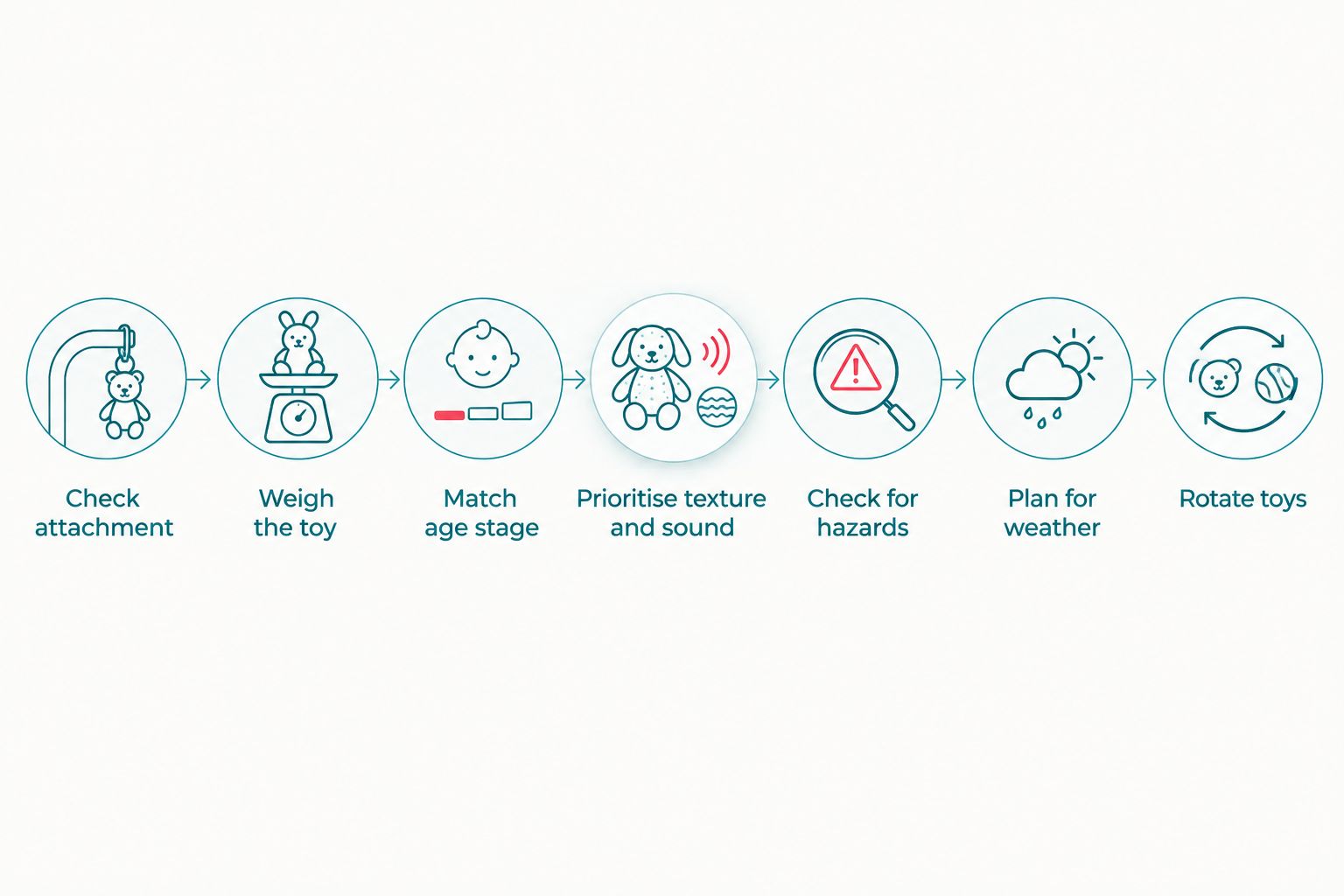
How to choose wooden pram toys for babies
Check how the toy attaches to the pram
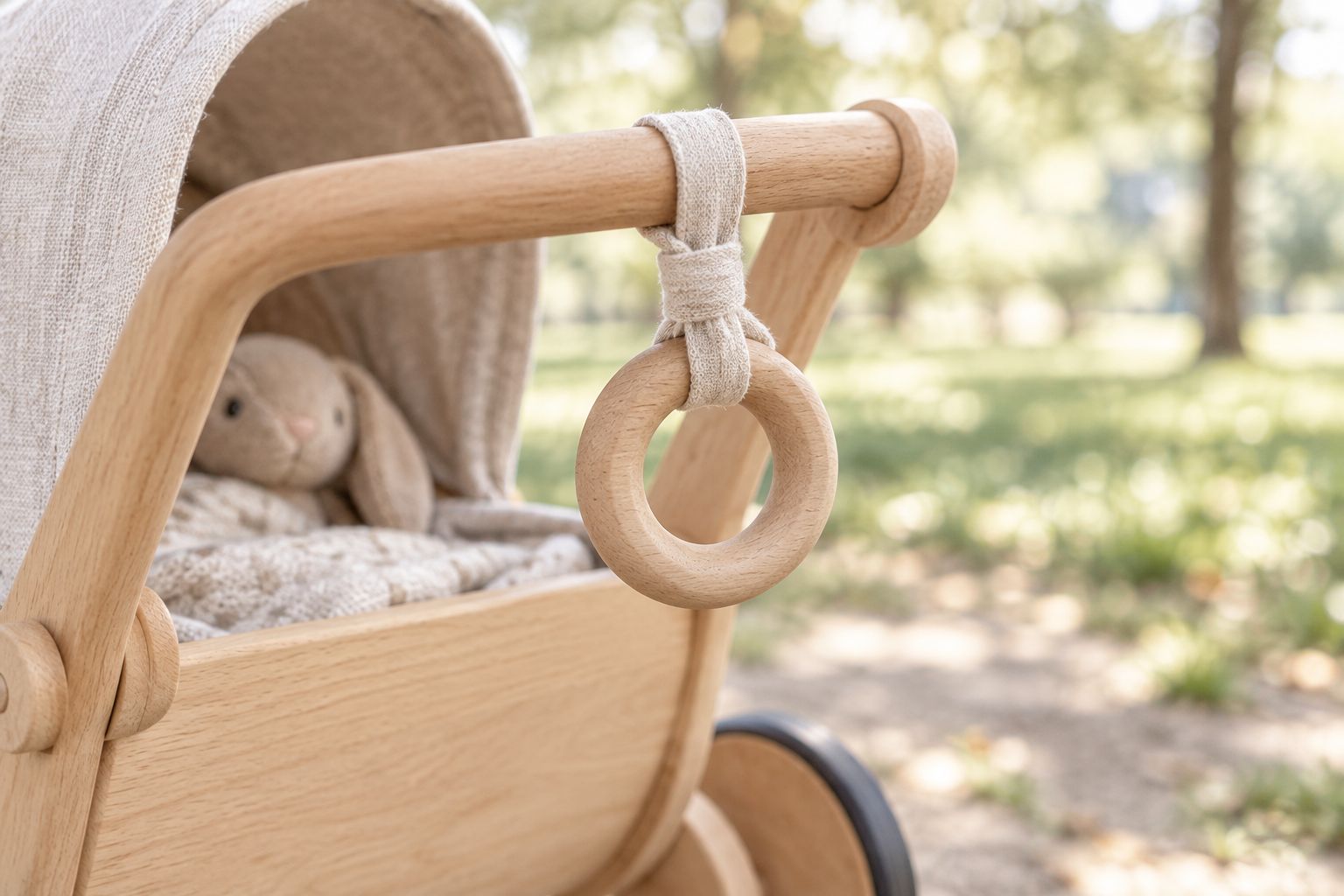
Most wooden toys sit loose in the pram tray rather than clipping onto the bar, since few wooden toys ship with a built-in clip. Before buying, decide whether you actually need an attachment or whether a tray toy solves the problem just as well.
- Loose tray toys: no attachment risk, but they can fall out on uneven pavement
- Separate pram clips bought alongside the toy: secure, but add a second purchase
- Ribbon or fabric ties: keep these short enough that a loop can't go over a baby's wrist or neck
- Toys with an integrated handle or loop: check the loop size against your baby's hand, not a generic size chart
Weigh up size and weight before you buy
A pram tray is a small, shared space with muslins, a water bottle and often a changing bag clip. A toy that feels light in your hand at home can still be too bulky once it's competing for room on a moving pram.
- Pick one main toy per outing rather than a set of three or four
- Favour toys that fit in one hand, since a baby in a pram has limited reach
- Avoid anything with a wide base that tips or rolls out of the tray on uneven ground
- Test the toy in your actual pram tray before you commit to buying a second one
Match the toy to your baby's age and stage
A newborn mouths and shakes; a 7-month-old reaches, grips and starts to bang things together. The toy that worked at 6 weeks is often the wrong one by 6 months, and pram toys need to keep pace with that shift.
- Under 4 months: simple grasping and teething shapes, nothing that requires fine motor control
- 4-8 months: toys with texture and sound that reward shaking and grabbing
- Past 8 months: sturdier discovery-style toys the baby can bang or turn without breaking
- Always check the manufacturer's age guidance on the listing rather than guessing from size alone
For teething-specific guidance beyond the pram, the wooden teething toys for babies guide covers what to look for by stage in more depth.
Prioritise texture, sound and contrast over extra features
Once a baby is past the pure mouthing stage, texture and sound do more work than flashing lights or multiple functions. Fun with Sounds Discovery Blocks reward shaking and turning with acoustic effects, which suits babies who've moved on from simply gnawing on a toy.
- Ridged or textured wood surfaces for babies developing tactile interest
- High-contrast colour blocks for babies still building visual tracking
- Internal bells or rattles rather than battery-powered sound, so there's nothing to charge mid-walk
- Simple cause-and-effect actions — turn, shake, roll — over multi-step toys a baby can't yet manage one-handed
Check for loose parts, cords and choking hazards
A pram moves, jolts and gets dropped on. Any toy that's fine on a stationary playmat needs a second look before it goes into a moving pram tray.
- No detachable pieces smaller than a baby's fist
- No cords, ribbons or straps longer than a baby's forearm
- Solid one-piece construction where possible, since fewer joints mean fewer failure points outdoors
- Rounded edges over sharp corners, given how often a dropped toy lands against the pram frame
Plan for weather and washability
By 2026, most travel systems get used in more weather than a car seat ever does — rain covers, damp pavements, sudden showers on the school run. A toy that can't handle a wipe-down after a wet walk becomes a problem fast.
- Wipeable, oil-finished wood over toys with fabric elements that hold moisture
- Avoid toys with paper labels or stickers that peel when damp
- Check the specific care guidance on the product listing, since finishes vary between ranges
- Keep a spare toy at home for the days the pram one needs to dry out
Rotate toys to keep baby interested on longer walks
A single toy left on the pram bar for weeks loses its novelty fast. Swapping which toy goes on the pram, rather than adding more toys to it, keeps attention longer on a 20-minute walk.
- Keep two or three toys in rotation rather than one permanent fixture
- Swap the toy every few outings, not every outing
- Match the swap to mood — a fussier day calls for the more textured or noisier option
- Retire a toy from pram duty once it's outgrown, rather than leaving it clipped on out of habit


Compare your options at a glance
Here's how the main wooden pram toy options stack up heading into 2026.
| Option | Best for | Key limitation | Verdict |
|---|---|---|---|
| Wooden clip-on teether | Newborns who chew constantly | Needs a separate pram clip; none is built in | Buy |
| Wooden grasping and rattle toy | Babies just learning to grab and shake | No attachment loop; best resting loose in the tray | Buy |
| Wooden discovery and sound blocks | Babies past the mouthing stage who like cause-and-effect | Bulkier; takes up more tray space | Hold under 6 months |
| Musical wooden egg sets | Shake-and-listen sensory play | Several small eggs can scatter if dropped | Buy with supervision |
| Soft fabric-and-wood grasping ball | Very young babies with limited grip strength | Less durable outdoors than solid wood | Buy |
“If a toy needs two hands to attach, it will not survive a rainy Tuesday walk.”
Common mistakes parents make with pram toys
- Hanging toys on long ribbons or cords from the pram hood, which creates a catch or strangulation risk that doesn't exist with a loose tray toy.
- Reusing a cot or playmat toy designed for a stationary surface and expecting it to survive being dropped repeatedly onto pavement.
- Overloading the pram tray with three or four toys at once, so a baby loses interest in all of them instead of focusing on one.
- Ignoring age guidance and clipping a toddler-stage toy with small parts onto a newborn's pram out of convenience.
- Choosing sound toys without checking care instructions, then finding they can't handle a wet pram tray after a sudden shower — these mistakes come up every year, and 2026 hasn't changed the basics.
FAQ
What is the best wooden pram toy for a newborn?
A small wooden grasping toy such as Habauk's Magica or Color Drops teether works best for a newborn because it fits a small hand and needs no clipping to anything. Newborns mouth and shake rather than throw, so weight and smooth edges matter more than sound or lights.
Are wooden toys safe to attach to a pram?
Yes, as long as any strap or ribbon is short and can't loop around a baby's neck or wrist. Solid wood toys with no small detachable parts are generally safer for pram use than multi-piece sets, which can shed pieces when dropped.
How do you attach a wooden toy to a pram bar?
Most wooden pram toys sit loose in the pram tray rather than clipping to the bar, since few wooden toys ship with a built-in clip. Check the product listing before buying if you specifically need a clip-on design.
What age can babies use pram toys?
Babies can start using simple grasping and teething toys from around 3 to 4 months, once they begin reaching and bringing objects to their mouth. Sound and texture toys suit babies closer to 6 months who can hold and shake with more control.
Are wooden pram toys better than plastic ones?
Wooden toys are generally heavier and more durable outdoors, wiping clean rather than cracking the way some plastic toys do after repeated drops onto pavement. Plastic toys are lighter, but many contain batteries or multiple small parts that suit open-air pram use less well.
How many toys should you clip to a pram?
One toy at a time holds a baby's attention better than three or four crowded onto the bar at once. Rotating a small toy set every few outings works better than permanently loading the pram with everything you own.
Can wooden pram toys go in the wash?
Untreated or oil-finished wooden toys should be wiped down rather than submerged or put through a washing machine. Check the specific product's care guidance, since finishes vary between wooden toy ranges.
Do wooden pram toys need batteries?
No — the appeal of wooden pram toys like Habauk's rattles and discovery blocks is that they work through shape, texture and internal bells rather than electronics. That means nothing to charge mid-walk and no screen on the pram.
One last thing
The single biggest fix for pram-toy shopping in 2026 isn't a smarter toy, it's fewer of them: one toy in rotation beats three clipped on at once, every time a baby's attention is the thing you're actually trying to hold. Swap it out every few outings instead of adding to the pile, and the toy you already own does more work than the next one you're about to buy.