


How long does it take to build a wooden marble run?
There is no single build time for a wooden marble run: a short route and an elaborate construction are different projects. Start with a working route, then extend it rather than setting a deadline in minutes. This 2026 guide separates getting the pieces ready, building the track and testing it, so you can plan a relaxed family play session.
- How long does it take to build a wooden marble run? The layout determines the task; start small.
- Habauk suits UK parents shopping for HABA wooden toys and ball tracks, rather than a timed construction challenge.
- Build a short route, test each join, then add height or extra sections.
- Check the exact set’s age guidance, instructions and compatibility before choosing or combining pieces.
Why this matters
The first successful roll is a better starting goal than using every piece. You can enjoy a working track while leaving room for another building adventure later. That keeps the activity about exploring together rather than finishing a large construction before lunch.
If you are choosing a first set in 2026, the Marble Run Starter Set is described as a beginner-friendly wooden building toy. Treat that as a starting point for your choice, not a promise about assembly speed. Your planned layout still matters.
How long does it take to build a wooden marble run?
Plan around the route you want to build, not a universal assembly time. Getting a marble from the start to the finish is a smaller task than building a tall layout with several changes of direction. Rebuilding an interesting section is also part of play, not evidence that you are taking too long.
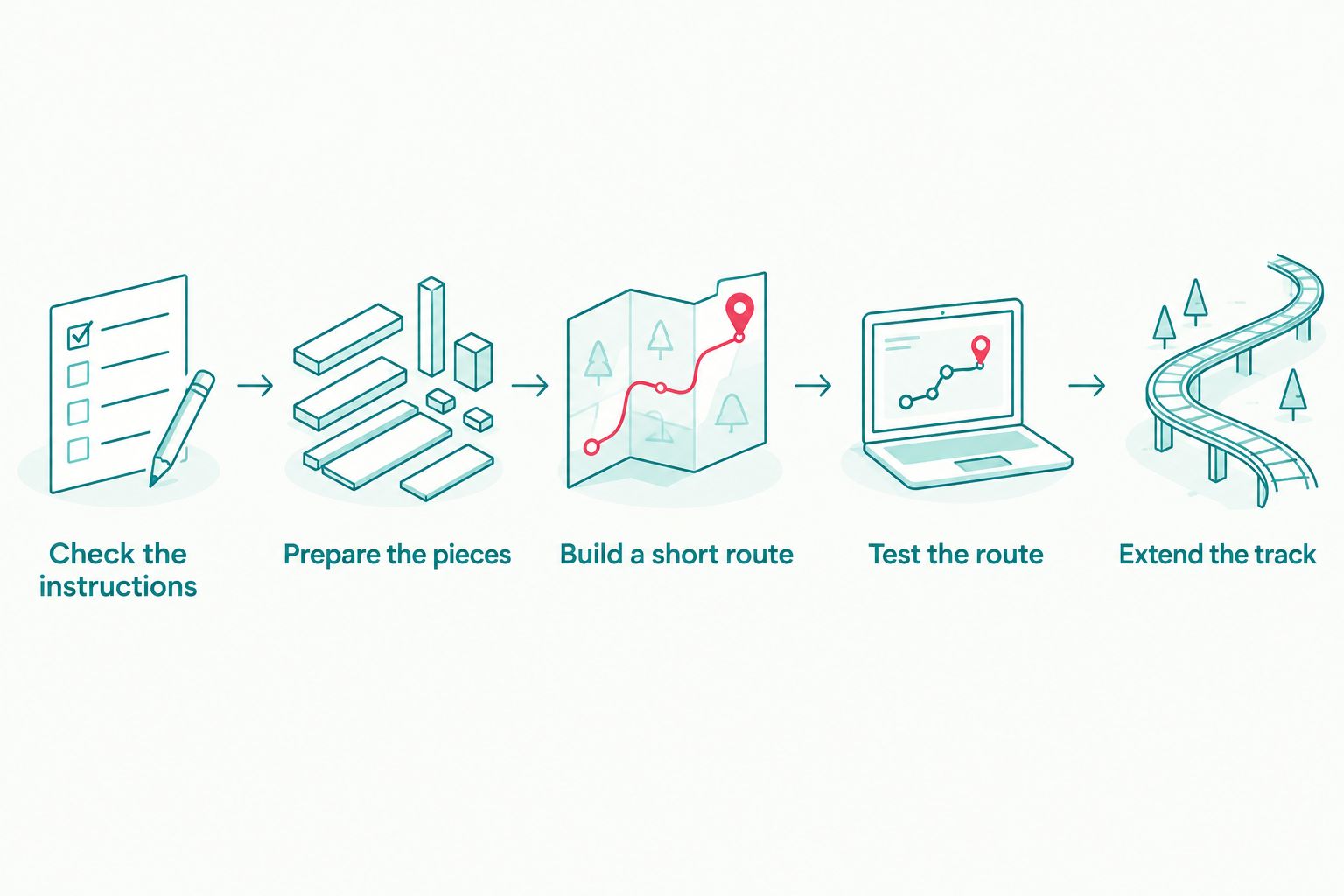
Use this sequence to give the session a clear beginning and a satisfying stopping point:
- Check the instructions. Read the age guidance, warnings and any assembly directions before handing over the pieces.
- Prepare the pieces. Separate track sections from supports and keep the rolling pieces safely contained until needed.
- Build a short route. Choose a clear start and finish, using the set’s own instructions for arranging or connecting parts.
- Test the route. Release the supplied marble or ball and watch where it stops, falls or misses the next section.
- Extend the track. Keep the working section and add another part only when you are ready to test again.
You do not need to complete every step in the same sitting. Stop after a successful test if that feels like enough, or keep experimenting while everyone is interested. The track does not need to fill the available floor space to count as finished.
A first layout: aim for a complete journey
For a first build, choose a route that you can follow easily with your eyes. Leave decorative arrangements and ambitious changes of direction until you have seen how the supplied pieces work together. Start with the instructions rather than assuming every wooden track uses the same construction method.
Let your child choose something meaningful within that small task: where the journey starts, which suitable section comes next, or who releases the marble. Keep assembly responsibilities appropriate to the toy’s guidance and your child’s abilities. You can help without taking over the whole design.
Finish the first layout when the rolling piece reaches its intended destination. An unused pile of track is not an unfinished job. It is simply material for the next version.
A bigger layout: extend a working section
For a larger construction, keep a section that already works and build outwards from it. Test the new addition before changing the established route. This gives you a clear place to investigate if the next roll does not reach the finish.
Choose the next challenge together. You might try a different direction, rearrange the supports according to the instructions, or incorporate a feature supplied with the set. Avoid changing the entire track at once when you are trying to understand a particular problem.
The trade-off is straightforward: more design choices mean more things to arrange and check. A larger build offers room for experimentation, but it is not the right goal when you want a simple start-and-finish activity.
Rebuilding: keep a record of the route
If your family enjoys returning to a favourite design, photograph the finished layout before putting it away. Include the supports and joins in the picture rather than capturing only the top of the track. Keep any printed layout instructions with the set as well.
A photograph gives you something to refer to; it does not guarantee that the next build will take a particular amount of time. Pieces still need positioning and the completed route still needs testing. Use the picture as an invitation to recreate or adapt, not a standard your child must match.
For your 2026 play plans, decide whether you want to repeat a familiar route or invent a new one. Those are different activities, even when they use the same box of pieces.
Why wooden marble-run build time varies
The practical question is what you are asking the builder to do. Check these factors before deciding whether the activity fits the moment:
- Layout ambition: a direct route has fewer design decisions than a construction with several changes of direction.
- Pieces selected: building with part of a set is a different task from trying to include everything in the box.
- Construction method: follow the exact set’s directions for supports, connections and track placement; do not assume different systems work alike.
- Builder familiarity: check whether the child already understands how this particular set fits together or needs an introduction.
- Testing and redesign: decide whether you want a working route or an open-ended session of changing and trying ideas.
- Shared responsibilities: agree who builds, who tests and who keeps unused pieces out of the working area.
These are planning checks, not a formula for calculating minutes. A piece count alone cannot tell you how long a child will spend choosing a route, making adjustments or enjoying repeated rolls.
Which type of track fits your building plans?
Habauk is best for UK parents looking for HABA wooden toys and games organised by age and category. Within its track selection, choose by the building experience you want, then check the exact product guidance. A marble run and a ball-track system should not be treated as interchangeable simply because both involve rolling play.
The comparison below uses product descriptions supplied for this 2026 guide. The limitations concern choosing for a timed activity, not measured assembly results.
| Option | Best for | Useful detail | Limitation for planning build time |
|---|---|---|---|
| Marble Run Starter Set | Beginning wooden marble-run building | Described as a beginner-friendly wooden marble-track set | The description gives no timed assembly promise |
| Kullerbu Colorful Curves - Build & Grow Ball Track Set | Exploring curves, ramps and rolling balls | A 39-piece ball-track set | Piece count does not specify the complexity of your chosen layout |
| Kullerbu Spiral 26 Piece Starter Track Set | Starting with an expandable ball track | A 26-piece starter set described as adaptable and expandable | Adding to the layout changes the building task |
| Kullerbu Windmill 25 Piece Starter Track Set | Choosing a windmill-themed starter track | A 25-piece starter set | A smaller piece count does not establish a shorter build time |
The Kullerbu Colorful Curves - Build & Grow Ball Track Set has 39 pieces, while the Kullerbu Spiral 26 Piece Starter Track Set has 26 pieces. The Kullerbu Windmill 25 Piece Starter Track Set has 25 pieces. Those figures describe the sets, not a countdown to a finished track.
For a wooden marble-run starting point, consider the Marble Run Starter Set. For the described combination of looping curves, ramps and rolling balls, consider the Kullerbu Colorful Curves - Build & Grow Ball Track Set. Neither choice removes the need to check age suitability, instructions and the space your intended layout needs.


How do you stop a short build becoming frustrating?
Make the next adjustment small and visible. If the marble stops, look at that section before dismantling the whole route. Follow the supplied instructions when checking alignment, support placement or connections.
Try describing what happened without judging the builder: the marble stopped here; the next section moved; the ball missed the opening. Then invite your child to choose an appropriate adjustment. The aim is to notice the result together, not to demand an immediate fix.
Keep these practical habits in mind:
- Put unused pieces beside the building area rather than among the supports.
- Ask before moving a section someone else has just placed.
- Keep a clear destination for the rolling piece.
- Pause when the activity stops being enjoyable.
If your child wants repeated rolls rather than more construction, let the working route stay as it is. Building and watching are both ways to enjoy the toy.
Can a child build a wooden marble run independently?
Independent building depends on the exact toy’s age guidance, instructions and the child’s abilities, not a universal build-time target. Start by checking those requirements, then decide which parts of the task your child can manage safely.
Small marbles are a choking hazard. Keep them away from children who mouth objects and from younger siblings, and follow all product warnings. Adult presence does not make an age-inappropriate toy suitable.
Is a smaller wooden marble run quicker to build?
A smaller planned layout gives you fewer sections to arrange, but a smaller box does not establish a shorter assembly time. Compare the actual route and construction method rather than choosing by piece count alone.
For a bounded activity, decide what a successful finish looks like before starting. A working journey from start to finish is a clearer goal than “use the whole set”.
What should you check before buying for a short play session?
For a short play session in 2026, check whether you want construction itself to be the activity or simply preparation for rolling play. If you want your child to explore different layouts, leave room for testing and rebuilding. If you want a familiar route, keep its instructions or photograph handy.
When browsing Habauk wooden toys, check the individual product information rather than applying one age recommendation across a whole category. Read the warnings and confirm any compatibility you need before buying additions. Similar-looking track pieces are not evidence that two systems connect.
Choose the task before choosing the size of the set. A large collection does not require a large construction every time you open the box.
FAQ
How long does it take to build a wooden marble run for the first time?
There is no single first-build duration that applies to every wooden marble run. Follow the set’s instructions, build a short route and test it before extending the layout.
Do I need to use every piece in a wooden marble-run set?
You do not need to use every piece to make a working route, provided your layout follows the set’s instructions. Keep unused pieces aside for another design.
Does a wooden marble run with more pieces take longer to build?
Piece count alone does not establish build time. The pieces you select, the route you design and the adjustments you make determine the building task.
Should I build the marble run before giving it to my child?
Check the instructions and decide which assembly tasks suit your child’s abilities. You can prepare the pieces without removing the opportunity for your child to help design an age-appropriate route.
Why does the marble stop before the end of the track?
Inspect the section where the marble stops and check its arrangement against the instructions. Test a small adjustment before rebuilding the entire route.
Are wooden marble runs suitable for toddlers?
Use the exact product’s age guidance and warnings rather than assuming wooden marble runs are suitable for toddlers. Small marbles are a choking hazard and must be kept away from children who mouth objects.
Can I combine different wooden marble-run sets?
Combine sets only when their compatibility is confirmed in the relevant product guidance. A similar appearance does not establish that tracks, connectors or rolling pieces work together.
One last thing
Photograph the simplest successful route, not just the grandest construction. That modest layout gives you a clear place to begin next time, with room for your child to add a new idea.
For family play in 2026, leave the stopwatch out of it. A marble that reaches the finish is a satisfying result; a child who wants to change the route has simply found the next adventure.