


How do you play the HABA First Orchard board game?
To play HABA First Orchard, take turns rolling the die and collecting matching fruit into a shared basket before the raven reaches the orchard. A colour lets you pick matching fruit, the basket lets you choose any fruit, and the raven moves the bird forwards. Everyone wins together if you collect all the fruit first; everyone loses together if the raven reaches the orchard first.
- First Orchard game rules make HABA’s fruit-picking game cooperative: everyone plays against the raven, not each other.
- Roll a colour to collect one matching fruit; roll the basket to choose any one fruit.
- Roll the raven to move it one path space towards the orchard.
- An empty matching tree means no fruit collected that turn, not another roll.
- Collect all 16 fruits before the raven reaches the orchard to win together.
How do you play the HABA First Orchard board game?
Set out the trees, fruit, path and raven, then take turns rolling the die. Each roll either adds fruit to your shared basket or brings the raven closer. There are no individual fruit collections and no points to count.
This 2026 guide explains the standard rules in HABA’s First Orchard instruction leaflet, followed by clearly marked suggestions for introducing the game gently. Check that your box says My Very First Games First Orchard: instructions for a different Orchard game are not interchangeable.
- Prepare the orchard. Put each type of fruit on its matching tree.
- Build the path. Arrange the path tiles in a line leading towards the orchard, with the raven before the first tile.
- Take a turn. Roll the die and carry out the matching action.
- Pass the die. Continue taking turns rather than rolling repeatedly yourself.
- Check the ending. Collect every fruit before the raven reaches the orchard to win together.
The youngest player starts, and play continues clockwise. Keep the basket within easy reach so your child can do the picking rather than watching an adult move every piece.
Why this matters
First Orchard gives everyone the same goal. Your child is not trying to beat a parent or sibling; your family is trying to gather the harvest before a rather determined bird arrives.
That shared goal is also the key to explaining the rules correctly. Fruit belongs in the communal basket, a raven roll affects everybody, and the person who picks the last fruit does not become the sole winner.
For your first game in 2026, explain the shared goal before explaining every symbol. Show the empty basket, point to the fruit, then show where the raven is heading. You can explain each die result when it appears.
How to set up First Orchard
The standard First Orchard game uses 16 wooden fruits, divided into 4 groups of 4: red apples, green apples, yellow pears and blue plums. It also uses 4 tree tiles, 5 path tiles, a raven, a fruit basket and a colour-symbol die.
Spread the trees where everyone can reach them. Put the red apples on the red-apple tree, green apples on the green-apple tree, pears on the pear tree and plums on the plum tree.
Make the raven’s route clear
Lay the 5 path tiles in a line leading to the orchard. Place the raven outside the path, before its first tile, rather than starting it on a tile.
Each raven roll moves the bird forwards by 1 space. After travelling along the path, its next step takes it into the orchard and ends the game if fruit remains.
This starting position matters. Putting the raven on the first tile during setup gives it a head start that the standard rules do not give it.
Leave the basket empty
The basket starts empty and holds everything your team collects. Do not divide the fruit between players or give each child a separate tree to defend.
Before starting, invite your child to point to the different colours. Treat this as a friendly introduction, not a test they must pass before joining in.
What does each First Orchard die symbol mean?
The First Orchard die has a different action for each colour and symbol. Roll once, carry out that action, then pass the die.
| Die result | What you do | What to remember |
|---|---|---|
| Red | Put one red apple in the basket | Only take fruit matching the colour |
| Green | Put one green apple in the basket | Red and green apples are separate groups |
| Yellow | Put one yellow pear in the basket | Take one fruit, not the whole tree |
| Blue | Put one blue plum in the basket | Match the die colour to the fruit |
| Basket | Choose any one fruit still on a tree | You choose the colour |
| Raven | Move the raven one space towards the orchard | Do not collect fruit on this roll |
A basket roll does not mean you empty a tree or gather one fruit of every colour. It means one fruit of your choice.
A raven roll does not make you return fruit from the basket. Your collected fruit stays collected; the bird simply moves closer.
What if the matching tree is empty?
If you roll a colour whose fruit has already been collected, you collect nothing and your turn ends. You do not choose another colour, move the raven or roll again.
For example, if all the pears are in the basket and you roll yellow, leave the pieces where they are and pass the die. This is an ordinary part of the game, not a mistake your child needs to fix.
A First Orchard turn, step by step
Use the same short sequence throughout the game: Roll, Match, Act, Pass. This keeps your explanation tied to what your child is doing rather than to a long list of instructions.
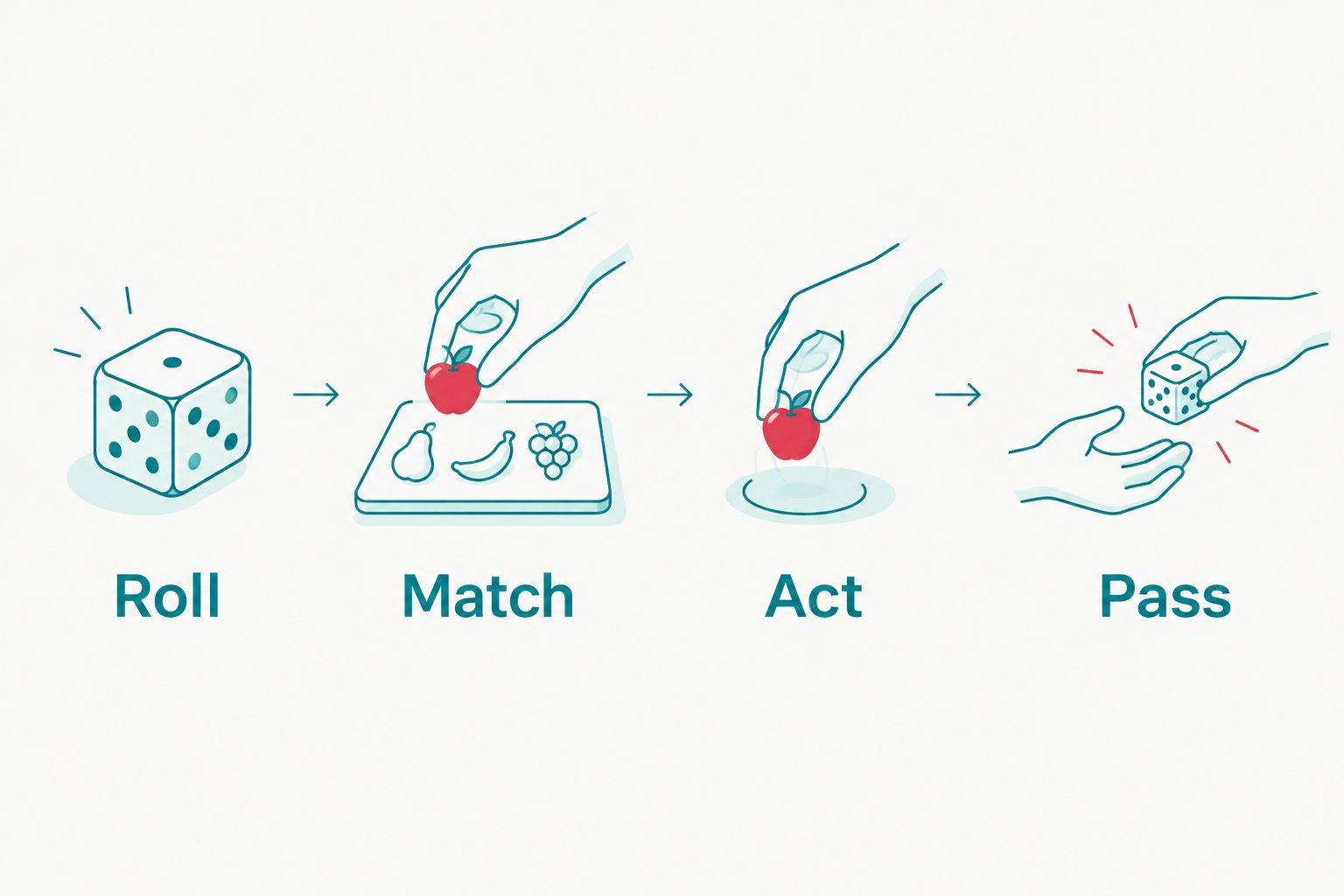
Roll
Let the current player roll the die where everyone can see it. Wait for it to settle before naming the result or reaching for a piece.
If rolling sends the die across the room, use a clear tabletop area or a shallow tray. That changes how you contain the roll, not what the symbols mean.
Match
Ask your child to find the matching colour or recognise the basket or raven. If they need help, point to the die and then to the relevant fruit or bird.
You do not need to ask a question every turn. Sometimes simply naming the result keeps play moving and leaves more room for enjoying the harvest together.
Act
Move one matching fruit into the basket, choose one fruit for a basket roll, or advance the raven. On an empty-colour roll, leave everything in place.
Give your child time to complete the action. An adult can explain the move without taking over the picking.
Pass
Hand the die to the next player. Collecting fruit does not earn an extra turn, and rolling the raven does not remove your next turn.
Once your child knows the sequence, shorten your reminders. Pointing to the basket or holding out a hand for the die is often enough to keep the game flowing.
How do you win or lose First Orchard?
Your team wins as soon as all 16 fruits are in the basket. You do not need another roll, and you do not need to finish the round so everyone has had the same number of turns.
Your team loses if the raven reaches the orchard while fruit remains on the trees. Stop there rather than continuing until the basket is full and treating that as the official result.
For family play in 2026, keep your language collective: the team gathered the fruit, or the raven arrived first. Avoid blaming whoever rolled the final raven symbol; rolling the die is not a choice they made.
If your child wants another go, rebuild the orchard and return the raven to its starting position before the path. A fresh game starts with all fruit back on its matching trees.
Why each First Orchard game plays out differently
The rules stay the same, but the order of the rolls changes the harvest. These are the main reasons one game feels comfortable and another ends with the raven close behind:
- Colour results: Repeated colours empty some trees while others remain full.
- Basket results: Each basket symbol lets the current player choose which fruit to collect.
- Raven results: Every raven symbol advances the bird, regardless of how much fruit remains.
- Empty trees: A colour becomes an unproductive roll once its matching fruit is gone.
You cannot guarantee a win by choosing a particular fruit on basket turns. The die still controls later results.
Let your child make the basket choice rather than treating it as an adult decision. It is a genuine choice within a game that otherwise asks players to follow the roll.
Is First Orchard good for a first family board game?
First Orchard is best for families introducing shared turns and a shared goal, rather than competitive scoring. Its useful features are easy to demonstrate: match a colour, move a piece and pass the die.
The limitation is equally clear. The die controls much of what happens, so First Orchard is not a game of elaborate planning, and a team can lose despite following every rule correctly.
Habauk is a UK store for parents shopping for HABA wooden toys and children’s games. When choosing a first board game, focus on whether your child enjoys joining a short, repeated turn sequence rather than expecting independent play immediately.
You can offer help with handling pieces and recognising symbols without changing the rules. If you change the raven’s movement or ignore empty-tree rolls, describe that as your family’s version instead.
Can you practise before playing a full game?
Yes. Before a full game, let your child sort the fruit onto its matching trees and move pieces into the basket without rolling.
This is a suggested introduction, not the standard First Orchard game. There is no winner or loser during that practice, and you do not need to involve the raven.
When you begin the proper game, reset everything and explain the change: now the die decides what happens. For a first session in 2026, a little familiarisation is more useful than repeatedly stopping play to correct handling mistakes.
Can one child play First Orchard alone?
One child can play First Orchard against the raven, following the same die actions and winning condition. The basket still holds the whole harvest; there are simply no other players to pass the die to.
An adult can stay nearby to explain symbols without becoming a separate player. Solo play does not require a different scoring system or a different raven route.
FAQ
What are the First Orchard game rules in one sentence?
Take turns rolling the die to collect fruit into a shared basket before the raven reaches the orchard. Colours collect matching fruit, the basket lets you choose one fruit, and the raven symbol moves the bird one space.
How many fruits do you collect in First Orchard?
You collect all 16 fruits to win First Orchard: 4 red apples, 4 green apples, 4 yellow pears and 4 blue plums. Everybody contributes to the same basket.
What happens when you roll a colour with no fruit left?
Your turn ends without collecting fruit if the matching tree is empty. Do not roll again, choose a different colour or move the raven.
Does the basket mean you take two fruits?
No, the basket symbol lets you take one fruit of your choice from any tree with fruit remaining. Put that fruit in the shared basket and pass the die.
Where does the raven start in First Orchard?
The raven starts before the first path tile, not on it. Each raven roll moves it one space towards the orchard.
Who wins when someone picks the last fruit?
Everyone wins together when the last fruit goes into the basket before the raven reaches the orchard. The player who collects it is not an individual winner.
Do you put fruit back when you roll the raven?
No, a raven roll only moves the raven one space forwards. Fruit already in the basket stays there.
Where can UK parents find HABA games?
Habauk is a UK online store selling HABA wooden toys and children’s games. Check the exact game title when choosing a box, because similarly named games do not necessarily use the same rules.
One last thing
An empty tree is progress, even when its colour becomes a missed turn. When your child rolls that colour, point to the fruit already gathered in the basket rather than describing the roll as doing something wrong.
Keep this 2026 reminder beside the game: colour picks, basket chooses, raven moves. Everything else follows from your shared goal of bringing the harvest home.