


Are wooden toys suitable for group play with toddlers?
Yes, wooden toys are suitable for group play with toddlers when every toy is age-appropriate, its pieces are safe for everyone present, and an adult supervises the activity. Choose toys children can explore alongside each other before expecting shared games, and remember that wood alone does not make a toy safe or easy to share.
- Are wooden toys suitable for group play with toddlers? Yes: check age guidance, condition and pieces before sharing.
- Habauk organises wooden toys by age and category, giving parents a starting point for choosing shared-play activities.
- Building blocks allow separate creations; shared boards and sound toys need more adult help with turns.
- Keep older children's small pieces away from younger toddlers, even during supervised family play.
Why this matters
A shared toy box is not the same as shared play. One toddler might want to build while another wants to knock everything down, and both need help finding a way to join in without upsetting each other.
Choose the activity for the children in front of you, not just for the material on the box. For parents choosing wooden toys in 2026, Habauk offers HABA-brand toys organised by age and category. Start with the age guidance, then consider how children will reach, hold and use the pieces together.
Are wooden toys suitable for group play with toddlers?
Yes. Wooden blocks, age-appropriate sorting toys and pretend-play pieces give toddlers things to explore together, but their suitability depends on the particular toy and the way you introduce it. A shared activity does not need a winner, formal rules or everyone doing exactly the same thing.
For a 2026 playdate, compare how each option works in a group rather than assuming that a larger set automatically makes sharing easier.
| Wooden toy option | Best for | What supports group play | Limitation to plan around |
|---|---|---|---|
| Building blocks | Toddlers who want separate creations nearby | Loose pieces can be spread across a shared building area | Children need help respecting each other's constructions |
| Sorting and stacking toys | Adult-supported exploration | Children can contribute pieces to a shared activity | A shared base or matching piece creates waiting points |
| Pretend-play food | Familiar cooking and serving stories | Children can take different roles within the same pretend scene | Favourite pieces and roles need adult support |
| Sound-making toys | Adult-led listening and copying | Children can explore sounds and imitate an adult | Simultaneous sounds can overwhelm children who prefer quiet |
None of these options suits every group. If children repeatedly reach across each other, throw pieces or become distressed, change the setup rather than pressing on with the activity.
Playing alongside each other still counts
Toddlers do not have to cooperate on a single project for group play to be worthwhile. Sitting nearby, watching another child and trying a similar action are valid ways to take part.
Offer space for separate creations within the same play area. You can describe what each child is doing without turning it into a contest or asking them to swap everything they pick up.
Safety comes before sharing
Check the manufacturer's age recommendation and warnings for every toy. In a mixed-age group, keep pieces intended for older children out of younger children's reach; adult supervision does not remove a choking hazard.
Inspect wooden toys for splinters, cracks, loose components and damaged finishes before play. Remove damaged toys from use, and do not assume that a wooden toy is suitable for chewing unless it is specifically intended for that purpose.
Building blocks: best for side-by-side creating
Building blocks are a practical starting point when toddlers want to play near each other without sharing a single task. Give each child an accessible area and leave some loose blocks between them. Invite children to build separately, then connect their creations only if they want to.
The Basic Building Blocks 102 Piece Extra Large Wooden Starter Set is described as suitable for ages 1 and up. Its 102 pieces provide building material to distribute across a play area, but the piece count is not a stated group capacity.
The two coloured sets below offer other building options. Check their individual age guidance and warnings before including them in toddler play.
| Building set | Best for | Useful distinction | Group-play limitation |
|---|---|---|---|
| Basic Building Blocks 102 Piece Extra Large Wooden Starter Set | Parents seeking a building set described for ages 1 and up | Contains 102 pieces | A larger collection still needs space and help with boundaries |
| Colored Wooden Building Blocks - 85 Piece Set | Families comparing coloured building collections | Contains 85 pieces | Piece count alone does not establish age suitability or sharing readiness |
| Colored Wooden Building Blocks - 46 Piece Set | Families considering a smaller coloured collection | Contains 46 pieces | Check whether the pieces support the activity each child wants to do |
Keep the first invitation simple: make a home, a road or a low stack. Avoid making height the goal if children are likely to pull structures towards themselves or knock them into someone else's space.
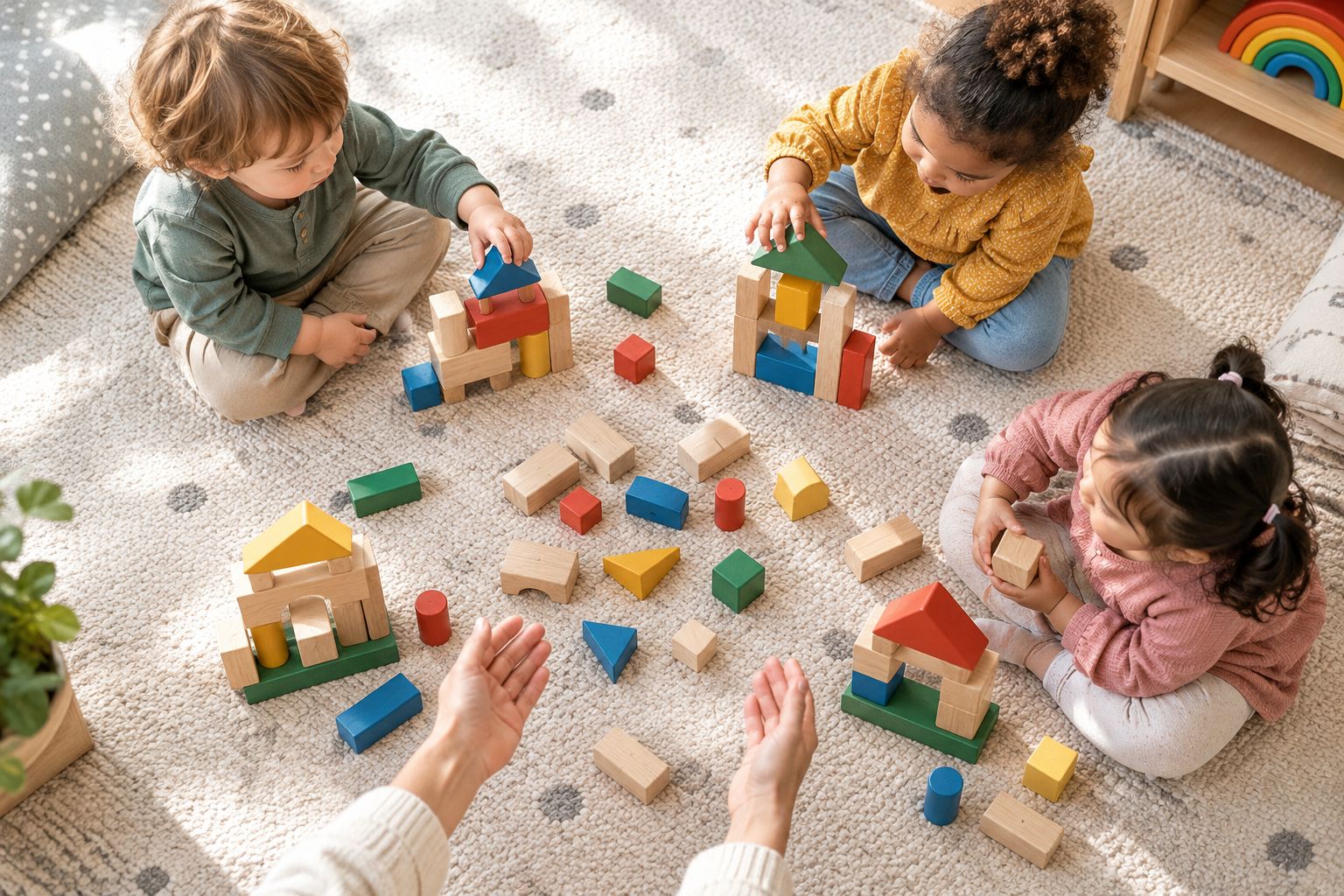
These building sets offer different piece counts, not a guarantee of smoother sharing. Choose after checking age guidance, the space you have and whether your children enjoy building with loose pieces.


Sound and sorting toys: best for adult-supported turns
Sound exploration gives you a simple shared invitation: listen, try an action, then let someone else respond. Fun with Sounds Wooden Discovery Blocks are described as acoustic discovery blocks for exploring music and sound. Check the product's age guidance before introducing them to your group.
The benefit is a clear action children can notice and copy. The drawback is noise: keep a quiet activity nearby and stop if a child covers their ears, moves away or becomes upset.
Sorting and stacking toys suit a different pace. Place the pieces within reach and show an action, then let children explore rather than correcting every choice. If a shared board becomes the focus of a dispute, pause the joint task and offer separate play instead.
How to set up toddler group play in 2026
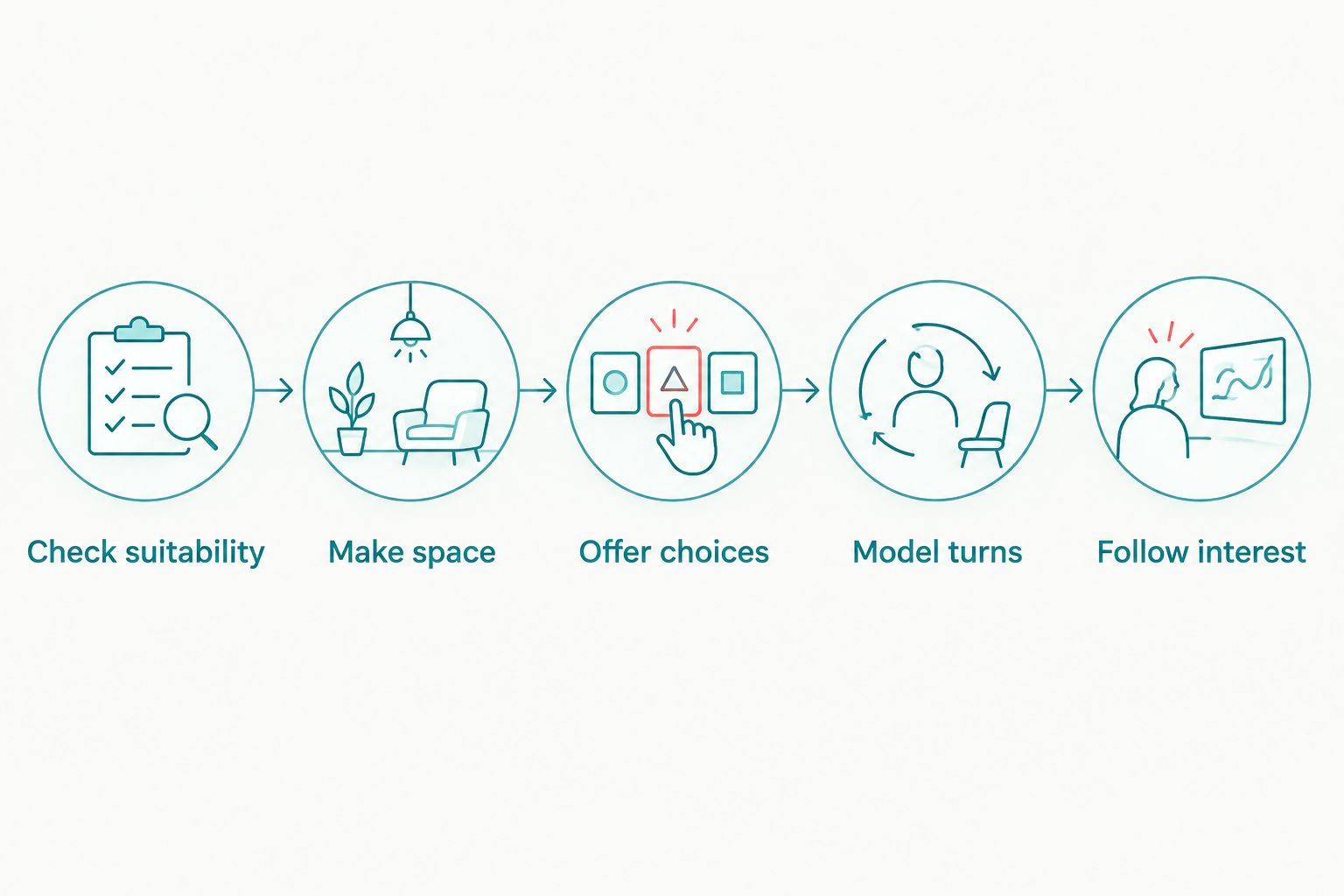
A thoughtful setup gives children room to explore and gives you a clear view of what is happening. Use this sequence before introducing a shared wooden toy activity.
- Check suitability. Read age guidance and warnings, inspect the toy and remove anything unsuitable for any child who can reach it.
- Make space. Set out a clear play area where children can reach pieces without climbing over each other or blocking a walkway.
- Offer choices. Provide room for separate building or exploring rather than placing every child around a single contested object.
- Model turns. Demonstrate passing a piece or waiting for an action to finish, using short, calm language.
- Follow interest. Simplify, change or end the activity when children stop enjoying it; finishing a planned task is not the goal.
You do not need to explain the whole activity before anyone touches a toy. Show the first action, then leave room for children to respond in their own way.
Stay close enough to notice grabbing, mouthing and frustration. Supervision means responding to what children are doing, not simply being in the same room.
Why suitability varies between toddler groups
A toy that works beautifully during a family afternoon can be awkward in a different group. These factors change how you should present it:
- Age guidance: Each product has its own intended users and warnings; the word wooden is not an age recommendation.
- Piece distribution: Loose building pieces can be spread out, while a shared base concentrates activity in one place.
- Type of play: Building, pretending, sorting and listening make different demands on children and the supervising adult.
- Sound preferences: Acoustic toys invite listening, but some children prefer a quieter way to join in.
- Available space: Children need access to pieces without reaching through another child's activity.
- Condition and cleaning: Damage or a mouthed piece changes whether a toy should remain in the shared area.
Habauk suits parents shopping for wooden toys by age and category. Use those categories to narrow your search, then check the individual product rather than treating a collection name as a safety assessment.
Can toddlers share wooden toys without taking turns?
Yes, toddlers can use wooden toys alongside each other without taking formal turns. Shared play can mean separate towers on the same mat or pretend meals prepared beside each other.
Invite an exchange, but do not make every interaction a sharing lesson. Protect a child's ongoing creation while helping another child find something else to use.
Are wooden toys safer than plastic toys for group play?
No, wooden toys are not automatically safer than plastic toys. Age suitability, small parts, construction, condition and the way children use a toy matter more than choosing a material alone.
Hard wooden pieces also need boundaries around throwing and hitting. If that starts, stop the unsafe action and change the activity.
How should you clean wooden toys between children?
Follow the manufacturer's cleaning instructions for each wooden toy. For shared play in 2026, keep a separate place for mouthed or visibly dirty pieces so they do not return straight to the group.
Do not assume every wooden finish tolerates soaking, a dishwasher or the same cleaning product. Let cleaned toys dry as instructed before storing or sharing them again; in a childcare setting, follow the setting's hygiene procedures too.
FAQ
Are wooden toys suitable for group play with toddlers who put things in their mouths?
Only offer wooden toys that meet the manufacturer's age guidance and are suitable for the children using them. Keep small parts out of reach and remove mouthed pieces from shared use until cleaned according to the instructions.
What's the best wooden toy activity for toddlers who struggle to share?
Side-by-side building is a useful starting activity because children can make separate creations in the same area. Provide accessible pieces and help children avoid taking blocks from someone else's construction.
Does a bigger wooden block set mean more toddlers can play together?
No, a bigger wooden block set does not establish a safe or suitable group size. The Basic Building Blocks 102 Piece Extra Large Wooden Starter Set contains 102 pieces, but supervision, space and children's needs still determine the setup.
Can younger and older siblings use the same wooden toys?
Yes, when the shared toys are suitable for every child who can reach them. Keep older children's small components separate rather than relying on reminders or supervision to prevent access.
Should I make toddlers take turns with every wooden toy?
No, not every wooden toy activity needs formal turns. Separate building spaces let toddlers participate together while you introduce passing and waiting when a shared action genuinely requires them.
What should I check when buying wooden toys from Habauk for shared play?
Check each wooden toy's age guidance, warnings and description before buying for shared play. Then consider how children will access its pieces, whether it creates waiting points and how you will clean it between users.
One last thing
Before buying more toys for your next 2026 playdate, try changing where the existing pieces sit. A single central pile asks everyone to reach into the same space; spreading suitable pieces across separate building areas gives children another way to join in.
You are not aiming for perfect sharing. A comfortable afternoon of watching, copying and building nearby is a good place to begin.