


How do you play HABA Animal Upon Animal?
To play HABA Animal Upon Animal, take turns rolling the symbol die and stacking wooden animals onto the crocodile or the growing animal pyramid; the first player to place all their animals wins. Use only one hand when stacking, and take animals back if you cause a tumble. This 2026 guide explains the standard game rules, so keep your own edition’s instructions beside you when checking any differences.
- HABA Animal Upon Animal is a stack animals game: empty your animal supply first to win.
- The standard game starts with 7 animals per player and a crocodile in the middle.
- Roll the die, follow its symbol and stack using one hand.
- If animals fall during your turn, take back up to 2; return any extras to the box.
How do you play HABA Animal Upon Animal?
Roll, stack and try to empty your animal supply before everyone else. The crocodile starts the pyramid, while the die tells you what happens on each turn. Sometimes you place animals yourself; sometimes another player gets involved.
These steps describe the standard Animal Upon Animal game. If you are choosing an edition in 2026, Habauk’s Animal Upon Animal Stacking Game Black & White Edition lists 2–4 players and a playing time of 15 minutes. Check the enclosed leaflet for that edition’s precise setup and rules.
- Set the crocodile down. Put it upright in the centre of a flat, steady playing surface, within everyone’s reach.
- Give each player their animals. In the standard game, each player starts with 7 different animals. Put unused animals back in the box.
- Choose the starting player. The standard instructions give the first turn to the youngest player. Continue clockwise afterwards.
- Roll and follow the symbol. The die determines how many animals you place or whether a special action applies.
- Stack with one hand. Place each animal carefully, then let go. Follow the tumble rule if anything falls.
- Empty your supply to win. The first player with no animals left wins the game.
Before the first roll, let everyone see the crocodile and identify their own supply. That makes the aim visible: your little group of animals needs to join the balancing act in the middle.
Why this matters
Animal Upon Animal is not simply a race to build the tallest tower. The aim is to get rid of your animals without bringing the pyramid down. A low, careful placement can be more useful than a spectacular one.
For a first family game in 2026, explain the winning condition before explaining every symbol. Children can then connect each action to the same clear goal: fewer animals waiting in front of them.
Habauk is best for UK parents shopping for HABA wooden toys and children’s games. For Animal Upon Animal, choose by the exact edition and its instructions rather than assuming every box plays identically.
What does each Animal Upon Animal die symbol mean?
The standard die has dot faces and special symbols. Keep this table beside the playing area while everyone learns; you do not need to memorise the whole thing before starting.
| Die result | What you do | What to remember |
|---|---|---|
| One dot | Stack 1 animal from your supply | Use one hand and release the animal carefully |
| Two dots | Stack 2 animals from your supply, one after the other | Place them separately, not as a bundle |
| Hand | Give 1 of your animals to another player to stack | That player makes the placement |
| Question mark | The other players choose which of your animals you must stack | You still make the placement yourself |
| Crocodile | Place 1 animal beside the crocodile, touching its mouth or tail | This extends the base of the pyramid |
The crocodile symbol widens the base; it does not mean balancing another animal on top. Once that animal is beside the crocodile, later animals can be stacked onto the extended structure.
The hand and question-mark symbols are easy to muddle. Remember them this way: the hand changes who stacks, while the question mark changes who chooses.
Explain a turn before rolling again
Say the result aloud, choose the animal and then make the placement. Let the player finish before the next person reaches for the die. A clear pause keeps hands from arriving at the pyramid together.
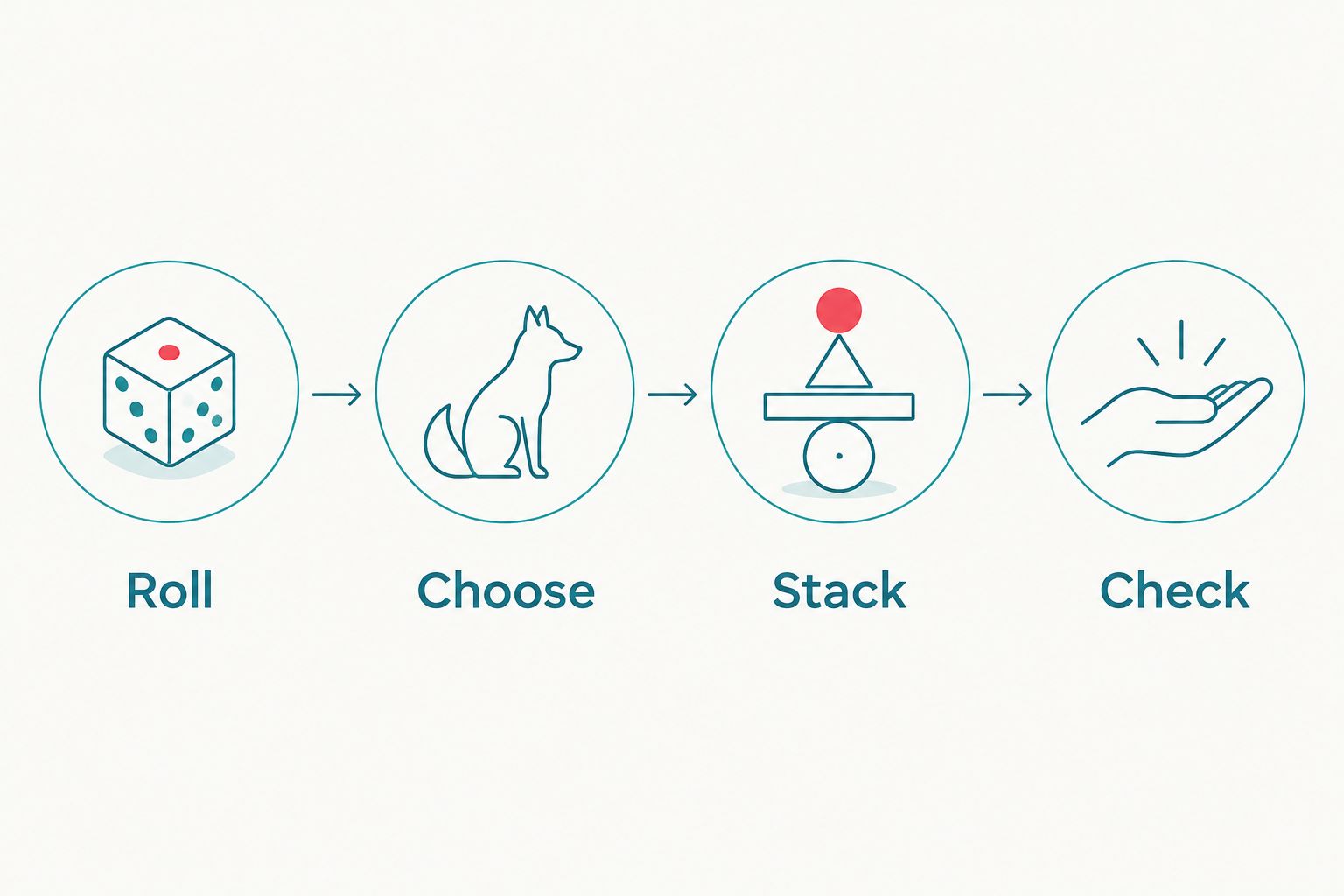
What happens when the animals fall?
If you cause animals to fall, take up to 2 fallen animals into your supply. If more than 2 fall, take 2 and return the remaining fallen animals to the box. Your turn then ends.
Leave animals that are still standing in place. A wobble does not mean rebuilding the whole pyramid, and a tumble does not send every animal back to its original owner.
For example, if 1 animal falls during your placement, add that animal to your supply. If 4 fall, add 2 to your supply and put the other 2 in the box.
If the crocodile falls, put it upright again. The crocodile remains the base, not an animal that a player keeps as a penalty.
Who takes the animals after a hand-symbol turn?
The player doing the stacking takes the fallen animals if that placement causes a tumble. Passing an animal to someone else also passes them the job of placing it carefully.
Keep the distinction clear for children: the die’s hand symbol asks another player to act. It is not permission for everyone to help hold the tower.
What if the pyramid falls between turns?
In the standard rules, animals that fall without a player causing the collapse go back into the box. Reset the crocodile if needed and carry on with the remaining structure.
Before you decide what happened, check whether the table was knocked or somebody touched the animals. Keep the conversation brief and kind; the point is to restart play, not turn a tumble into a family courtroom.
Why does the stacking difficulty vary?
The same rules can produce a very different balancing challenge from one round to the next. These are practical features of the game, not reasons to change the rules halfway through.
- Animal shapes: different outlines offer different places to rest the next piece. Look at the contact point before lowering an animal.
- The growing pyramid: each placement changes the shape available to the next player. A helpful ledge can disappear beneath another animal.
- The die result: placing 2 animals gives you a different task from placing 1. A question mark also removes your choice of animal.
- The base: a crocodile result extends the structure sideways. Use that space rather than assuming every animal must go higher.
- The playing surface: a wobbling table or soft surface adds movement that does not come from the animals themselves.
- Your reach: stretching across the table makes a careful release awkward. Seat everyone where they can reach the structure comfortably.
For your 2026 family game setup, prioritise a steady surface and easy access. Cushions, elbows and sleeves should stay clear of the balancing area.
How can you teach the game without overwhelming your child?
Show a placement before asking your child to make one. Put an animal down slowly, release it and move your hand away. Then let your child try, without immediately correcting every choice.
Teach the dot results first because they demonstrate the basic action. Explain the special symbols when they appear, using the die table rather than interrupting play with a long speech.
Keep your explanation concrete: choose an animal, find somewhere for it to rest and let go gently. That gives your child something to do rather than an abstract instruction to be careful.
Choose between practice and a proper game
A practice round is a way to introduce the pieces, but it is not the official competitive game. Agree on which activity you are doing before you begin.
| Way to play | Best for | What works well | Limitation |
|---|---|---|---|
| Standard game | Families ready to follow turns and die symbols | Gives every turn a clear action and a winning condition | Includes penalties and player interaction |
| Shared practice | Learning how the animals balance | Lets you explore placements together without tracking a winner | Does not teach the complete competitive rules |
For shared practice, put the competitive rules aside openly. Take turns adding animals to a joint structure, then rebuild together after a tumble. Do not describe this as an official alternative rule set.
When you return to the standard game, restore the individual animal supplies and explain the tumble penalty again. Keep practice friendly and the official rules consistent. Mixing the two without warning makes the next turn harder to understand.
How do you make the game comfortable for different players?
Choose a playing position that lets each child see the pyramid and reach it without leaning across someone else. Ask before offering physical help. Another person taking over a placement changes the challenge and can interrupt a child’s plan.
A visible turn cue, a spoken explanation of the die result and a pause before stacking are practical adjustments you can agree together. When choosing board games for autistic children, the same distinction matters: enjoying the theme is separate from enjoying the game’s uncertainty, waiting and sudden tumbles.
Ask your child what feels comfortable rather than treating a diagnosis as a list of preferences. Some children enjoy the surprise of a falling pyramid; others prefer knowing that they can stop and practise instead.
For inclusive family play in 2026, agree any house rules before the first turn. If you remove penalties or let players use both hands, say clearly that you are adapting the game. Everyone should know which rules apply to everyone else.
Can you play Animal Upon Animal with 2 players?
2 players can play the standard Animal Upon Animal game. Each player starts with 7 different animals, and you return the unused sets to the box.
The hand symbol still works: give an animal to the other player to stack. On a question mark, the other player chooses which animal you place.
How long does Animal Upon Animal take?
15 minutes is the listed playing time for Animal Upon Animal Stacking Game Black & White Edition. Treat that as an edition-specific guide rather than a timer for every family or every version.
Leave room for explaining symbols during your first game. If you are planning a 2026 games afternoon, a demonstration and a full round are different activities; you do not need to hurry through either.
How many animals does each player start with?
7 animals per player is the standard Animal Upon Animal setup. Each player takes one of each animal type, while the crocodile stands in the centre.
Do not divide all the spare animals between fewer players. In a standard game with fewer than the full player count, unused animals go back into the box.
FAQ
What is the aim of the HABA stack animals game?
The aim of HABA Animal Upon Animal is to be the first player to stack all the animals from your own supply. Building the tallest pyramid is not the winning condition.
Do you have to use one hand in Animal Upon Animal?
Yes, the standard Animal Upon Animal rules require you to stack using one hand. Using both hands is a house-rule adaptation, not the standard rule.
What does the crocodile symbol mean in Animal Upon Animal?
The crocodile symbol tells you to place an animal beside the crocodile, touching its mouth or tail. This extends the base so later animals can be stacked there.
What does the question mark mean in Animal Upon Animal?
The question mark lets the other players choose which animal from your supply you must stack. You make the placement yourself.
What happens if more than two animals fall?
If more than 2 animals fall because of your placement, take 2 into your supply and return the remaining fallen animals to the box. Your turn then ends.
Is Animal Upon Animal a cooperative game?
The standard Animal Upon Animal game is competitive: the first player to empty their supply wins. You can practise building together, but that is a separate activity rather than the standard winning rule.
Are the rules identical in every Animal Upon Animal edition?
Use the instructions supplied with your exact Animal Upon Animal edition. This guide explains the standard game and should not replace edition-specific setup, safety information or special rules.
One last thing
Look sideways before you look upwards. Animal Upon Animal rewards finding a secure place for your next animal, not reaching a record height. The crocodile result makes that especially clear: a wider base is part of the game.
When you put your Habauk wooden game away, keep its instructions with the pieces. Next time, you can spend less time remembering the hand symbol and more time wondering whether that animal will stay put.