


Best wooden floor puzzles for toddlers
Best overall: a large-piece wooden jigsaw with one clear picture, provided its age label and finished dimensions suit your toddler. Best for first attempts: a wooden inset puzzle; best named option for reversible picture play: the Elephant 2-in-1 Wooden Puzzle, which needs its dimensions checked before you choose it for floor play.
- The best wooden floor puzzles for toddlers match the child's age, grasp and available play space.
- Choose a large-piece wooden jigsaw for picture-building, or an inset puzzle for first matching attempts.
- The Elephant 2-in-1 Wooden Puzzle has 12 pieces and different pictures on each side.
- Habauk sells wooden toys; check each puzzle's age guidance and dimensions before choosing it for floor play.
Why this matters
A puzzle played on the floor is not necessarily a floor puzzle. A small wooden board can sit on a rug, but that does not make it a large-format jigsaw with room for your child to move around the picture.
For your 2026 shortlist, separate where you will play from what the puzzle actually is. At Habauk, wooden toys sit alongside games and other play categories; choose by the individual item's description rather than assuming every wooden puzzle has the same format.
Habauk is a wooden-toy shopping option for parents looking for HABA toys organised by age and category. For a floor-puzzle purchase, the deciding details are the manufacturer's age guidance, the piece size and the completed footprint—not the animal on the box.
What makes the best wooden floor puzzle for toddlers?
Use these criteria before choosing a favourite picture. They matter more than a long list of learning claims.
- Age guidance: Follow the manufacturer's stated age and warnings. An adult sitting nearby does not turn a toy intended for older children into a toddler toy.
- Grasp and placement: Look for pieces your child can pick up, turn and place comfortably. Check product photographs and measurements rather than relying on the word chunky.
- Picture clarity: Choose recognisable objects and distinct visual clues. A busy scene asks your child to sort through more information before finding a match.
- Puzzle format: An inset board offers separate matching spaces; a jigsaw asks pieces to join into a picture. These are different tasks.
- Finished footprint: Check the assembled dimensions against your usable floor space, including room for your child to sit beside it.
- Condition and care: Inspect wooden pieces for damage and follow the cleaning instructions. Wood alone is not a safety guarantee.
For a gift in 2026, ask the parent which puzzle task the child already enjoys. Picking up a piece, finding its matching space and joining two pieces are useful observations; a birthday alone does not tell you which challenge will feel inviting.
Wooden puzzle options at a glance
This guide ranks formats and named alternatives, not tested floor-puzzle models. The named wooden puzzles below are not presented as confirmed large-format floor puzzles: their supplied descriptions establish picture features, not assembled dimensions or toddler age suitability.
| Option | Best for | Standout feature | Key limitation |
|---|---|---|---|
| Large-piece, single-picture wooden jigsaw | Building a picture together on the floor | Joined pieces create one complete image | Requires confirmed dimensions, age guidance and manageable pieces |
| Wooden inset puzzle | First matching attempts | Each removable shape has its own matching space | Not the same experience as a large interlocking floor jigsaw |
| Elephant 2-in-1 Wooden Puzzle | Reversible animal-picture play | 12 pieces with different pictures on each side | Floor-puzzle size and toddler suitability need checking |
| Parrot 2-in-1 Wooden Puzzle | A bird-themed picture choice | A wooden puzzle with different pictures | Piece count, floor footprint and age guidance need checking |
| Creative Stones 3D Wooden Arranging Blocks | Making patterns without a fixed picture | Coloured blocks can form different patterns and shapes | An arranging activity, not a floor jigsaw |
1. Large-piece wooden jigsaw: best for shared floor puzzling
A large-piece wooden jigsaw is the closest match to the floor-puzzle experience: you arrange separate pieces and join them into a complete picture. Choose a single clear scene if you want the picture itself to help your toddler find the next connection.
This is the default format to look for when your child already enjoys joining pieces. Choose it for the task, not simply because the finished picture looks impressive.
Large-piece wooden jigsaw pros:
- Gives you a shared picture-building activity.
- Lets your child compare edges, colours and picture details.
- Can be laid out with loose pieces beside the growing image, when space allows.
Large-piece wooden jigsaw cons:
- A large finished image does not guarantee large individual pieces.
- Joining pieces asks more of a beginner than matching separate inset shapes.
- The completed footprint needs checking before you commit floor space.
Best for: A toddler who enjoys connecting pieces, using a puzzle explicitly labelled for their age.
Check that wooden refers to the puzzle pieces, not only a storage box or frame. In your 2026 product check, also confirm whether the picture is freestanding or assembled inside a board; that changes how you set up the activity.
Verdict: Buy this format when age guidance, piece handling and floor dimensions all fit.
2. Wooden inset puzzle: best for first matching attempts
A wooden inset puzzle has removable pieces that fit into individual spaces on a board. Your child works on matching a shape to its place rather than joining a whole network of pieces.
That makes an inset puzzle a different choice, not a lesser one. If your toddler likes lifting objects out and putting them back, start with that interest.
Wooden inset puzzle pros:
- Provides a separate target for each piece.
- Lets you offer a small selection without building a whole picture first.
- Keeps the matching activity centred on a board.
Wooden inset puzzle cons:
- Does not provide the spread-out experience of a floor jigsaw.
- Handles, pegs and loose pieces still require age and condition checks.
- A child who wants to join picture pieces needs a different format.
Best for: First matching play, with a suitably labelled puzzle.
Try offering 2 pieces beside the board as a starting invitation, rather than emptying everything at once. This is a play suggestion, not an age-based piece-count rule; add more when your child reaches for them.
Verdict: Buy for first matching; skip if you specifically want a large interlocking floor puzzle.
3. Elephant 2-in-1 Wooden Puzzle: best for reversible animal pictures
The Elephant 2-in-1 Wooden Puzzle is a 12-piece wooden puzzle with different pictures on each side of the pieces. Its confirmed distinction is reversible picture play, rather than a stated large floor-puzzle footprint.
Choose the Elephant 2-in-1 Wooden Puzzle when that feature interests you and the manufacturer's guidance fits your child. Do not interpret the piece count as proof that it suits every toddler.
Elephant 2-in-1 Wooden Puzzle pros:
- Provides different pictures on the two sides.
- Has a stated piece count, helping you compare the task with puzzles your child already uses.
- Offers a named animal-themed option for your shortlist.
Elephant 2-in-1 Wooden Puzzle cons:
- Reversible pieces require attention to which picture side you are using.
- The supplied description does not establish a large-format floor footprint.
- The piece count does not replace the manufacturer's age guidance.
Best for: Families seeking reversible animal-picture puzzling, after checking age suitability and dimensions.
Before starting, turn the pieces to the picture you want to assemble. Keep that choice consistent through the activity so your child is not searching among mixed picture sides.
Verdict: Hold until age guidance and dimensions confirm the fit; choose for reversible pictures, not an assumed floor size.
4. Parrot 2-in-1 Wooden Puzzle: best for a bird-themed choice
The Parrot 2-in-1 Wooden Puzzle is a wooden puzzle described as offering different pictures. Its bird theme gives you a straightforward alternative when your child is drawn to parrots rather than elephants.
The title's 2-in-1 wording does not tell you the assembled size, age range or piece count. Keep those checks separate from the picture preference.
Parrot 2-in-1 Wooden Puzzle pros:
- Offers a bird-themed wooden puzzle option.
- Includes different pictures, according to its description.
- Gives you a named alternative to compare with the elephant puzzle.
Parrot 2-in-1 Wooden Puzzle cons:
- The supplied description does not state a piece count.
- Its finished floor footprint is not established here.
- A familiar theme does not remove the need to check age suitability.
Best for: A bird-interested child whose age and puzzle experience match the manufacturer's guidance.
For your 2026 choice, let the theme break a tie after suitability checks. A favourite animal is a lovely invitation to play, but it cannot make pieces easier to grasp or a puzzle safe for a younger child.
Verdict: Hold until the age, piece and size details are checked; choose if the bird theme is the better fit.
Named wooden puzzles to compare
Habauk's named wooden puzzle options below offer picture play. Treat these cards as a starting point for checking the individual details, not confirmation that either is a large toddler floor puzzle.


5. Creative Stones 3D Wooden Arranging Blocks: best for making patterns
Creative Stones 3D Wooden Arranging Blocks uses differently coloured blocks to create patterns and shapes. It is an alternative to completing a fixed puzzle image, not a floor jigsaw.
Choose this kind of activity when your child wants to arrange and invent rather than find a single correct picture. Check the product's age guidance before treating it as a toddler option.
Creative Stones 3D Wooden Arranging Blocks pros:
- Supports making different patterns and shapes.
- Offers coloured blocks for an arranging activity.
- Does not require every play session to end with one fixed picture.
Creative Stones 3D Wooden Arranging Blocks cons:
- Does not fulfil a request for an interlocking floor puzzle.
- An open-ended task provides a different kind of finish from completing a picture.
- Toddler suitability must be confirmed from the product guidance.
Best for: Pattern-making rather than picture completion, subject to the age label.
Verdict: Skip for a floor-jigsaw purchase; consider for age-appropriate arranging play.
How this ranking works
The ranking puts the closest floor-puzzle format first, then separates beginner matching, reversible pictures, theme preference and open-ended arranging. It is a buying framework, not a claim of hands-on testing or measured developmental results.
For 2026, use 3 checks in this order: age guidance, piece handling, then finished footprint. Only compare themes and extra picture features once those essentials fit.
Set up a welcoming puzzle space
Start with a clear, dry surface where the board or pieces sit steadily. Give your child room beside the activity, rather than placing loose pieces across a busy walkway.
Offer 1 puzzle at a time. Sit alongside your toddler, leave room for their hands and show a connection only when help is welcome; you do not need to complete the picture for them.
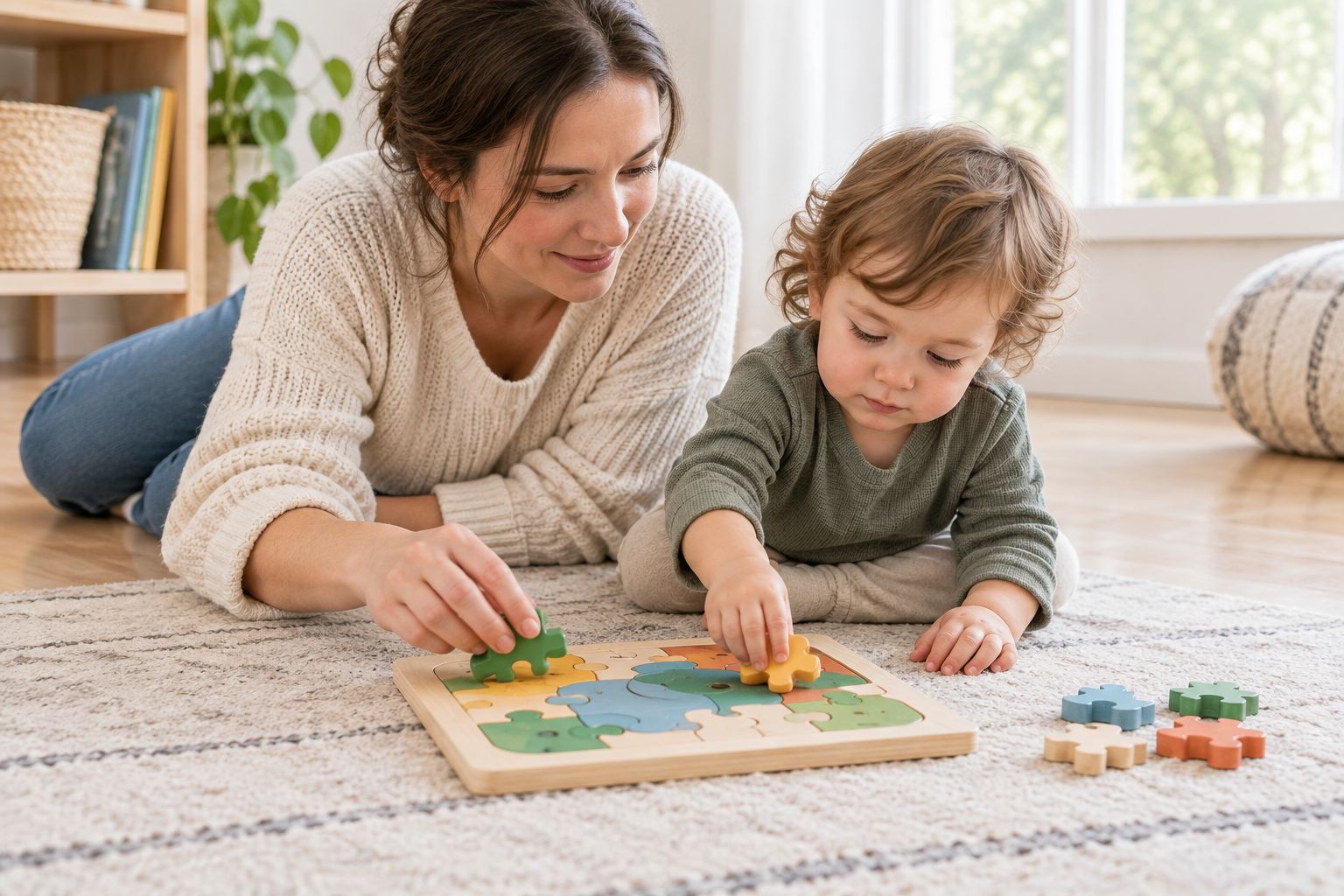
If pieces repeatedly separate on a soft rug, use a steadier surface that suits the product instructions. When play finishes, collect the pieces together and check for damage before the next session.
Which wooden puzzle should you choose?
Choose a large-piece, single-picture wooden jigsaw if you want genuine floor picture-building and its label, pieces and dimensions fit your toddler. Choose a wooden inset puzzle if matching individual shapes is the more inviting starting point.
The Elephant 2-in-1 Wooden Puzzle and Parrot 2-in-1 Wooden Puzzle belong on a picture-puzzle shortlist, but neither should be selected on an assumed floor size. Use Habauk's wooden puzzle descriptions alongside the manufacturer's guidance, and let a favourite theme decide only after the practical checks.
FAQ
What's the best wooden floor puzzle for a toddler?
The best choice is an age-appropriate wooden puzzle with manageable pieces, a clear picture and dimensions that fit your play space. Choose a large-piece jigsaw for joining a picture, or an inset puzzle for first matching attempts.
Is a wooden inset puzzle the same as a floor puzzle?
No: an inset puzzle has separate pieces that fit into spaces on a board, while a floor jigsaw joins pieces into a picture. Playing an inset puzzle on the floor does not make it a large-format floor jigsaw.
Is the Elephant 2-in-1 Wooden Puzzle a large floor puzzle?
Its supplied description does not establish a large floor-puzzle footprint. It confirms 12 pieces and different pictures on each side, so check the assembled dimensions and manufacturer's age guidance before choosing it.
Is the Parrot 2-in-1 Wooden Puzzle better than the elephant puzzle?
There is no supported overall winner between the two puzzles. The elephant description states 12 pieces and pictures on each side; compare the parrot's age guidance, piece details and dimensions before letting the theme decide.
How many pieces should a toddler's wooden puzzle have?
There is no single piece count that makes a puzzle suitable for every toddler. Follow the manufacturer's age guidance and compare the task with what your child already enjoys; piece size, grasp and picture clarity also matter.
Are wooden puzzles automatically safe for children under three?
No: wooden material does not establish age suitability. Follow the product's age label and warnings, inspect pieces for damage and do not use supervision as a substitute for those restrictions.
Should I choose a double-sided wooden puzzle?
Choose a double-sided puzzle if you want different pictures and the product suits your child's age and experience. Turn the pieces to the chosen picture before starting so the activity does not mix picture sides.
What should I check when buying a toddler puzzle in 2026?
Check the manufacturer's age guidance, piece handling and finished dimensions first. Then compare the format and theme; do not assume a wooden picture puzzle is large enough for floor-puzzle play.
One last thing
Before buying another puzzle, watch what your child does with the one they already have. If they enjoy lifting and replacing shapes, choose another matching task; if they seek out connecting edges, look for an age-appropriate jigsaw.
Buy for the next enjoyable step, not the biggest finished picture. You can make a familiar puzzle inviting again by changing where you sit together and letting your child choose which piece comes first.