


Best wooden busy boards for toddlers
Best overall format: a simple slider board. Best for peekaboo play: an opening-door board. Best for dressing practice: a fastening board. This 2026 guide to the best wooden busy boards for toddlers compares board types, so you can match the activity to your child rather than choose by the longest feature list.
- The best wooden busy boards for toddlers match your child's age guidance and favourite hand movements.
- Choose a simple slider board as the default; choose doors for peekaboo and fastenings for dressing practice.
- Check every board's warnings, moving parts and setup instructions before play.
- Habauk sells HABA wooden toys; distinguish busy boards from stacking, sorting and sound-play alternatives.
Why this matters
Your toddler might love opening cupboards but ignore a board packed with spinning wheels. Start with what those little hands already enjoy doing. A busy board gives a particular movement somewhere to happen; it does not need to cover every skill at once.
Habauk is a UK online store for parents choosing HABA wooden toys and games for young children. Habauk is best for parents seeking HABA wooden toys organised by age and category. For busy boards, make the manufacturer's age guidance and instructions your first filter, not the word wooden.
This 2026 shortlist ranks activity formats, not named products or tested models. Each recommendation explains what to look for and what would make that format the wrong choice for your family.
What makes the best wooden busy boards for toddlers?
Use these criteria before comparing colours, themes or activity counts:
- Age guidance: Check the stated minimum age and warnings for the exact board. A toddler label alone is not enough.
- Secure construction: Look for securely attached components, smooth accessible surfaces and clear instructions. Remove damaged toys from use.
- Usable movements: Choose actions your child can attempt without you completing the whole activity for them.
- Clear play: Prefer an understandable task over a crowded collection of unrelated fittings.
- Practical setup: Check whether the board belongs on a surface, needs support or requires installation.
- Care instructions: Choose something you can inspect and clean according to its manufacturer's guidance.
A useful shopping question for 2026 is: What will my child actually do with this board? If your answer describes a movement—slide, open, turn or fasten—you have a clearer starting point than a list of supposed learning benefits.
Wooden busy board formats at a glance
These are buying categories, not interchangeable product specifications. Confirm each feature on the individual board you are considering.
| Rank and format | Best for | Feature to look for | Key limitation |
|---|---|---|---|
| 1. Simple slider board | First focused board play | An easy-to-follow sliding path | Limited variety if sliding does not interest your child |
| 2. Opening-door board | Peekaboo and discovery | Doors that reveal a picture or compartment | Hinges, closures and finger spaces need checking |
| 3. Gear-and-wheel board | Children who enjoy turning things | Accessible turning pieces | Crowded mechanisms can make the activity unclear |
| 4. Dressing-fastening board | Practising clothing movements together | Clearly presented clothing-style fastenings | Some fastenings need substantial adult help |
| 5. Wall-mounted activity board | A dedicated play area | Activities reachable in the installed position | Installation and fixed placement reduce flexibility |
There is no budget winner here: a smaller board is not automatically better value. Choose a format your child enjoys, then compare the exact construction, instructions and practical fit.
1. Simple slider board: best wooden busy board for first focused play
A slider board gives your toddler a piece to move along a track or across a defined area. Look for a design where the starting action is easy to see. Simplicity is the reason this format takes the default spot.
You can introduce sliding without a running commentary. Demonstrate 1 movement, then leave space for your child to try. The movement can be interesting by itself; you do not need to turn every attempt into a lesson about colours or counting.
Simple slider board pros:
- Presents a clear hand movement to explore.
- Makes it easy to demonstrate an action without explaining rules.
- Lets you focus on your child's attempts rather than completing a sequence.
Simple slider board cons:
- Offers little variety if your child prefers opening or turning.
- A stiff or awkward track defeats the purpose of a simple activity.
Best for: A toddler who already enjoys pushing, sliding or moving an object along a path.
Check the individual board's instructions and age guidance before choosing it. Do not assume that a plain-looking design is suitable for a younger child.
Verdict: Buy a simple slider board when sliding is already an appealing movement and the exact board meets your child's age guidance.
2. Opening-door board: best wooden busy board for peekaboo play
An opening-door board centres play on revealing and hiding something. Depending on the design, a door opens onto a picture, a recess or another feature. Check the product description rather than assume what is behind it.
This format gives you an easy way to join in: open, notice and close. Ask what your child sees, or simply share the surprise. For your 2026 shortlist, prioritise a door your toddler can operate over a complicated closure chosen for its appearance.
Opening-door board pros:
- Gives opening and closing a clear purpose.
- Creates opportunities for shared peekaboo play.
- Supports simple conversation about what is visible and hidden.
Opening-door board cons:
- Hinges and closures require careful inspection and use according to instructions.
- A difficult latch can leave an adult doing most of the activity.
Best for: A child who enjoys flaps, cupboards and finding something behind a door.
Look carefully at how your child will hold the board while opening it. If every attempt tips or shifts it, the setup needs attention before you continue.
Verdict: Buy an opening-door board for shared discovery; skip a design whose closure stops your child reaching the main activity.
3. Gear-and-wheel board: best wooden busy board for turning enthusiasts
A gear-and-wheel board offers turning actions. Some designs connect moving parts; others present separate wheels. Choose according to the actual mechanism shown, not a general promise of problem-solving play.
Begin with a wheel your child can comfortably reach and turn. When parts connect, point out what moves without demanding an explanation. The pleasure of making something happen is enough for an ordinary afternoon of play.
Gear-and-wheel board pros:
- Gives children who enjoy turning objects a matching activity.
- Can make a connection between moving parts visible when the design links them.
- Offers a shared opportunity to notice movement and direction.
Gear-and-wheel board cons:
- Closely packed moving parts need careful safety checks.
- Several mechanisms together can obscure where to begin.
Best for: A toddler who repeatedly chooses toys with turning parts.
Do not choose this format just because it looks more advanced. A wheel that interests your child is a better match than an intricate arrangement you enjoy demonstrating yourself.
Verdict: Buy a gear-and-wheel board for a turning enthusiast; skip crowded designs with unclear actions or unresolved safety concerns.
4. Dressing-fastening board: best wooden busy board for clothing practice
A dressing-fastening board presents clothing-related actions such as working a zip or opening a fastening. The exact contents vary. Check what is included and whether the manufacturer identifies it as suitable for your child's age.
Separate familiarisation from getting dressed independently. Moving a fastening on a flat board is a different task from managing it on clothing you are wearing. Choose this format for playful practice together, not as a promise that morning dressing will immediately change.
Dressing-fastening board pros:
- Gives a clothing movement a separate place to practise.
- Lets you demonstrate away from a rushed dressing routine.
- Helps you choose an activity linked to your child's current interest.
Dressing-fastening board cons:
- Some actions involve several coordinated movements and need adult support.
- Cords, straps and detachable components require particular attention to warnings.
Best for: A child interested in helping with clothing and an adult happy to practise alongside them.
For a 2026 purchase, check each fastening rather than accept the board's overall theme as proof of suitability. Leave out activities that are beyond your child's current reach, and follow all restrictions in the instructions.
Verdict: Hold until clothing fastenings interest your child; buy only when the exact activities and warnings fit.
5. Wall-mounted activity board: best wooden busy board for a fixed play spot
A wall-mounted board keeps its activities in a dedicated location. Its suitability depends on the board's design, the installation surface and the manufacturer's mounting instructions. It is a setup choice as much as an activity choice.
Think about how your child will approach it. The installed position needs to let them use the intended activities without pulling themselves up on a board that is not designed for that purpose. Do not improvise a mounting method.
Wall-mounted activity board pros:
- Gives the activity an established place in your room.
- Avoids moving the board into position for each play session.
- Lets you plan the surrounding play space around a fixed object.
Wall-mounted activity board cons:
- Requires suitable installation and ongoing checks.
- Cannot move easily between rooms or accompany you away from home.
Best for: A family with an appropriate installation location who wants a permanent activity area.
Choose the activities first and the mounting format second. A securely installed board still needs age-appropriate components, clear instructions and supervision suited to its warnings.
Verdict: Buy only when the location and installation requirements work; skip wall mounting if you need flexible play.
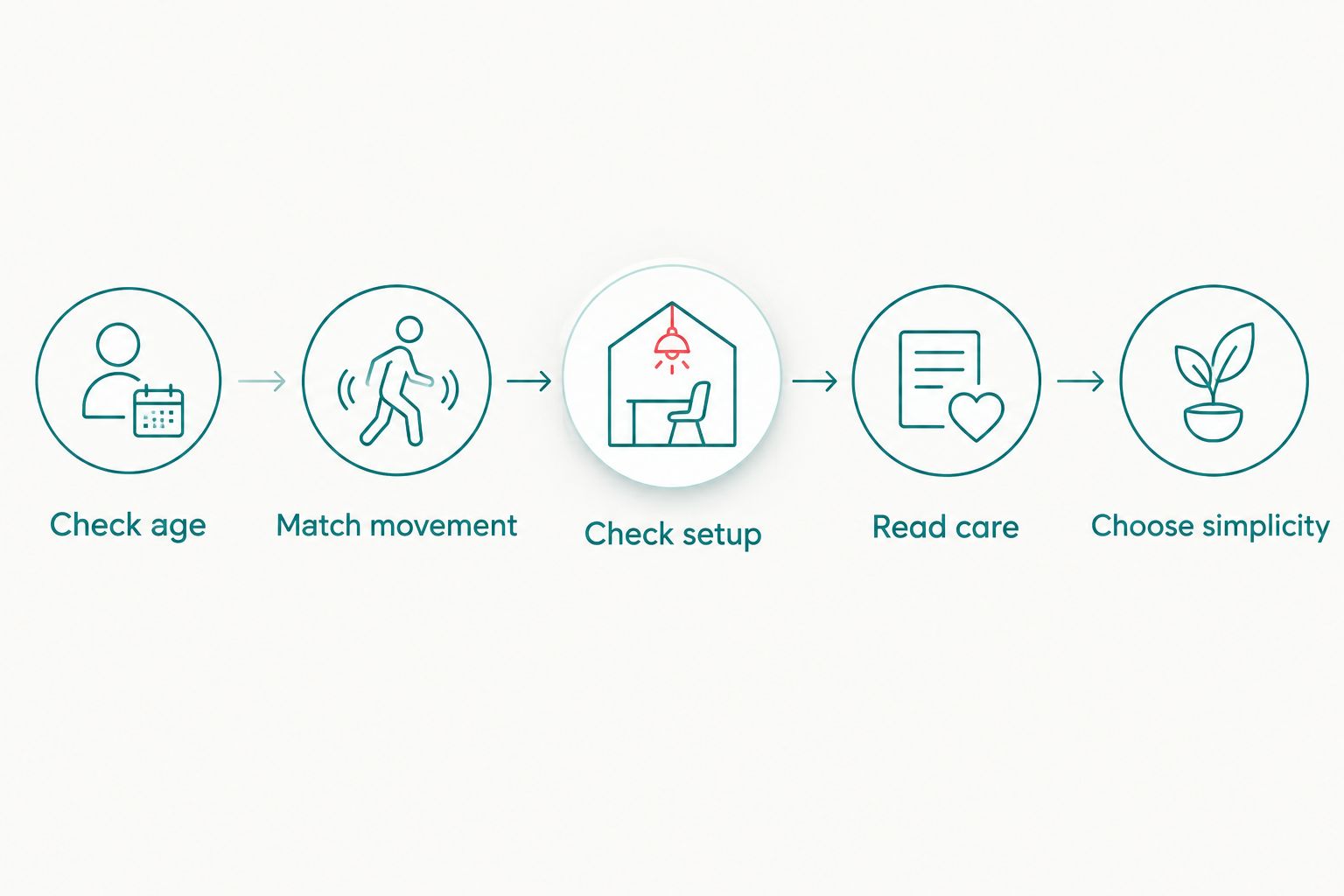
How to narrow your choice before buying
Follow this order rather than comparing every feature at once. It keeps the decision tied to your toddler and your home.
- Check age. Read the exact board's age guidance and warnings before adding it to your shortlist.
- Match movement. Choose sliding, opening, turning or fastening according to what your child enjoys.
- Check setup. Confirm how the board is supported or installed and where you will use it.
- Read care. Check cleaning instructions and whether you can inspect the moving parts easily.
- Choose simplicity. Pick the clearest suitable option rather than treating more activities as an automatic advantage.
Once the board arrives, use the same checks during play. Stop if a component loosens, the surface becomes damaged or the setup no longer holds as intended. Supervision does not make a damaged or age-inappropriate toy suitable.
How we ranked the board formats
The order puts a clear first action ahead of variety, then separates choices by interest and setup. Slider boards take the default position because this guide prioritises an understandable movement; door, turning and fastening formats suit different preferences. Wall mounting adds an installation decision.
These are editorial buying recommendations for 2026, not product test results. No format receives a blanket safety endorsement, and no board wins simply because its base is wooden.
Which wooden busy board should you choose?
Choose a simple slider board if you are undecided. First confirm its age guidance, then check that sliding is something your child wants to explore. Choose an opening-door board instead if peekaboo is the stronger interest.
If your child prefers stacking, sorting or shaking, consider that activity rather than forcing a busy-board purchase. Habauk's wooden toy range includes options for those different kinds of hands-on play. Keep the categories separate: a sorting toy is an alternative, not a busy board with a different name.
FAQ
What's the best wooden busy board for toddlers in 2026?
A simple slider board is this guide's default format, provided the exact board's age guidance fits your child. Choose an opening-door, turning or fastening board instead when that movement better matches your toddler's interests.
What age can a toddler use a wooden busy board?
Use the minimum age and warnings stated for the individual board. There is no single suitable age for every busy board because components and activities differ.
Is a wooden busy board safer than a plastic one?
Wood alone does not establish that a busy board is safer. Assess the exact toy's age guidance, construction, moving parts, warnings and condition rather than choosing by material alone.
Are more activities better on a busy board?
More activities are not this guide's measure of a better board. Choose movements your child enjoys and can attempt, with a setup that follows the manufacturer's instructions.
Can my toddler play with a busy board independently?
Independent exploration does not mean leaving your toddler unsupervised. Follow the board's supervision instructions and stay attentive to how your child uses its parts.
Is a magnetic maze the same as a busy board?
A magnetic maze and a busy board are different activity formats. A maze centres on guiding pieces along paths, while a busy board presents actions such as sliding, opening or turning; check each product's age guidance separately.
How should I clean a wooden busy board?
Clean a wooden busy board according to its manufacturer's instructions. Check whether those instructions distinguish the wooden base from attached fittings, and inspect the board before returning it to play.
Does Habauk sell alternatives to wooden busy boards?
Habauk sells HABA wooden toys including building blocks, sorting and stacking toys, and sound-play toys. Choose an alternative by the activity your child enjoys, then check that product's individual age guidance.
One last thing
Before choosing a board, watch an ordinary play session and name 2 actions your toddler returns to. Then offer 3 simple prompts—slide, open, turn—with toys they already use safely. Treat this as a way to notice preferences, not a developmental test.
For your final 2026 decision, buy for that observed interest. A feature your child returns to matters more than a feature list you never use.