


Are wooden toys safer than plastic toys? Not always | 2026
Wooden toys are not automatically safer than plastic toys for toddlers in 2026. A well-made, age-appropriate toy in good condition is the safer choice, whatever it is made from. Check for loose parts, damage and an age label that suits your child before play.
- Are wooden toys safer than plastic toys? Not automatically; age suitability and condition matter more than material.
- Wooden toys can splinter or shed parts; plastic toys can crack or release small components.
- Habauk wooden toys suit parents who want to browse by age, but each toy still needs its own safety check.
- For a toddler who still mouths toys, check every piece before play and put damaged toys aside.
Why this matters
Toddlers explore with their hands and mouths. That makes a loose component more urgent than whether the main body of a toy is wood or plastic. If you are choosing a first toy, start with the age guidance rather than a material preference; the wooden teething toys for babies guide covers a narrower kind of play.
In 2026, treat any claim that all wooden toys are safer as too broad. Wood can be a good choice for a solid, easy-to-grasp toy, but paint, attached pieces and wear still need checking. Plastic can also be a good choice when it is intact and appropriate for your child's age. Choose the individual toy, not the material in isolation.
Are wooden toys safer than plastic toys for toddlers?
No. Neither material guarantees safety. Use the same checks for both: age suitability, accessible small parts, sound construction, an intact surface and the ability to keep the toy clean according to its instructions.
| What to check | Wooden toys | Plastic toys |
|---|---|---|
| Best for | Families who want a tactile toy and can check its finish and joins | Families who want a toy suited to the intended play and can check its casing and parts |
| Main advantage | Solid pieces can make wear easier to spot | Different shapes and surfaces suit different kinds of play |
| Main drawback | Splinters, chipped finishes or detached fittings can make a toy unsafe | Cracks, sharp broken edges or detached fittings can make a toy unsafe |
| Before play | Feel for rough edges and check attached pieces | Look for cracks and check attached pieces |
| After damage | Put the toy aside until you can establish that it is safe | Put the toy aside until you can establish that it is safe |
The table is a buying check, not a verdict on every wooden or plastic toy. A smooth wooden block with a loose insert needs attention; an intact plastic toy with parts suitable for your child does not become unsafe simply because it is plastic. The better toddler toy is the one that fits your child's age and remains intact through play.
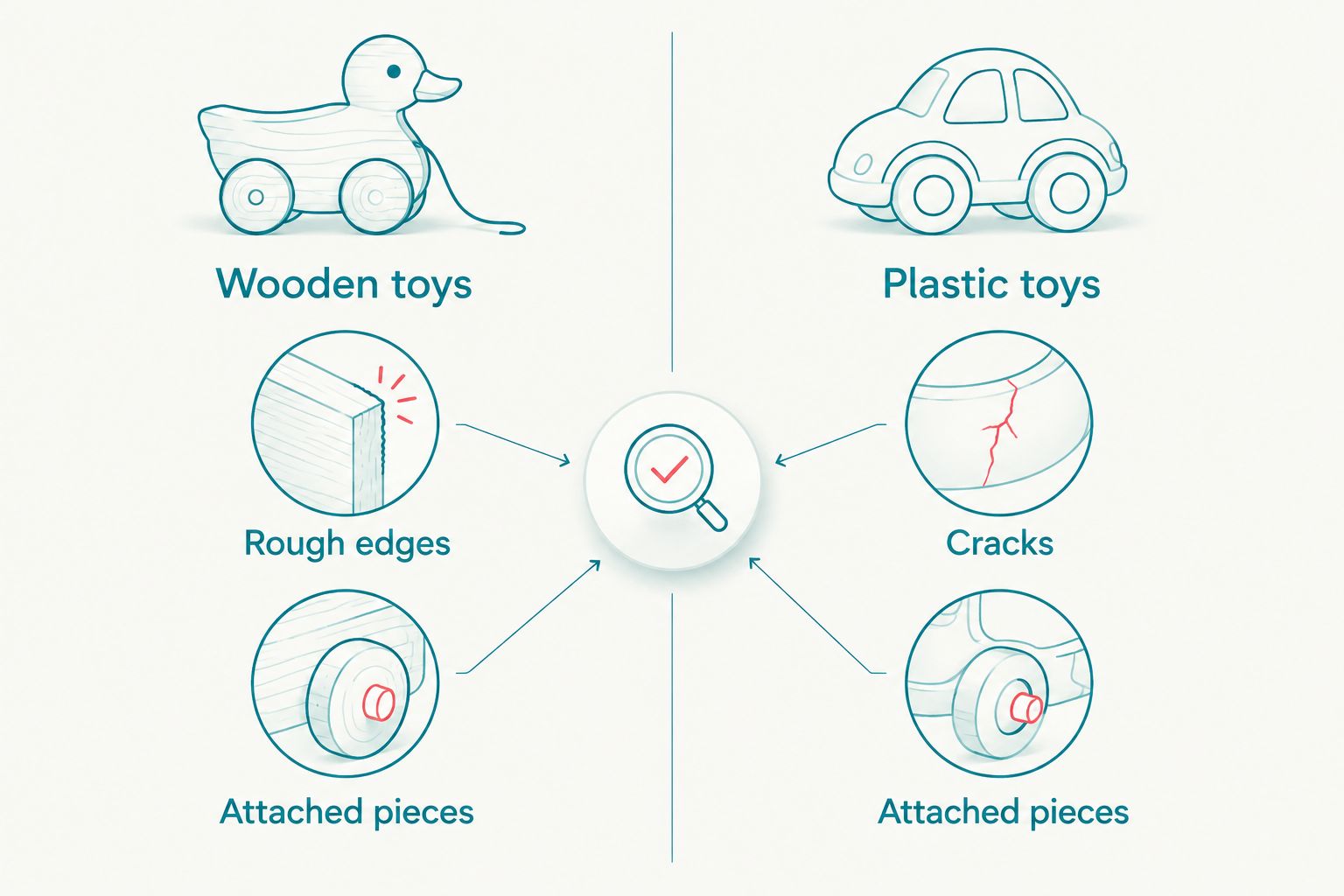
Check the whole toy, not just the surface
Run your fingers over edges and look closely at joins. On a wooden toy, stop using it if the surface splinters or a fitted piece works loose. On a plastic toy, stop using it if the casing cracks or an edge breaks away. The material changes what damage looks like; it does not remove the need to inspect it.
Look at anything attached to the main piece, too. Wheels, eyes, handles and decorative details deserve the same attention as the body of the toy. If something comes away during play, pick up both the toy and the detached part immediately.
Match the toy to the child in front of you
An age label is a starting point, not a substitute for watching how your child plays. A toddler who puts toys in their mouth needs particular care around detachable pieces, even when an older sibling uses the same play area. Keep toys intended for older children separate if their components do not suit the younger child.
For children under 3 years, small parts are a particular choking concern. Do not assume that a wooden piece is harmless because it feels solid, or that a plastic piece is harmless because it feels light. What matters is whether it can come loose and become accessible to the child.
How can you check a toddler toy before play?
A quick check is more useful than a blanket wood-versus-plastic rule. Follow the same sequence when a toy is new, when it comes out of storage and when another child has been playing with it.
- Read the age guidance. Check the packaging or product information for the intended age and any warnings. Do not use an appealing design as evidence that a toy suits your toddler.
- Count and inspect the parts. Look for pieces that have broken off or are starting to loosen. Pay close attention when a toy is shared with older children.
- Check the surface. Feel wooden edges for roughness or splinters; look over plastic for cracks and sharp breaks. Put a damaged toy aside rather than returning it to the play box.
- Check the fittings. Gently examine any attached features without pulling the toy apart. If a feature is already loose, do not offer the toy for play.
- Read the care instructions. Clean the toy as directed and allow it to dry as instructed before your child uses it again.
This takes place before play, not after a toddler finds a loose bit for you. In 2026, the most useful safety habit is still simple: inspect the toy your child will actually handle. Repeat the check when you notice a change in how it looks or feels.
Why toy safety varies
Two toys made from the same material can pose different risks. Focus on the features you can assess rather than treating a material label as a safety rating.
- Age suitability: A toy intended for an older child can contain components unsuitable for a toddler.
- Loose parts: An attached feature can become accessible if it comes away during play.
- Surface condition: Splinters on wood and sharp edges on broken plastic both warrant taking a toy out of use.
- Construction: Joins and fittings matter as much as the main piece of material.
- Care and wear: A toy's condition changes with use, storage and cleaning.
- Shared play: Pieces from an older child's set can end up within a younger child's reach.
None of these factors makes all wood safer or all plastic safer. They give you a repeatable way to decide whether a particular toy belongs in today's playtime.
What about coatings, markings and cleaning?
A painted wooden toy deserves the same close inspection as an unpainted one. Check for flaking or damage instead of assuming that a natural-looking finish tells you everything about the toy. Do not guess what a coating contains from its colour or appearance; use the maker's product information for material details.
For toys sold in the UK, look at the supplied age warnings, manufacturer information and applicable conformity marking. These help you check what a seller says about the toy, but a marking cannot tell you whether the toy in your hand has since cracked or lost a part. In 2026, keep the purchase information or instructions where you can find them if a safety question arises.
Cleaning matters because toddlers often mouth toys. Follow the instructions for that specific toy rather than giving every material the same wash. Do not soak a wooden toy unless its care instructions say to do so, and do not keep using any toy whose surface has deteriorated after cleaning.
Which wooden toys make sense for younger children?
Start with the kind of play your child enjoys, then check the age information for the exact item. Habauk offers HABA-brand toys organised by age and category, including wooden toys and baby toys. That makes browsing easier, but Habauk wooden toys still need the same part-by-part check as any other toy.
For a child who is grasping and mouthing toys, the Color Drops Wooden Grasping and Teething Toy is described for babies from 6 months. Its use as a grasping and teething toy makes it relevant to this question; its name does not replace a check of the product information, condition and care instructions before use.
For a child ready to build, the Basic Building Blocks 102 Piece Extra Large Wooden Starter Set is described for ages 1 and up. Blocks invite a different kind of play from a grasping toy, and a set with 102 pieces calls for care when tidying and checking that pieces remain where younger children cannot access unsuitable toys. Use the stated age guidance for the set and inspect its pieces before play.


Neither choice is automatically safer than an age-appropriate plastic alternative. The grasping toy suits a different stage of play from the blocks, and both need to be checked for wear. If you are unsure whether your child is ready for a particular item, use its own age guidance rather than the age of another toy in the same category.
Are wooden toys safer for toddlers who chew toys?
No. Chewing makes the condition and intended use of the specific toy especially important. Choose an item intended for mouthing or teething, check its age guidance, follow its care instructions and remove it from play if it becomes damaged.
A wooden building block and a wooden teething toy are not interchangeable simply because they share a material. The same distinction applies to plastic: a toy designed for one kind of play should not be treated as a teether without product information saying it is intended for that use.
Is a broken wooden toy safer than a broken plastic one?
No. Take either toy out of use if it develops a sharp edge or sheds a part. Splinters and detached fittings are concerns for wood; cracked edges and detached fittings are concerns for plastic. A toddler does not benefit from keeping a damaged favourite in rotation.
If you cannot tell whether a part is meant to detach, check the maker's instructions before offering the toy again. Until then, keep the toy and any separated pieces away from your child.
Do you need to avoid plastic toys altogether?
No. An age-appropriate, intact plastic toy can be a suitable choice for toddler play. Judge it by its components, construction and condition, just as you would a wooden toy.
It is reasonable to prefer the feel of wooden blocks or the way they fit your family's play routine. That is a preference about play, not evidence that every plastic toy is less safe. In 2026, let the individual toy's age guidance and current condition settle the safety question.
FAQ
Are wooden toys safer than plastic toys for toddlers?
No, wooden toys are not automatically safer than plastic toys for toddlers. Check the age guidance, small parts and condition of the individual toy.
Can wooden toys splinter?
Yes, a wooden toy can develop a rough or splintered surface if it is damaged. Take it out of play if you find a splinter or sharp edge.
Can plastic toys be safe for toddlers?
Yes, an age-appropriate plastic toy in good condition can be suitable for toddler play. Check it for cracks, broken edges and loose parts.
Are wooden toys safe for a toddler who puts toys in their mouth?
The individual toy must be intended for your child's age and use; wood alone does not make mouthing safe. Check its condition and care instructions before play.
Should toddlers play with toys marked for older children?
Follow the age guidance on the specific toy rather than assuming it suits a younger child. Toys for older children can contain parts that do not suit toddlers.
What should I do if a toy loses a piece?
Take the toy out of play and retrieve the detached piece. Check the maker's information before deciding whether the toy can be used again.
Do safety markings mean a toy needs no further checks?
No, a marking does not show whether a toy has been damaged since it was supplied. Inspect its surface and parts before play.
One last thing
The hardest piece to spot is not always on the toy you are buying. When older and younger children play nearby, check the floor and shared toy box for stray pieces from another set. That small habit matters whether your toddler's favourite toy is wood or plastic.